Kojic Acid Market Size, Share & Industry Analysis, By Grade (Food Grade, Pharmaceutical Grade, Cosmetic Grade, and Industrial Grade), By Production Method (Fermentation & Chemical Synthesis), By Application (Personal Care & Cosmetics, Food & Beverages, Pharmaceuticals, Industrial, and Others), and Regional Forecast, 2026-2034
 Download Free Sample
Kojic Acid Market Size and Future Outlook
 Listen to Audio Version
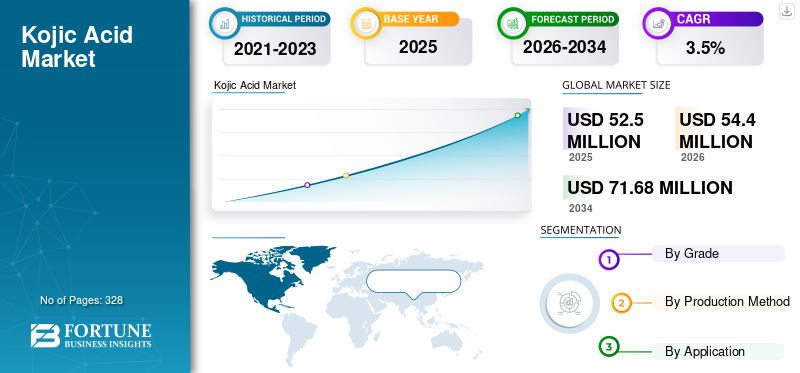
The global kojic acid market size was valued at USD 52.5 million in 2025. The market is projected to grow from USD 54.4 million in 2026 to USD 71.68 million by 2034 at a CAGR of 3.5% during the 2026-2034 forecast period. Asia Pacific dominated the global kojic acid market with a market share of 54.67% in 2025.
Kojic acid is a naturally derived organic compound (5-hydroxy-2-hydroxymethyl-4H-pyran-4-one) produced through the fermentation of carbohydrates by fungi such as Aspergillus oryzae. It functions primarily as a tyrosinase inhibitor, reducing melanin formation, and is widely used in cosmetic formulations for skin-brightening and anti-pigmentation applications.
In addition to personal care, kojic acid serves as an antioxidant and chelating agent in food preservation, pharmaceuticals, and specialty chemical processes. Its regulatory acceptance across major regions and versatility in multiple end-use sectors have positioned it as an important specialty ingredient in the global market. Foodchem International Corporation, Fengchen Group, Shaanxi Kingsci Biotechnology Co., Ltd, Jinan Boss Chem Co., Ltd, Lyphar International Corporation are the key players operating in the market.
Download Free sample to learn more about this report.
Kojic Acid Market Key Takeaways
 Global Market Size & Forecast
- 2025 Market Size: USD 52.5 million
- 2026 Market Size: USD 54.4 million
- 2034 Forecast Market Size: USD 71.68 million
- CAGR: 3.5% (2026–2034)
 Market Share
- Asia Pacific dominated the market with a 54.67% share in 2025.
- The fermentation segment is expected to dominate the market due to its sustainability, safety, and quality advantages.
- The pharmaceuticals segment held the second-largest market share globally.
 Key Regional Highlights
Asia Pacific
Asia Pacific generated USD 28.7 million in 2025, maintaining its leading market position.
North America
North America held a significant market share in 2025, driven by strong demand for advanced skincare solutions.
Europe
Europe is projected to witness steady growth during the forecast period.
U.S.
U.S. market is projected to witness steady growth during the forecast period.
Japan
Japan market is projected to witness steady growth during the forecast period.
Read More

MARKET DYNAMICS
KOJIC ACID MARKET TRENDS
Growing adoption of stabilized and derivative forms of Kojic Acid is emerging as a major market trend
Cosmetic manufacturers are increasingly shifting from pure kojic acid to more stable derivatives—such as kojic dipalmitate, kojic acid monoesters, and encapsulated kojic acid—to overcome challenges related to oxidation, discoloration, and formulation instability. These advanced forms offer improved shelf life, enhanced skin compatibility, and better incorporation into modern skincare systems such as serums, emulsions, and multi-active formulations. The rise of these value-added derivatives is reshaping product development strategies and contributing to premiumization across the skincare segment.
MARKET DRIVERS
Rising Use Of Kojic Acid in Skin-Brightening Solutions Drives Market Growth
Kojic acid, a well-established tyrosinase inhibitor, remains one of the most trusted active ingredients used by cosmetic manufacturers to address these concerns, particularly across Asia-Pacific, where brightening and tone-correcting products dominate facial skincare routines. Consumers increasingly seek products that target dark spots, melasma, post-inflammatory hyperpigmentation, and uneven skin tone conditions now more widely recognized due to greater dermatological awareness and digital skin analysis technologies. Dermatologists globally report that up to 40% of cosmetic consultations involve hyperpigmentation-related concerns, making it one of the most common skin issues in women aged 25–45.
This sustained consumer demand, combined with a shift toward natural and fermentation-derived active, continues to strengthen market adoption of kojic acid in premium and mass-market skincare formulations.
Download Free sample to learn more about this report.
MARKET RESTRAINTS
Growing Regulatory Scrutiny And Safety Concerns Limit Stable Market Growth
A major restraint for the kojic acid market is the growing regulatory scrutiny and safety concerns associated with its stability and potential for skin irritation. Kojic acid is highly prone to oxidation and discoloration when exposed to light, heat, or air, which complicates formulation and reduces product shelf life. This instability raises manufacturing costs as companies must use stabilizers, encapsulation systems, or switch to higher-priced derivatives such as kojic dipalmitate.
In addition, regulatory bodies—including the EU’s Scientific Committee on Consumer Safety (SCCS), Japan’s Ministry of Health, Labour and Welfare (MHLW), and ASEAN Cosmetic Directive—have imposed strict concentration limits (typically ≤1%) due to risks of irritation and sensitization in some users. These regulatory constraints limit dosage flexibility, slow down new product approvals, and discourage mass-market adoption. Combined, these challenges create a high compliance burden and restrict the broader scalability of kojic acid in global cosmetic formulations.
MARKET OPPORTUNITIES
Growing Demand for Multifunctional Skincare Ingredients Supports Future Growth
A key opportunity for the kojic acid market is the growing demand for multifunctional skincare ingredients, driven by consumer preference for simplified routines and products offering multiple benefits in a single formulation. Kojic acid possesses not only skin-brightening properties but also antioxidant, antimicrobial, and chelating functions, making it highly attractive for inclusion in “all-in-one” serums, tone correctors, and anti-aging formulations. Brands are increasingly formulating kojic acid with complementary actives such as niacinamide, vitamin C derivatives, and tranexamic acid to deliver synergistic effects—an approach that enhances product performance without requiring high concentrations. This aligns well with global trends toward dermaceutical, science-backed skincare, especially in markets including the U.S., South Korea, India, and the GCC. As consumer behavior shifts toward premium, multi-effect skincare, kojic acid’s versatility positions it as a valuable ingredient for next-generation brightening blends and hybrid formulations across both mass and prestige segments.
MARKET CHALLENGES
High Sensitivity Of The Ingredient To Environmental Degradation Can Pose A Challenge For the Market
A major challenge facing the kojic acid market is the high sensitivity of the ingredient to environmental degradation, which complicates manufacturing, storage, and global distribution. Kojic acid oxidizes rapidly when exposed to light, air, or elevated temperatures, causing discoloration, reduced potency, and formulation instability. This instability is a major concern for manufacturers in tropical or high-humidity regions such as Southeast Asia, India, and parts of Africa, where supply chain conditions can accelerate degradation. As a result, companies must invest in controlled-environment storage, specialized packaging, and stabilizing excipients, all of which increase production costs and limit scalability. These requirements are especially burdensome for small and mid-sized formulators. Furthermore, inconsistent product stability can lead to batch rejections, shorter shelf life, and reduced consumer confidence, particularly in mass-market skincare. The combined impact of quality control risks and elevated handling costs makes stability management one of the most persistent operational challenges in the kojic acid industry.
SEGMENTATION ANALYSIS
By Grade
High Demand for Anti-Pigmentation Products Leads to Cosmetic Grade Segmental Growth
Based on grade, the market is segmented into food grade, pharmaceutical grade, cosmetic grade, and industrial grade.
The cosmetic-grade kojic acid has become the most popular form due to strong global demand for skin-brightening and anti-pigmentation products. This grade offers high purity, safety compliance, and suitability for facial serums, creams, and dermaceutical formulations. Its ability to inhibit tyrosinase effectively makes it widely preferred by cosmetic manufacturers, especially in Asia-Pacific, the Middle East, and emerging markets where tone-correcting skincare dominates. As a result, cosmetic grade accounts for the largest share among food, pharmaceutical, and industrial grades.
The pharmaceutical grade is the second largest segment. It is valued for its high purity and controlled manufacturing standards, making it suitable for medical and dermatological applications. This grade is commonly used in prescription and OTC formulations targeting melasma, post-inflammatory hyperpigmentation, and other pigmentary disorders. Its stringent quality specifications ensure consistent efficacy and safety, supporting its role in creams, gels, and combination therapies prescribed by dermatologists.
By Production Method
Fermentation Segment to Dominate Due To Its Sustainability Benefits
Based on production method, the market is segmented into fermentation and chemical synthesis.
The fermentation segment is expected to dominate the kojic acid market due to its sustainability, safety, and quality advantages over chemical synthesis. Fermentation-derived kojic acid, produced using fungi such as Aspergillus oryzae, is considered a natural and environmentally friendly option that aligns with the growing consumer preference for clean-label and bio-based cosmetic ingredients. This method also yields higher purity levels, making it well-suited for cosmetic and pharmaceutical applications where safety and efficacy are critical. With increasing regulatory emphasis on greener manufacturing processes and reduced chemical residues, fermentation continues to gain preference over synthetic production.
By Application
Personal Care & Cosmetics Segment to Dominate Due to High Demand for Skin-Brightening Products
Based on type, the market is segmented into personal care & cosmetics, food & beverages, pharmaceuticals, industrial, and others.
The personal care & cosmetics segment is expected to dominate the kojic acid market due to consistently high global demand for skin-brightening and anti-pigmentation products. Kojic acid is one of the most widely used natural tyrosinase inhibitors and is a key ingredient in formulations designed to treat melasma, dark spots, post-inflammatory hyperpigmentation, and uneven skin tone. Its multifunctional properties—such as antioxidant and antimicrobial activity—make it highly attractive for use in serums, creams, lotions, soaps, and targeted spot-correcting treatments.
The pharmaceuticals segment held the second-largest Kojic Acid Market Share. In pharmaceuticals, kojic acid is used in dermatological formulations targeting melasma, post-inflammatory hyperpigmentation, and sun-induced pigmentation disorders. Pharmaceutical-grade kojic acid has high purity and is incorporated into prescription creams, medicated gels, and combination therapies with ingredients such as retinoids or hydroquinone. Its strong tyrosinase-inhibiting properties make it a valuable active for clinicians treating pigmentary disorders.
The food & beverages segment uses kojic acid primarily as an anti-browning and antioxidant agent. It inhibits enzymatic browning in fresh-cut fruits, vegetables, and seafood by blocking the activity of polyphenol oxidase (PPO). This helps maintain color, freshness, and shelf life in minimally processed foods.
To know how our report can help streamline your business, Speak to Analyst
KOJIC ACID MARKET REGIONAL OUTLOOK
Asia Pacific
Asia Pacific accounted for the leading kojic acid market share in 2025, driven by strong demand for skin-brightening and anti-pigmentation products across major countries such as China, Japan, South Korea, India, and Southeast Asian nations. The region has a long-standing cultural preference for tone-correcting skincare, making kojic acid a key ingredient in serums, creams, and dermaceutical formulations. Additionally, Asia Pacific hosts a large base of cosmetic manufacturers and fermentation-based producers, ensuring strong supply and competitive pricing. Rising disposable incomes, rapid urbanization, and expanding retail beauty markets further support the region’s leading market position.
To know how our report can help streamline your business, Speak to Analyst
North America
North America held a significant share in 2025 due to strong demand for advanced skincare solutions and clinically backed brightening products. The region’s well-established cosmetic and dermatology industries extensively use kojic acid in formulations targeting hyperpigmentation, sun damage, and post-inflammatory dark spots. High consumer awareness, along with the popularity of professional-grade and dermaceutical products, supports stable market growth. Additionally, the U.S. remains a major importer of high-purity kojic acid for cosmetic, pharmaceutical, and research applications, reinforcing North America’s position as an important and steadily expanding regional market.
Europe
Consumers in countries such as Germany, France, Italy, and the U.K. increasingly seek solutions for age spots, photo aging, and pigmentation caused by sun exposure. Although the EU maintains strict safety regulations, including a 1% concentration limit, its mature cosmetic industry and high-quality formulation standards drive steady adoption of kojic acid and its derivatives. The region’s emphasis on clean-label, science-backed active ingredients further solidifies Europe’s position as a key market.
Latin America
The increasing demand for brightening skincare across Brazil, Mexico, Chile, and Colombia is boosting demand. The region’s warm climate and strong sun exposure contribute to widespread concerns about pigmentation, increasing interest in products containing kojic acid for tone correction. Growing middle-class purchasing power, expansion of local cosmetic manufacturing, and the influence of global beauty trends further stimulate demand. Although market maturity varies across countries, Latin America continues to adopt kojic acid in both mass-market and dermaceutical skincare formulations.
Middle East & Africa
High sun exposure throughout the Middle East & Africa contributes to an increase in cases of melasma and dark spots, encouraging the use of kojic acid–based products. Rising beauty and personal care spending, particularly in Saudi Arabia and the UAE, combined with the expansion of retail channels and international brand presence, fuels market growth. While still developing in parts of Africa, Middle East & Africa remains an emerging but fast-evolving market for kojic acid.
COMPETITIVE LANDSCAPE
KEY INDUSTRY PLAYERS
Major Investments in Developing Products for Sustainability by Key Industry Players
Foodchem International Corporation, Fengchen Group, Shaanxi Kingsci Biotechnology Co., Ltd, Jinan Boss Chem Co., Ltd, Lyphar International Corporation are the key players in the market. Major investments by companies in developing products that address evolving demands for sustainability and performance.
LIST OF KEY KOJIC ACID MARKET PLAYERS PROFILED IN THE REPORT:
- Foodchem International Corporation (China)
- Fengchen Group. (China)
- Shaanxi Kingsci Biotechnology Co., Ltd (China)
- Jinan Boss Chem Co., Ltd (U.S.)
- Lyphar International Corporation (China)
- Zhejiang Skyherb Biotechnology Co., Ltd (China)
- Zhejiang Shengxiao Chemicals Co., Ltd. (China)
- Hubei Xiangxi Chemical Industry Co., Ltd (China)
KEY INDUSTRY DEVELOPMENTS:
REPORT COVERAGE
The report provides a detailed analysis of the market. It focuses on key aspects, such as leading companies, Form, Grade, Type, and Application. Besides this, it offers insights into the market and current industry trends and highlights key industry developments. In addition to the factors mentioned above, the report encompasses several factors contributing to the market's growth.
Request for Customization to gain extensive market insights.
Report Scope & Segmentation
| ATTRIBUTE | DETAILS |
| Study Period | 2021-2034 |
| Base Year | 2025 |
| Forecast Period | 2026-2034 |
| Historical Period | 2021-2023 |
| Unit | Value (USD Million) |
| Growth Rate | CAGR of 3.5% from 2026 to 2034 |
| Segmentation | By Grade, By Production Process, By Application, By Region |
| By Grade |
· Food Grade · Pharmaceutical Grade · Cosmetic Grade · Industrial Grade |
| By Production Method |
· Fermentation · Chemical Synthesis |
| By Application |
· Personal Care & Cosmetics · Food & Beverages · Pharmaceuticals · Industrial · Others |
| By Region |
· North America (By Grade, By Production Method, By Application, By Country) o U.S. (By Application) o Canada (By Application) · Europe (By Grade, By Production Method, By Application, By Country) o Germany (By Application) o U.K. (By Application) o France (By Application) o Italy (By Application) o Rest of Europe (By Application) · Asia Pacific (By Grade, By Production Method, By Application, By Country) o China (By Application) o India (By Application) o Japan (By Application) o South Korea (By Application) o Rest of Asia Pacific (By Application) · Latin America (By Grade, By Production Method, By Application, By Country) o Mexico (By Application) o Brazil (By Application) o Rest of Latin America (By Application) · Middle East & Africa (By Grade, By Production Method, By Application, By Country) o GCC (By Application) o South Africa (By Application) o Rest of Middle East & Africa (By Application) |
Frequently Asked Questions
Fortune Business Insights says that the global market size was valued at USD 52.5 million in 2025 and is projected to reach USD 71.68 million by 2034.
Recording a CAGR of 3.5%, the market is slated to exhibit steady growth during the forecast period of 2026-2034.
The Personal Care & Cosmetics segment led in 2025.
Asia Pacific held the highest market share in 2025.
Rising use of kojic acid in skin-brightening solutions drives market growth.



- 2021-2034
- 2025
- 2021-2024
- 328
Get 30-60 hrs Free Customization
Expand Regional and Country Coverage, Segments Analysis, Company Profiles, Competitive Benchmarking, and End-user Insights.


















-
US +1 833 909 2966 ( Toll Free )
-
Get In Touch With Us