Fuel Ethanol Market Size, Share & Industry Analysis, By Blend Type (E10 & Below, E11-E25, E26-E84, and E85 & Above), By Feedstock (Sugarcane-based Ethanol, Corn-based Ethanol, Wheat-based Ethanol, and Others), By End User (Commercial Vehicles, Passenger Vehicles, and Others), and Regional Forecast, 2026-2034
 Download Free Sample
Fuel Ethanol Industry Analysis (2026-2034)
 Listen to Audio Version
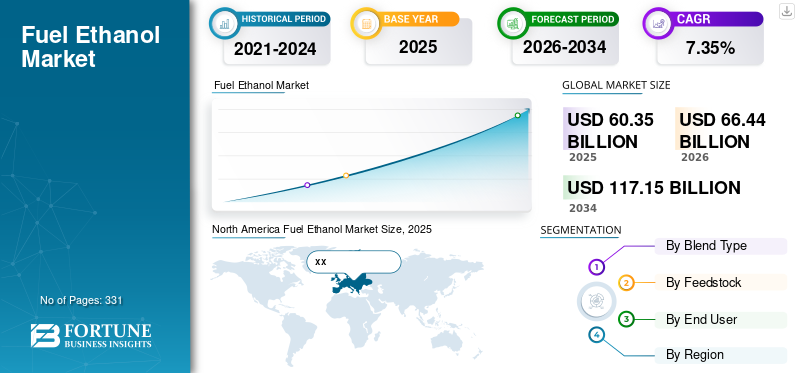
The global fuel ethanol market size was valued at USD 60.35 billion in 2025 and is projected to grow from USD 66.44 billion in 2026 to USD 117.15 billion by 2034, exhibiting a CAGR of 7.35% during the forecast period. North America dominated the global fuel ethanol market with a market share of 50.91% in 2025.
Fuel ethanol demand remains linked to gasoline consumption and renewable-fuel policy. In the United States, the Environmental Protection Agency finalized renewable-fuel requirements for 2026 and 2027 at levels above earlier statutory-era targets, reinforcing policy support for biofuel consumption. The rule establishes total renewable-fuel requirements of 26.81 and 27.02 billion ethanol-equivalent gallons, respectively.
UNICA reports that the 2024/25 Centre-South crop produced a record 34.96 billion liters of ethanol, including 8.19 billion liters from corn. This demonstrates how feedstock diversification is changing the production base within established ethanol markets.
Corn-based ethanol benefits from established infrastructure in the United States, while sugarcane ethanol benefits from integrated sugar-energy systems in Brazil. Wheat-based production remains relevant in markets where grain availability, policy, and industrial infrastructure support competitive conversion.
The constraints are feedstock-price volatility, land-use concerns, water requirements, logistics, policy dependence, and competition from electric vehicles and other low-carbon fuels. Carbon-intensity differentiation is becoming more important as regulators and fuel buyers place greater emphasis on lifecycle emissions.
Technology is moving toward better fermentation, energy integration, yield optimization, and lower-carbon process energy. Advanced pathways can improve the regulatory value of ethanol where lifecycle criteria determine eligibility.
Leading companies in the global fuel ethanol industry include POET LLC, Archer Daniels Midland (ADM), Valero Renewable Fuels, Raízen S.A., and Green Plains Inc. These companies are actively expanding ethanol production capacity, improving feedstock utilization efficiency, and investing in low-carbon fuel technologies to support global decarbonization goals. Many are also focusing on carbon capture and storage (CCS), Sustainable Aviation Fuel (SAF) pathways, and advanced biofuel development to enhance the environmental benefits of ethanol. Additionally, they continue to strengthen supply chains, optimize production processes, and support higher ethanol blending initiatives across major fuel markets such as the U.S., Brazil, and emerging economies.
Download Free sample to learn more about this report.
Fuel Ethanol Market Key Takeaways
 Global Market Size & Forecast
- 2025 Market Size: USD 60.35 billion
- 2026 Market Size: USD 66.44 billion
- 2034 Forecast Market Size: USD 117.15 billion
- CAGR: 7.35% from 2026–2034
 Market Share
- North America dominated the market with a 50.91% share in 2025.
- The E10 & Below segment held the largest market share of 58.96% in 2025.
- The Corn-based Ethanol segment held the largest market share of 57.51% in 2025.
 Key Regional Highlights
North America
Reached USD 30.73 billion in 2025, driven by extensive production infrastructure, Renewable Fuel Standard (RFS) policies, and growing investments in sustainable aviation fuel and carbon capture projects.
Asia Pacific
Reached USD 8.10 billion in 2025, supported by expanding ethanol blending programs, rising transportation fuel demand, and strong government initiatives in India and China.
Europe
Reached USD 5.27 billion in 2025, driven by stringent renewable energy targets, widespread E10 adoption, and investments in advanced biofuel technologies.
U.S.
The market reached USD 29.84 billion in 2025 and is projected to reach USD 32.78 billion by 2026, supported by over 190 ethanol biorefineries and strong policy support under the Renewable Fuel Standard.
Japan
The market reached USD 0.33 billion in 2025 and is projected to reach USD 0.36 billion by 2026, driven by increasing use of bioethanol-derived ETBE and the country's carbon neutrality strategy.
Read More

Key Market Dynamics
Fuel Ethanol Market Trends
Expansion of Higher Ethanol Blending Programs Worldwide is Amplifying Market Growth
One of the most significant trends shaping the industry is the global shift toward higher ethanol blending levels in transportation fuels. Historically, E10 (10% ethanol blend) has been the dominant fuel blend across most countries; however, governments are increasingly adopting E15, E20, and even higher blends to reduce greenhouse gas emissions and improve energy security. India has accelerated its ethanol blending program and achieved nearly 20% blending several years ahead of its original target, while Brazil continues to operate one of the world's most advanced ethanol markets with a mandatory gasoline blend of around 27% and widespread use of hydrous ethanol in flex-fuel vehicles.
In the U.S., year-round sales approval for E15 in several states has further supported ethanol demand. This trend is expected to continue as countries seek cost-effective pathways to decarbonize transportation without requiring immediate replacement of internal combustion vehicle fleets. As a result, fuel ethanol producers are investing in capacity expansion, logistics infrastructure, and feedstock diversification to meet the rising demand generated by higher blending mandates worldwide.
The fuel ethanol market is moving from a volume-driven biofuel model toward a carbon- and policy-adjusted value model, where feedstock choice, lifecycle emissions, blending policy, and export access increasingly determine competitiveness.
Brazil increased the mandatory anhydrous ethanol blend in regular gasoline from 27% to 30% in August 2025, strengthening structural domestic demand. The country's framework also permits further adjustment within a defined technical range. Brazil's corn ethanol industry processed approximately 6.5 million tonnes of corn in the 2024/25 harvest and produced about 8.2 billion litres of ethanol. Corn ethanol increasingly complements, rather than replaces, sugarcane production, improving feedstock flexibility.
A third trend is export-oriented production in the United States. USDA reported record U.S. fuel ethanol exports of 2.13 billion gallons in the 2024/25 marketing year, with Canada and the Netherlands among the expanding destinations. This indicates that export competitiveness is becoming an increasingly important outlet as domestic gasoline consumption matures.
Technology is also shifting toward higher-yield and lower-carbon pathways. Brazil's cellulosic ethanol model uses bagasse and straw, allowing additional fuel production from existing agricultural residues rather than requiring proportional expansion of cultivated land. The broader renewable-transport market is becoming more competitive, however. The International Energy Agency expects renewable electricity, particularly for electric vehicles, to account for the largest share of renewable-transport growth through 2030.
Market Drivers
Download Free sample to learn more about this report.
Government Policies Supporting Decarbonization and Energy Security to Push Market Growth
Government regulations and biofuel mandates remain the primary driver for the fuel ethanol market growth. Many countries view ethanol as a strategic tool for reducing transportation-sector emissions while simultaneously decreasing dependence on imported petroleum products. The U.S. Renewable Fuel Standard (RFS), Brazil's RenovaBio program, and India's National Biofuel Policy have collectively created strong and stable demand for fuel ethanol. According to industry data, global fuel ethanol production exceeds 30 billion gallons annually, with the U.S. and Brazil accounting for nearly 80% of worldwide output.
Ethanol blending also contributes to energy security by displacing gasoline imports and supporting domestic agricultural industries. For example, India's ethanol blending initiative has helped reduce crude oil imports while creating additional revenue streams for sugarcane and grain producers. As governments strengthen climate commitments and pursue net-zero objectives, transportation fuels with lower carbon intensity are expected to receive continued policy support. These regulatory frameworks provide long-term market visibility, encouraging investments in ethanol production facilities, storage terminals, and distribution infrastructure across both developed and emerging economies.
The strongest driver of the fuel ethanol market is policy-backed gasoline blending, which converts renewable-fuel targets into recurring physical demand. In the United States, the Environmental Protection Agency finalized 2026 and 2027 Renewable Fuel Standard volumes at 25.82 and 25.98 billion ethanol-equivalent gallons, respectively, while maintaining 15 billion gallons of conventional biofuel. The implication is direct: policy continues to anchor a substantial demand base for conventional ethanol.
The International Energy Agency identifies ethanol policy as a longstanding pillar of Brazil's transport-energy system and notes that the Fuel of the Future Law strengthens the country's framework for ethanol and other low-carbon fuels. This supports both domestic consumption and continued investment in production efficiency.
Market Restraints
Feedstock Price Volatility and Agricultural Supply Dependence Limit Market Growth
A major restraint facing the industry is its dependence on agricultural feedstocks, whose availability and pricing can fluctuate significantly due to weather conditions, crop yields, and competing demand from food and feed markets. Corn is the primary feedstock in North America, while sugarcane dominates production in Brazil and parts of Asia. Droughts, floods, adverse weather events, and geopolitical disruptions can affect crop output and substantially increase production costs for ethanol manufacturers.
For instance, periods of elevated corn prices in the U.S. have historically compressed ethanol producer margins, while fluctuations in global sugar prices can influence the profitability of Brazilian ethanol production. In addition, concerns regarding food-versus-fuel competition continue to attract scrutiny from policymakers and environmental organizations, particularly during periods of agricultural supply shortages.
Since feedstock expenses often account for the majority of ethanol production costs, prolonged commodity price inflation can reduce competitiveness against conventional gasoline. Consequently, ethanol producers must continuously improve operational efficiency and diversify feedstock sourcing strategies to mitigate the financial risks associated with agricultural market volatility.
The principal restraint is feedstock and policy sensitivity: ethanol economics can deteriorate quickly when agricultural inputs rise or blending incentives weaken. Corn, sugarcane, and wheat compete with food, animal feed, exports, and other industrial uses. The International Energy Agency notes that biofuel producers continued to face economic pressure in 2025, with feedstock costs and policy uncertainty affecting profitability across the broader biofuels sector.
Mandates support demand, but changes in blending requirements, exemptions, credit mechanisms, or fuel standards can alter plant economics rapidly. The United States illustrates this exposure: EPA continues to adjust Renewable Fuel Standard implementation, while temporary fuel waivers have periodically changed the practical availability of higher ethanol blends.
Market Opportunities
Development of Sustainable Aviation Fuel and Advanced Biofuels to Create New Growth Avenues
The emergence of Sustainable Aviation Fuel (SAF) presents a substantial opportunity for the industry. Aviation accounts for a significant share of global transportation emissions, and airlines are under increasing pressure to reduce their carbon footprint. Ethanol-to-jet (ETJ) technology enables fuel ethanol to be converted into SAF, creating a new high-value demand channel beyond traditional road transportation. Several leading ethanol producers and technology developers have announced investments in ETJ projects to capitalize on this opportunity.
Governments in North America and Europe are also introducing incentives and blending requirements to accelerate SAF adoption. Industry estimates indicate that SAF demand could increase dramatically over the next decade as airlines pursue net-zero commitments and regulatory mandates take effect. Fuel ethanol producers are particularly well-positioned to participate as they already possess large-scale production infrastructure and established feedstock supply chains.
The growth of SAF could help diversify revenue streams, improve profitability, and reduce the industry's dependence on gasoline blending markets. Consequently, ethanol producers are increasingly exploring advanced processing technologies, carbon capture systems, and strategic partnerships to secure a role in the evolving sustainable aviation fuel value chain.
The strongest opportunity in the fuel ethanol market is capacity expansion linked to durable blending mandates, particularly where domestic fuel demand, agricultural feedstocks, and energy-security objectives reinforce one another.
India is a high-priority expansion market. The International Energy Agency reports that Indian ethanol consumption increased from less than 2 billion litres annually in 2018 to more than 11 billion litres in 2025. The country has advanced its target for 20% nationwide ethanol blending to the fourth quarter of 2026, creating demand for additional feedstock, production capacity, logistics, and blending infrastructure.
Market Challenges
Rising Competition from Electric Vehicles and Alternative Technologies to Limit Market Growth
The rapid adoption of Electric Vehicles (EVs) represents one of the most significant long-term challenges for the industry. Governments worldwide are promoting vehicle electrification through subsidies, emissions regulations, and investments in charging infrastructure. Major automotive manufacturers have committed billions of dollars toward EV development, while several countries have announced future restrictions on internal combustion engine vehicle sales.
As EV market penetration increases, gasoline consumption growth is expected to moderate, potentially limiting future demand for ethanol blending. China, Europe, and parts of North America are experiencing particularly strong EV adoption, with electric vehicle sales accounting for a growing share of new vehicle registrations.
Although ethanol remains an important near- and medium-term decarbonization solution, especially in regions where internal combustion vehicles will dominate for many years, the industry must adapt to changing transportation trends. To remain competitive, ethanol producers are increasingly investing in low-carbon fuels, carbon capture technologies, renewable chemicals, and sustainable aviation fuel pathways. Successfully diversifying beyond traditional gasoline blending markets will be critical to maintaining long-term growth and relevance in an evolving energy landscape.
Segmentation Analysis
By Blend Type
Blending Programs and Widespread Compatibility of E10 With Conventional Gasoline-Powered Vehicles Led to the E10 & Below Segment’s Growth
Based on blend type, the market is segmented into E10 & Below, E11-E25, E26-E84, and E85 & above.
The E10 & below segment accounted for approximately 58.96% of the fuel ethanol market share in 2025. The segment includes blends such as E5, E7, and E10, which are widely used across North America, Europe, China, and many developing economies as they require minimal modifications to existing vehicles and fuel infrastructure. Growth is supported by mandatory blending programs and the widespread compatibility of E10 with conventional gasoline-powered vehicles.
E10 and lower blends remain the broadest conventional pathway because they fit established gasoline infrastructure and a large installed vehicle fleet. The International Energy Agency defines E10 as gasoline containing 10% ethanol by volume. In the United States, E10 remains the common retail blend, supporting a deep demand base.
Demand comes from refiners, fuel blenders, distributors, and retail networks seeking mandate compliance, octane value, and reliable supply. Adoption requires limited infrastructure change, making E10 commercially attractive where gasoline markets are mature. The constraint is saturation. USDA reported a 10.1% average U.S. ethanol blend rate in March 2025, showing limited incremental demand from conventional blending alone.
However, the segment is relatively mature in developed markets where blending mandates have already been largely implemented, limiting future expansion potential. As a result, the segment is expected to grow at a moderate pace of around 3.8% CAGR during 2026–2034. It is driven primarily by vehicle fleet growth in emerging economies and incremental increases in ethanol consumption within established markets.
The E11-E25 segment is projected to grow at the fastest rate, recording a CAGR of 8.27% during the forecast period. E11-E25 represents the principal higher-blend expansion zone for compatible gasoline vehicles. E15 and E20 are strategically important because they can increase ethanol consumption without requiring a complete shift to flex-fuel vehicles.
Demand is driven by blending mandates, energy-security objectives, octane requirements, and agricultural policy. India illustrates this pathway. The country has advanced its nationwide 20% ethanol-blending target to the fourth quarter of 2026.
Primary buyers include refiners, oil marketing companies, fuel retailers, and government-linked procurement systems. Adoption depends on vehicle compatibility, fuel specifications, storage infrastructure, retail availability, and consumer acceptance.
E26-E84 is a more specialized segment because higher ethanol concentrations require compatible vehicles, dedicated infrastructure, or both. Its strategic importance comes from providing an outlet for substantially higher ethanol consumption.
Demand is concentrated in flexible-fuel vehicle fleets and markets with established high-blend programs. The U.S. Environmental Protection Agency reports more than 17 million flexible-fuel vehicles capable of operating on E85.
Fuel retailers, fleet operators, refiners, and distributors are the principal buyers. Adoption depends on vehicle density, station economics, geographic concentration, and fuel-price competitiveness.
E85 and higher blends represent the most ethanol-intensive gasoline applications. The IEA defines E85 as containing 65% to 85% ethanol by volume. (iea.Demand comes primarily from flexible-fuel applications, specialized fleets, and markets with deliberate high-blend policies. Fuel retailers and fleet operators are the principal commercial buyers.
Adoption is constrained by vehicle compatibility, station density, fuel availability, and fuel-energy-density considerations. These factors limit universal deployment.
To know how our report can help streamline your business, Speak to Analyst
By Feedstock
Established Agricultural Supply Chain and Extensive Production Infrastructure Led to Corn-based Ethanol Segment’s Growth
Based on feedstock, the market is segmented into sugarcane-based ethanol, corn-based ethanol, wheat-based ethanol, and others.
The corn-based ethanol segment accounted for approximately 57.51% of the market share in 2025. The segment represents the largest share due to the dominance of the U.S., which contributes more than half of global ethanol output. The segment benefits from an established agricultural supply chain, extensive production infrastructure, and long-standing policy support through programs such as the Renewable Fuel Standard (RFS). Corn ethanol plays a critical role in reducing gasoline consumption and enhancing fuel octane levels globally.
Corn-based ethanol is the dominant conventional feedstock pathway in the United States. Its competitive advantage comes from established farming, storage, transportation, and processing infrastructure. USDA identifies corn as the primary feedstock for U.S. fuel ethanol. Demand comes from domestic blending, exports, and renewable-fuel compliance. Buyers include refiners, fuel blenders, exporters, and commodity traders.
However, the segment faces challenges related to feedstock price volatility, weather-related crop risks, and ongoing debates regarding food-versus-fuel competition. To improve sustainability and competitiveness, producers are investing in Carbon Capture and Storage (CCS), process efficiency improvements, and low-carbon ethanol production technologies. Despite maturity in key markets, corn-based feedstock for ethanol is expected to remain the dominant global feedstock segment due to its scale, infrastructure advantages, and continued policy-driven demand.
The sugarcane-based ethanol segment is expected to grow at a CAGR of 8.40% during the forecast period. Sugarcane-based ethanol has a strong competitive position in Brazil because integrated sugar-energy operations can allocate cane between sugar and ethanol according to relative economics. This flexibility creates a differentiated production model.
Demand comes from domestic gasoline blending, exports, and energy-security objectives. Producers include integrated mills, ethanol specialists, and energy companies. Adoption depends on cane availability, weather, crushing economics, logistics, and government policy. Brazil's 2024/25 Centre-South crop produced 34.96 billion liters of ethanol, including 8.19 billion liters from corn. The result demonstrates increasing feedstock diversification within Brazil's ethanol system.
Wheat-based ethanol is relevant in regions where wheat supplies and grain-processing infrastructure support competitive fermentation. It provides feedstock diversification but competes directly with food and feed uses.
Demand is shaped by regional blending policy, wheat prices, conversion efficiency, coproduct value, and plant location. Producers and agricultural processors are the primary buyers of feedstock.
By End User
Government Blending Mandates to Propel Passenger Vehicles Segment’s Growth
Based on end user, the market is segmented into commercial vehicles, passenger vehicles, and others.
The commercial vehicles segment is the fastest-growing segment, registering a CAGR of 7.87% during the forecast period. Commercial vehicles offer a selective ethanol opportunity, particularly where gasoline-powered fleets can use higher blends or flexible-fuel configurations. However, heavy transport increasingly competes with battery-electric, hydrogen, renewable diesel, and other propulsion pathways.
Fleet operators evaluate fuel cost, availability, vehicle compatibility, maintenance, and route economics. Adoption is strongest where fueling infrastructure is concentrated, and vehicle specifications permit higher blends.
The principal restraint is technology substitution. The IEA expects road-transport fuel demand patterns to change as electric vehicles, efficiency improvements, and biofuels reshape transportation.
The passenger vehicles segment represented the largest market share of around 84.61% in 2025. The dominance of this segment is driven by the widespread use of ethanol-blended gasoline in passenger cars, motorcycles, and light-duty vehicles across major markets such as the U.S., Brazil, Europe, China, and India. Government blending mandates, including E10, E15, E20, and E27 programs, primarily target gasoline used in passenger transportation, making this segment the principal consumer of fuel ethanol. In Brazil, millions of flex-fuel passenger vehicles can operate on high-ethanol blends, including hydrous ethanol, further strengthening demand.
Passenger vehicles remain the principal end-use base because gasoline engines consume most conventional fuel ethanol. Demand depends on gasoline consumption, vehicle compatibility, blending mandates, fuel economics, and consumer access.
The installed fleet creates a substantial foundation, but the long-term outlook differs by geography. Electrification can reduce gasoline consumption in developed markets, while rising mobility and blending mandates can increase ethanol demand elsewhere.
India demonstrates this divergence. Strong transport-fuel growth and the E20 policy create additional ethanol demand even as vehicle electrification progresses.
Regional Insights
By region, the market has been studied across North America, Europe, Asia Pacific, Latin America, and the Middle East & Africa.
North America Fuel Ethanol Market Analysis
North America Fuel Ethanol Market Size, 2025 (USD Billion)
To get more information on the regional analysis of this market, Download Free sample
North America is the dominant region in the market, and in 2025 it was valued at USD 30.73 billion, accounting for approximately 50.91% of global revenues. North America is the most mature market globally, supported by extensive production infrastructure and long-standing renewable fuel policies. Ethanol is blended into the vast majority of gasoline sold in the region, with E10 serving as the standard fuel blend and E15 gaining wider adoption.
The region also hosts several of the world's largest ethanol producers, including POET, ADM, and Valero Renewable Fuels. Ongoing investments in carbon capture and ethanol-to-sustainable aviation fuel projects are further strengthening North America's position as a global hub for low-carbon fuel innovation, leading to a rise in production and consumption of fuel ethanol.
North America has an established ethanol production and distribution ecosystem, supported by large-scale corn processing, integrated fuel logistics, and extensive blending infrastructure. The United States accounts for the largest share of regional production, while Canada provides an additional demand base through renewable-fuel requirements. Future commercial opportunities will depend increasingly on higher-blend adoption, export economics, carbon-intensity reduction, feedstock optimization, and efficient plant operations.
United States Fuel Ethanol Market
The U.S. market was valued at USD 29.84 billion in 2025 and is estimated to reach USD 32.78 billion in 2026. The U.S. is the world's largest market and serves as the backbone of the global ethanol industry. The country accounts for nearly half of global fuel ethanol output and has over 190 operating ethanol biorefineries distributed across major corn-producing states.
The United States has a highly developed ethanol supply chain, with extensive corn-processing capacity, established production facilities, rail networks, storage terminals, and fuel-blending infrastructure. Renewable Fuel Standard requirements continue to support baseline demand, while exports provide an additional commercial outlet. Future investment will increasingly depend on production efficiency, carbon-intensity improvements, coproduct economics, higher-blend penetration, and the ability to manage corn-price and policy exposure.
Asia Pacific
The Asia Pacific market was valued at USD 8.10 billion in 2025, accounting for approximately 13.42% of the global market. Asia Pacific is emerging as one of the fastest-growing markets due to rising transportation fuel demand and supportive government blending programs. India has become a major growth engine, increasing ethanol production from less than 1 billion gallons in the early 2020s to more than 2.5 billion gallons by 2025, driven by its nationwide E20 blending initiative.
China remains one of the largest ethanol producers in the region, while Thailand has established a mature gasohol market with widespread use of E20 and E85 fuels. The region benefits from a diverse feedstock base, including corn, sugarcane, cassava, and molasses, which enhances supply flexibility. Growing concerns regarding energy security and fuel import dependence continue to encourage ethanol adoption across several Asia Pacific economies.
China Fuel Ethanol Market
China remains the dominant contributor in Asia Pacific, valued at USD 2.34 billion in 2025, and is estimated to reach USD 2.60 billion in 2026. China is one of the largest markets in Asia and has developed a substantial ethanol industry to support energy security and agricultural utilization objectives. The country accounts for approximately 30% of the Asia Pacific market, supported by large-scale corn-based ethanol production and regional E10 fuel programs. Government efforts to utilize surplus grain inventories and reduce transportation emissions have encouraged ethanol adoption. Although electric vehicle penetration is increasing rapidly, China's large vehicle fleet continues to create opportunities for ethanol-blended fuels.
India Fuel Ethanol Market
India was valued at USD 2.12 billion in 2025 and is estimated to reach USD 2.36 billion in 2026. India has emerged as one of the fastest-growing markets globally due to strong government support and ambitious blending targets. The country increased ethanol blending from less than 2% in 2014 to nearly 20% within a decade, making it one of the most successful biofuel expansion programs worldwide. Growth has been supported by abundant sugarcane and grain feedstocks, investments in distillery capacity, and efforts to reduce crude oil import dependence. Continued policy support is expected to make India a key driver of global ethanol demand over the next decade.
Japan Fuel Ethanol Market
Japan was valued at USD 0.33 billion in 2025 and is estimated to reach USD 0.36 billion in 2026. Japan maintains a relatively niche market compared to other major economies but remains committed to low-carbon transportation fuels. Rather than directly blending large volumes of ethanol into gasoline, Japan primarily uses ETBE (ethyl tert-butyl ether) derived from bioethanol to meet fuel quality and environmental objectives. The country's energy transition strategy emphasizes carbon neutrality by 2050, encouraging fuel suppliers to diversify into renewable fuel options. Growing interest in sustainable aviation fuel and advanced biofuels is also creating new opportunities for ethanol utilization.
Europe Fuel Ethanol Market Analysis
Europe accounted for USD 5.27 billion in 2025, representing approximately 8.74% of global revenues. Europe's market is driven by stringent environmental regulations and renewable energy targets aimed at reducing transportation emissions. Countries such as France, Germany, the U.K., Spain, and Poland have established strong ethanol industries supported by domestic agricultural feedstocks such as wheat and corn.
Europe has an established renewable-fuel ecosystem shaped by transport decarbonization requirements, sustainability criteria, and fuel-quality standards. Grain-based ethanol remains relevant across several markets, although production economics differ by feedstock availability and energy costs. Commercial positioning increasingly depends on lifecycle emissions, certification, and regulatory compliance. Opportunities are stronger for suppliers offering lower-carbon pathways as vehicle electrification gradually changes conventional gasoline demand.
Germany Fuel Ethanol Market
Germany was valued at USD 0.98 billion in 2025 and is estimated to reach USD 1.08 billion in 2026. Germany is one of the largest markets in Europe and a major consumer of renewable transportation fuels. The country is supported by a strong agricultural base and advanced biorefining infrastructure that utilizes wheat, corn, and other feedstocks. Germany is among the leading European countries in E10 gasoline adoption and continues to promote low-carbon fuel solutions to meet climate targets. Ethanol remains an important component of the country's strategy to reduce greenhouse gas emissions from the transportation sector while supporting renewable energy integration.
France Fuel Ethanol Market
The France market was valued at USD 1.02 billion in 2025 and is estimated to reach USD 1.12 billion in 2026. The market has strengthened significantly, following the nationwide introduction of E10 gasoline. The country is one of Europe's major consumers of wheat-based ethanol and relies on domestic production facilities to support renewable fuel requirements. Ethanol blending plays an important role in reducing lifecycle emissions from road transportation and supporting national climate objectives. Ongoing decarbonization initiatives and renewable fuel policies continue to sustain ethanol demand despite increasing adoption of electric vehicles.
Latin America
Latin America accounted for USD 14.79 billion in 2025, accounting for approximately 24.51% of global revenues. Latin America is a cornerstone of the global industry due to its abundant sugarcane resources and advanced biofuel programs. Brazil, one of the leading producers, operates one of the world's most successful biofuel ecosystems, supported by a mandatory gasoline blend of around 27% ethanol and a fleet of millions of flex-fuel vehicles capable of using hydrous ethanol. Sugarcane-based ethanol dominates regional production owing to its favorable energy balance and lower lifecycle emissions. Beyond Brazil, countries such as Argentina, Colombia, and Paraguay continue to expand blending programs to support emissions reduction and energy security objectives.
Middle East & Africa
The Middle East & Africa was valued at USD 1.46 billion in 2025. The region’s market remains relatively small but presents considerable long-term growth opportunities. South Africa is the region's largest market for fuel ethanol and serves as a key production center due to its agricultural resources and established biofuel policies. Several African countries, including Kenya, Ethiopia, Zimbabwe, and Malawi, have developed ethanol programs utilizing sugarcane and molasses feedstocks to reduce dependence on imported fuels. For example, Zimbabwe has implemented ethanol blending programs that have significantly increased domestic biofuel utilization in transportation. While ethanol adoption remains limited across much of the Middle East, growing investments in renewable energy, transportation decarbonization, and economic diversification initiatives are expected to create favorable conditions for future market development across the broader region.
GCC Fuel Ethanol Market
The GCC market was valued at USD 0.012 billion in 2025 and is estimated to reach USD 0.013 billion in 2026. The GCC region currently represents a relatively small market due to the dominance of conventional petroleum fuels and limited ethanol blending mandates. However, countries such as Saudi Arabia and the UAE are increasingly investing in renewable energy and low-carbon technologies as part of long-term economic diversification strategies. Programs such as Saudi Vision 2030 and the UAE Net Zero 2050 initiative are encouraging exploration of alternative fuel pathways, including biofuels. As transportation decarbonization gains momentum, the region is expected to gradually evaluate ethanol's role within broader sustainability frameworks.
Fuel Ethanol Industry Competitive Landscape
Expanding Ethanol Production and Improving Feedstock Efficiency by Key Players are Boosting Market Share
Leading companies such as POET LLC, Archer Daniels Midland (ADM), Valero Renewable Fuels, Raízen S.A., and Green Plains Inc. are playing a critical role in advancing the fuel ethanol market. These companies are actively focused on expanding ethanol production capacity, improving feedstock efficiency, and reducing the carbon intensity of their operations to meet growing demand for low-carbon transportation fuels.
The global fuel ethanol industry is shaped by large-scale agricultural processors, integrated energy companies, specialized biofuel producers, and technology providers. Competitive positioning depends on feedstock access, plant efficiency, logistics, blending-market access, coproduct economics, and lifecycle carbon performance. Production capacity remains important, but procurement decisions increasingly consider the delivered cost and carbon profile of ethanol rather than volume alone.
Competitive advantage increasingly centers on five variables. Feedstock security determines exposure to commodity-price volatility, while conversion efficiency influences ethanol yield and operating margins. Logistics integration affects delivered economics, particularly for exporters. Carbon intensity increasingly affects eligibility and pricing within regulated low-carbon fuel systems. Policy positioning determines access to blending-driven demand.
Strategic partnerships are expanding across agricultural suppliers, refiners, technology developers, transport operators, and fuel distributors. These relationships can improve feedstock security, accelerate technology deployment, and provide access to new blending markets.
Technology differentiation is becoming particularly relevant in established production regions. Producers are investing in process optimization, energy integration, coproduct recovery, and lower-carbon production pathways. Cellulosic ethanol provides another strategic avenue because agricultural residues can increase fuel output without requiring equivalent expansion of conventional feedstock acreage.
Capital intensity remains a meaningful entry barrier. New facilities require substantial investment in fermentation systems, distillation, dehydration, storage, utilities, environmental controls, and logistics.
List of Key Fuel Ethanol Companies Profiled
- POET LLC (U.S.)
- Archer Daniels Midland (U.S.)
- Valero Renewable Fuels (U.S.)
- Green Plains Inc. (U.S.)
- Flint Hills Resources (U.S.)
- The Andersons, Inc. (U.S.)
- Raízen S.A. (Brazil)
- BP Bunge Bioenergia (Brazil)
- São Martinho S.A. (Brazil)
- Atvos (Brazil)
- Tereos Group (France)
- Cristal Union (France)
- CropEnergies AG (Germany)
- Verbio SE (Germany)
- Wilmar International Ltd. (Singapore)
Latest Fuel Ethanol Industry Developments
- August 2025: Raízen advanced the expansion of its second-generation (2G) ethanol operations utilizing sugarcane bagasse and agricultural residues. The investment aims to increase renewable fuel production without requiring additional agricultural land. The initiative supports Brazil's decarbonization goals and strengthens Raízen's leadership in advanced biofuels.
- February 2025: POET announced a partnership to connect its ethanol production facilities to a carbon capture and sequestration network. The project is designed to capture and permanently store carbon dioxide emissions generated during ethanol production. This initiative supports the company's strategy to lower ethanol carbon intensity and strengthen its position in low-carbon fuel markets.
- April 2025: Green Plains Inc. appointed Eco-Energy LLC as its exclusive ethanol marketing partner, transferring ethanol marketing and logistics responsibilities across its operating platform. The strategic purpose was to streamline commercial operations, improve market access, and strengthen value realization for its low-carbon ethanol portfolio. Capabilities involved included biofuel marketing, transportation logistics, customer-network access, supply-chain coordination, and commercial optimization.
- August 2025: POET LLC agreed to acquire Green Plains Inc.’s Obion ethanol facility in Tennessee, adding approximately 120 million gallons of annual bioethanol capacity and expanding POET's network to 35 bioprocessing facilities. The strategic purpose was to strengthen access to southeastern fuel markets while increasing production scale. Capabilities involved included corn-based ethanol production, grain procurement, rail infrastructure, biofuel distribution, and integrated bioprocessing.
- September 2025: Green Plains Inc. completed the sale of its Obion, Tennessee ethanol facility to POET for $190 million, using the proceeds to retire junior mezzanine debt and strengthen liquidity. The strategic purpose was to improve balance-sheet flexibility and concentrate capital on its lower-carbon biorefining strategy. Capabilities involved included ethanol production, agricultural processing, carbon-reduction initiatives, financial restructuring, and portfolio optimization.
- November 2025: Archer Daniels Midland (ADM) and Tallgrass commenced operations at the Columbus, Nebraska carbon capture and storage facility, connecting ADM's ethanol complex to Tallgrass's Eastern Wyoming Sequestration Hub through the Trailblazer pipeline. The strategic purpose was to reduce the lifecycle carbon intensity of ethanol production and strengthen access to low-carbon fuel markets. Capabilities involved included industrial carbon capture, CO₂ pipeline transportation, and permanent geological sequestration.
REPORT COVERAGE
The report provides a comprehensive analysis of the market, focusing on key aspects such as leading companies, product processes, and Porter’s Five Forces. Additionally, the report provides valuable insights into market trends and highlights key industry developments. In addition to the factors mentioned above, the report also encompasses several factors that contributed to the market's growth in recent years.
Request for Customization to gain extensive market insights.
REPORT SCOPE & SEGMENTATION
| ATTRIBUTE | DETAILS |
| Study Period | 2021-2034 |
| Base Year | 2025 |
| Estimated Year | 2026 |
| Forecast Period | 2026-2034 |
| Historical Period | 2021-2024 |
| Growth Rate | CAGR of 7.35% from 2026 to 2034 |
| Unit | Value (USD Billion) |
|
Segmentation |
By Blend Type
|
|
By Feedstock
|
|
|
By End User
|
|
|
By Region
|
Frequently Asked Questions
According to Fortune Business Insights, the global market value stood at USD 60.35 billion in 2025 and is projected to reach USD 117.15 billion by 2034.
In 2025, the market value stood at USD 30.73 billion.
The market is expected to exhibit a CAGR of 7.35% during the forecast period.
By blend type, the E10 & below segment is expected to lead the market.
Government policies supporting decarbonization and energy security are driving market expansion.
POET LLC, Archer Daniels Midland (ADM), Valero Renewable Fuels, Raízen S.A., and Green Plains Inc. are the major players in the global market.
North America dominated the market in 2025.



- 2021-2034
- 2025
- 2021-2024
- 331
Get 30-60 hrs Free Customization
Expand Regional and Country Coverage, Segments Analysis, Company Profiles, Competitive Benchmarking, and End-user Insights.



















Related Reports
-
US +1 833 909 2966 ( Toll Free )
-
Get In Touch With Us