KRAS Inhibitors Market Size, Share & Industry Analysis, By Drug (Sotorasib, Adagrasib, Divarasib, Olomorasib, RMC-6236, KRAS G12D Inhibitors, and Others), By Disease Indication (Non-Small Cell Lung Cancer, Colorectal Cancer, Pancreatic Cancer, Biliary Tract Cancer, and Others), By Age Group (Pediatric and Adults), By Type (KRAS G12C Inhibitors, KRAS G12D Inhibitors, and Others), By Route of Administration (Oral and Parenteral), By Distribution Channel (Hospital Pharmacies, Specialty Pharmacies, Retail & Drug Store Pharmacies, and Online Pharmacies), and Regional Forecast, 2026-2034
 Download Free Sample
KRAS Inhibitors Market Size and Future Outlook
 Listen to Audio Version
The KRAS inhibitors market size was valued at USD 602.0 million in 2025. The market is projected to grow from USD 720.0 million in 2026 to USD 3,650.0 million by 2034, exhibiting a CAGR of 13.01% during the forecast period. North America dominated the KRAS inhibitors market with a market share of 76.82% in 2025.
The market is developing rapidly as precision oncology therapeutics moves toward mutation-specific treatment for cancers with high unmet need. The market is gaining momentum with recent approvals of KRAS inhibitor therapies that have validated KRAS as a druggable target, while newer programs targeting KRAS G12D, pan-KRAS, and multi-KRAS mutations are expanding the treatment opportunity beyond the currently approved patient pool. As biomarker testing becomes more routine and companies advance next-generation inhibitors, the market is expected to shift from a niche targeted therapy category into a broader oncology growth area.
- For instance, in October 2025, Bayer AG and Kumquat Biosciences initiated a Phase I clinical trial for KQB548/BAY 3771249, an investigational KRAS G12D inhibitor for KRAS-mutated tumors such as pancreatic, colorectal, and lung cancer. The development highlights how companies are moving beyond KRAS G12C and investing in high-need KRAS G12D mutations, which may significantly expand the future addressable market for KRAS inhibitors.
Furthermore, major players, such as Amgen Inc., Bristol Myers Squibb Company, Innovent Biologics, Inc., and InventisBio Co., Ltd., are actively pursuing strategic collaborations and acquisitions, as well as investment initiatives to expand their offerings, enhance market access, and strengthen their market presence.
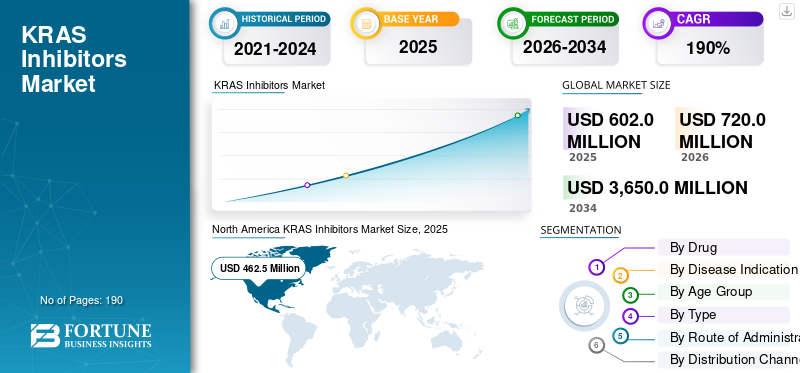
Download Free sample to learn more about this report.
KRAS Inhibitors Market KEY TAKEAWAYS
 Global Market Size & Forecast
- 2025 Market Size: USD 602.0 million
- 2026 Market Size: USD 720.0 million
- 2034 Forecast Market Size: USD 3,650.0 million
- CAGR: 13.01% during 2026–2034
 Market Share
- North America dominated the global market with a 76.82% share in 2025.
- Sotorasib Captured the largest drug segment share in 2025.
- Non-Small Cell Lung Cancer held the largest indication share in 2025.
 Key Regional Highlights
North America
Dominated the market with a valuation of USD 462.5 million in 2025.
Europe
The market is projected to reach USD 97.9 million in 2026 and grow at a 30.36% rate.
Asia Pacific
The market is estimated to reach USD 66.7 million in 2026.
U.S.
The market is estimated at approximately USD 505.0 million in 2026, accounting for around 70.13% of global revenue.
Japan
The market is estimated at approximately USD 34.8 million in 2026, accounting for around 4.84% of global revenue.
Read More

KRAS INHIBITORS MARKET TRENDS
Expansion Beyond KRAS G12C to Broaden Treatment Opportunity is a Prominent Trend Observed
Key companies are actively expanding beyond KRAS G12 to broaden treatment alternatives. This shift from first-generation KRAS G12C-focused therapies toward broader mutation coverage, especially KRAS G12D and other high-prevalence variants, is a prominent market trend. The shift is crucial as G12C inhibitors opened the market, but they address only a portion of KRAS-mutated cancers. As companies develop therapies for G12D-mutated pancreatic, colorectal, and lung cancers, the eligible patient pool is expected to expand, supporting stronger long-term market growth. These factors also encourage pharmaceutical companies to invest in next-generation inhibitors, degraders, and combination approaches that may overcome resistance and improve treatment outcomes across difficult-to-treat solid tumors.
- For instance, in April 2026, Astellas Pharma dosed its first patient in a Phase 3 registrational study evaluating setidegrasib (ASP3082), a KRAS G12D-directed protein degrader, in combination with chemotherapy for first-line treatment of KRAS G12D-mutated metastatic pancreatic ductal adenocarcinoma.
MARKET DYNAMICS
MARKET DRIVERS
Download Free sample to learn more about this report.
Growing Adoption of Precision Oncology to Support KRAS Inhibitor Uptake
The rising adoption of precision oncology is driving the KRAS inhibitors market growth, as treatment decisions are increasingly based on specific genetic mutations rather than tumor location alone. KRAS-mutated cancers require accurate biomarker testing to identify eligible patients for targeted therapy. As testing becomes more common for lung, colorectal, and pancreatic cancers, physicians can better match patients to KRAS-directed drugs, improving treatment selection and increasing the use of these therapies. This shift from generalized treatment to mutation-specific therapy is expected to strengthen demand for KRAS inhibitors across major oncology sectors.
- In January 2025, Amgen Inc. received U.S. FDA approval for LUMAKRAS (sotorasib) in combination with Vectibix (panitumumab) for chemorefractory KRAS G12C-mutated metastatic colorectal cancer. The approval specifically applies to patients identified with KRAS G12C-mutated disease, showing how biomarker-led precision oncology is directly expanding the commercial use of KRAS inhibitors.
MARKET RESTRAINTS
Limited Mutation Coverage of Approved KRAS Drugs to Restrict Broader Patient Adoption
A key restraint challenging market growth is limited mutation coverage. Currently approved therapies primarily target the KRAS G12C mutation, while other common KRAS variants, such as G12D and G12V, still have limited approved treatment options. This limits market expansion as many patients with KRAS-mutated cancers are ineligible for existing targeted therapies. As a result, commercial uptake remains concentrated in selected cancer populations. At the same time, broader use across pancreatic, colorectal, and other KRAS-driven tumors depends on the success of next-generation mutation-specific or pan-KRAS therapies. This slows near-term adoption and keeps the market dependent on pipeline progress rather than on broad product availability.
- For instance, a 2025 review published in The Oncologist highlighted that currently approved KRAS inhibitors are only available for the G12C mutation, which occurs in fewer than half of KRAS-mutated lung cancer patients, and that resistance generally develops within a year. This published evidence supports the restraint that narrow mutation coverage and limited durability reduce the broader market opportunity for approved KRAS inhibitors.
MARKET OPPORTUNITIES
Combination Therapy Approaches to Improve Response and Overcome Resistance
The market is creating strong growth opportunities through combination therapy, as single-agent KRAS inhibition may not provide durable responses for all patients. Cancer cells can activate alternative signaling pathways or develop resistance after initial treatment, which reduces the long-term benefit of monotherapy. As a result, companies are combining KRAS inhibitors with EGFR inhibitors, immunotherapies, chemotherapy, and other targeted agents to improve response rates and extend treatment durability. This creates a clear opportunity for market growth, as successful combinations can expand KRAS inhibitor use across broader tumor types, earlier treatment lines, and larger commercial patient pools.
- For instance, in May 2026, Merck received U.S. FDA Breakthrough Therapy Designation for calderasib (MK-1084), an investigational oral KRAS G12C inhibitor, in combination with KEYTRUDA (pembrolizumab). This approval shows how combination strategies can help expand KRAS inhibitor use beyond lung adenocarcinoma treatment and address resistance-related limitations in colorectal cancer treatment.
MARKET CHALLENGES
Safety and Tolerability Concerns to Affect Treatment Continuity and Challenge Market Expansion
The market faces a key challenge including safety and tolerability concerns, as patients receiving these therapies may require close monitoring, dose reduction, temporary treatment interruption, or permanent discontinuation. This affects market growth as oncologists need to balance targeted treatment benefits with risks, including gastrointestinal adverse reactions, hepatotoxicity, QTc prolongation, and interstitial lung disease/pneumonitis. When adverse events become severe or difficult to manage, treatment continuity can be disrupted, reducing patient adherence and limiting broader adoption in routine oncology practice. As KRAS inhibitors move into combination regimens and earlier lines of therapy, managing toxicity will remain important for improving long-term acceptance.
- For instance, in April 2025, NIH published a report titled ‘Potency and Safety of KRAS G12C Inhibitors in Solid Tumors: A Systematic Review’ that revealed Adagrasib was associated with higher rates of nausea and diarrhea, while Sotorasib had more frequent elevations in ALT and AST, indicating a higher risk of liver toxicity. Divarasib and Garsorasib, on the other hand, exhibited a higher rate of grade 3 TRAEs, which might limit their clinical use despite their efficacy.
Segmentation Analysis
By Drug
Sotorasib Dominated Due to First-mover Advantage and Wider Commercial Use
Based on the drug, the market is categorized into sotorasib, adagrasib, divarasib, olomorasib, RMC-6236, KRAS G12D inhibitors, and others.
By drug, sotorasib captured the largest market share. Sotorasib is the first approved KRAS G12C inhibitor, thus creating the initial commercial base for the market. Its early approval helped physicians gain clinical experience with KRAS-targeted therapy, especially in previously treated KRAS G12C-mutated NSCLC. This first-mover position also supported stronger brand recognition, wider availability, and earlier inclusion in oncology treatment pathways. As a result, sotorasib maintained a leading position while newer KRAS inhibitors were still expanding their clinical and commercial presence.
- For instance, in December 2023, Amgen Inc. stated that LUMAKRAS/LUMYKRAS had been received by over 15,000 patients worldwide through clinical development, early access, and commercial use, highlighting its stronger real-world and commercial reach compared with later entrants.
The others segment is expected to grow at a CAGR of 43.39% over the forecast period.
To know how our report can help streamline your business, Speak to Analyst
By Disease Indication
Non-Small Cell Lung Cancer Segment Led Due to Early KRAS-targeted Approval and High Testing Adoption
Based on disease indication, the market is segmented into non-small cell lung cancer, colorectal cancer, pancreatic cancer, biliary tract cancer, and others.
In 2025, non-small cell lung cancer held the largest KRAS inhibitors market share. KRAS G12C inhibitors were first commercialized in this cancer type. NSCLC has a well-established molecular testing ecosystem, which makes it easier to identify KRAS G12C-positive patients and link them with molecularly targeted therapies. Since oncologists already use biomarker-based treatment decisions in lung cancer, KRAS inhibitors have been adopted more quickly in this setting than in indications where KRAS-targeted treatment pathways are still emerging. This early clinical validation and testing readiness made NSCLC the strongest revenue-generating indication.
- For instance, in May 2021, Amgen announced that the U.S. FDA approved LUMAKRAS for adult patients with KRAS G12C-mutated locally advanced or metastatic NSCLC who have received at least one prior systemic therapy, making it the first approved targeted treatment for this patient group.
The pancreatic cancer segment is projected to grow at a 39.86% CAGR during the forecast period.
By Age Group
Adults Segment Dominate Owing to Higher Disease Burden and Greater Treatment Adoption
Based on the age group, the market is segmented into adult and pediatric.
Based on age group, adults segment dominated the market as KRAS-mutated solid tumors, such as lung, colorectal, and pancreatic cancers, occur mainly in adult populations. Most clinical trials and regulatory approvals for KRAS inhibitors have also focused on adult patients, which directly supports higher commercial use in this group. Since approved KRAS therapies are linked to adult oncology indications and require molecular testing, hospitals and oncologists primarily prescribe these drugs within adult cancer care pathways. This makes the adult segment the largest contributor to the market.
- For instance, in June 2024, Bristol Myers Squibb announced U.S. FDA accelerated approval of KRAZATI in combination with cetuximab for adult patients with previously treated KRAS G12C-mutated locally advanced or metastatic colorectal cancer.
The pediatric segment is projected to grow at a CAGR of 37.64% during the forecast period.
By Type
KRAS G12C Inhibitors Segment Dominated Due to Approved Drug Availability and Strong Clinical Validation
Based on type, the market is segmented into KRAS G12C inhibitors, KRAS G12D inhibitors, and others.
In 2025, KRAS G12C inhibitors held the dominant position in the market. It is the most commercially validated KRAS mutation target. Approved therapies such as sotorasib and adagrasib are specifically designed for KRAS G12C-mutated cancers, while other KRAS mutation types, such as G12D and G12V, remain largely dependent on investigational pipelines. This creates a direct commercial presence for G12C, as approved products, companion testing, physician familiarity, and reimbursement pathways are already established.
- For instance, in June 2024, Bristol Myers Squibb reported that KRAZATI demonstrated a statistically significant improvement in progression-free survival in patients with pretreated KRAS G12C-mutated locally advanced or metastatic NSCLC in the KRYSTAL-12 confirmatory trial.
The KRAS G12D inhibitors segment is projected to grow at a 40.68% CAGR over the study period.
By Route of Administration
Oral Route Segment Dominated Due to Patient Convenience and Chronic Oncology Treatment Suitability
Based on route of administration, the market is segmented into oral and parenteral routes.
In 2025, the oral route of administration captured largest market share as leading KRAS inhibitors are available as oral therapies, making them more convenient than infusion-based regimens. Oral drugs support easier administration, reduce frequent hospital visits, and allow patients to continue therapy in outpatient settings under an oncologist's supervision. This is crucial in advanced cancer care, where treatment continuity and patient convenience influence adoption. As more next-generation KRAS inhibitors are also being developed as oral therapies, this route is expected to remain dominant.
- For instance, in May 2026, Genentech announced that it would present data on divarasib, a next-generation oral KRAS G12C inhibitor, in combination with pembrolizumab for treatment-naïve patients with KRAS G12C-positive advanced NSCLC.
The parenteral segment is projected to grow at a CAGR of 39.42% over the forecast period.
By Distribution Channel
Hospital Pharmacies Dominated Due to Oncology-led Treatment Initiation and Monitoring
Based on distribution channel, the market is segmented into hospital pharmacies, specialty pharmacies, retail & drug store pharmacies, and online pharmacies.
The hospital pharmacies dominated the market. This dominance stems from KRAS inhibitors being used in advanced cancer treatment, where therapy decisions are usually made by oncologists in hospital or cancer center settings. These drugs require biomarker confirmation, treatment monitoring, adverse-event management, and coordination with other therapies, which makes hospital-based dispensing and oncology pharmacy support highly important. Even when KRAS inhibitors are oral, treatment initiation often remains linked to hospital oncology departments. This strengthens the role of hospital pharmacies as the leading distribution channel.
- For instance, in September 2023, Ferring announced that the first U.S. patient was dosed with commercially available ADSTILADRIN as part of its early experience program, with urologists at participating clinics able to prescribe the intravesical gene therapy for eligible high-risk bladder cancer patients.
The online pharmacies segment is projected to grow at a CAGR of 30.36% over the forecast period.
KRAS Inhibitors Market Regional Outlook
By geography, the market is categorized into Europe, North America, Asia Pacific, Latin America, and the Middle East & Africa.
North America
North America KRAS Inhibitors Market Size, 2025 (USD Million)
To get more information on the regional analysis of this market, Download Free sample
North America held the dominant share in 2024 at USD 370.7 million and maintained its leading position in 2025 at USD 462.5 million. The North America market is growing due to strong adoption of biomarker testing, early access to approved KRAS G12C inhibitors, and high treatment demand in NSCLC and colorectal cancer. Strong oncology infrastructure and reimbursement support further improve uptake.
U.S. KRAS Inhibitors Market
Given North America's substantial contribution and the U.S. dominance in the region, the U.S. market is estimated at around USD 505.0 million in 2026, accounting for roughly 70.13% of the global market.
Europe
Europe is projected to grow at 30.36% over the coming years, the second-highest among all regions, and reach a valuation of USD 97.9 million by 2026. Growth in European countries is supported by rising adoption of precision oncology, expanding molecular testing programs, and increasing use of targeted therapies across major countries. Regulatory approvals and clinical trial activity are also strengthening access.
U.K. KRAS Inhibitors Market
The U.K. market is estimated at USD 18.8 million in 2026, accounting for roughly 2.62% of the global market.
Germany KRAS Inhibitors Market
Germany's market is projected to reach approximately USD 22.5 million in 2026, equivalent to around 3.12% of the global market.
Asia Pacific
Asia Pacific is estimated to reach USD 66.7 million in 2026 and secure third place in the market. The market is expanding due to a large pool of cancer patients, improved access to genomic profiling in cancer testing, and growing investment in advanced oncology care. Japan, China, South Korea, and Australia are key contributors due to the rising adoption of targeted therapies.
Japan KRAS Inhibitors Market
The Japanese market in 2026 is estimated at around USD 34.8 million, accounting for approximately 4.84% of the global market.
China KRAS Inhibitors Market
China's market is projected to be among the largest worldwide, with 2026 revenues estimated at around USD 17.1 million, accounting for approximately 2.37% of global sales.
India KRAS Inhibitors Market
The Indian market is estimated at around USD 3.6 million in 2026, accounting for roughly 0.50% of global revenue.
Latin America and the Middle East & Africa
The Latin America and Middle East & Africa regions are expected to witness growth in this market during the forecast period. The market in Latin America is estimated to reach a valuation of USD 13.0 million. Growth in the region is driven by rising cancer diagnosis rates, the gradual expansion of molecular diagnostics, and improved access to specialty oncology drugs in Brazil and Mexico. In the Middle East & Africa, the GCC is set to reach USD 4.9 million in 2026.
South Africa KRAS Inhibitors Market
The South African market is projected to reach approximately USD 1.8 million by 2026, accounting for roughly 0.25% of global revenue.
COMPETITIVE LANDSCAPE
Key Industry Players
New Product Launches among Key Companies to Propel Market Progress
The KRAS inhibitors market is becoming increasingly competitive, with established oncology companies, large pharmaceutical players, and emerging biotechnology firms leading the way with mutation-specific and next-generation KRAS-targeted therapies. Major companies such as Amgen, Bristol Myers Squibb, GenFleet Therapeutics, Innovent Biologics, InventisBio, and Jacobio Pharma Co., Ltd., are focusing on differentiated treatment options to strengthen their market position. These companies are increasingly investing in KRAS inhibitors, pan-KRAS approaches, protein degraders, and combination therapies to improve treatment outcomes, overcome resistance, and expand the eligible patient population across lung, colorectal, pancreatic, and others.
- For instance, in April 2026, Astellas Pharma announced that the first patient was dosed in a Phase 3 registrational study evaluating setidegrasib, a KRAS G12D-directed protein degrader, in combination with chemotherapy for first-line treatment of KRAS G12D-mutated metastatic pancreatic ductal adenocarcinoma. The product is designed to degrade mutant KRAS G12D protein, offering a differentiated approach for a high-need cancer population with limited targeted treatment options.
Several companies are adopting product approvals, clinical trial advancements, licensing agreements, pipeline expansion, and strategic collaborations as key growth strategies to strengthen their market presence. Leading oncology players are expanding approved KRAS G12C therapies into additional indications and combination regimens, while emerging companies are focusing on broader KRAS mutation coverage and novel mechanisms of action. The competitive landscape is expected to intensify as companies increasingly focus on next-generation inhibitors, broader tumor coverage, earlier-line treatment settings, and differentiated products that can address resistance and capture higher-value patient segments.
LIST OF KEY KRAS INHIBITORS COMPANIES PROFILED
- Amgen Inc. (U.S.)
- Bristol Myers Squibb Company (U.S.)
- Innovent Biologics, Inc. (China)
- InventisBio Co., Ltd. (China)
- Jacobio Pharmaceuticals Group Co., Ltd. (China)
- Revolution Medicines, Inc. (U.S.)
- Hoffmann-La Roche Ltd (Switzerland)
- Eli Lilly and Company (U.S.)
- Astellas Pharma Inc. (Japan)
- Bayer AG (Germany)
KEY INDUSTRY DEVELOPMENTS
- June 2026: Tango Therapeutics, Inc. showcased positive initial data from its ongoing Phase 1/2 study of vopimetostat, an investigational PRMT5 inhibitor with first- and best-in-class potential, in combination with Revolution Medicines’ RAS(ON) inhibitors in patients with MTAP-deleted and RAS-mutant metastatic pancreatic ductal adenocarcinoma (PDAC).
- May 2026: Akari Therapeutics, Plc announced positive preclinical data highlighting synergistic cytotoxic activity of AKTX-101 in combination with KRAS inhibition in KRAS-mutated pancreatic cancer models at the American Society of Clinical Oncology (ASCO) Annual Meeting 2026.
- April 2026: Erasca, Inc. announced positive preliminary Phase 1 dose escalation data for its potentially best-in-class, pan-RAS molecular glue ERAS-0015 in patients with RAS-mutant solid tumors.
- June 2025: Revolution Medicines, Inc. received Breakthrough Therapy Designation from the U.S. FDA for daraxonrasib, the company’s RAS(ON) multi-selective inhibitor, for previously treated metastatic PDAC in patients with KRAS G12 mutations.
- April 2025: Verastem Oncology received clearance from the U.S. FDA for the Investigational New Drug (IND) application of VS-7375, an oral KRAS G12D (ON/OFF) inhibitor for clinical evaluation. The company expects to initiate a Phase 1/2a study in mid-2025 with plans for multiple expansion cohorts, including combinations, in advanced solid tumors, such as pancreatic cancer, colorectal cancer, and non-small cell lung cancer.
- August 2024: Innovent Biologics, Inc. received approval from China's National Medical Products Administration (NMPA) for Dupert (fulzerasib), a KRAS G12C inhibitor for the treatment of adult patients with advanced non-small cell lung cancer (NSCLC) harboring a KRAS G12C mutation who have received at least one systemic therapy.
REPORT COVERAGE
The report provides a detailed market analysis. It focuses on key aspects, including leading companies, segments and regions. The report further evaluates market trends, drivers, restraints, opportunities, and the competitive landscape across major regions. It also highlights key industry developments, regulatory approvals, and company strategies expected to shape the global KRAS inhibitors market during the forecast period.
Request for Customization to gain extensive market insights.
Report Scope & Segmentation
| ATTRIBUTE | DETAILS |
| Study Period | 2021-2034 |
| Base Year | 2025 |
| Estimated Year | 2026 |
| Forecast Period | 2026-2034 |
| Historical Period | 2021-2024 |
| Growth Rate | CAGR of 13.01% from 2026 to 2034 |
| Unit | Value (USD Million) |
| Segmentation | By Drug, Disease Indication, Age Group, Type, Route of Administration, Distribution Channel, and Region |
| By Drug |
|
| By Disease Indication |
|
| By Age Group |
|
| By Type |
|
| By Route of Administration |
|
| By Distribution Channel |
|
| By Region |
|
Frequently Asked Questions
According to Fortune Business Insights, the global market value stood at USD 602.0 million in 2025 and is projected to reach USD 3,650.0 million by 2034.
In 2025, North America the market value stood at USD 462.5 million.
The market is expected to grow at a CAGR of 13.01% over the forecast period of 2026-2034.
The sotorasib segment is expected to lead the market.
Growing adoption of precision oncology to support KRAS inhibitors uptake.
Amgen Inc., Bristol Myers Squibb Company, Innovent Biologics, Inc., and InventisBio Co., Ltd. are among the major players in the global market.
North America accounted for the largest market share in 2025.



- 2021-2034
- 2025
- 2021-2024
- 190
Get 30-60 hrs Free Customization
Expand Regional and Country Coverage, Segments Analysis, Company Profiles, Competitive Benchmarking, and End-user Insights.













.webp)






-
US +1 833 909 2966 ( Toll Free )
-
Get In Touch With Us