 Download Free Sample



Get a Quote
Receive a tailored pricing based on your needs.
- Choose license type
- Multiple user options
- Custom scope & coverage
- Fast turnaround
"Designing Growth Strategies is in our DNA"
 Listen to Audio Version
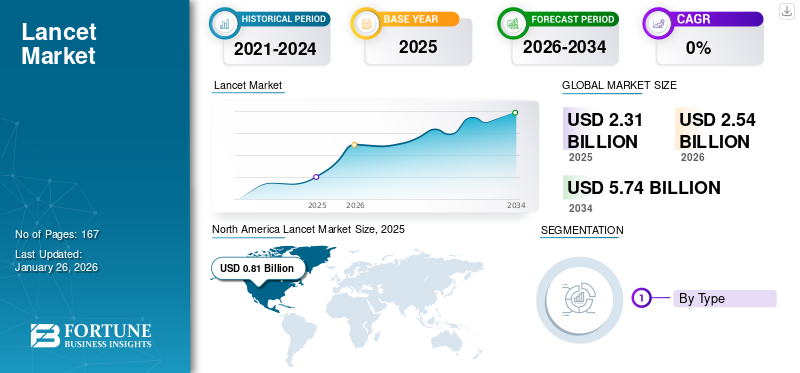
The global lancet market size was valued at USD 2.31 billion in 2025. The market is projected to grow from USD 2.54 billion in 2026 to USD 5.74 billion by 2034, exhibiting a CAGR of 10.72% during the forecast period. North America dominated the lancet market with a market share of 34.98% in 2025.
Lancets are small, sharp medical devices that are used to provide quick, minimally penetrating skin punctures, typically on the tip of the finger. They are most commonly used to draw up capillary blood specimens for blood sugar tests as well as other diagnostic examinations. They are either disposable or part of automated safety devices to minimize the risk of needle-stick injury. The growing awareness about the safety of sharp devices to avoid needle-stick injuries and the rising number of diagnostic and monitoring examinations are driving the demand for lancets globally, augmenting the market growth.
The global market is fragmented, with prominent companies being BD, HTL-STREFA (MTD Medical Technology and Devices), SARSTEDT AG & Co. KG, Cardinal Health, and others. These major players are increasingly implementing various growth strategies such as new product launches, acquisitions, and geographical expansions to capture a substantial market share.
Download Free sample to learn more about this report.
 Market Size & Forecast
 Market Share
 Key Regional Highlights
North America
North America generated USD 0.81 billion in 2025 and is projected to reach USD 0.88 billion in 2026, driven by strong demand for advanced lancets.
Europe
Europe accounted for USD 0.78 billion in 2025 and is expected to reach USD 0.85 billion in 2026, supported by the presence of major industry players.
Asia Pacific
Asia Pacific reached USD 0.62 billion in 2025 and is forecast to grow to USD 0.70 billion in 2026 due to rising diabetes prevalence and healthcare awareness.
U.S.
The market is estimated to reach USD 0.82 billion in 2026
Japan
The market is expanding steadily, supported by increasing demand for blood glucose monitoring and advanced safety lancets.
Read More

Rising Prevalence of Diabetes and Chronic Diseases to Drive the Market Growth
Over the past decades, the rising global cases of diabetes have tremendously boosted the product demand as they are used extensively to collect blood specimens to check the daily glucose levels of diabetic patients.
In addition, the growing adoption of home-based monitoring solutions as well as the need for convenient, less invasive blood sampling techniques are boosting the demand for advanced types of lancets such as safety lancets. Such a scenario is anticipated to drive the global lancet market growth during the forecast period.
Cost Sensitivity of Safety Lancets to Restrict Market Expansion
Although routine blood sampling requires lancets, price variation among various types of lancets, such as safety lancets, is expected to challenge their adoption. Lancets that are safety-based, as an example, tend to be more costly than traditional ones, where cost becomes a vital factor, particularly in developing countries where the budget for healthcare is limited.
Such price differences are pushing healthcare professionals to opt for cheaper options and are also deterring advanced product adoption among patients, which is expected to hamper the market growth.
Increasing Need for Home Healthcare Monitoring to Create Lucrative Growth Opportunities
In recent years, the rising demand for home diagnosis has been generating lucrative opportunities for lancet providers to increase their product supply globally. Several patients managing their chronic conditions, especially diabetes, from home is surging the demand for convenient blood sampling devices such as lancets.
As a result, lancets, especially safety lancets that minimize the risk of needle-stick injury occurrence, are gaining importance among patients who need routine blood tests without professional assistance. This is expected to create significant opportunities for manufacturers to increase product manufacturing capacity to meet growing demand, supporting the market expansion.
Technological Advancements and Sustainable Designs to Emerge as a Key Market Trend
The integration of ultra-fine gauge technology with ergonomic, user-friendly designs is significantly improving patient comfort and blood sampling accuracy. As a result, manufacturers are increasingly developing lancets with 21G-30G ultra-thin needles and spring-loaded mechanisms to enable nearly painless capillary blood collection.
These innovations are being fueled by stringent regulatory guidelines that encourage the use of safety-engineered sharps to minimize needle-stick injuries in healthcare settings. Additionally, the growing emphasis on sustainability has prompted design improvements such as reduced plastic consumption and the use of biodegradable materials, highlighting a broader shift toward environment-friendly products.
Limited Spending in Developing Regions to Challenge Market Growth
In developing countries, underdeveloped healthcare infrastructure and limited budgets for diagnostic devices are restricting access to high-end products such as lancets. Consequently, people in the affected areas are preferring cheap, sharp objects such as needles due to unaffordability, limited government spending on healthcare, and limited insurance cover.
Such restricted spending is limiting the uptake of advanced types of lancets and also limiting importation, further inhibiting access to such products among patients. Moreover, limited awareness about the benefits of the newer, safer, and more user-friendly lancets in these regions is also challenging the market growth of lancets in these regions.
Download Free sample to learn more about this report.
Safety Lancets Segment Led the Market in 2024 due to Increasing Adoption among Diabetic Patients
On the basis of the segmentation by type, the market is classified into standard lancets, safety lancets, and specialty lancets.
To know how our report can help streamline your business, Speak to Analyst
The Safety Lancet segment is projected to dominate the market with a share of 51.55% in 2026. The safety lancets segment dominated the global lancet market share in 2024. The growth is attributed to its proven safety and convenience. As a result, type 1 diabetes patients, who require daily monitoring of blood glucose, are using this product for blood drawing to place on the blood glucose meter. In response, the key players are launching advanced safety lancet products to the market, thereby increasing product penetration globally.
The standard lancet segment is projected to grow at a CAGR of 10.5% during the forecast period.
Needle Segment to Dominate Due to Lesser Pain and Superior Safety Features
By incision type, the market is categorized into needle and blade.
In 2026, the Needle segment is projected to lead the market with a 93.65% share. the segment is anticipated to dominate with a 93.6% share. Patients are highly preferring needles due to their ease of use, superior safety features, and reduced pain during blood sampling. The demand for needles is increasing more prominently among patients who require frequent testing with less risk of needle-stick injury. This is expected to drive the segment’s growth during the forecast period.
The blade segment is expected to grow at a CAGR of 10.0% over the forecast period.
Adults Segment to Dominate Due to Higher Testing Rate and Product Adoption
By age group, the market is categorized into adults and pediatrics.
The adult segment is expected to capture the largest share of the market, accounting for 72.92% in 2026. In 2025, the segment is anticipated to dominate with a 72.8% share. The segment’s growth is attributed to increasing cholesterol testing, HbA1c or glycated hemoglobin testing, and other testing among adults. This is fueling the utilization of lancets among this age group. Furthermore, the increasing blood glucose monitoring in type 2 diabetes adults is also anticipated to increase the utilization of lancets.
The pediatric segment is expected to grow at a CAGR of 10.1% over the forecast period.
23G-28G Segment to Dominate Due to Superior Comfort, Less Pain, and Significant Availability
Based on gauge size, the market is trifurcated into 22G and below, 23G-28G, and above 28G.
The 23G–28G segment is expected to hold the largest market share, accounting for 73.35% in 2026. In 2025, the segment is anticipated to dominate with a 73.3% share. The 23G-28G gauge range is thin enough to reduce discomfort compared to larger gauges such as 21G-22G. Moreover, most of the commercially available lancing devices are designed to work optimally with 23G-28G lancets, which further increases product demand and is expected to drive the segment’s growth.
The above 28G segment is expected to grow at a CAGR of 10.1% over the forecast period.
Blood Glucose Monitoring Segment to Dominate Due to Growing Diabetic Population
Based on application, the market is segmented into blood glucose monitoring, hemoglobin testing, cholesterol testing, and others.
The blood glucose monitoring segment accounted for the largest share of the market in 2024. In 2025, the segment is anticipated to dominate with a 56.3% share. The growth is attributed to the increasing number of individuals self-monitoring their blood glucose, thereby driving the purchase rate of lancets. Additionally, increasing diabetes prevalence globally is supporting the demand for lancets by pushing the need for self-monitoring of blood glucose.
The hemoglobin testing segment is expected to grow at a CAGR of 10.8% over the forecast period.
Retail Pharmacies Segment to Dominate Due to Direct Accessibility and Convenience
Based on distribution channel, the market is segmented into hospital pharmacies, retail pharmacies, and online pharmacies.
In 2024, the global market was dominated by retail pharmacies in terms of distribution channel. Most custom-fitted devices are prescribed and fitted at dental clinics. There is a surge in the number of retail pharmacies globally. This is making them the most convenient point of purchase for routine self-monitoring devices, such as lancets, due to widespread availability. In addition, these channels are selling lancets in combination with glucose meters, strips, or diabetes care kits to primary users, which is expected to fuel the segment’s growth. The segment is set to hold 51.9% share in 2025.
In addition, the hospital pharmacies segment is projected to grow at a CAGR of 10.2% during the forecast period.
On the basis of geography, the market has been subdivided into North America, Latin America, Europe, Asia Pacific, and the Middle East & Africa.
North America Lancet Market Size, 2025 (USD Billion) To get more information on the regional analysis of this market, Download Free sample
The market in North America reached USD 0.81 billion in 2025, representing 34.98% of total market revenue, and is projected to reach USD 0.88 billion in 2026. the region also accounted for a major share with a value of USD 0.88 billion. The growth is attributed to the strong demand for advanced products and reimbursement for chronic disease monitoring devices, including lancets. This is driving the key players to increase the supply of such products in the region. In 2026, the U.S. market is estimated to reach USD 0.82 billion.
Europe contributed approximately USD 0.78 billion to the global market in 2025, accounting for 33.58% share, and is expected to reach USD 0.85 billion in 2026. Europe is projected to expand at a substantial rate in the coming years and is expected to record the second-highest growth rate of 10.2% during the forecast period, reaching a market value of USD 0.78 billion by 2025. The growth is largely attributed to the strong presence of key players in countries such as the U.K., Germany, and France, which contributes to the wide availability of lancets in the region. Based on these factors, the U.K., Germany, and France are projected to record market values of USD 0.07 billion, USD 0.19 billion, and USD 0.07 billion, respectively, by 2026.
In 2025, the Asia Pacific market stood at USD 0.62 billion, representing 26.90% of global demand, and is projected to grow to USD 0.7 billion in 2026. The growth in the region is supported by increasing healthcare awareness and the rising prevalence of chronic diseases requiring regular blood glucose monitoring. Furthermore, India and China are expected to reach market values of USD 0.15 billion and USD 0.32 billion, respectively, by 2026.
The Latin America market accounted for USD 0.07 billion in 2025, representing 3.03% of the global industry, and is expected to reach USD 0.07 billion in 2026. Latin America is projected to witness moderate growth during the forecast period. Growth in the region is primarily driven by increasing penetration and supply of lancets, along with rising awareness about safety and specialty lancets.
Middle East & Africa maintained a strong presence in the global market, reaching USD 0.03 billion in 2025, accounting for 1.50% share, and is expected to reach USD 0.04 billion in 2026. The Middle East & Africa region is also anticipated to experience moderate growth over the projection period. In this region, GCC countries are projected to reach a market value of USD 0.02 billion in 2025, supported by growing healthcare awareness and increasing adoption of safety lancets.
Extensive Product Range and Growing Adoption of Customized Devices Strengthened the Leading Position of Key Players
The global lancet market is highly fragmented, with major players such as HTL-STREFA, BD, and Abbott holding a dominant share in 2024. These companies are focusing on strengthening their market hold by increasing product availability worldwide, launching innovative products, and signing strategic distribution agreements.
Moreover, these players are focusing on portfolio diversification to solidify their market position. Other major participants in the market include Cardinal Health, B. Braun SE, Terumo Medical Corporation, and SARSTEDT AG & Co. KG. These players are emphasizing product innovation and global expansion strategies to strengthen their brand reputation and market position.
Request for Customization to gain extensive market insights.
|
ATTRIBUTE |
DETAILS |
|
Study Period |
2021-2034 |
|
Base Year |
2025 |
|
Estimated Year |
2026 |
|
Forecast Period |
2026-2034 |
|
Historical Period |
2021-2024 |
|
Growth Rate |
CAGR of 10.72% from 2026-2034 |
|
Unit |
Value (USD Billion) |
|
Segmentation |
By Type
By Incision Type
By Age Group
By Gauge Size
By Application
By Distribution Channel
By Geography North America (By Type, Incision Type, Age Group, Gauge Size, Application, Distribution Channel, and Country)
Europe (By Type, Incision Type, Age Group, Gauge Size, Application, Distribution Channel, and Country/Sub-region)
Asia Pacific (By Type, Incision Type, Age Group, Gauge Size, Application, Distribution Channel, and Country/Sub-region)
Latin America (By Type, Incision Type, Age Group, Gauge Size, Application, Distribution Channel, and Country/Sub-region)
Middle East & Africa (By Type, Incision Type, Age Group, Gauge Size, Application, Distribution Channel, and Country/Sub-region)
|
Fortune Business Insights says that the global market value stood at USD 2.31 billion in 2025 and is projected to reach USD 5.74 billion by 2034.
In 2025, the North America market value stood at USD 0.81 billion.
The market is expected to exhibit a CAGR of 10.72% during the forecast period of 2026-2034.
In 2025, the safety lancets segment led the market by type.
The key factors driving the market are the increasing prevalence of diabetes and an increasing demand for home-based monitoring.
BD, SARSTEDT AG & Co. KG, HTL-STREFA, and Abbott are some of the prominent players in the market.
North America dominated the market in 2024.
Innovation of ultra-thin needles, increasing SMBG users, and new launches are favoring the product adoption globally.

Get 30-60 hrs Free Customization
Expand Regional and Country Coverage, Segments Analysis, Company Profiles, Competitive Benchmarking, and End-user Insights.













.webp)






Related Reports
Get In Touch With Us
US +1 833 909 2966 ( Toll Free )
Receive a tailored pricing based on your needs.
Discuss your questions with our industry experts.
Have questions? Get quick answers before you purchase.

