Laundry Care Market Size, Share & Industry Analysis, By Product Type (Detergents, Fabric Softeners and Conditioners, and Others), By Form (Powder, Liquid, Pods, and Others), By Ingredient Source (Synthetic, Organic, and Others), By Distribution Channel (Wholesaler/Distributors, Supermarket/Hypermarket, Online Retail, and Others), and Regional Forecast, 2026-2034
 Download Free Sample
(Offer valid till 15th Oct 2026)

KEY MARKET INSIGHTS
 Listen to Audio Version
The global laundry care market size was valued at USD 114.02 billion in 2025. The market is projected to grow from USD 118.38 billion in 2026 to USD 215.65 billion by 2034, exhibiting a CAGR of 7.79% during the forecast period. Asia Pacific dominated the global market with a share of 40.34% in 2025.
Laundry care comprises detergents, fabric enhancers, stain removers, and specialty laundry additives and is a cornerstone of the household and FMCG sector. The market growth is driven by high product penetration in developed regions and expanding access and premiumization in emerging economies. Increasing consumer spending power, rising urbanization, and growing hygiene awareness, combined with strong emphasis on environmentally-friendly and sustainable formulations, drives market growth. Further, the rise in demand for smart and automatic washing machines along with compatible high-efficiency detergents and fabric softeners and conditioners, particularly in developing markets with growing middle-class income populations, strengthens product demand. Also, the swift expansion of subscription-based delivery services and online instant shopping is reforming distribution, empowering refill systems and eco-brands to reach a wider consumer base.
Major companies such as Procter & Gamble, Unilever, Henkel, Kao Corporation, and LG Household & Health Care dominate the global landscape, while private labels and regional brands are gaining share through competitive pricing and local adaptation. Retailer-owned brands and regional manufacturers are expanding share by offering cost-effective, locally formulated detergents, challenging multinational dominance in price-sensitive markets.
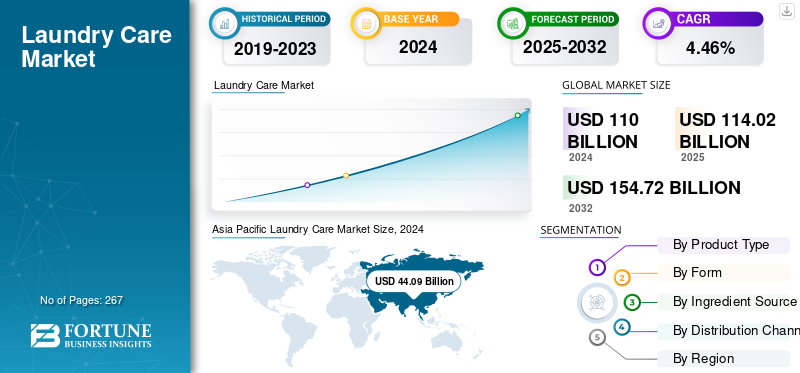
Download Free sample to learn more about this report.
Laundry Care Market Key Takeaways
 Global Market Size & Forecast
- 2025 Market Size: USD 114.02 billion
- 2026 Market Size: USD 118.38 billion
- 2034 Forecast Market Size: USD 215.65 billion
- CAGR: 7.79% (2026–2034)
 Market Share
- Asia Pacific dominated the market with a 40.34% share in 2025.
- The detergents segment is projected to lead the market, accounting for 65.32% of the global market in 2026.
- The powder segment is expected to dominate the market, contributing 57.77% of the global market in 2026.
 Key Regional Highlights
Asia Pacific
Asia Pacific generated USD 45.99 billion in 2025 and is projected to reach USD 48.06 billion in 2026.
North America
North America accounted for USD 26.33 billion in 2025 and is projected to reach USD 27.22 billion in 2026.
Europe
Europe generated USD 23.82 billion in 2025 and is expected to grow to USD 24.53 billion in 2026.
U.S.
U.S. market is projected to reach USD 22.85 billion by 2026.
Japan
Japan market is projected to reach USD 3.99 billion by 2026.
Read More

MARKET DYNAMICS
MARKET DRIVERS
Rising Hygiene Awareness and Lifestyle Modernization Driving Market Expansion
The increased emphasis on hygiene and sanitation, coupled with rising disposable incomes and lifestyle modernization drives the market expansion. The pandemic perpetually altered consumer behavior, creating strong and sustained demand for laundry care products that enables fabric care, deep cleaning, and germ protection. For instance, Procter & Gambler stated that their fabric and home care unit sales grew by 11% in the midst of 2020, as a consequence of COVId-19. With rising awareness of personal as well as household sanitation and disinfection, urban and semi-urban households have transformed laundry from a routine chore into a wellness-driven activity. Thus, shoppers seek out laundry products that combine fabric protection, maintenance along with cleaning efficiency.
Furthermore, lifestyle adoption of contemporary ways of living highlighted by increased appliance usage, hectic schedules, and rising consumer preference for appropriate formats such as fabric conditioners, liquid detergents, and pods has broadened the market for value-added laundry solutions. In developing countries, improved access to washing machines and rapid expansion of middle-class population has led to a structural shift from powder and bar detergents toward liquid and specialized formulations, intensifying market expansion globally.
MARKET RESTRAINTS
Environmental Concerns and Chemical Footprint Restraining Market Expansion
The primary aspect impeding the demand for laundry care products is the strict environmental inspection surrounding the chemical compounds and water usage in a variety of laundry formulations. Several ingredients such as surfactants, phosphates, and microplastic form the main composition of the laundry products, which are responsible for polluting water bodies and creating ecological imbalance. Stricter guiding mandates imposed by regulatory bodies in developed regions such as Europe and North America and growing consumer inclination toward biodegradable, low-foam, and eco-friendly substitutes is pushing market players to reformulate products, which further increases compliance and R&D costs. In addition, eco-conscious shoppers are restricting chemically formulated detergents or switching to refill and concentrated formats, which further brings down the overall consumption percentage, restricting market growth.
MARKET OPPORTUNITIES
Expansion of Refill & Reusable Packaging Models Creating Growth Avenues
Market players can capitalize on the closed-loop delivery/refill models or refillable packaging systems as they set them in the forefront of sustainability while appealing to environmentally aware buyers. This system shrinks the use of single-use plastic waste and matches with the consumer shift toward sustainable home care daily essentials.
For instance, Ocado, U.K. based online retailer, started small scale, preliminary study, providing 3-liter non-bio liquid detergent and fabric conditioner in refillable bottles, where the empty containers are segregated, cleaned, and refilled. Another packaging firms Mediacor and Amcor introduced a “recycle-ready” spouted pouch solution for fabric cleaning and laundry, focused on creating refills and more scalable and practical solutions.
LAUNDRY CARE MARKET TRENDS
Rise of On-Demand & Subscription Laundry Services Pose as Market Trends
Individuals of present times are heavily depending on laundry services provided by the laundromats and laundry facilities, sinking the necessity to buy laundry products and instead generating new growth prospects and consumption models via services. Millennials and Gen Z population in particular, opt for laundry services from outside via wash & delivery, subscription model, or app-based pickup. For instance, Cents, a laundry tech company, at the Clean Show 2025 introduced a subscription pricing feature for pickup/delivery and wash-and-fold services, facilitating predictable recurring revenue for operators. Moreover, players such as Rinse and Poplin (formerly SudShare) already run app-based laundry services in many U.S. cities, illustrating how digital platforms are transforming consumer behavior around laundry.
Download Free sample to learn more about this report.
Segmentation Analysis
By Product Type
Essential and High-Frequency Usage of Detergents Contributing to Segment’s Highest Share
On the basis of product type, the market is segmented into detergents, fabric softeners and conditioners, and others. Others include stain removal agents, pre-treatment products, bleaches, and others laundry additives.
Detergents product type accounted for the majority of the laundry care market share of roughly about 65.32% of the total market in 2026. The segment’s growth was supported by its significant role in routine clothes cleaning across all geographies and income groups. Whether in powder, pod, or liquid form, detergents signify the core necessity of the fabric care and wash cycle, assuring repetitive and consistent purchases. Moreover, constant product innovation, such as concentrated liquid formulations and enzyme based detergents, serving diverse washing machine types and fabric needs consolidates the segment’s growth.
In contrast, fabric softeners and conditioners are projected to expand at a CAGR of 4.20% over the projected years. Since these products cater as premium add-ons or complementary or, leading to lower penetration rates, particularly in emerging markets.
To know how our report can help streamline your business, Speak to Analyst
By Form
Convenience and Broader Machine Compatibility to Contribute to Liquid Form Segment
By form, the market is categorized into powder, liquid, pods, and others.
The liquid detergent segment dominates the global fabric care market, primarily due to its ease of use, quick dissolvability, and suitability for modern automatic washing machines. Consumers increasingly prefer liquid formats for their ability to remove stains effectively at lower temperatures and prevent residue on clothes further advantages over traditional powders.
The powder segment is expected to account for 57.77% of the market in 2026.
Rising demand for front-load washing machines combined with the growth of refillable and concentrated liquid fabric care products, prompted this consumer inclination toward liquid formulations across the globe. Moreover, growing adoption of front-load washing machines, along with the rise of concentrated and refillable liquid formulations, has accelerated this shift across both developed and emerging markets.
The pods segment is expected to grow at a CAGR of 5.62% over the forecast period.
By Ingredient Source
Cost Efficiency, Proven Performance, and Wide Availability to Support Growth of Synthetic Formulations
Based on ingredient source, the market is segmented into synthetic, organic, and others.
The synthetic category dominated the ingredient source segment with a market share of 85.70% in 2026. This dominance is supplemented by well-established supply chains of these ingredient sources, cost-benefits, scalability while product manufacturing, and constant results offered by their usage. Compounds such as artificial stabilizers, surfactants, and enzymes used in making of fabric care products offer reliable efficacy and are available at cheaper costs, providing performance consistency across varied wash conditions and water hardness. These aspects make them suitable choices for mass-market products. For instance, Procter & Gambler’s Ariel and Tide brands are formulated using optimized synthetic surfactant blends. This has enabled them to provide greater results even in short-cycle washes or low-temperature which is an important aspect while making a purchase.
Although the organic/bio-based alternatives are growing, they remain premium-priced and hence niche, restricting their market share in mainstream product lines.
By Distribution Channel
High Reach, Border Product Assortments, and Impulse Shelf Visibility Drives Supermarket/ Hypermarket Channel Growth
Based on distribution channel, the market is segmented into wholesaler/distributor, supermarket/hypermarket, online retail, and others.
The supermarket/hypermarket distribution channel commands the largest share of 50.21% in 2026. The segment combines broad consumer access, product visibility, and frequent purchase behavior. These modern retail formats offer space for promotional displays, brand differentiation, and a wide SKU variety that entices shoppers.
- In 2024, the FMCG sector broadly, supermarkets, hypermarkets, and convenience stores account for over 70% of global FMCG turnover, highlighting how these channels naturally dominate in fast-moving household categories such as laundry care, as per OECD Retail and E-Commerce Statistics.
In addition, online retail is the fastest-growing channel and is projected to grow at a CAGR of 6.30% during the study period.
Laundry Care Market Regional Outlook
By region, the market is categorized into Europe, North America, Asia Pacific, Latin America, and the Middle East & Africa.
Asia Pacific
Asia Pacific Laundry Care Market Size, 2025 (USD Billion) To get more information on the regional analysis of this market, Download Free sample
Asia Pacific contributed 40.34% to the global market in 2025, with a valuation of USD 45.99 Billion, and is projected to reach USD 48.06 Billion in 2026. The laundry care market growth in the region is driven by its massive population base, accelerating urbanization, rising disposable incomes, and shifting consumer behavior toward modern and hygienic laundry solutions. Large and growing middle class in populous countries including China, India, and Southeast Asia raises per-household consumption of laundry products. Moreover, increased access to modern laundry appliances such as automatic washers has created demand for liquid, pod, and premium formats on a broader scale. Furthermore, local manufacturing scale and cost efficiencies supporting wide availability and competitive pricing across dense markets fuels market expansion. In 2025,
The Japan market is projected to reach USD 3.99 billion by 2026, the China market is projected to reach USD 16.48 billion by 2026, and the India market is projected to reach USD 14.99 billion by 2026.
North America
North America and Europe markets are anticipated to witness steady growth in the coming years. During the forecast period, In 2025, North America represented USD 26.33 Billion, accounting for 23.09% of the worldwide market, and is projected to grow to USD 27.22 billion in 2026. The region’s growth is driven by rising consumer inclination toward concentrated, eco-friendly formulations, strong presence of prominent players, and high per-capita spending on home-care daily essentials.
The U.S. market is projected to reach USD 22.85 billion by 2026. Buyers in the U.S. and Canada have major preference for liquid fabric care and plant-based or hypoallergenic varieties, augmenting value growth despite market maturity. Innovation in cold-water wash technologies and refillable packaging led by brands such as Tide and Seventh Generation further supports the region’s premium and sustainable market expansion.
Europe
The Europe market generated USD 23.82 Billion in 2025, representing 20.89% of the global market landscape, and is expected to reach USD 24.53 Billion in 2026. In the region, the UK market is projected to reach USD 4.63 billion by 2026, while the Germany market is projected to reach USD 5.28 billion by 2026. Stringent environmental regulations and consumer adoption of green cleaning products strengthen market growth in Europe. Markets such as Germany, the U.K., and France are witnessing rising use of bio-based detergents and low-temperature wash products that align with EU energy-efficiency and carbon reduction goals. The region’s mature retail infrastructure and strong demand for eco-friendly private-label detergents also sustain steady growth in value terms.
South America and Middle East & Africa
Over the forecast period, South America and the Middle East & Africa regions would witness a significant growth in this marketspace. The South America region captured 8.78% of the global market in 2025, generating USD 10.01 Billion in revenue, and is projected to reach USD 10.42 Billion in 2026. In urban and higher-income segments, consumers are moving from powders to liquids, pods, and concentrated formulations, seeking better cleaning, convenience, and gentler fabrics driving South America’s market growth. The Middle East & Africa market was valued at USD 7.87 Billion in 2025, capturing 6.90% of global revenue, and is estimated to reach USD 8.16 Billion in 2026.
COMPETITIVE LANDSCAPE
Key Industry Players
Leading FMCG Giants Focused on Innovation and Sustainability Driving Robust Competition
The global market for laundry care is split up between strong international multi-brand companies such as Unilever, Procter & Gambler, Kao Corporation, Henkel, and LG Household & Health Care together with strong domestic brands and private labels. These laundry care brands strive for market share while competing on sustainability initiatives, product differentiation, and online shopper’s engagement via social media and influencer-led marketing. The major growth strategy adopted by multi-nationals mainly involves the expansion of subscription and refill models to fulfill evolving consumer demand. These players also strive on product advancement and portfolio diversification through multi-brand strategy while also focusing on environment-suitable packaging to attract eco-conscious consumers. Market players are also heavily investing in localized production and smaller pack sizes to capture and have a strong foothold in the emerging markets of Asia Pacific, South America, and parts of the Middle East & Africa. Moreover, they are also leveraging e-commerce partnership and AI-driven marketing to enhance their consumer reach.
LIST OF KEY LAUNDRY CARE COMPANIES PROFILED
- Procter & Gamble Co. (P&G) (U.S.)
- Unilever PLC (U.K.)
- Henkel AG & Co. KGaA (Germany)
- Kao Corporation (Japan)
- LG Household & Health Care Ltd. (South Korea)
- Reckitt Benckiser Group plc (U.K.)
- Church & Dwight Co., Inc. (U.S.)
- Lion Corporation (Japan)
- Blue Moon Group Holdings Limited (China)
- The Clorox Company (U.S.)
KEY INDUSTRY DEVELOPMENTS
- September 2025: Procter & Gamble, an American multinational consumer goods company, introduced Bounce Intense, a next-generation dryer sheet engineered to deliver 10× the freshness compared to a baseline dryer sheet, and to maintain scent through wear for up to four weeks. The product combines heat-activated fragrance technology with static, softening, and wrinkle-control benefits to address consumer complaints about freshness loss during drying. It launches in two signature scents and is available through major online and retail channels including Amazon, Walmart, and Kroger.
- September 2025: Kao Corporation, in partnership with CP (Charoen Pokphand), introduced “extra” detergent tailored for the Thai market, emphasizing affordability without compromising performance. The launch is aligned with Kao’s strategy to expand presence in Southeast Asia’s mass market segments. The product will leverage local distribution and pricing strategies to increase accessibility for everyday consumers. This move strengthens Kao’s competitive positioning in emerging markets by combining global formulation expertise with regional market sensitivity.
- August 2025: LinenMaster, Alliant Systems, and Infinite Laundry have announced their merger to form a unified entity named TEXO, combining expertise in laundry operations, software, and technology solutions. The integration aims to streamline service offerings, enhance operational efficiencies, and provide integrated platform support across the commercial laundry, linen, and hospitality sectors. Through combining infrastructure, data systems, and customer bases, the new entity seeks accelerated growth and scale advantages in the laundry services marketplace.
- July 2025: Northleaf Capital Partners and AVALT announced the planned acquisition of WASH Multifamily Holdings Inc., a leading route-based laundry infrastructure service provider in North America, from EQT, a global investment organization. The deal, expected to close in Q3 2025 subject to regulatory approval, positions WASH for expanded investment in technology, service growth, and deeper engagement across multifamily and institutional laundry contracts.
- May 2025: Radienz Living, in partnership with Graphic Packaging International, has launched CleanClose with ChildBlock, the first child-resistant, curbside-recyclable paperboard packaging for laundry pods. The design meets durable supply chain standards while replacing conventional plastic pouches with more sustainable paperboard. It is certified under U.S. regulation 16 CFR 1700.20 for child resistance. The packaging aligns with consumer demand for safety and recyclability, positioning Radienz as a sustainability innovator in laundry care.
REPORT COVERAGE
Request for Customization to gain extensive market insights.
Report Scope & Segmentation
| ATTRIBUTE | DETAILS |
|
Study Period |
2021-2034 |
|
Base Year |
2025 |
|
Estimated Year |
2026 |
|
Forecast Period |
2026-2034 |
|
Historical Period |
2021-2024 |
|
Growth Rate |
CAGR of 7.79% from 2026 to 2034 |
|
Unit |
Value (USD Billion) |
| Segmentation | By Product Type, Form, Ingredient Source, Distribution Channel, and Region |
| By Product Type |
|
| By Form |
|
| By Ingredient Source |
|
| By Distribution Channel |
|
| By Region |
|
Frequently Asked Questions
Fortune Business Insights says that the global market value stood at USD 114.02 billion in 2025 and is projected to reach USD 215.65 billion by 2034.
In 2025, the market value stood at USD 45.99 billion.
The market is expected to exhibit a CAGR of 7.79% during the forecast period.
The detergents segment led the market by product type.
The key factors driving the market growth are rising urbanization and hygiene awareness, increasing spending power of consumers on high end home care products, along with growing focus on sustainability and eco-friendly formulation.
Procter & Gamble, Unilever, Henkel, Kao Corporation, and LG Household & Health Care are some of the prominent players in the market.
Asia Pacific dominated the market in 2025.
Growing adoption of front-load washing machines, along with the rise of concentrated and refillable liquid formulations expected to favor the product adoption.



- 2021-2034
- 2025
- 2021-2024
- 267
-
(Offer valid till 15th Oct 2026)
Get 30-60 hrs Free Customization
Expand Regional and Country Coverage, Segments Analysis, Company Profiles, Competitive Benchmarking, and End-user Insights.
















Related Reports
-
US +1 833 909 2966 ( Toll Free )
-
Get In Touch With Us