Lint Remover Market Size, Share & Industry Analysis, By Product Type (Manual Removers, Battery-Operated Electric Removers, Rechargeable Electric Removers, and Corded Electric Removers), By Application (Apparel, Upholstery, and Soft Furnishings), By Price Range (Economy, Mid-Range, and Premium), By End-User (Residential, Commercial Laundry & Dry Cleaning, Hospitality, Apparel Retail, and Textile & Garment Manufacturing), By Distribution Channel (Electronics & Appliance Stores, E-commerce Marketplaces, Supermarkets & Hypermarkets, and Department Stores), and Regional Forecast, 2026-2034
 Download Free Sample
(Offer valid till 15th Sep 2026)

Lint Remover Market Size and Future Outlook
 Listen to Audio Version
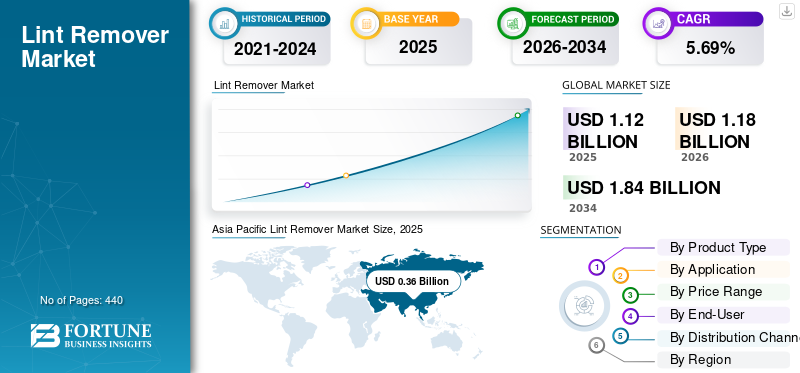
The global lint remover market size was valued at USD 1.12 billion in 2025 and is projected to grow from USD 1.18 billion in 2026 to USD 1.84 billion by 2034, exhibiting a CAGR of 5.69% during the forecast period. Asia Pacific dominated the lint remover market with a market share of 32.14% in 2025.
Lint removers support polyester fabric cleaning by removing lint, fuzz, and surface pills from everyday garments and home textiles. In addition, such products are essentially used by consumers as a hair extraction tool for apparel cleanliness. The increasing consumer emphasis on garment longevity and the rising awareness about sustainable fashion are driving the demand for such garment care appliances. Furthermore, the emergence of fabric lint rollers of eco-conscious designs, including the products of washable & reusable lint rollers, USB charging, smart LED display, and hybrid multi-surface cleaning capabilities, is positively contributing to the global market expansion.
Prominent companies in the global market include 3M, Versuni Holding B.V., Spectrum Brands Holdings, Inc., Groupe SEB S.A., and Conair LLC.
Download Free sample to learn more about this report.
LINT REMOVER MARKET TRENDS
Emergence of Pet-centric Lint and Hair Removers to Favor Market Growth
Standard sticky tape rollers often fail to remove pet hair due to the barbed structures that weave deeply into fabric fibers. Rollers equipped with heavy-duty materials including textured silicone, specialized rubber ridges, and micro-grooved copper or steel rakes embed deeply into the garment fabric and effectively remove pet hairs. The increasing pet humanization and emergence of lint remover formats specifically designed for pet hair removal are driving up product demand across many countries. According to the American Pet Products Association (APPA), as of 2024, around 49 million American households own a cat, compared to 40 million in 2023. In addition, the increasing usage of pet hair removers among the high-traffic pet areas, including velvet couches, micro-fiber car seats, plush carpets, and heavy dog beds, is favoring the global market growth.
MARKET DYNAMICS
MARKET DRIVERS
Download Free sample to learn more about this report.
Advancements in Development of Electric Fabric Shavers to Drive Product Demand
Consumers are upgrading their basic lint removing tool with electric fabric shavers equipped with USB charging, stronger suction capability, larger shaving heads, safety mesh, and detachable lint collectors. The growing product replacement rate is driving the product revenues worldwide. In addition, consistent manufacturers' launch of electric fabric clothing shavers are encouraging consumers to purchase such products, driving the global lint remover market growth. For instance, Philips offers USB-chargeable fabric shavers that exhibit protective fabric shaving heads and a mesh design to remove pills of different sizes effectively.
|
Rank |
Market Drivers |
Overall Impact Rank |
CAGR Contribution (2026-2034) |
Impact 2026-2028 |
Impact 2029-2031 |
Impact 2032-2034 |
|
1 |
Rising demand for garment care and clothing life extension |
High |
+1.85% |
High |
High |
High |
|
2 |
Increasing pet ownership and pet-hair removal needs |
High |
+1.55% |
High |
High |
High |
|
3 |
Growth of rechargeable electric lint removers and fabric shavers |
Medium-High |
+1.35% |
Medium |
High |
High |
|
4 |
Expansion of e-commerce marketplaces and online product discovery |
Medium |
+1.20% |
High |
Medium |
Medium |
|
5 |
Rising use across home textiles, upholstery, and soft furnishings |
Medium |
+0.95% |
Medium |
Medium |
High |
|
6 |
Others (travel-size lint removers, commercial laundry usage, hospitality fabric maintenance, apparel retail use, fashion and tailoring services, product bundling, refill packs, and improved packaging, and so on) |
Low |
+0.70% |
Low |
Low |
Low |
|
|
Total Positive Growth Contribution |
|
+7.60% |
|
|
|
MARKET RESTRAINTS
Battery and Blade Safety Concerns with Electric Lint Removal Products to Restrain Market Growth
Electric fabric shavers with weak blade mesh often cause damage to garment fabric, with little or no risk of injury. Increasing battery and blade safety concerns due to the usage of low-cost, counterfeit rechargeable fabric shavers are restraining the product demand worldwide. In addition, increasing concerns of overheating, short runtime, and charging failure due to such products are hampering the product demand globally.
|
Rank |
Market Restraints |
Overall Impact Rank |
Negative CAGR Contribution (2026-2034) |
Impact 2026-2028 |
Impact 2029-2031 |
Impact 2032-2034 |
|
1 |
High price competition from low-cost and private-label products |
High |
-0.85% |
High |
High |
Medium |
|
2 |
Fabric damage, battery, and blade safety concerns in electric devices |
Medium |
-0.55% |
Medium |
Medium |
Medium |
|
3 |
Environmental concerns over disposable adhesive roller sheets |
Medium |
-0.35% |
Low |
Medium |
High |
|
4 |
Others (low consumer awareness in emerging markets, short product replacement cycles, counterfeit products, weak brand loyalty, and limited differentiation among basic lint rollers and manual lint brushes, and so on) |
Low |
-0.16% |
Low |
Low |
Low |
|
|
Total Negative Growth Impact |
|
-1.91% |
|
|
|
MARKET OPPORTUNITIES
Brands Partnerships with Commercial End-Users that Often Use Multi-unit Roller Packs to Create New Growth Opportunities
Increasing garment appliances’ brand partnerships with commercial end-users, including hospitality settings, apparel retailing outlets, laundry operators, and others that often use multi-unit packs and other high-durability lint roller models, is creating newer market growth opportunities. In addition, consistent brand efforts to broaden the portfolio of sustainable garment care products with commercial-use bulk packs, subscription refills, customized cleaning kits, and private-label lint rollers are augmenting the market growth.
MARKET CHALLENGES
Robust Presence of Unorganized Manufacturers Selling Cheaper-quality Products to Challenge Key Players' Product Sales
The strong presence of unorganized and private-label industry manufacturers selling cheaper-quality products, including adhesive lint rollers, refill packs, manual removers, and lint brushes, is hampering the key players’ product sales, posing challenges to the global industry growth. In addition, the emergence of unorganized online shopping sites offering low-quality products at premium prices is hampering the global market expansion.
Segmentation Analysis
By Product Type
Rechargeable Removers Segment Dominated the Market due to Greater Convenience and Performance over Counterparts
By product type, the market is segmented into manual removers, battery-operated electric removers, rechargeable electric removers, and corded electric removers.
The rechargeable electric removers segment accounted for the leading global lint remover market share of 34.00% in 2025. The segment is projected to grow at the fastest CAGR of 8.70% from 2026 to 2034. Unlike manual removers, rechargeable removers can effectively remove fabric pills, fuzz, and lint more efficiently from sweaters, coats, blankets, upholstery, and other household textiles. In addition, they avoid the need for disposable battery replacement, compared to the battery-operated models. The segment’s leading share is attributed to the perfect balance of convenience, portability, performance, and long-term usability provided by the rechargeable electric removers, compared to the counterpart product types. In addition, the growing consumer accessibility to the rechargeable removers with detachable lint containers options is driving the segment growth.
To know how our report can help streamline your business, Speak to Analyst
The battery-operated electric removers segment is projected to expand at the second-fastest CAGR of 4.40% during 2026-2034. The growing consumer accessibility to the battery-operated models with ergonomic grip, large shaving head, and detachable lint catcher is driving the segment growth.
By Application
Significant Usage of Lint Removal Devices for Garment Maintenance and Life Extension Led to Dominance of Apparel Segment
Based on application, the market is divided into apparel, home textiles, upholstery, soft furnishings, fabric accessories, and other fabric products.
The apparel segment accounted for a leading market share of 55.00% in 2025. The segment is projected to grow at a CAGR of 5.50% from 2026 to 2034. The segment’s leading share is attributed to the significant usage of lint removal devices to remove lint, fuzz, and pilling from the fabric of daily-wear clothing. In addition, increasing consumer emphasis on maintaining garment appearance and garment life extensions to gain control over fast-fashion shopping costs is generating considerable segmental revenues.
The upholstery segment is projected to grow at the fastest CAGR of 6.30% from 2026 to 2034. The increasing usage of reusable pet hair removers, lint rollers, and electric fabric shavers to collect dust and lint from the upholstery surfaces is driving the segment growth.
By Price Range
Better Balance of Affordability, Product Quality, and Durability with Mid-Range Rollers Led to Mid-range Segment’s Dominance
Based on price range, the market is divided into economy, mid-range, and premium.
The mid-range segment garnered a leading market share of 44.00% in 2025. The segment is growing at a CAGR of 5.80% from 2026 to 2034. Compared to the economically produced products, consumers usually prefer products of mid-range price ranges as they need safer blades, stronger motors, and better adhesive strength. In addition, such products are affordable compared to premium products. The segment’s leading share is attributed to the better balance of affordability, product quality, durability, and convenience with mid-range products, compared to the products of counterpart price ranges.
The premium segment is projected to grow at the fastest rate of 7.60% during the forecast period. The growing number of upper-income consumer groups seeking premium-priced, USB-rechargeable electric fabric shavers of ergonomic designs, stainless steel blades, protective mesh, and strong motors is driving the segment expansion.
By End-User
Significant Purchases of Garment Care Appliances among Households for Daily Clothing Maintenance Led to Residential Segment’s Dominance
Based on end-user, the market is divided into residential, commercial laundry & dry cleaning, hospitality, apparel retail, textile & garment manufacturing, and fashion & tailoring services.
The residential segment accounted for a leading market share of 78.00% in 2025. The segment is poised to expand at a CAGR of 5.60% from 2026 to 2034. Significant purchases of garment care accessories for delicate fabrics’ maintenance and longevity purposes are generating considerable revenues from the residential segment. In addition, expanding compact-housing infrastructural facilities seeking innovative electric appliances is driving the segment growth.
The hospitality segment is projected to surge at the fastest rate of 6.80% during the forecast period of 2026-2034. Expanding infrastructure of luxury hotels and motels seeking innovative garment care appliances is driving the segment growth.
By Distribution Channel
Consistent Product Availability at Discounted Rates in E-commerce Stores to Drive E-commerce Marketplaces Segment Growth
Based on distribution channel, the market is divided into e-commerce marketplaces, brand-owned online stores, supermarkets & hypermarkets, department stores, specialty home care stores, electronics & appliance stores, and other offline retail.
The e-commerce marketplaces segment exhibited a leading market share of 38.00% in 2025. The segment is poised to grow at the fastest CAGR of 8.10% from 2026 to 2034. The rising adoption of online shopping for garment care appliances and consistent e-commerce marketplaces' provision of discounted electric fabric shavers are driving the product revenues. In addition, the emergence of shopping applications offering branded bulk packs, combo kits, refill rolls, and discounted multi-unit packs at affordable prices is augmenting the segment growth.
The brand-owned online stores segment is projected to grow at the second-fastest CAGR of 7.30% during the forecast period. The emergence of direct-to-consumers (DTC) brand sites offering premium quality products with doorstep delivery options is driving the segment growth.
Lint Remover Market Regional Outlook
By region, the market is categorized into North America, Europe, Asia Pacific, South America, and the Middle East & Africa.
Asia Pacific
Asia Pacific Lint Remover Market Size, 2025 (USD Billion)
To get more information on the regional analysis of this market, Download Free sample
The Asia Pacific market is projected to grow at the fastest rate of 6.70% from 2026 to 2034. The region held a leading market share of 32.00% and a market size of USD 0.36 billion in 2025. Greater consumer accessibility to manual remover rollers, battery-operated electric fabric shavers, and rechargeable types of lint removing appliances across supermarkets and departmental store settings is generating considerable product revenues across the region. In addition, the rising adoption of e-commerce shopping and an increasing number of brand stores offering premium-based garment care appliances are driving the regional market growth.
China Lint Remover Market
The China market is projected to be one of the largest markets in the Asia Pacific, with revenues of around USD 0.12 billion in 2025, representing roughly 10.40% of global product sales. Lint removing appliances support knitwear maintenance by gently removing fuzz, lint, and pills from sweaters, cardigans, and wool-blend garments. The increasing demand for such products is driving the China market growth.
India Lint Remover Market
The India market stood at around USD 0.047 billion in 2025, accounting for roughly 4.20% of global market revenues.
Japan Lint Remover Market
The Japan market stood at around USD 0.067 billion in 2025, accounting for roughly 6.00% of global revenues.
North America
The North America region held the second-largest global market share of 30.50% in 2025. The regional market is expected to maintain a similar position from 2026 to 2034. The North American market size is estimated to reach USD 0.34 billion by 2026 and is projected to grow at a CAGR of 5.10% during 2026-2034. Significant demand for electric garment care appliances among commercial laundry settings, hotels, and co-living facilities, coupled with increasing consumer preferences for innovative electric fabric shavers, is driving the regional market growth. In addition, the expanding household infrastructural facilities seeking innovative technology-based products are driving product revenues across the region. According to the Canada Real Estate Association, as of the year ended April 2026, the listing of new housing facilities for sale reached 96,083 units, compared to 95,856 during the year ended April 2025.
U.S. Lint Remover Market
The U.S. market size reached USD 0.25 billion in 2025, accounting for around 22.20% of the global sales. The rising pet humanization and increasing demand for pet hair removal devices are driving the product revenues across the U.S.
Europe
The European region is expected to maintain its third-leading market position during the forecast period (2026-2034). The European market size reached USD 0.28 billion in 2025, accounting for approximately 25.00% of global product sales. The regional market is projected to grow at a CAGR of 4.60% during 2026-2034. The increasing construction of hospitality settings seeking innovative garment care appliances is driving the Europe market growth. In addition, consistent garment care product innovations and advancements in the development of fabric shavers, lint rollers, clothes maintenance tools, and reusable cleaning formats are encouraging environmentally conscious consumers to buy such products, driving the European market growth.
U.K. Lint Remover Market
The U.K. market reached around USD 0.045 billion in 2025, representing approximately 4.00% of global sales.
Germany Lint Remover Market
The Germany market reached approximately USD 0.058 billion in 2025, equivalent to around 5.20% of global sales.
Latin America and the Middle East & Africa
The markets in Latin America and the Middle East & Africa are expected to grow at a moderate pace from 2026 to 2034. The Latin American market reached a valuation of USD 0.073 billion in 2025. The significant consumer demand for affordable manual removers, refill packs, reusable lint brushes, and entry-level pet hair removers is generating considerable product revenues across the Latin American region.
The growing laundry care facilities seeking premium-based garment care appliances are driving Middle East & African market growth. In the region, the UAE reached a valuation of USD 0.013 billion in 2025.
South Africa Lint Remover Market
The South African market reached approximately USD 0.011 billion in 2025, accounting for roughly 1.00% of global market revenues.
COMPETITIVE LANDSCAPE
Key Industry Players
Consistent B2B Partnerships and Portfolio Expansion to Help Key Players Maintain their Market Positions
The key players operating in the global market are 3M, Versuni Holding B.V., Spectrum Brands Holdings, Inc., Groupe SEB S.A., and Conair LLC. These players focus on broadening the portfolio of furniture fabric and garment care products to drive the sales of their garment care business category. In addition, they establish strategic partnerships with commercial end-users, including laundry care facilities and hospitality settings, to sell bulk quantities of products and maintain global market positions.
LIST OF KEY LINT REMOVER COMPANIES PROFILED
- 3M (U.S.)
- Versuni Holding B.V. (Netherlands)
- Spectrum Brands Holdings, Inc. (U.S.)
- Groupe SEB S.A. (France)
- Conair LLC (U.S.)
- Bradshaw Home Inc. (U.S.)
- Panasonic Holdings Corporation (Japan)
- Xiaomi Corporation (China)
- Helen of Troy Limited (U.S.)
- SVP Worldwide (U.S.)
KEY INDUSTRY DEVELOPMENTS
- January 2026: William Prym Holding GmbH introduced the Lint Shaver PURE in a retail display format. This initiative expanded Prym’s textile-care range with a new battery-operated lint shaver designed for woollen jumpers, knitwear, and household textiles.
- November 2024: Steamery AB launched a pink-colored Pilo 2 Fabric Shaver and Lint Brush to broaden its garment care product portfolio. These wardrobe care tools are suitable for gifting, fashion-conscious consumers, and premium garment & blanket maintenance.
- June 2024: Nori expanded its original steam-iron product by introducing a fabric shaver, deionized ironing water, and laundry-care These fabric shavers help consumers address lint, fuzz, and pilling removal from garments.
REPORT COVERAGE
The global lint remover market analysis provides an in-depth study of market insights, size, and forecast by business model and all other market segmentation bases included in the report. In addition, the report provides details on the market outlook, market dynamics, and trends expected to drive the market during the forecast period. The market report includes information on technological advancements, new product launches, key industry developments, partnerships, mergers, and acquisitions. The market research report also includes a detailed competitive landscape, with market share and profiles of key players.
Request for Customization to gain extensive market insights.
Report Scope & Segmentation
| ATTRIBUTE | DETAILS |
| Study Period | 2021-2034 |
| Base Year | 2025 |
| Estimated Year | 2026 |
| Forecast Period | 2026-2034 |
| Historical Period | 2021-2024 |
| Growth Rate | CAGR of 5.69% from 2026 to 2034 |
| Unit | Value (USD Billion) |
| Segmentation | By Product Type, Application, Price Range, End-User, Distribution Channel, and Region |
| By Product Type |
|
| By Application |
|
| By Price Range |
|
| By End-User |
|
| By Distribution Channel |
|
| By Geography |
|
Frequently Asked Questions
Fortune Business Insights says that the global market value stood at USD 1.12 billion in 2025 and is projected to reach USD 1.84 billion by 2034.
In 2025, the Asia Pacific market value stood at USD 0.36 billion.
The global market is projected to grow at a CAGR of 5.69% from 2026 to 2034.
By product type, the rechargeable electric removers segment held the leading market share in 2025.
The advancements in the development of electric fabric shavers is a key factor driving the market growth.
3M, Versuni Holding B.V., Spectrum Brands Holdings, Inc., Groupe SEB S.A., and Conair LLC are the leading players in the market.
Asia Pacific dominated the market in 2025.
The increasing brand partnerships with commercial end-users that often use multi-unit roller packs are expected to create new market growth opportunities.



- 2021-2034
- 2025
- 2021-2024
- 440
-
(Offer valid till 15th Sep 2026)
Get 30-60 hrs Free Customization
Expand Regional and Country Coverage, Segments Analysis, Company Profiles, Competitive Benchmarking, and End-user Insights.



















Related Reports
-
US +1 833 909 2966 ( Toll Free )
-
Get In Touch With Us