Liquid Dietary Supplements Market Size, Share & Industry Analysis, By Type (Vitamins, Minerals, Omega Fatty Acids, Proteins & Amino Acids, Herbal & Botanical Supplements, and Others), By Ingredient Source (Plant-Based, Animal-Based, and Others), By Application (General & Health Wellness, Immune Health, Bone & Joint Health, Digestive Health, and Others), By Distribution Channel (Supermarkets/Hypermarkets, Pharmacies & Drug Stores, Specialty Stores, Online Retail, and Others), and Regional Forecast, 2026-2034
 Download Free Sample
(Offer valid till 15th Oct 2026)

Liquid Dietary Supplements Market Size and Future Outlook
 Listen to Audio Version
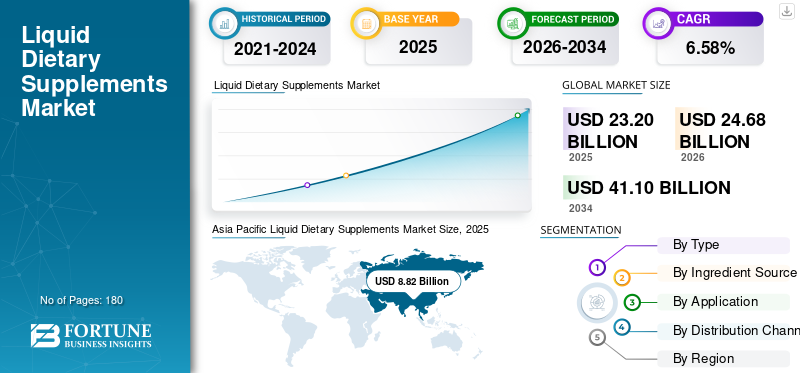
The global liquid dietary supplements market size was valued at USD 23.20 billion in 2025. The market is projected to grow from USD 24.68 billion in 2026 to USD 41.10 billion by 2034, exhibiting a CAGR of 6.58% during the forecast period. Asia Pacific dominated the liquid dietary supplements market with a market share of 38.01% in 2025.
Liquid dietary supplements are drinkable, concentrated liquid products composed of herbs, minerals, and vitamins. These supplements are formulated to support wellness and enhance hydration as compared to tablets/pills. Regarding target end users, liquid health products primarily focus on fitness enthusiasts, athletes, and adolescents. Similar to other dietary supplements, it is also regulated by the Food and Drug Administration (FDA), a government agency, as a food item. A few of the popular forms include shots and drops. Geographically, North America and Europe are the leading consumers, which fuels the demand for liquid dietary supplements.
Companies such as Nestlé Health Science, Unilever plc, and Amway are prominent players in the market. New product launches are a pivotal strategy adopted by key players to improve their position.
Download Free sample to learn more about this report.
Liquid Dietary Supplements Market KEY TAKEAWAYS
 Market Size & Forecast
- 2025 Market Size: USD 23.20 Billion
- 2026 Market Size: USD 24.68 Billion
- 2034 Forecast Market Size: USD 41.10 Billion
- CAGR: 6.58% from 2026-2034
 Market Share
- Asia Pacific holds 38.01% market share.
- Vitamins dominated the market in 2025.
- Plant-based ingredients dominated the market in 2025.
 Key Regional Highlights
Asia Pacific
Asia Pacific holds 38.01% market share, supported by a growing aging population.
North America
North America held the second-largest position, with a market value of USD 6.70 billion in 2025.
Europe
Europe held the third-largest position, valued at USD 5.19 billion in 2025.
U.S.
The U.S. market was valued at USD 5.44 billion in 2025.
Japan
Japan was valued at USD 1.54 billion in 2025, accounting for approximately 6.62% of global market revenues.
Read More

LIQUID DIETARY SUPPLEMENTS MARKET TRENDS
Growing Popularity of Beauty-From-Within Supplements is an Ongoing Trend
The global market is witnessing a remarkable trend towards beauty-from-within supplements. Today, the majority of consumers recognize that overall appearance (skin health and hair strength) is influenced not only by topical cosmetics but also by dietary nutrition status. This sudden awareness has encouraged individuals to gravitate towards liquid formulations comprising components (zinc, vitamins, minerals), linked with aesthetic and dermatological advantages. Incorporation of these ingredients into liquid supplements helps reduce wrinkles and improve skin elasticity. Moreover, it boosts hydration and protects the outer skin layer from environmental damage. Seeing these advantages, companies in the beauty and wellness space are focusing on introducing new beauty and wellness supplements for consumers.
MARKET DYNAMICS
MARKET DRIVERS
Download Free sample to learn more about this report.
Growing Incidences of Micronutrient Deficiencies Fuel the Use of Supplements
The rising awareness of micronutrient deficiencies among global consumers is a key driver of supplement use. High reliance on ultra-processed foods, modern lifestyles, and irregular eating patterns has largely led to inadequate intake of important minerals and vitamins. To fill this nutritional gap, consumers are gravitating towards supplements that are composed of essential nutrients. For instance, individuals are opting for zinc liquid solutions to enhance immune system function. Moreover, iodine supplements are being consumed because they help reduce goiter.
Additionally, folic acid is gaining high popularity in strengthening prenatal health. Additionally, the improved availability of health information via wellness-focused media and medical consultations further boosts awareness. As a result, individuals can easily eliminate numerous chronic diseases through supplementation.
MARKET RESTRAINTS
Shorter Shelf Life of Supplements and Flavor Restrictions Impede the Market's Potential
One of the major difficulties in the global industry is the limited shelf life of supplements. Liquid health products are typically more prone to microbial contamination, oxidation, and degradation than solid forms (capsules and tablets). Most liquid formulations comprise minerals, botanical extracts, and vitamins, which can easily lose potency, especially when exposed to light, temperature fluctuations, and oxygen. To maintain stability, these supplements need cold-chain logistics, additives, and specialized packaging, which can boost distribution and manufacturing costs. Another key challenge in the market is palatability restrictions. The majority of herbal extracts, vitamins, and minerals have bitter or metallic tastes, which are more noticeable in liquids than in solid formats. As a result, the aforementioned factors hamper the global liquid dietary supplements market growth.
MARKET OPPORTUNITY
Technological Advancements in the Supplements Industry Create Growth Possibilities
The use of modern technologies in the supplements industry creates various growth opportunities. To protect nutrients from degradation, producers worldwide are using microencapsulation technologies. This advanced technique creates a barrier that helps maintain stability during transportation and storage. Liposomal technology is another popular technique as it enhances bioavailability and nutrient absorption. Moreover, nanoemulsion technology is being adopted by manufacturers to strengthen the stability and dispersion of fat-soluble components. In addition, firms are incorporating digitally controlled production equipment and formulation systems to assure consistency, specifically in liquid supplements. Besides this, flavor masking technologies are also gaining popularity, further opening several growth opportunities.
Segmentation Analysis
By Type
Vitamins Segment Lead in the Market Owing to Strong Consumer Familiarity
Based on the type, the market is distributed into vitamins, minerals, omega fatty acids, proteins & amino acids, herbal & botanical supplements, and others.
The vitamins segment dominated the market in 2025. Compared to other types, vitamin supplements have been consumed for decades and are the most recognized category in the supplements sector. This form of vitamins allows producers to combine a range of vitamins in a single formulation to cater to various consumer needs. Moreover, it has improved consumer familiarity and has broad application across wide demographic groups, further fueling its consumption rate. As a result, the above-mentioned factors boost the segment's potential.
The others are projected to grow at a high CAGR of 13.20% over the forecast period.
By Ingredient Source
Plant-based Category Dominated the Market Due to Additional Advantages Beyond Traditional Nutrition
Depending on the ingredient source, the market is segmented into plant-based, animal-based, and others.
In 2025, the plant-based category led the global industry. Plant-centric supplements are highly favored by individuals following a vegetarian/vegan diet, unlike animal-sourced ingredients, which don't align with clean-label trends. Compared with microbial or other sources, plants contain a wide range of bioactive compounds, such as carotenoids, polyphenols, and flavonoids, which offer additional advantages beyond traditional nutrition. Moreover, the increasing focus on sustainability and minimal risk of allergens further strengthens its acceptance. Thus, such factors augment the global liquid dietary supplements market growth.
The animal-based segment is projected to grow at a CAGR of 5.86% over the forecast period.
To know how our report can help streamline your business, Speak to Analyst
By Application
General Health & Wellness Led the Market Owing to Broader Nutritional Support
Based on application, the market is distributed into general health & wellness, immune health, bone & joint health, digestive health, and others.
General health & wellness dominated the global industry in 2025. Today, most consumers are opting for liquid supplements to enhance their overall health and wellness. The products formulated for wellness include a range of ingredients that can target several health concerns, unlike bone health and heart health-centric supplements. Additionally, the surging emphasis on proactive health management is another factor that increases dependence on health-promoting supplements.
The digestive health segment is projected to grow at a high CAGR of 9.84% over the forecast period.
By Distribution Channel
Pharmacies & Drug Stores Lead the Market Owing to Consumer Trust
Depending on the distribution channel, the market is divided into supermarkets/hypermarkets, pharmacies & drug stores, specialty stores, online retail, and others.
In 2025, the pharmacies & drug stores led the global industry. This channel gains huge benefit with respect to credibility as it is associated with healthcare practitioners. The proximity of drug stores is another factor that increases the reliance of customers. Moreover, these outlets follow supply chain controls and regulatory standards, assuring the products they sell are of high quality. Additionally, the wide range of medicinal brands for specific health concerns further bolsters the segment's potential.
The online retail is projected to grow at a high CAGR of 8.50% over the forecast period.
Liquid Dietary Supplements Market Regional Outlook
By region, the market is categorized into Europe, North America, Asia Pacific, South America, and the Middle East & Africa.
Asia Pacific
Asia Pacific Liquid Dietary Supplements Market Size, 2025 (USD Billion)
To get more information on the regional analysis of this market, Download Free sample
The Asia Pacific region dominates globally and reached a valuation of USD 8.82 billion in 2025. The growing aging population and increasing consumer awareness of raw material/natural ingredients are key factors boosting the region's potential. In the region, India and China were accounted for USD 1.70 billion and USD 3.37 billion, respectively, in 2025.
India Liquid Dietary Supplements Market
The Indian market in 2025 reached a valuation of USD 1.70 billion, accounting for roughly 7.33% of the global market revenues.
The flourishing liquid dietary supplements industry and strong focus on weight management solutions are driving factors in the market.
China Liquid Dietary Supplements Market
China's market is projected to be one of the largest worldwide, reached a valuation of USD 3.37 billion in 2025, accounting for roughly 14.51% of global market sales.
Japan Liquid Dietary Supplements Market
The Japanese market in 2025 reached a value of USD 1.54 billion, accounting for approximately 6.62% of the global market revenues.
North America
The North America market reached a valuation of USD 6.70 billion in 2025 and holds the second position globally. The market in North America is expected to grow due to increasing consumer awareness of health claims and rising demand for natural ingredients and enriched food and beverage products. Moreover, the new product launches and improved infrastructure are driving regional growth.
U.S. Liquid Dietary Supplements Market
Based on North America's strong contribution and the U.S. dominance within the region, the U.S. market was valued at around USD 5.44 billion in 2025, accounting for roughly 23.46% of global sales.
Europe
Europe was valued at USD 5.19 billion in 2025, recording a growth rate of 6.40% in the coming years, and secured the third position. The rising older adult population and increasing awareness of health promoting products are propelling the region's potential.
Germany Liquid Dietary Supplements Market
The Germany market in 2025 reached a valuation of USD 1.09 billion, representing roughly 4.70% of the global market revenues.
U.K. Liquid Dietary Supplements Market
The U.K market reached a value of USD 0.88 billion in 2025, equivalent to around 3.79% of the global market sales.
South America, the Middle East, and Africa
The South America and Middle East & Africa regions are expected to witness moderate growth in this market space during the forecast period. The South America market reached a valuation of USD 1.54 billion in 2025. The growing number of online retailers and the surging demand for nutritional supplements are expected to drive demand. The Middle East and Africa market was accounted for USD 0.95 billion in 2025.
South Africa Liquid Dietary Supplements Market
The South Africa market was accounted for USD 0.43 billion in 2025, representing roughly 1.85% of global revenues.
COMPETITIVE LANDSCAPE
Key Industry Players
New Product Launches Help the Firms to Improve Their Market Position
The market exhibits a fragmented structure, with intense competition among market players operating in this segment. In this market, the key companies are primarily adopting new product launches as the main strategy. Via this approach, players can cater to rising consumer demands and enhance their brand image.
LIST OF KEY LIQUID DIETARY SUPPLEMENTS COMPANIES PROFILED
- Amway (U.S.)
- Herbalife Nutrition Ltd. (U.S.)
- USANA Health Sciences (U.S.)
- Salus Haus GmbH & Co. KG (Germany)
- Procter & Gamble (U.S.)
- Nestlé Health Science (Switzerland)
- MaryRuth Organics (U.S.)
- Orthomol Holding GmbH (Germany)
- Nature's Way Products LLC (U.S.)
- Unilever plc (India)
KEY INDUSTRY DEVELOPMENTS
- March 2026 – IntroDrink, an online retailer of health products in Switzerland, expanded its portfolio of mineral supplement drinks to address nutritional gaps.
- July 2025 – Vytanutra, a Californian vitamin and mineral supplements producer, introduced LiqLutein, a liquid supplement that is produced to enhance visual wellness.
- March 2025 – New Chapter, a subsidiary of a U.S.-based company, Procter & Gamble, announced the launch of its liquid multivitamin for American children and adults. The supplement is available in two flavor variants; mixed berry and orange.
- January 2025 – Unilever plc, an Indian consumer goods enterprise, revealed liquid I.V. across the Indian market. This launch targets the premium segment and competes directly with energy and sports drinks.
- March 2023 – Child Life Essentials, an American brand of children's supplements, released an organic elderberry liquid supplement, free of synthetic colors and additives.
REPORT COVERAGE
The global liquid dietary supplements market provides an in-depth study of the market size & forecast by all the market segments included in the market reports. The global market forecast analysis includes details on the market dynamics and global market trends expected to drive the market during the forecast period. The global market analysis offers information on the technological advancements, new product launches, key industry developments, and details on partnerships, mergers & acquisitions. The industry forecast also encompasses a detailed competitive landscape with information on the market segmentation, market share, and profiles of key operating players.
Request for Customization to gain extensive market insights.
Report Scope & Segmentation
| ATTRIBUTE | DETAILS |
| Study Period | 2021-2034 |
| Base Year | 2025 |
| Estimated Year | 2026 |
| Forecast Period | 2026-2034 |
| Historical Period | 2021-2024 |
| Growth Rate | CAGR of 6.58% from 2026-2034 |
| Unit | Value (USD Billion) |
| Segmentation | By Type, Ingredient Source, Application, Distribution Channel, Region |
| By Type |
|
| By Ingredient Source |
|
| By Application |
|
| By Distribution Channel |
|
| By Region |
|
Frequently Asked Questions
Fortune Business Insights says that the global market value stood at USD 23.20 billion in 2025 and is projected to reach USD 41.10 billion by 2034.
In 2026, the market value stood at USD 9.51 billion.
The market is expected to exhibit a CAGR of 6.58% during the forecast period of 2026-2034.
By ingredient source, the plant-based segment led the global market in 2025.
Growing incidences of micronutrient deficiencies fuel the use of supplements.
Nestle Health Science, Unilever plc, and Amway are among the key players in the market.
Asia Pacific held the largest market share in 2025.
The growing popularity of beauty-from-within supplements is an ongoing trend.



- 2021-2034
- 2025
- 2021-2024
- 180
-
(Offer valid till 15th Oct 2026)
Get 30-60 hrs Free Customization
Expand Regional and Country Coverage, Segments Analysis, Company Profiles, Competitive Benchmarking, and End-user Insights.



















Related Reports
-
US +1 833 909 2966 ( Toll Free )
-
Get In Touch With Us