Low-Cost Satellite Market Size, Share & Industry Analysis, By Type (Minisatellite, Microsatellite, and Nanosatellite), By Application (Earth Observation, Communication, Navigation, Scientific Research, and Others), and 28V DC), By Component (Telemetry, Tracking and Command, Power System, Propulsion System, Command & Data Handling, and Others), By End Use (Civil & Commercial, and Government & Military) and Regional Forecast, 2026-2034
 Download Free Sample
KEY MARKET INSIGHTS
 Listen to Audio Version
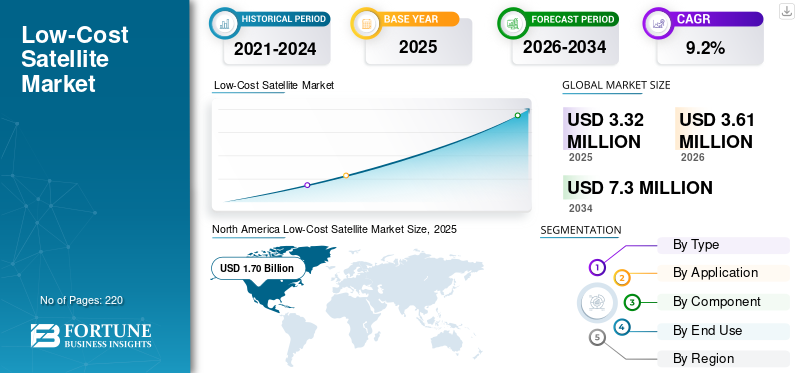
The global low-cost satellite market size was valued at USD 3.32 billion in 2025. The market is projected to grow from USD 3.61 million in 2026 to USD 7.30 billion by 2034, exhibiting a CAGR of 9.2% during the forecast period. North America dominated the global low-cost satellite market with a market share of 51.20% in 2025.
The global low cost satellite market is expected to grow significantly due to rising deployment of small satellites for commercial services, increasing demand for frequent Earth observation updates, and wider adoption of constellation based architectures. Low cost satellites benefit from standardized platforms, higher use of commercial off the shelf electronics, shorter development cycles, and repeatable manufacturing approaches that reduce unit cost and delivery time. In addition, government and defense programs are increasingly favoring resilient architectures that use larger numbers of smaller satellites, which supports sustained demand for cost optimized spacecraft production.
For instance, multiple government programs are shifting toward proliferated low Earth orbit constellations for missile warning, tactical communications, and surveillance, where affordability and production scale matter as much as peak performance.
Key players are focusing on innovations such as modular satellite buses, software defined payloads, higher onboard autonomy, and production line manufacturing methods to support faster delivery and lower mission costs.
Download Free sample to learn more about this report.
Low-Cost Satellite Market Takeaways
 Global Market Size & Forecast
- 2025 Market Size: USD 3.32 billion
- 2026 Market Size: USD 3.61 billion
- 2034 Forecast Market Size: USD 7.30 billion
- CAGR: 9.20% from 2026–2034
 Market Share
- North America dominated the low-cost satellite market with a 51.20% share in 2025.
- The Minisatellite segment is expected to hold the largest market share, supported by the market's 9.20% CAGR during 2026–2034.
- The Civil & Commercial segment is projected to maintain the leading market share due to rising deployment of communication and Earth observation constellations.
 Key Regional Highlights
North America
North America led the global market with USD 1.70 billion in 2025 and is projected to reach USD 1.84 billion in 2026, driven by strong investments in commercial satellite constellations and space technologies.
Europe
Europe is expected to record a 9.8% CAGR from 2026–2034, supported by increasing investments in satellite communications, Earth observation, and space research initiatives.
Asia Pacific
Asia Pacific emerged as the second-largest regional market with USD 0.86 billion in 2025, driven by growing satellite programs and increasing investments from China and India.
U.S.
The market was valued at approximately USD 1.64 billion in 2025, supported by the country's strong commercial space ecosystem and government-backed satellite programs.
Japan
The market was estimated at approximately USD 0.08 billion in 2025, accounting for around 2.4% of global revenue, driven by continued investments in satellite technology and space innovation.
Read More

LOW-COST SATELLITE MARKET TRENDS
Shift Toward Standardized Platforms and High Rate Manufacturing is a Prominent Trend Observed in Market
The market is moving toward standardized satellite platforms designed for repeatable production and quicker integration of payloads. Operators are prioritizing faster technology refresh cycles to improve imaging quality, communications throughput, and onboard processing without waiting for long spacecraft development timelines. This trend is strengthening demand for modular architectures, common avionics stacks, and design to cost subsystems, especially in low Earth orbit constellations.
Download Free sample to learn more about this report.
MARKET DYNAMICS
MARKET DRIVERS
Rise in Constellation Deployment and Demand for Frequent Coverage is Expected to Drive Market Growth
A primary driver for the low cost satellite market is the expansion of constellations across communications, Earth observation, and IoT connectivity, where service delivery depends on deploying many satellites and maintaining consistent replenishment. Frequent revisit requirements in Earth observation, along with the need for expanded connectivity coverage, are increasing procurement of cost optimized satellite platforms. In parallel, defense and security users are investing in distributed space architectures to improve mission resilience, which further supports low-cost satellite market growth.
MARKET RESTRAINTS
Regulatory and Compliance Requirements to Limit Market Expansion
A primary restraint for the low cost satellite market is the regulatory and compliance burden related to licensing, spectrum coordination, and orbital debris mitigation. Even when satellites are designed to be affordable, operators must meet licensing obligations and demonstrate responsible operations, including end of life disposal plans. These requirements can add time, cost, and complexity, especially for new entrants and for missions operating in congested orbital regions.
MARKET OPPORTUNITIES
Growing Adoption of Hosted Payload and Service Based Models Presents Growth Opportunities for Market Growth
An important opportunity is the growing use of hosted payloads and service based procurement models, where customers purchase mission capability rather than owning and operating the full spacecraft. This approach lowers upfront costs, reduces schedule risk, and allows faster access to orbit for government, research, and commercial users. In addition, demand is rising for dedicated low cost missions for technology demonstration and rapid validation of new sensors and communications payloads, which supports recurring procurement of standardized satellite platforms.
MARKET CHALLENGES
Orbital Congestion and Sustainability Requirements Acts a Challenge for Market
A major challenge for the low cost satellite market is operating responsibly at scale. As satellite numbers increase, the complexity of collision avoidance, tracking, coordination, and deorbit compliance also increases. Operators must invest in mission assurance, space situational awareness, and sustainability measures, which can pressure the cost advantage if not planned early in the design and operations model.
Segmentation Analysis
By Type
Standardized Platforms and Constellation Scale-Up to Propel Segmental Growth
Based on the type, the market is divided into minisatellite, microsatellite, and nanosatellite.
The minisatellite segment is anticipated to account for the largest low-cost satellite market share. The growth is driven by its strong fit for constellation missions requiring higher payload power, longer design life, and more capability per satellite while still staying within cost optimized manufacturing approaches. Minisatellites also support a wider range of payload classes in communications and Earth observation, which improves revenue potential and drives higher adoption.
The nanosatellite segment is anticipated to rise with a CAGR of 11.0% over the forecast period.
To know how our report can help streamline your business, Speak to Analyst
By Application
Rising Demand for Persistent Coverage and Faster Revisit to Propel Segmental Growth
Based on application, the market is segmented into earth observation, communication, navigation, scientific research, and others.
The communication segment is anticipated to account for the largest market share, due to the strong expansion of LEO based connectivity services and growing demand for broadband and specialized communication links. Low cost satellites enable operators to deploy larger fleets with shorter replacement cycles, which supports better coverage continuity and capacity expansion while keeping overall program cost under control.
The earth observation segment is projected to grow at a steady annual growth rate of 10.4% over the forecast period.
By Component
High Use of Commercial Off-The-Shelf Subsystems and Modular Architectures Push Segment Growth
Based on component, the market is segmented into telemetry, tracking and command, power system, propulsion system, command & data handling, and others.
The telemetry, tracking and command segment is anticipated to account for the largest market share, driven by the need for reliable communications links for constellation operations, command uplinks, and health monitoring across large satellite fleets. As satellite numbers increase, operators prioritize robust and scalable TT&C solutions to ensure continuous control, reduce downtime, and support automated fleet management, which directly supports segment growth.
The propulsion system segment is expected to grow with a fastest growth rate of 10.7% over the forecast period.
By End Use
Growing Constellation Procurement and National Space Capability Expansion Fuel Segment Growth
Based on end use, the market is segmented into civil & commercial and government & military.
The civil & commercial segment is expected to hold the highest market share in 2025. The factors attributing to segment growth are increasing commercial deployment of communication and Earth observation constellations, rising demand for satellite data services, and wider use of cost optimized spacecraft for faster mission execution. Commercial operators prefer low cost satellites as they enable scalable fleet expansion, faster replacement, and lower risk per satellite, improving overall business economics.
The government & military segment is projected to grow with a steady growth rate at a CAGR of 8.7% over the forecast period.
Low-Cost Satellite Market Regional Outlook
By region, the market is segmented into North America, Europe, Asia Pacific, Latin America, and the Middle East & Africa.
North America
North America Low-Cost Satellite Market Size, 2025 (USD Billion)
To get more information on the regional analysis of this market, Download Free sample
North America dominated the market in 2025 with a valuation of USD 1.70 billion, growing to USD 1.84 billion in 2026, driven by strong demand for small satellites across commercial communications, Earth observation, and defense resilient space architectures. The U.S. dominates due to active procurement of standardized satellite platforms, rapid constellation deployments, and continued investments in LEO based capabilities for broadband, surveillance, and tactical applications. Adoption accelerates as manufacturers scale production lines, increase modularity, and shorten delivery cycles for cost optimized missions.
U.S Low-Cost Satellite Market
Based on North America’s strong contribution and the U.S. dominance within the region, the U.S. market can be approximated at around USD 1.64 billion in 2025. Growth is supported by rising deployment of small satellites for constellation refresh and the use of high rate manufacturing approaches to reduce cost per satellite. The U.S. government continues to encourage proliferated LEO approaches for resilience and faster capability updates.
Europe
Europe is projected to record a growth rate of 9.8% during 2026 to 2034, which is the second highest among all regions. The market in the region grows due to expanding demand for sovereign Earth observation, secure communications, and stronger interest in commercial space services supported by national and regional programs. Countries such as the U.K., France, and Germany are increasing investment in small satellite missions and constellation concepts to improve coverage, revisit performance, and strategic autonomy. Regional manufacturers are also focusing on modular satellite buses and faster integration to reduce mission timelines and improve affordability.
U.K Low-Cost Satellite Market
The U.K. market in 2025 is estimated at around USD 0.10 billion, representing roughly 3.2% of global low-cost satellite revenues.
France Low-Cost Satellite Market
The France market is projected to reach approximately USD 0.12 billion in 2025, equivalent to around 3.5% of global low-cost satellite sales.
Asia Pacific
Asia Pacific is estimated to reach USD 0.86 billion in 2025 and secure the position of the second-largest region in the market. In the region, India and China are both estimated to reach USD 0.13 billion and USD 0.52 billion, respectively in 2025. The Asia Pacific market grows rapidly due to expanding national space programs, rising demand for Earth observation and communications capacity, and growing interest in deploying constellations for government and commercial services. Moreover, strong manufacturing ecosystems and increasing focus on self-reliance in space capabilities support development of standardized, cost optimized satellite platforms across the region.
Japan Low-Cost Satellite Market
The Japan market in 2025 is estimated at around USD 0.08 billion, accounting for roughly 2.4% of global low-cost satellite revenues.
China Low-Cost Satellite Market
China’s market is projected to be one of the largest worldwide, with 2025 revenues estimated at around USD 0.57 billion, representing roughly 15.5% of global low-cost satellite sales.
India Low-Cost Satellite Market
The India market in 2025 is estimated at around USD 0.13 billion, accounting for roughly 4.0% of global low-cost satellite revenues.
Latin America and the Middle East & Africa
Latin America and the Middle East & Africa regions are expected to witness moderate growth in this market space during the forecast period. The Latin America market is set to reach a valuation of USD 0.09 billion in 2025, driven by rising demand for cost efficient Earth observation for agriculture, disaster monitoring, environmental monitoring, and infrastructure planning, particularly in Brazil and Mexico. Growing interest in connectivity programs and public sector satellite data use also supports demand for affordable satellite missions. In the Middle East & Africa region, increasing investment in national space programs, early stage constellation initiatives, and demand for Earth observation and communications services support adoption of low cost satellite platforms.
Saudi Arabia Low-Cost Satellite Market
The Saudi Arabia market is projected to reach around USD 0.04 billion in 2025, representing roughly 1.3% of global low-cost satellite revenues.
COMPETITIVE LANDSCAPE
Key Industry Players
Focus on Multi-Band Jamming and C-UAS Integrations by Key Players to Propel Market Progress
The global low cost satellite market remains competitive and is increasingly shaped by players that can deliver reliable satellites at scale through standardized platforms and repeatable manufacturing methods. Key companies are focusing on modular satellite buses, faster payload integration, higher onboard autonomy, and software defined capabilities to reduce time to deployment and improve affordability. In addition, many players are strengthening partnerships with launch providers, component suppliers, and downstream service operators to support end to end constellation execution and quicker replenishment cycles.
Other prominent players are prioritizing scalable production, mission flexibility, and system level integration to serve commercial communications, Earth observation, and government resilience requirements.
LIST OF KEY LOW-COST SATELLITE COMPANIES PROFILED
- Airbus (Europe)
- Thales Alenia Space (France)
- Lockheed Martin (U.S.)
- Northrop Grumman (U.S.)
- Boeing (U.S.)
- L3Harris Technologies (U.S.)
- Raytheon Technologies (U.S.)
- Maxar Technologies (U.S.)
- Sierra Space (U.S.)
- OHB SE (Germany)
- Planet Labs (U.S.)
KEY INDUSTRY DEVELOPMENTS
- December 2025: U.S. Space Development Agency (SDA) announced awards totaling USD 3.5 billion to Lockheed Martin, L3Harris, Northrop Grumman, and Rocket Lab to build 72 Tracking Layer Tranche 3 satellites for its proliferated LEO architecture.
- December 2025: Rocket Lab announced it was awarded a USD 816 million prime contract to design and manufacture 18 satellites for SDA’s Tracking Layer Tranche 3 program.
- February 2025: MDA Space and Globalstar announced a definitive contract valued at approximately USD 1.1 billion for MDA to manufacture more than 50 software defined digital satellites for Globalstar’s next generation LEO constellation.
- January 2025: Planet Labs announced a multi-year USD 230 million commercial agreement to build and deliver Pelican high resolution satellites for a long standing Asia Pacific commercial partner.
- December 2024: Airbus Defense and Space and Eutelsat Group announced a contract for Airbus to build the first batches of OneWeb constellation extension satellites totaling 100 spacecraft, supporting continuity and expansion of LEO services.
Request for Customization to gain extensive market insights.
Report Scope & Segmentation
|
ATTRIBUTE |
DETAILS |
|
Study Period |
2021-2034 |
|
Base Year |
2025 |
|
Estimated Year |
2026 |
|
Forecast Period |
2026-2034 |
|
Historical Period |
2021-2024 |
|
Growth Rate |
CAGR of 9.2% from 2026-2034 |
|
Unit |
Value (USD Billion) |
|
Segmentation |
By Type, Application, Component, End Use, and Region |
|
By Type |
· Minisatellite · Microsatellite · Nanosatellite |
|
By Application |
· Earth Observation · Communication · Navigation · Scientific Research · Others |
|
By Component |
· Telemetry · Tracking and Command · Power System · Propulsion System · Command & Data Handling · Others |
|
By End Use |
· Civil & Commercial · Government & Military |
|
By Region |
· North America (By Type, By Application, By Component, By End Use, and Country) o U.S. (By End Use) o Canada (By End Use) · Europe (By Type, By Application, By Component, By End Use, and Country) o U.K. (By End Use) o Germany (By End Use) o France (By End Use) o Russia (By End Use) o Rest of Europe (By End Use) · Asia Pacific (By Type, By Application, By Component, By End Use, and Country) o China (By End Use) o Japan (By End Use) o India (By End Use) o South Korea (By End Use) o Rest of Asia Pacific (By End Use) · Latin America (By Type, By Application, By Component, By End Use, and Country) o Brazil (By End Use) o Mexico (By End Use) o Rest of Latin America( By Aircraft Type) · Middle East & Africa (By Type, By Application, By Component, By End Use, and Country) o UAE (By End Use) o Saudi Arabia (By End Use) o Rest of the Middle East & Africa (By End Use) |
Frequently Asked Questions
According to Fortune Business Insights, the global market value stood at USD 3.32 billion in 2025 and is projected to reach USD 7.30 billion by 2034.
In 2024, the market value stood at USD 1.70 billion.
The market is expected to exhibit a CAGR of 9.2% during the forecast period.
By end use, the civil & commercial segment is expected to lead the market.
The rise in constellation deployment and demand for frequent coverage are driving market expansion.
Airbus (Europe), Thales Alenia Space (Europe), Lockheed Martin (U.S.), and Northrop Grumman, among others are some of the major players in the global market.
North America dominated the market in 2025.



- 2021-2034
- 2025
- 2021-2024
- 220
Get 30-60 hrs Free Customization
Expand Regional and Country Coverage, Segments Analysis, Company Profiles, Competitive Benchmarking, and End-user Insights.




















Related Reports
-
US +1 833 909 2966 ( Toll Free )
-
Get In Touch With Us