Magnesium Oxide Nanoparticles Market Size, Share & Industry Analysis, By Particle Size (Less than 30 nm, 30 nm to 50 nm, and More than 50 nm), By Purity (99.0%, 99.9%, and Above 99.9%), By End Use (Refractory, Chemical, Electrical & Electronics, Healthcare, Environmental, and Others), and Regional Forecast, 2026-2034
 Download Free Sample
KEY MARKET INSIGHTS
 Listen to Audio Version
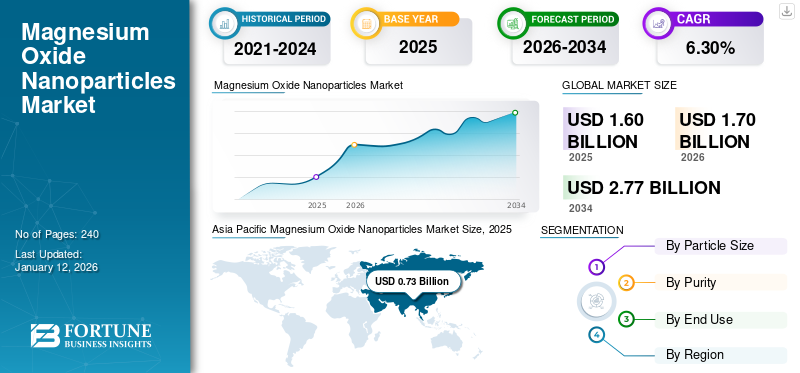
The global magnesium oxide nanoparticles market size was valued at USD 1.6 billion in 2025. The market is projected to grow from USD 1.7 billion in 2026 to USD 2.77 billion by 2034, exhibiting a CAGR of 6.30% during the forecast period. Asia Pacific dominated the magnesium oxide nanoparticles market with a market share of 45% in 2025.
Magnesium oxide (MgO) nanoparticles are tiny particles, typically ranging between 1 and 100 nanometers in size, which are composed of magnesium and oxygen atoms. They are characterized by their unique physical, chemical, and electronic properties due to their nanoscale dimensions and high surface area. Their unique properties, such as high thermal stability, excellent dielectric properties, and enhanced surface area-to-volume ratio, have made the MgO nanoparticles a choice of material in many applications.
MgO nanoparticles are drawing significant interest compared to other nanoparticles commonly utilized across similar application areas, as they are considered more versatile and offer high chemical stability. In addition to their exceptional properties, they exhibit a good balance of biocompatibility, non-toxicity, and stability, making them attractive for various biomedical applications. The growing biomedical industry is fueling the demand for innovative materials, which is anticipated to increase market growth.
American Elements, Anhui Fitech Materials Co., Ltd., Inframat Corporation, Merck KGaA, and Nanografi Advanced Materials are identified as a few key players in the market. The companies are investing in research and development to innovate bio-based methods to produce nanoparticles of MgO.
Download Free sample to learn more about this report.
Magnesium Oxide Nanoparticles Market Key Takeaways
 Global Market Size & Forecast
- 2025 Market Size: USD 1.6 billion
- 2026 Market Size: USD 1.7 billion
- 2034 Forecast Market Size: USD 2.77 billion
- CAGR: 6.30% from 2026-2034
 Market Share
- Asia Pacific dominated the magnesium oxide nanoparticles market with a 45.00% share in 2025.
- The 30 nm to 50 nm particle size segment is projected to lead the market in 2026.
- The 99.9% purity segment is projected to dominate the market in 2026.
 Key Regional Highlights
Asia Pacific
Asia Pacific accounted for USD 0.73 billion in 2025 and is projected to reach USD 0.77 billion in 2026.
North America
North America reached USD 0.38 billion in 2025 and is expected to grow to USD 0.40 billion in 2026.
Europe
Europe recorded USD 0.34 billion in 2025 and is projected to reach USD 0.36 billion in 2026.
U.S.
Rising demand for advanced nanomaterials in healthcare, electronics, and industrial applications is supporting market growth.
Japan
The market is projected to reach USD 0.13 billion in 2026.
Read More

MARKET DYNAMICS
MARKET DRIVERS
Growing Demand for Advanced Materials in Refractories to Boost Market Growth
As industries seek to increase equipment efficiency, productivity, and lifespan, they require advanced materials with improved performance characteristics. The expansion and modernization of industries such as steel, cement, glass, and petrochemicals are increasing the demand for advanced, efficient, and sustainable refractories. The increasing demand for modern refractories spurs the adoption of new refractory materials with improved properties. MgO nanoparticles offer improved properties such as thermal resistance and resistivity to thermal shock, making them valuable in refractory applications including steelmaking, glass manufacturing, and high-temperature furnaces. Therefore, the growing demand for advanced materials in refractories will boost the global magnesium oxide nanoparticles market growth during the forecast period.
MARKET RESTRAINTS
Nanoparticle's Potential Toxic Environmental Impact and Safety Concerns May Hamper Market Growth
Though nanoparticle is the new talk of the town, it is not adopted much due to concerns about their potential toxicity and environmental impact. While they offer unique properties and potential benefits, the relatively unknown effects of nanoparticle exposure and their potential for environmental persistence and accumulation have raised significant safety questions. According to the document published by the National Library of Medicine, engineered nanoparticles can be more toxic than larger particles as they can move more freely than bulkier molecules. There is also a possibility that these nano-sized compounds interact with metabolic networks and cellular constituents, which may result in unknown effects. In addition, nanowastes could be extremely hazardous and chemically reactive, which makes safe handling and disposal more stringent compared to normal bulk-sized compounds. The aforementioned fearful facts, safety concerns, and complex handling & waste management process may limit the rapid adoption of MgO nanoparticles.
MARKET OPPORTUNITIES
Growing Demand in Wide Application Areas from Chemical Industry to Create Lucrative Opportunities
MgO nanoparticles are used in various chemical industry applications due to their unique properties, including high surface area, thermal and chemical stability, and biocompatibility. One of the important functions of the chemical compound is its efficacy in enhancing catalytic reactions due to its large surface area, which provides more sites for chemical reactions. As a result, they are used in various catalytic processes, including oxidation, reduction, and acid-base catalysis. In addition to catalysts, it is also utilized as a high-temperature dehydrating agent in various manufacturing processes, especially in producing silicon steel sheets, high-grade ceramic materials, and electronic industry materials. In addition, the chemical compound is utilized as a raw material, a fire retardant, and a fuel additive. Therefore, the growing demand in wide application areas from the chemical industry is set to create lucrative opportunities in the market.
MAGNESIUM OXIDE NANOPARTICLES MARKET TRENDS
Trend of Bio-based Materials and Momentum Towards Sustainability to Drive Market Growth
The increasing use of bio-based materials, alongside the trend toward sustainable solutions, will significantly drive the demand for magnesium oxide nanoparticles. This is because nanoparticles of MgO can be effectively synthesized using plant, fungal, bacterial, and algal extracts, making them a viable and sustainable alternative to traditional chemical synthesis methods. The use of bio-based materials for synthesizing nanoparticles of MgO, often referred to as "green synthesis," is gaining prominence due to its eco-friendly nature. This method makes them ideal for biomedical applications, such as drug delivery, tissue engineering, and antimicrobial agents, further driving their demand. Production of bio-based MgO nanoparticles will expand its adoption scope in many application areas, such as agriculture for seed priming and plant growth, medicine for antimicrobial and anticancer, and environmental remediation for heavy metal removal. This versatility will drive their adoption across different industries, bolstering demand further.
Download Free sample to learn more about this report.
IMPACT of COVID-19
The COVID-19 pandemic has adversely impacted business operations in numerous ways, including the temporary suspension of production, which caused disruptions in the supply chain. Lockdown measures have hampered production operations in refractory, chemical, ceramics, paints, and coatings. These industries are identified as prominent end-use industries of MgO nanoparticles, and reduced production activity in these industries affected the market negatively in 2020. However, end-use areas such as healthcare and electronics created moderate demand for the product, offsetting the reduced demand from other end-use industries.
Segmentation Analysis
By Particle Size
30 nm to 50 nm Particle Size Dominated Owing to Its Wide Adoption and Cost Effectiveness
On the basis of particle size, the market is segmented into less than 30 nm, 30 nm to 50 nm, and more than 50 nm.
In 2026, the 30 nm to 50 nm particle size segment is projected to lead the market with a 0.06% share. This particle size is widely adopted and dominant due to its wide adoption and cost-effectiveness compared to other particle sizes. Also, this range exhibits good stability, even under abrupt environmental conditions, which is crucial for their use in various applications. The range offers high adsorption of pollutants from water and air at a cost-effective price. Less than 30 nm particle size is more expensive than a mid-range particle.
Less than 30 nm particle size is poised to grow significantly during the forecast period due to higher surface energy and enhanced ionic character. The small size of MgO nanoparticles significantly increases their surface area-to-volume ratio, enhancing their ability to interact with other molecules and substances. This is crucial for applications such as catalysis and adsorption, where a larger surface area allows for more active reaction sites. As a result, the less than 30 nm particle size is anticipated to experience the fastest growth in the foreseen period.
By Purity
99.9% Purity Leads Due to High Utilization in Chemical & Healthcare Industries
Based on purity, the market is segregated into 99.0%, 99.9%, and above 99.9%.
The 99.9% purity segment is projected to dominate the market with a share of 0.05% in 2026 and will likely continue its dominance during the forecast timeframe. 99.9% purity MgO nanoparticles are widely utilized in various industries due to their exceptional properties and versatility. Their high purity ensures reliable performance, while the nanoscale size enhances their reactivity and surface area, leading to wide adoption in chemical and healthcare. MgO nanoparticles can improve fuel efficiency and prevent corrosion in various materials. The nanoparticles have antibacterial properties and can be incorporated into dental materials to enhance their antibacterial effectiveness. With such huge utilization in chemical and healthcare, 99.9% pure MgO nanoparticle is set to remain the primary choice in the market.
In addition, the increasing use of high-purity (above 99.9%) MgO nanoparticles is driven by their versatile properties and applications in various fields, including biomedical, material science, and catalysis. Specifically, MgO nanoparticles, with their unique characteristics, are gaining popularity due to their antimicrobial, antioxidant, and anticancer properties. Their biocompatibility and stability further enhance their utility in biomedical applications such as drug delivery, tissue engineering, and bioimaging. Additionally, MgO nanoparticles are being explored for their potential to enhance materials' mechanical and barrier properties, making them valuable in nanocomposite applications. Such exceptional properties and growing demand from specialty applications will drive the segment's growth significantly during the forecast period.
By End Use
To know how our report can help streamline your business, Speak to Analyst
Refractory Segment Dominated the Market Owing to Growing Demand for Advanced Materials
Based on end use, the market is segmented into refractory, chemical, electrical & electronics, healthcare, environmental, and others.
The refractory segment is expected to lead the market, contributing 0.03% globally in 2026. Due to modernization, there is a growing demand for advanced materials in refractories, and governments call to upgrade their existing production facilities to meet sustainability goals. Companies including EPRUI Nanoparticles & Microspheres and Konada New Materials Technology Company offer nano-sized materials for refractory applications. Such a scenario paves the growth trajectory for MgO nanoparticles, which will assist the refractory segment to remain dominant during the assessment period.
The electrical and electronics segment is anticipated to showcase significant growth, owing to the material's high thermal stability, electrical insulation, and ability to act as a heat sink. MgO nanoparticles are used in various applications such as capacitors, resistors, and semiconductors, making them ideal for modern electronic devices. With megatrends including AI and hyper data centers, electronics are set to expand, boosting the demand for MgO nanomaterials.
Another important application area is healthcare, which is utilized for biomedical and drug delivery applications. The compound is being explored for its potential to enhance drug delivery to specific target sites, improving therapeutic efficacy and reducing side effects. Owing to its antimicrobial properties, it can effectively prevent bacterial infections and biofilms, a major concern in various medical devices. With such promising applications, the healthcare segment is expected to grow moderately until 2032.
MAGNESIUM OXIDE NANOPARTICLES MARKET REGIONAL OUTLOOK
Asia Pacific
Asia Pacific Magnesium Oxide Nanoparticles Market Size, 2025 (USD Billion)
To get more information on the regional analysis of this market, Download Free sample
Asia Pacific contributed approximately USD 0.73 billion to the global market in 2025, accounting for 45.00% share, and is expected to reach USD 0.77 billion in 2026. The region will dominate the demand for nanoparticles due to the presence of massive refractory, chemical, and electronics industries. In Asia Pacific, China is a major consumer of magnesium oxide nanoparticles for applications such as refractory and chemical. The market growth in China is attributed to the increasing use of the magnesium oxide nanoparticles in refractory and the expanding electronics industry. The Japan market is projected to reach USD 0.13 billion by 2026, the China market is projected to reach USD 0.43 billion by 2026, and the India market is projected to reach USD 0.08 billion by 2026.
North America
In 2025, North America held 24.00% of the global market share, reaching a valuation of USD 0.38 billion, and is projected to grow to USD 0.4 billion in 2026. The growth of North America’s magnesium oxide nanoparticles market is attributed to the region's increasing use of green technologies. Industries such as electronics, aerospace, automotive, and healthcare increasingly incorporate MgO nanoparticles into their products, contributing to market growth. The U.S. is identified as a leading country due to the presence of massive electronics and refractory production plants. The U.S. MgO nanoparticles market is projected to generate sales revenue of USD 0.50 billion by the end of 2032.
Europe
The market in Europe reached USD 0.34 billion in 2025, representing 21.00% of total market revenue, and is projected to reach USD 0.36 billion in 2026. Europe is another prominent region in the market, where the increased focus on sustainability will create a progressive environment for the market to flourish. Also, Europe is heavily focusing on green and advanced refractories, which will fuel the demand for high-performance materials. The increased focus is driven by the European Green Deal, which aims to reduce emissions and achieve climate neutrality. Specifically, there is a push for more sustainable, energy-efficient, refractory materials that can withstand the demands of advanced industrial processes. The UK market is projected to reach USD 0.06 billion by 2026, while the Germany market is projected to reach USD 0.09 billion by 2026.
Latin America
In 2025, Latin America generated USD 0.09 billion, contributing 5.60% to global market revenue, and is projected to grow to USD 0.09 billion in 2026. The Brazil market dominates the Latin American region. The Brazilian chemical industry is a major contributor to the country's economy, generating significant revenue from various sectors such as chemicals, agriculture, pharmaceuticals, and cosmetics. Brazil is a large chemical producer and consumer, ranking among the world's top chemical markets. The presence of a massive chemical industry and the growing adoption of nanoparticles in the chemical industry will propel regional growth.
Middle East & Africa
The Middle East & Africa region captured 4.00% of the global market in 2025, generating USD 0.06 billion in revenue, and is projected to reach USD 0.07 billion in 2026. The presence of major economies such as the GCC and South Africa primarily drives the Middle East region's magnesium oxide nanoparticle industry. The Gulf Cooperation Council (GCC) refractories market is experiencing growth, driven by demand from industries including steel, cement, glass, and non-ferrous metals. The market is projected to increase significantly in value in the foreseen period, ultimately increasing the consumption of nanomaterials. Country-level shares are not prepared due to the lack of data availability.
COMPETITIVE LANDSCAPE
Key Industry Players
Major Players Are Investing in Research & Development to Promote Product Adoption
Some major players, such as Merck, Inframat Advanced Materials, Martin Marietta Magnesia Specialties, and SkySpring Nanomaterials, are investing in research & development to explore and promote the adoption of magnesium oxide nanoparticles. For instance, Merck, a prominent chemical and pharmaceutical company, is actively developing and supplying MgO nanoparticles for research and industrial purposes. Along with companies, several research-based institutes, such as The Royal Society of Chemistry, have also published several research papers portraying their advantages and disadvantages. Manufacturers can align their product portfolio with the facts published in these research papers to build their expansion strategies on a finer level. The market will flourish in the long-term forecast with ongoing research and development.
LIST OF KEY MAGNESIUM OXIDE NANOPARTICLE COMPANIES PROFILED
- AdNano Technologies Pvt Ltd. (India)
- American Elements (U.S.)
- Anhui Fitech Materials Co., Ltd. (China)
- Inframat Advanced Materials LLC (U.S.)
- Merck KGaA (Germany)
- MTI Korea (South Korea)
- Nanografi Advanced Materials (Germany)
- Nanoshel (U.K.)
- SAT NANO (China)
- SkySpring Nanomaterials, Inc. (U.S.)
REPORT COVERAGE
The global market research report provides detailed market analysis and focuses on crucial aspects such as leading companies, particle size, purity, and end use. Also, the report offers insights into market trends and highlights vital industry developments and the competitive landscape. In addition to the factors mentioned above, the report encompasses various factors that have contributed to the growth of the market in recent years.
Request for Customization to gain extensive market insights.
Report Scope & Segmentation
|
ATTRIBUTE |
DETAILS |
|
Study Period |
2021-2034 |
|
Base Year |
2025 |
|
Estimated Year |
2026 |
|
Forecast Period |
2026-2034 |
|
Historical Period |
2021-2024 |
|
Growth Rate |
CAGR of 6.30% from 2026-2034 |
|
Unit |
Volume (Tons), Value (USD Billion) |
|
Segmentation |
By Particle Size
|
|
By Purity
|
|
|
By End Use
|
|
|
By Region
|
Frequently Asked Questions
Fortune Business Insights says that the global market size was USD 1.7 billion in 2026 and is projected to reach USD 2.77 billion by 2034.
Growing at a significant CAGR of 6.30%, the market will exhibit considerable growth over the forecast period (2026-2034).
Based on end use, the refractory segment led the market in 2024.
Growing demand for advanced materials in refractories to boost market growth
American Elements, Anhui Fitech Materials Co., Ltd., Inframat Corporation, Merck KGaA, and Nanografi Advanced Materials are the leading players in the market.
The growing demand for advanced materials from the refractory and healthcare industry are anticipated to drive the product adoption.



- 2021-2034
- 2025
- 2021-2024
- 240
Get 30-60 hrs Free Customization
Expand Regional and Country Coverage, Segments Analysis, Company Profiles, Competitive Benchmarking, and End-user Insights.


















Related Reports
-
US +1 833 909 2966 ( Toll Free )
-
Get In Touch With Us