Manned Security Services Market Size, Share, Russia-Ukraine War & Industry Analysis, By Service Type (Static Guarding, Mobile Patrol & Rapid Response, Event Security & Crowd Management, Executive Protection, Critical Infrastructure Security, Industrial & Asset Protection, Loss Prevention & Retail Security, and Specialized Defense & Government Security), By Deployment Model (Traditional Guarding, Hybrid Guarding, Remote Guarding & Limited On-Site Presence, & Others), By Training Level (Basic Guarding, Intermediate Guarding, & Others), By End User, and Regional Forecast, 2026-2034
 Download Free Sample
KEY MARKET INSIGHTS
 Listen to Audio Version
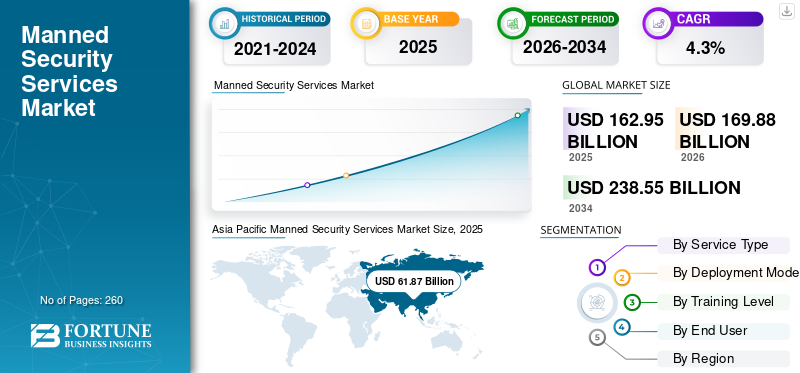
The global manned security services market size was valued at USD 162.95 billion in 2025. The market is projected to grow from USD 169.88 billion in 2026 to USD 238.55 billion by 2034, exhibiting a CAGR of 4.3% during the forecast period. Asia Pacific dominated the global manned security services market with a market share of 37.96% in 2025.
Manned security services involve hiring professional guards to watch over people, buildings, and valuable assets. This can include office towers, warehouses, hospitals, malls, and power plants. The market is growing as the world is becoming riskier. There are rising concerns about crime, protests, insider threats, and terrorism. Cities are getting more crowded, logistics hubs and data centers are increasing, and regulators are pushing companies to show they take safety and duty of care seriously. Many organizations prefer to outsource their security needs to specialist firms. These firms can provide trained guards, flexible coverage, and packages that combine guarding with technology.
The manned security industry has a few large players and many regional specialists. At the top, companies such as Allied Universal, which includes G4S, Securitas, GardaWorld, and Prosegur manage large teams of guards for airports, banks, tech parks, logistics centers, and critical infrastructure globally. Meanwhile, regional companies such as SIS India, Secom in Japan, and various strong local firms across the Middle East, Africa, and Latin America take care of much of the daily guarding on the ground. Despite a few global giants, the market still feels very local, focused on relationships, and highly competitive.
Download Free sample to learn more about this report.
MARKET DYNAMICS
MARKET DRIVERS
Heightened Real-World Risk and Duty-of-Care Pressure Market Growth
The manned security market is the belief among boards, insurers, and employees that the world has become riskier. They also witness rising expectations for duty of care. Companies now face more crime near their facilities, increasing political and social tensions, and a clear rise in threats against staff and executives. As a result, having a visible guard presence has become essential for basic risk and compliance practices. Many large companies are boosting guard coverage at offices, logistics hubs, data centers, and critical infrastructure. They often move from basic guarding to more trained, vetted, and integrated security teams.
- In September 2025, a global survey by Allied Universal of over 2,300 security chiefs in 31 countries found that 42% reported a significant rise in threats of violence against company executives. This figure climbed to 66% for U.S. tech firms, leading many organizations to improve executive protection and overall security spending.
MARKET RESTRAINTS
Labor Shortages, High Turnover, and Wage Pressure Restrain Guarding Profitability
The manned security market is the simple fact that it’s hard to hire and even harder to keep good guards. Turnover is high, work is demanding, and wage expectations are rising almost everywhere. That squeezes margins for guarding companies that already operate on thin hourly rates, forces them to absorb cost increases or fight constant price battles with clients, and makes it difficult to invest properly in training and supervision. For end-users, chronic churn at guard posts hurts service quality and trust; for providers, it turns every large contract into a staffing fire drill instead of a scalable business.
MARKET OPPORTUNITIES
Urbanization and New Infrastructure Projects Open Fresh Guarding Demand
As more people move into big cities and fast-growing secondary towns, every new mall, office park, metro line, warehouse cluster, and gated community adds more doors, perimeters, and public spaces that someone has to physically watch. For manned security firms, that urban build-out is a structural tailwind: even if tech takes some of the low-end work, the sheer number of new sites needing 24/7 coverage keeps pushing demand for guards, supervisors, and specialized teams.
MANNED SECURITY SERVICES MARKET TRENDS
Hybrid Guarding and Tech-Enabled Officers Are Redefining Manned Security
A major trend in this market is that manned security is quietly turning into hybrid security. The guard is still present at the gate or patrol point; however, they are now supported by cameras, analytics, remote command centers, drones, and even robots. Clients no longer just want a person on site; they want a guard who can manage alarms from various systems, verify video events on a tablet, escalate to a remote operations center, and connect to incident-reporting apps in real time. This change is affecting how major companies position themselves, focusing more on security solutions than just guarding. It also alters how they train guards and where profits lie, shifting from low-margin hours on post to tech-enabled contracts that are more reliable and harder to commoditize.
MARKET CHALLENGES
Fragmented, Unwell Regulated Guard Forces Create Quality and Compliance Risks
One of the major challenges for the global market is ensuring that security operations remain professional and compliant. The industry is large, fragmented, and slightly regulated. In North America, Europe, Asia Pacific, and markets of South Africa, it is common to find thousands of small firms providing security guards for residential buildings, malls, event security, and industrial sites. Clients are hiring trained security personnel to manage access control, conduct patrols, and respond to security risks in real time. This creates reputational and legal risks for large brands, undermines trust in manned guarding services, and slows manned security services market growth, even as demand for broader security solutions and systems rises in this multi-billion dollar global manned security market.
Impact of Russia-Ukraine War
Russia-Ukraine War Triggers Surge in Critical Infrastructure Protection and Regional Manned Guarding Demand
The Russia-Ukraine war has pushed governments and companies to rethink physical security operations, especially around energy, transport, and other critical infrastructure in Europe and nearby regions. Repeated attacks on pipelines, power grids, and logistics corridors have shown how vulnerable these assets are. This has increased the demand for manned guarding services, trained security personnel, and stricter access control at refineries, LNG terminals, rail hubs, and border crossings. This conflict has effectively turned parts of Eastern Europe into a real-world stress test for security measures. It has sped up investment in on-the-ground security guards, integrated security systems, and real-time monitoring. Other regions are following this example, leading to a rise in global demand for manned security services.
Since Russia's full-scale invasion in February 2022, analysts in Europe and NATO have repeatedly warned that Russian attacks on Ukrainian energy and transport assets present a broader hybrid threat to European critical infrastructure. This has led to calls for stronger protection of pipelines, power cables, and gas storage sites. EU security studies now clearly connect the war to a need for better protection of physical energy infrastructure across the continent.
Download Free sample to learn more about this report.
Segmentation Analysis
By Service Type
Due to Its Role as Front Line of Everyday Security Operations, Static Guarding Segment Dominates Market
In terms of service type, the market is categorized into static guarding, mobile patrol & rapid response, event security & crowd management, executive protection, critical infrastructure security, industrial & asset protection, loss prevention & retail security, and specialized defense & government security.
Static guarding dominates the manned guarding services market as most customers still start with a guard at the gate. Whether its residential buildings, corporate offices, malls, warehouses, or public sites across North America, Europe, Asia Pacific, and regions such as South Africa, clients want trained security personnel physically present to manage access control, deter threats, and handle security risks in real time before they escalate. Results in segment dominance.
- In March 2019, a FICCI-backed report on India’s private security industry noted that the sector employs around 8.9 million private security guards. It pointed out that a large portion of the workforce takes on manned guarding roles, such as on-site security guards at industrial sites, commercial properties, and residential complexes.
The executive protection segment in the market is expected to show fastest growth at a CAGR of 6.1% over the forecast period.
By Deployment Model
Simplicity and Client Preference for Traditional Guarding Segment Dominates Market
On the basis of deployment model, the market is classified into traditional guarding, hybrid guarding, remote guarding & limited on-site presence, and mobile-only security.
Traditional guarding is the primary choice for security deployment as most customers prefer having visible guards on site rather than relying on cameras. In North America, Europe, Asia Pacific, and regions such as South Africa, residential buildings, offices, and industrial sites typically employ trained security personnel at gates and lobbies. These guards manage access control, deter threats, and respond in real time. As technology advances, the demand for manned security services remains focused on traditional on-site guard positions.
Hybrid guarding segment is expected to show fastest growth at a CAGR of 9.6% over the forecast period.
By Training Level
Large Demand for Low-Cost Guard Posts, Basic Guarding Segment Dominates Market
Based on training level, the market is segmented into basic guarding, intermediate guarding, specialized guarding, and elite/protective services.
Basic guarding leads by training level as most security operations worldwide still focus on low-cost security guards who perform simple but essential tasks. These tasks include watching entrances, patrolling residential buildings, checking IDs, and managing access control in real time. In North America, Europe, Asia Pacific, and markets of South Africa, most demand for manned guarding services comes from this entry-level services type. Clients aim to stretch tight security budgets across many sites while still maintaining "a guard on the door" as their main security measure.
Elite/protective services segment is the fastest growing segment in the market at a CAGR of 7.2% growth across the forecast period.
To know how our report can help streamline your business, Speak to Analyst
By End User
High Footfall and Constant Access Control Needs, Commercial Real Estate and Corporate Offices Segment Dominates Market
Based on by end user, the market is segmented into commercial real estate & corporate offices, industrial & manufacturing, logistics, warehousing, distribution, energy & utilities, government & public sector, healthcare institutions, and others.
Commercial real estate and corporate offices drive the demand for manned security services. These sites are always active with tenants, visitors, contractors, and deliveries coming in and out throughout the day. This activity creates ongoing security risks that require immediate decisions at the door. Property managers in North America, Europe, and Asia Pacific depend on trained security staff at lobbies, reception desks, and parking areas for access control. They support security systems and ensure smooth security operations so that business can continue without interruptions. This group of end-users plays a key role in the growth of the global manned security market.
Logistics, warehousing, distribution segment is expected to show fastest growth at a CAGR of 6.1% growth across the forecast period.
Manned Security Services Market Regional Outlook
Rapid Urbanization and Expanding High-Risk Assets, Asia-Pacific Segment Dominates Market
By region, the market is categorized into Europe, North America, Asia Pacific, and the Rest of the World.
Asia Pacific
Asia Pacific Manned Security Services Market Size, 2025 (USD Billion)
To get more information on the regional analysis of this market, Download Free sample
Asia Pacific leads the global market holding around 37.97% market share. Rapid urbanization, dense residential buildings, large industrial areas, and fast-growing logistics hubs are all increasing the need for security guards. In India, China, and Southeast Asia, more malls, offices, data centers, and warehouses create a greater demand for everyday security operations. Trained security staff manage access control, support security systems, and handle security risks as they arise. Based on these factors, countries such as China expect to reach a valuation of USD 21.62 billion, and India is set to reach USD 14.71 billion by 2026.
North America
North America held the dominant manned security services market share in 2024 valuing at USD 38.83 billion and also took the leading share in 2025 with USD 39.97 billion, led primarily by the U.S., which alone contributes over 89.08% share in 2025 of the regional share. In the U.S., manned guarding services are an essential part of daily security operations. They are found in high-rise corporate offices, tech campuses, suburban residential buildings, hospitals, stadiums, and event security venues.
Europe
Europe is expected to witness significant growth in the market in the coming years. During the forecast period, the Europe region is projected to have a growth rate of 2.6%. The market in Europe is estimated to be USD 41.50 billion in 2025,driven directly by the Russia-Ukraine war. In this region, both the U.K. and France are expected to reach USD 7.91 billion and USD 5.82 billion, respectively, in 2026. In Europe, manned guarding services operate within a strict framework of regulations, unions, and compliance rules. This ensures that standards remain high, but it also creates cost pressure for providers.
Rest of the World
Meanwhile, the rest of the world including Middle East & Africa and Latin America contributes 12.03% in 2025. Middle East & Africa and Latin America, has comparatively smaller in share but is growing at a CAGR of 5.4%. In Latin America and the Middle East & Africa, the need for manned guarding services comes from a combination of high security risks and rapidly changing cities. In countries such as Brazil, Mexico, and Colombia, security guards are a common sight in malls, residential buildings, and logistics sites. In Saudi Arabia, the UAE, Egypt, and South Africa, significant funds go into protecting energy assets, ports, airports, and large event venues.
COMPETITIVE LANDSCAPE
Key Industry Players
Scale Advantages and Local Relationships, a Few Giants and Many Regional Players Shape Competitive Landscape
The competitive landscape in the global manned guarding services market features a mix of a few large companies and thousands of regional specialists competing for site-by-site contracts. At the top, players such as Allied Universal (including G4S), Securitas, GardaWorld, and Prosegur manage large guard forces across North America, Europe, and parts of Asia Pacific. They bundle manned guarding services with electronic security systems and broader security solutions. Alongside them, strong regional names such as SIS India, Secom (Japan), and top firms in South Africa, the Gulf, and Latin America lead local security operations for residential buildings, event security, critical infrastructure, and commercial sites. This combination keeps the market fragmented.
Global brands provide scale, compliance, and technology, while local companies excel in price, relationships, and the ability to adjust service types and access control practices to real-time security risks. This drives intense competition, even as demand for manned security services supports long-term growth in this multi-billion-dollar global manned security market.
LIST OF KEY MANNED SECURITY SERVICES COMPANIES PROFILED:
- Allied Universal (U.S.)
- Securitas AB (Sweden)
- GardaWorld Corporation (Canada)
- Prosegur Compañía de Seguridad, S.A. (Spain)
- G4S Limited (U.K.)
- SIS Limited (India)
- Secom Co., Ltd. (Japan)
- The Brink’s Company (U.S.)
- ICTS Europe (France)
- Paladin Security Group Ltd. (Canada)
- ADT Inc. (U.S.)
- S-1 Corporation (South Korea)
KEY INDUSTRY DEVELOPMENTS:
- November 2024: Prosegur reported its results for the first nine months of 2024, showing net profit of USD 71 million (€66 million) and a 6.4% rise in total sales, with its Prosegur Security division (guarding and integrated security services) growing revenue by around 12%, underlining sustained demand for contracted manned security across Europe and Latin America.
- October 2024: Private-equity firm BC Partners agreed to sell its majority stake in Canadian security services giant GardaWorld in a deal valuing the company at about Approx. USD 10.1 billion (C$13.5 billion), with GardaWorld’s founder and management taking a 70% stake and new institutional investors coming in, effectively resetting ownership of one of the world’s largest manned guarding providers.
- December 2023: The State of Hawaii issued highway security guard service specifications under solicitation HWY-OM-2023-32A, seeking licensed guard agencies to provide on-call security officers at various highway facilities, with requirements for 24/7 coverage on an as-needed basis.
- February 2023: Allied Universal was awarded a five-year contract to help secure Dallas Fort Worth International Airport (DFW) in the U.S., providing on-site security services at one of the busiest aviation hubs in the world.
- February 2022: SIS Limited in India won a two-year contract worth about USD 30 million (INR 225 crore) to provide security personnel across 18 Mahanadi Coalfields (Coal India) sites, deploying guards in multiple categories for round-the-clock coverage at mines and associated facilities.
REPORT COVERAGE
The global manned security services market analysis provides an in-depth study of market size; company profiling & forecast by all the market segments included in the report. It includes details on the market dynamics and market trends expected to drive the market in the forecast period. It offers information on the technological advancements, new product launches, key industry developments, and details on strategic partnerships, mergers & acquisitions. The market research report also encompasses detailed competitive landscape with information on the market share and profiles of market key players.
Request for Customization to gain extensive market insights.
Report Scope & Segmentation
| ATTRIBUTE | DETAILS |
| Study Period | 2021-2034 |
| Base Year | 2025 |
| Forecast Period | 2026-2034 |
| Historical Period | 2021-2024 |
| Growth Rate | CAGR of 4.3% from 2026 to 2034 |
| Unit | Value (USD Billion) |
|
Segmentation |
By Service Type, Deployment Model, Training Level, End User, and Region |
|
By Service Type
|
|
|
By Deployment Model
|
|
|
By Training Level
|
|
|
By End User
|
|
| By Region |
|
Frequently Asked Questions
Fortune Business Insights says that the global market value stood at USD 169.88 billion in 2026 and is projected to reach USD 238.55 billion by 2034.
In 2025, the market value stood at USD 39.97 billion.
The market is expected to exhibit a CAGR of 4.3% during the forecast period.
The static guarding segment led the market by service type.
The heightened real-world risk and duty-of-care pressure are the key factors driving the market.
Allied Universal, Securitas AB, GardaWorld Corporation, Prosegur Compañía de Seguridad, S.A., G4S Limited, SIS Limited, Secom Co., Ltd., and Brink’s Company, ICTS Europe, and Paladin Security Group Ltd., among others are the top companies in the market.
Asia Pacific dominated the market in 2024.



- 2021-2034
- 2025
- 2021-2024
- 260
Get 30-60 hrs Free Customization
Expand Regional and Country Coverage, Segments Analysis, Company Profiles, Competitive Benchmarking, and End-user Insights.




















-
US +1 833 909 2966 ( Toll Free )
-
Get In Touch With Us