Railway Management System Market Size, Share & Industry Analysis, By Railway Type (Conventional Railways and Urban Railways), By Application (Passenger Transportation and Freight Transportation), By Deployment (On-premise and Cloud), By Component (Solutions and Services), and Regional Forecast, 2026-2034
 Download Free Sample
(Offer valid till 15th Oct 2026)

Railway Management System Market Size and Future Outlook
 Listen to Audio Version
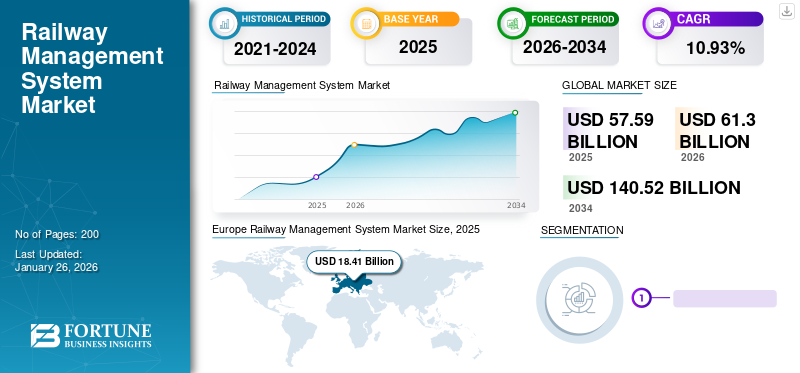
The global railway management system market size was valued at USD 57.59 billion in 2025. The market is projected to grow from USD 61.3 billion in 2026 to USD 140.52 billion by 2034, exhibiting a CAGR of 10.93% during the forecast period. Europe dominated the global market with a share of 25.52% in 2025.
A railway management system combines solutions and services to enhance the speed, safety, and reliability of rail services. It integrates technology and planning to optimize routes, schedules, and capacity in real-time, leveraging data to meet consumer demands for better services and safer travel. This system supports efficient rail infrastructure utilization and improves overall operational efficiency.
The global market is moving toward sustainable infrastructure development, including energy-efficient solutions and internet of things (IoT) integration for real-time monitoring and control. However, the market is driven by urbanization and demographic growth, which increase demand for efficient transportation, encouraging investments in automation, innovative technologies, and expanded rail networks.
Top players in the global market include Alstom SA (France), Siemens AG (Germany), Hitachi Ltd. (Japan), Huawei Technologies Co., Ltd. (China), and ABB (Switzerland). Other key companies are Cisco Systems, Inc. (U.S.), IBM Corporation (U.S.), Indra Sistemas SA (Spain), and Wabtec Corporation (U.S.). These firms leverage strategies such as product innovation, partnerships, and acquisitions to reinforce their market presence and drive a competitive edge.
Download Free sample to learn more about this report.
Download Free sample to learn more about this report.
Market Dynamics
Market Drivers
Urbanization and Connectivity Needs Drives Product Demand in the Market
As cities expand and populations increase, there is a rising demand for efficient public transportation to manage commuter traffic and reduce road congestion. Railways connect urban, suburban, and long-distance regions, providing sustainable mobility solutions. Governments are investing heavily in infrastructure development under innovative city initiatives to enhance interconnectivity. Advanced tools such as IoT, cloud computing, and data analytics optimize rail operations, enabling seamless communication, real-time tracking, and predictive maintenance. Additionally, the need for affordable fares, safety, comfort, and improved passenger experiences further fuels the adoption of railway management systems over the forecast period.
In August 2024, SFMTA secured initial approvals for a project to modernize its outdated train-control system, replacing it with a communication-based system to enhance safety, reliability, and operational efficiency citywide.
Market Restraints
High Initial Investment Costs and Complexity in Integration Restrains Market Growth
Implementing advanced IoT, artificial intelligence (AI), and predictive maintenance solutions requires substantial capital expenditure for hardware, software, and infrastructure upgrades. Governments and operators often struggle with budget constraints, delaying modernization projects. Additionally, integrating modern systems with aging infrastructure poses technical challenges due to compatibility issues. Legacy systems lack the flexibility to support sophisticated technologies, making seamless integration difficult without a complete overhaul of IT ecosystems. This process demands thorough planning, skilled personnel, and significant time, which increases the costs and slows product adoption rates. These factors collectively hinder the widespread deployment of railway management systems globally.
Market Opportunities
Expanding Railway Networks Provide Significant Growth Opportunities
Governments worldwide are capitalizing heavily on rail infrastructure projects, such as the U.S. allocating USD 100 billion for rail improvements and Germany planning to invest USD 190 billion by 2030. These initiatives aim to modernize networks, enhance connectivity, and meet growing passenger and freight demands while supporting green mobility goals. The expansion requires sophisticated management systems for traffic control, predictive maintenance, and efficient scheduling to avoid congestion and delays. Additionally, technologies such as IoT and automated timetabling systems are crucial for managing increased network complexity, ensuring operational efficiency, and improving passenger experiences.
In March 2024, MDOT awarded USD 16 million through the Michigan Rail Enhancement Grant Program for 10 freight rail projects, improving safety, efficiency, accessibility, and capacity while leveraging USD 11 million in private investments.
Market Challenges
Data Security and Privacy Concerns Challenge Market Growth
Modern rail systems increasingly rely on internet of things (IoT) devices, advanced communication networks, and digital platforms, which expand the attack surface for malicious actors. Vulnerabilities in legacy systems, insecure protocols, and resource-constrained devices can lead to data breaches, service disruptions, or ransomware attacks, compromising operational safety and passenger trust. Privacy risks also arise from unprotected passenger data, surveillance systems, and entertainment platforms, potentially leading to unauthorized access or misuse.
Additionally, inadequate cybersecurity planning and reliance on third-party vendors further complicate the risk mitigation efforts. These challenges necessitate costly investments in robust cybersecurity frameworks to ensure resilience, which is anticipated to hamper market growth over the forecast period.
Railway Management Market Trends
Digitalization and Automation Trends are Reshaping Market Growth
Technologies comprising Artificial Intelligence (AI), the Internet of Things (IoT), cloud computing, big data analytics, and others transform rail operations by enabling predictive maintenance, real-time monitoring, and automated control systems. Automation reduces human errors, enhances safety, and optimizes scheduling, routing, and dispatching processes, thus increasing operational efficiency and lowering costs. Digital platforms such as e-ticketing and intelligent surveillance systems improve passenger experiences and streamline operations. Industry 4.0 concepts such as Railway 4.0 also integrate advanced technologies to create interconnected ecosystems that boost capacity without requiring new infrastructure investments. These advancements ensure sustainable growth and competitiveness in the rail sector, further driving the railway management system market growth.
In May 2023, Europe’s Rail FP1 MOTIONAL was launched with USD 104.26 million in funding, aiming to enhance flexibility, efficiency, and resilience in European rail traffic management, supporting the Single European Rail Area through digitalization and automation.
Impact of COVID-19
Pandemic Resulted in Disruptions in Production and Supply Chains and Reduced Demand for Rail Services
Lockdowns and travel restrictions led to a sharp decline in passenger rail usage, with demand for mass transit dropping to as low as 15% in some regions. Freight operations also suffered, operating at reduced capacity due to logistical challenges and supply chain holdups. Budget constraints during the pandemic delayed infrastructure upgrades and Research and Development (R&D) investments, slowing technological advancements. Additionally, railway operators faced financial losses due to decreased revenue and postponed projects, hampering the market's growth during the pandemic.
Segmentation Analysis
By Railway Type
Increasing Investments in Growing Long-Distance Rail Networks, particularly in Developing Regions, led to Conventional Railways Segment Expansion
The market is segmented into conventional railways and urban railways, based on railway type.
Conventional railways held the largest market share of 64.09% in 2025. The segment’s growth is driven by increasing investments in expanding long-distance rail networks, particularly in developing regions. Governments are prioritizing infrastructure projects to improve public transportation and reduce traffic congestion. Conventional railways remain a cost-effective and reliable mode of transport for intercity travel, especially in densely populated regions such as Asia Pacific. Rising demand for safe, efficient, and sustainable transport further boosts this segment.
- In June 2024, ADComms launched Monica Hub, an AI-powered data aggregation platform integrating over 70 systems to transform rail operations, enabling real-time insights for safer, more efficient, and cost-effective journeys.
The urban railways segment is estimated to expand at the fastest-growing CAGR during the forecast period. The segment's growth is driven by increasing urbanization and the need for efficient public transportation to reduce traffic congestion. Urban rail systems, such as metros and trams, offer fast, eco-friendly, and cost-effective solutions for densely populated cities. Government initiatives for smart cities and substantial investments in expanding rail networks further boost this segment. Additionally, urban railways help lower the pollution and improve connectivity within towns.
By Application
Cost-Effectiveness, Energy Efficiency, and Ability to Transport Bulk Goods over Long Distances Enhanced Freight Transportation Demand
The market is segmented, by application, into passenger transportation and freight transportation.
In 2026, the freight transportation segment is projected to lead the market with a 63.72% share. Its cost-effectiveness, energy efficiency, and ability to transport bulk goods over long distances drive the segmental growth. Rail freight offers advantages in environmental performance, land use, and safety compared to other modes of transport. Increasing demand for shipping agricultural products, chemicals, and industrial goods fuels this segment. Investments in digitizing rail freight operations and expanding infrastructure further enhance its growth potential. The segment is anticipated to capture 63.70% of the market share in 2025.
In March 2024, Fujitsu Limited and JR Freight launched a system streamlining rolling stock maintenance for railway operators across Japan. Leveraging JR Freight's expertise, the system digitizes inspection and repair processes, reducing labor costs and ensuring high-quality operations through standardized methods. It addresses labor shortages and regulatory compliance challenges while promoting sustainable rail transport. JR Freight will support Fujitsu in introducing this cost-effective, adaptable system to other railway operators nationwide, enhancing operational efficiency.
The passenger transportation segment is estimated to develop at the fastest-growing CAGR of 9.30% during the forecast period. Increasing urbanization, rising demand for eco-friendly and cost-effective public transport, and government investments in metro and high-speed rail projects drive the segment growth. Railways offer an efficient solution to reduce road congestion and carbon emissions. Additionally, advancements in digital technologies, such as passenger information systems and automated scheduling, enhance safety and convenience, improving passenger experiences and boosting adoption.
By Deployment
Ability to Provide Enhanced Control, Security, and Reliability Boosts On-premise Segment Growth
The market is divided by deployment into on-premise and cloud.
The on-premise segment is anticipated to hold a dominant market share of 67.06% in 2026., due to its ability to offer superior control, security, and reliability, driving its growth. On-premise systems enable railway operators to store and manage critical operational data locally, reducing exposure to cyber threats and external disruptions. These solutions suit legacy systems, ensuring seamless integration without extensive overhauls. Additionally, regions with strict compliance regulations prefer on-premise deployments for better adherence to data protection laws. This segment is expected to dominate the market share by 67% in 2025.
The cloud segment is attributed to develop at the fastest-growing CAGR of 10.40% over the forecast period. The segment’s growth is attributed to its scalability, cost-efficiency, and ability to provide real-time access to data. Cloud-based systems enable ongoing software updates, remote monitoring, and centralized control, reducing operational disruptions. They enhance safety, improve passenger experiences, and support predictive maintenance using advanced analytics. Additionally, cloud platforms minimize infrastructure costs while offering flexibility for scaling operations, making them ideal for modernizing railway networks.
In November 2024, The Rail Safety and Standards Board (RSSB) unveiled its AI-powered Wheelset Intervention Support Tool to enhance rail freight safety and efficiency. Using predictive analytics, it proactively identifies wheelset issues, preventing costly repairs and disruptions. The tool leverages data from wheel impact load detectors to monitor wheelset degradation, optimize maintenance schedules, improve reliability, and reduce long-term costs. In pilot testing, it aims for full deployment in 2025 to transform U.K. rail freight operations.
By Component
Modernizing and Optimizing Railway Operations Propelled Solutions Segment Growth
The market is divided, by component, into solutions and services.
The solution sub-segment includes rail asset management, rail operations management, rail traffic management, rail control, rail maintenance management, passenger information system, and rail security. Moreover, the services sub-segment includes consulting, system integration and deployment, support and maintenance.
In 2026, the solution segment held the dominant position in the market. The segment is likely to attain 64.56% of the market share in 2026. The segment is also attributed to developing at the fastest-growing CAGR during the forecast period. This is attributed to progress due to its critical role in modernizing and optimizing railway operations. Solutions such as traffic management, operations management, asset management, and passenger information systems enhance efficiency, reduce costs, and improve service quality. They address key concerns such as punctuality, safety, and infrastructure maintenance while enhancing passenger satisfaction through real-time updates. Increasing investments in railway expansion and digitalization further boost demand for these solutions.
In July 2024, Mitsubishi Electric launched a railway data analysis service using its Serendie digital platform. The service optimizes energy usage and railway asset operations, promoting decarbonization and operational efficiency.
The services segment held the second-largest market share in 2024. This segment is expected to record a CAGR of 9.10% during the forecast period. This is driven by increasing demand for consulting, system integration, deployment, and maintenance services. As railways adopt advanced technologies such as IoT and AI, expert guidance is required to ensure seamless implementation and integration with existing systems. Support and maintenance services are critical for operational reliability, minimizing downtime, and enhancing safety. Additionally, tailored service solutions help optimize operations and improve overall efficiency.
To know how our report can help streamline your business, Speak to Analyst
Railway Management Market Regional Outlook
North America
North America maintains a significant market share, driven by technological improvements and the increased demand for efficient transportation solutions. North America maintained a strong presence in the global market, reaching USD 14.7 billion in 2025, accounting for 25.52% share, and is expected to reach USD 15.64 billion in 2026. Increasing adoption of IoT, AI, and big data analytics enhances operational efficiency, safety, and passenger experience. Government initiatives to modernize infrastructure and promote sustainable mobility further boost growth. Rising urbanization and smart city investments fuel demand for advanced systems such as traffic management and passenger information solutions, ensuring improved connectivity and environmental sustainability. In May 2023, The FRA launched a rail safety program with USD 5 million in funding under the Bipartisan Infrastructure Law, supporting research, innovation, and workforce development. It aims to enhance safety, efficiency, and sustainability in rail operations.
The market size in U.S. is predicted to hit USD 10.99 billion in 2025. The growth of the railway management system in the U.S. is driven by several factors, including significant investments in infrastructure, such as those made under the Bipartisan Infrastructure Law, which aims to enhance rail systems across the country. Technological advancements, such as the integration of IoT, AI, and automation, are improving operational efficiency, safety, and maintenance. Additionally, the increasing urbanization and demand for efficient mass transit solutions are pushing for more robust rail networks. Furthermore, sustainability goals are encouraging investments in energy-efficient and environmentally friendly rail technologies, ensuring the long-term growth and modernization of the sector. The U.S. market is valued at USD 11.65 billion by 2026.
Europe
Europe Railway Management System Market Size, 2025 (USD Billion)
To get more information on the regional analysis of this market, Download Free sample
The European railway management system market is expected to maintain the largest market share. The regional market's growth is driven by the growing adoption of the European Rail Traffic Management System (ERTMS), which enhances cross-border interoperability and safety by replacing over 20 national signaling systems with a unified standard. In 2025, Europe generated USD 18.41 billion, contributing 31.96% to global market revenue, and is projected to grow to USD 19.59 billion in 2026. ERTMS improves operational efficiency, increases rail capacity, and supports international freight and passenger transport. Additionally, government investments in sustainable mobility, digitalization, and smart infrastructure align with environmental goals, further boosting the region's railway modernization efforts. In January 2025, HS2 Ltd, in collaboration with Connected Places Catapult and the (DOT) Department for Transport, selected six U.K.-based SMEs for its seventh Innovation Accelerator program. These firms will develop innovative solutions addressing challenges in automating asset management, maximizing site productivity, and future-proofing operations. Over 20 weeks, they will refine their ideas with HS2 and present them to industry players. The program aims to enhance railway technology, streamline HS2 delivery, and improve future rail service reliability. The U.K. market size is estimated to hit USD 2.12 billion in 2026. On the other hand, Germany market size is projected to hit USD 1.57 billion in 2026 and France is likely to reach USD 0.83 billion in 2025.
Asia Pacific
The Asia Pacific railway management system market is projected to hold the second-largest market share in 2024. The Asia Pacific market accounted for USD 17.4 billion in 2025, representing 30.21% of the global industry, and is expected to reach USD 18.52 billion in 2026. This is propelled by rapid urbanization, populace growth, and the need for efficient transportation solutions. Governments are heavily investing in expanding and modernizing railway infrastructure, focusing on high-speed rail networks to enhance connectivity and stimulate economic development. The implementation of advanced tools such as IoT, predictive analytics, and automation improves operational efficiency and passenger experience. Public-private partnerships and sustainability initiatives further accelerate growth in this dynamic market. The market value in China is expected to be USD 8.33 billion in 2026.
On the other hand, India is projecting to hit USD 3.53 billion and Japan is likely to hold USD 1.45 billion in 2026.
In July 2024, Morocco’s ONCF announced plans to modernize railway infrastructure nationwide. Key pillars include technological innovation, sustainability, network expansion, strategic partnerships, and continuous investment in personnel development.
Rest of the World
Rest of the world, comprising South America and the Middle East & Africa, witnesses a decent growth in the market driven by infrastructure development, modernization efforts, and government investments in sustainable transportation. Rest of the World accounted for USD 7.09 billion in 2025, representing 12.30% of the global market share, and is projected to reach USD 7.54 billion in 2026. Countries in South America focus on upgrading rail systems for efficiency and safety, while the Middle East & Africa prioritize smart transport solutions to improve connectivity and freight operations. Public-private partnerships, digitalization, and the adoption of advanced technologies such as IoT and automation further enhance operational capabilities and passenger services in these regions.
Competitive Landscape
Key Market Players
Sustainability Practice with EV Fleet Adoption Provides Competitive Edge to Key Players Operating in the Market
The global market is highly competitive, with key players focusing on technological innovation, strategic partnerships, and geographic expansion to strengthen their market position. Key companies such as Alstom SA, Siemens AG, Hitachi Rail, IBM Corporation, Huawei Technologies, and ABB Ltd. dominate the market by offering advanced solutions such as predictive maintenance, traffic management, and automation systems. These players invest in R&D to develop cutting-edge technologies such as IoT, AI, and big data analytics. Strategic acquisitions, such as in January 2021, Alstom's acquisition of Bombardier Transportation, enhance product portfolios and global reach. Additionally, regional competition intensifies as emerging markets in Asia Pacific and Latin America witness increased investments in railway modernization and digitalization to meet growing transportation demands.
List of Key Railway Management System Companies Profiled:
- Alstom SA (France)
- Siemens AG (Germany)
- Hitachi, Ltd. (Japan)
- Huawei Technologies Co., Ltd. (China)
- Wabtec Corporation (U.S.)
- Cisco Systems, Inc. (U.S.)
- ABB Ltd. (Switzerland)
- Indra Sistemas, S.A. (Spain)
- IBM Corporation (U.S.)
- CAF, Construcciones y Auxiliar de Ferrocarriles, S.A. (Spain)
- Honeywell International Inc. (U.S.)
- Hyundai Rotem (South Korea)
- Huawei (China)
Key Industry Developments
September 2024: RailPulse launched its groundbreaking telematics platform to revolutionize North American railcar operations. Utilizing GPS and advanced sensors, it provides real-time insights into railcar location, condition, and health, enhancing safety, efficiency, and visibility for shippers, railroads, and owners. This vendor-neutral system aggregates data securely, enabling alerts, geofencing, and fleet optimization. Developed over two years with industry collaboration, it marks a significant milestone in modernizing freight rail operations.
March 2024: Hitachi Rail launched Train Maintenance DX as a Service, integrating digital expertise to improve maintenance efficiency, teamwork, and motivation while addressing labor challenges in railway operations.
February 2024: Huawei launched its Smart Railway Perimeter Detection Solution at MWC 2024, leveraging AI and multi-dimensional sensing to enhance safety, efficiency, and intelligent railway transformation globally.
November 2023: Hyundai Rotem launched the KTCS-2 train management system on the Jeolla Line in South Korea, utilizing LTE-R technology for real-time data transmission. Based on ETCS Level 2, KTCS-2 enhances safety, efficiency, and capacity by 20%. Supporting speeds up to 230 km/h enables automatic operation at the GoA2 level. Hyundai Rotem also developed KTCS-3, which locates trains wirelessly without relying on track circuits.
October 2023: Norfolk Southern launched Digital Train Inspection Portals featuring AI-powered machine vision technology, enhancing rail safety and efficiency across its 22-state network with real-time defect detection and analysi
Investment Analysis and Opportunities
Rising Vehicle Demand and Technological Advancements Fuels Market Investments, Providing Opportunity for Growth
The market presents significant investment opportunities driven by urbanization, sustainability goals, and technological advancements. Investments in digitalization, automation, and IoT-based solutions enable efficient rail operations, predictive maintenance, and real-time monitoring. Government funding for infrastructure modernization and public-private partnerships further enhance growth potential. Rising demand for eco-friendly transport and improved connectivity in urban areas creates opportunities for deploying advanced systems such as traffic management and passenger information solutions. However, high initial deployment costs and integration complexities remain challenges, requiring meticulous planning and innovative approaches to capitalize on these opportunities.
Report Coverage
Request for Customization to gain extensive market insights.
The global market report analyzes the market in-depth. It highlights crucial aspects such as prominent companies, market segmentation, competitive landscape, railway type, application, deployment, and component. Besides this, the market research report provides insights into the market trends and highlights significant industry developments. In addition to the aspects mentioned earlier, the report encompasses several factors contributing to the market growth over recent years.
[5Z1nqQRNx]
Report Scope & Segmentation
|
ATTRIBUTE |
DETAILS |
|
Study Period |
2021-2034 |
|
Base Year |
2025 |
|
Forecast Period |
2026-2034 |
|
Historical Period |
2021-2024 |
|
Growth Rate |
CAGR of 10.93% from 2026 to 2034 |
|
Unit |
Value (USD Billion) |
|
Segmentation |
By Railway Type
By Application
By Deployment
By Component
By Region
|
Frequently Asked Questions
Fortune Business Insights says the market was valued at USD 57.59 billion in 2025 and is anticipated to reach USD 140.52 billion by 2034.
The market will exhibit a CAGR of 10.93% over the forecast period (2026-2034).
In 2025, the on-premise segment by deployment held the largest market share.
Urbanization and connectivity need drive market growth.
Key companies such as Alstom SA, Siemens AG, Hitachi Rail, IBM Corporation, Huawei Technologies, and ABB Ltd. dominate the market.
In 2025, Europe led the global market.



- 2021-2034
- 2025
- 2021-2024
- 200
-
(Offer valid till 15th Oct 2026)
Get 30-60 hrs Free Customization
Expand Regional and Country Coverage, Segments Analysis, Company Profiles, Competitive Benchmarking, and End-user Insights.




















Related Reports
- Europe Railway Passenger Coaches Market
- Locomotive Maintenance Market
- Check Rails Market
- Railway Passenger Coaches Market
- Europe Rail Infrastructure Market
- North America Rail Infrastructure Market
- Metro Rail Infrastructure Market
- Railway Lubricants Market
- Rail Wheel Market
- Railway Signalling System Market
- Railway Axle Market
- Locomotive Market
- Rolling Stock Market
-
US +1 833 909 2966 ( Toll Free )
-
Get In Touch With Us