Green Coffee Market Size, Share & Industry Analysis, By Type (Arabica and Robusta), End Product (Roasted Coffee, Instant/Soluble Coffee, and Green Coffee Bean Extract), and Regional Forecast, 2026-2034
 Download Free Sample
(Offer valid till 30th Sep 2026)

KEY MARKET INSIGHTS
 Listen to Audio Version
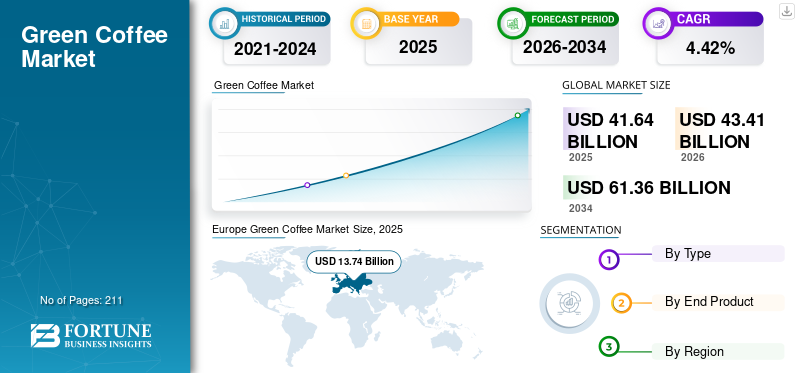
The global green coffee market size was USD 41.64 billion in 2025 and is projected to grow from USD 43.41 billion in 2026 to USD 61.36 billion by 2034, exhibiting a CAGR of 4.42% during the forecast period. Europe dominated the green coffee market with a market share of 33.00% in 2025. The industry growth is driven by specialty coffee demand, health benefits awareness, and expansion in global coffee markets.
The global green coffee growth is supported by rising consumption across the food and beverage industries and increasing demand for specialty coffee. The green coffee market size is growing as coffee roasters and beverage manufacturers prioritize high-quality green coffee beans for diverse product offerings. Demand is further reinforced by expanding coffee markets in emerging economies and evolving consumer preferences toward premium and sustainably sourced products.
Coffee-producing countries continue to play a central role in shaping the global green coffee supply chain dynamics. Regions such as Latin America, Africa, and Asia-Pacific dominate production, with arabica coffee maintaining a significant share due to its flavor profile and market demand. Production costs, climatic variability, and agricultural practices directly influence green coffee prices and overall supply stability.
Green coffee market growth is also supported by increasing awareness of the health benefits associated with unroasted beans. Applications in dietary supplements and functional beverages are expanding, particularly in developed markets. This diversification is enhancing value addition within the global green coffee industry and influencing product innovation strategies among manufacturers. Supply chain optimization remains a key focus area. Coffee producers and exporters are investing in traceability, sustainability certifications, and logistics improvements to meet evolving buyer requirements. These initiatives are reshaping green coffee market trends and strengthening long-term trade relationships.
The industry is witnessing prominent growth across the globe. The increasing demand for plant-based dietary supplements, functional food, and beverages has significantly increased the demand for green coffee beans. The rising demand for specialty coffee varieties across developing and developed markets is expected to fuel market growth during the forecast period.
The World Health Organization declared COVID-19 a pandemic, and governments across the globe implemented severe restrictions on international trade and nationwide lockdowns, resulting in the closure of manufacturing and processing. Thus, with global trade on hold, including manufacturing and processing, and with stockpiling among consumers owing to the fear, there was an unprecedented supply and demand shock, disrupting the global green coffee market.
The decrease in supply and a sudden spike in demand caused a rapid growth in the prices of coffee in the initial phase of the pandemic. This significantly impacted the countries dependent on imports for coffee, as countries including Brazil, India, and others record the majority of production. At the end of June 2020, the International Coffee Organization (ICO) composite indicator fell below the USD 100 cents/lb mark. COVID-19 has posed an enormous challenge to the global coffee sector, which has experienced a prolonged period of low prices. However, coffee bean extract is gaining admiration due to its perceived health effects. The increasing demand for health-improving ingredients in dietary supplements and nutraceuticals would fuel the market growth in the foreseeable years.
Download Free sample to learn more about this report.
Green Coffee Market KEY TAKEAWAYS
 Market Size & Forecast
- 2025 Market Size: USD 41.64 Billion
- 2026 Market Size: USD 43.41 Billion
- 2034 Forecast Market Size: USD 61.36 Billion
- CAGR: 4.42% from 2026–2034
 Market Share
- Europe dominated the green coffee market with a 33.00% share in 2025.
- The Arabica coffee segment is projected to account for 57.11% of the market in 2026.
- The roasted coffee segment is expected to hold a 72.59% market share in 2026.
 Key Regional Highlights
Europe
Europe generated USD 13.74 billion in 2025 and is projected to reach USD 14.24 billion in 2026.
North America
North America accounted for USD 8.93 billion in 2025 and is expected to reach USD 9.34 billion in 2026.
Asia Pacific
Asia Pacific reached USD 9.77 billion in 2025 and is projected to grow to USD 10.26 billion in 2026.
U.S.
The green coffee market is valued at USD 8.29 billion by 2026.
Japan
The green coffee market is valued at USD 3.16 billion by 2026.
Read More

Key Market Dynamics
Market Trends
Rising Popularity of Nutraceuticals & Dietary Supplements to Drive Market Growth
Consumer purchasing behavior has shifted significantly towards selecting healthful product varieties that have improved overall physical wellness in the past few years. The consumer interest in food ingredients having functional properties has increased considerably due to their safer counterparts. The modern-day consumer lifestyle has increased the prevalence of lifestyle-related health conditions such as obesity, diabetes, and cardiovascular disorders.
Nutraceuticals and dietary supplements are gaining traction among consumers to enhance health. In the past few years, plant extracts containing active ingredients have become more prevalent in dietary supplements as they are perceived to be healthier and safer. Green coffee bean extracts are now widely used in nutraceuticals in the form of powder and liquid. Functional beverages containing these extracts are dominating the retail aisles across European and North American countries. The growing concerns regarding health during and after the pandemic are driving the green coffee market growth in the foreseeable future.
The green coffee market is evolving in response to shifting consumer preferences and structural changes in global coffee markets. A prominent trend is the growing demand for specialty coffee, which emphasizes traceability, origin differentiation, and quality grading. Coffee roasters increasingly prioritize direct sourcing from coffee-producing countries, strengthening relationships within the supply chain and enhancing product transparency.
Sustainability is becoming a defining element of green coffee market trends. Buyers are focusing on ethically sourced green coffee beans with certifications related to environmental and social standards. This shift is influencing procurement strategies and encouraging coffee producers to adopt sustainable farming practices. As a result, supply chain transparency and responsible sourcing are gaining importance across the global green coffee industry.
Digitalization is also shaping market dynamics. Adoption of data-driven supply chain management tools is improving inventory tracking, quality control, and pricing transparency. These technologies enable better coordination between coffee producers, exporters, and coffee roasters.
Another key trend is the diversification of green coffee applications. Beyond traditional roasted coffee, green coffee extracts are increasingly used in dietary supplements and functional beverages. This expansion supports value addition and broadens revenue streams.
Download Free sample to learn more about this report.
Market Drivers
Growing Knowledge Regarding Health Benefits of Green Coffee among Consumers to Drive Market Growth
Green coffee beans are a major source of chlorogenic acid, an antioxidant that can be readily absorbed in the body. This knowledge regarding the high antioxidant content in the product has considerably increased its demand in the past few years. Bean extracts are extensively utilized in dietary supplements and functional beverages to improve their nutritional profile.
Studies have highlighted that chlorogenic acid present in the product helps maintain healthy blood glucose levels. Green coffee bean extracts in beverages are now witnessing heightened sales across retail outlets, as most of them claim to improve weight loss. The growing concerns related to obesity and lifestyle-related health disorders such as diabetes and cardiovascular diseases would also drive the market growth during the forecasted period.
Rising Popularity of Specialty Coffee to Fuel Market Growth Significantly
The increasing discretionary income levels among consumers in Asia Pacific, Europe, and North America have significantly amplified the demand for high-value food and beverages. Consumers nowadays are ready to spend more on better quality products that have enticing tastes and flavors. Specialty coffee is gaining popularity among consumers due to its diversified origins and flavors. Specialty coffees are different from regular coffees as they are grown at higher elevations and are traceable and processed carefully after harvest.
Coffee varieties from Kenya, Colombia, Guatemala, and Ethiopia are popular across European and North American countries. The emerging trend of healthy coffee varieties with known origins also fuels the demand among consumers. Specialty coffee is gaining traction among millennials as it is perceived as a better quality and high-value product. The leading coffee manufacturers, such as Olam and Starbucks, are focused on investing in new specialty coffee product launches to expand their portfolio. Thus, the factors mentioned above would boost the market growth in the future markets.
The green coffee market growth is primarily driven by rising global consumption across the food and beverage industries and expanding coffee markets in both developed and emerging economies. Increasing demand for specialty coffee is encouraging coffee roasters to source high-quality green coffee beans, particularly arabica coffee, to meet evolving consumer preferences. This shift toward premium offerings is strengthening value creation across the global green coffee supply chain.
Growing awareness of health benefits associated with green coffee is also supporting market expansion. Consumers are increasingly incorporating green coffee extracts into dietary supplements and functional beverages. These applications are gaining traction due to perceived antioxidant properties and metabolic benefits, contributing to diversification within the green coffee market.
Market Restraints
Price Volatility of Coffee Bean to Act as a Key Restraint for Market Growth
Coffee has been the most highly traded commodity after oil, as it is one of the most popular beverages in the world. The U.S., the European Union (EU), and Japan are the largest importers of coffee beans in the world. Specialty, fair-traded, organic, and bird-friendly coffee varieties have given rise to new trends in traditional coffee-importing markets such as the U.S., E.U., and Japan. Coffee import values have significantly increased in the past decade, more than 100% in most regions such as the Asia Pacific and the Middle East. Coffee price volatility has been significantly higher due to weather, disease, and external shocks.
The green coffee market faces several constraints related to supply chain volatility, price fluctuations, and environmental factors. Climatic variability remains a major challenge, as coffee production is highly sensitive to temperature and rainfall patterns. Unpredictable weather conditions in coffee-producing countries can disrupt yields, affecting the availability of green coffee beans and increasing green coffee prices.
Production costs also present a significant restraint. Rising labor costs, input expenses, and transportation charges impact profitability for coffee producers. Small-scale farmers are particularly vulnerable to these pressures, which can limit investment in productivity improvements and affect overall green coffee market growth.
Supply chain inefficiencies further constrain market performance. Fragmented distribution networks and limited infrastructure in some producing regions can lead to delays and quality inconsistencies. These issues affect the ability of coffee roasters to secure reliable supplies of green coffee.
Market price volatility introduces additional uncertainty. Green coffee prices are influenced by global demand, currency fluctuations, and speculative trading. This variability complicates procurement planning for buyers and reduces margin predictability across the value chain.
According to the International Coffee Organization (ICO), in September 2021, coffee bean prices reached new record highs. According to the ICO, the monthly average price of coffee increased by 6.2% to USD 170.02 cents/lb in September 2021 from USD 160.14 cents/lb in August 2021. The cost of production has been rising in many coffee-producing countries, according to the International Coffee Organization. Therefore, the price volatility of coffee beans is likely to hamper the market in the forthcoming years.
Market Opportunities
The green coffee market presents significant opportunities driven by evolving consumer demand, product diversification, and expansion in emerging coffee markets. Increasing interest in specialty coffee offers substantial growth potential for producers capable of delivering high-quality arabica coffee and differentiated origin profiles. Coffee roasters are actively seeking premium green coffee beans, creating opportunities for value-added sourcing strategies.
Expansion of applications in dietary supplements and functional beverages represents a key opportunity area. Green coffee extracts are gaining popularity due to perceived health benefits, supporting demand beyond traditional roasted coffee consumption. This diversification enables manufacturers to tap into wellness-focused consumer segments and enhance the overall green coffee market size.
Emerging markets in the Asia-Pacific and the Middle East are also creating new growth avenues. Rising disposable incomes and changing consumption patterns are driving demand for coffee products, increasing imports of green coffee. These regions present opportunities for exporters from established coffee-producing countries.
Technological advancements in agriculture and supply chain management are improving efficiency and quality. Adoption of precision farming techniques and digital logistics platforms enables better yield management and traceability. These innovations support a consistent supply and strengthen competitiveness.
Green Coffee Market Segmentation Analysis
By Type Analysis
To know how our report can help streamline your business, Speak to Analyst
The global market is segmented by type, end product, and geography. The roasted coffee segment is expected to hold a 72.6% share in 2025.
Arabica
Arabica Segment Holds Largest Market Share due to Wide Consumption
Arabica coffee is the dominant coffee type across the world, and this segment holds the largest market share expected for 57.11% in 2026. Arabica is known for its higher quality, which makes it the most demanded coffee in developed markets of Europe and North America. Most of the roasted coffee consumed in European and North American countries is obtained from Arabica. Arabica has higher production across the world compared to the other coffee varieties. The increasing discretionary income levels among consumers in the developing markets will drive their demand in the upcoming years.
Arabica coffee dominates the global green coffee market share, driven by its superior flavor profile, lower caffeine content, and strong demand across specialty coffee segments. Coffee roasters prioritize Arabica coffee for premium roasted coffee products, particularly in developed coffee markets. Producing countries in Latin America and parts of Africa remain key suppliers, benefiting from favorable climatic conditions and established cultivation practices.
Arabica beans command higher green coffee prices due to quality differentiation and consumer preference. This segment contributes significantly to the green coffee market size, especially within specialty coffee and high-end food and beverages applications. However, arabica production is highly sensitive to climatic variability, increasing exposure to supply risks. Despite these challenges, demand remains resilient, supported by growing interest in traceability, sustainability, and origin-specific offerings.
Adoption behavior reflects a clear shift toward premiumization. Coffee producers and exporters are investing in quality enhancement, certification, and direct trade relationships to capture higher value. This segment continues to shape green coffee market trends, particularly in markets emphasizing quality and sustainability.
Robusta
Robusta variety is the fastest-growing type of coffee. The rising demand for instant coffee mixes fuels the growth of Robusta. Also, most of the instant coffee manufactured uses Robusta as a primary raw material. According to the data released by the International Coffee Organization, prices for Robusta have always been lower than those for Arabica. The amplified demand for instant coffee during the COVID-19 pandemic has significantly increased the requirement for Robusta among coffee manufacturers.
Robusta coffee represents a substantial portion of the global green coffee market growth, characterized by higher caffeine content, stronger flavor, and greater resistance to environmental stress. Coffee-producing countries in the Asia-Pacific and Africa dominate robusta production, benefiting from lower production costs and higher yield stability.
Robusta is widely used in instant/soluble coffee and blended roasted coffee products, supporting mass-market demand. Its cost advantage makes it attractive for large-scale coffee roasters and manufacturers operating in price-sensitive segments. This segment contributes significantly to volume within the global green coffee supply chain.
Market dynamics for robusta are influenced by expanding demand in emerging coffee markets, where affordability remains a key factor. Technological improvements in processing and quality control are enhancing Robusta’s positioning, enabling broader application beyond traditional low-cost segments. As a result, robusta continues to play a critical role in balancing supply and supporting overall green coffee market size expansion.
By End Product Analysis
Roasted Coffee
Roasted Coffee Holds Major Share due to its Higher Popularity. This market is mainly fueled by higher demand for roasted coffee among consumers, accounting a share 72.59% globally in 2026. Roasted coffee is highly consumed across European countries and in the U.S., making it the most consumed end product. Roasted coffee is of high quality as it retains most of the coffee flavor. The growing demand for roasted coffee across the developing markets of the Asia Pacific and the Middle East has substantially driven the market growth.
Roasted coffee represents the largest end-product segment within the green coffee market, driven by widespread consumption across global coffee markets. Green coffee beans serve as the primary raw material for coffee roasters, who transform them into various roasted profiles to meet consumer preferences.
Demand is strongly linked to specialty coffee trends, with increasing focus on origin, flavor complexity, and roasting techniques. Arabica coffee is predominantly used in premium roasted coffee products, while robusta is often blended for cost efficiency and flavor balance. This segment accounts for a significant share of the green coffee market size and revenue generation.
Supply chain efficiency is critical, as coffee roasters require consistent quality and timely delivery of green coffee beans. Investments in logistics, storage, and traceability are enhancing operational performance. Roasted coffee continues to drive green coffee market growth, supported by evolving consumption patterns and premiumization trends.
Instant/Soluble Coffee
Instant or soluble coffee represents a key segment characterized by convenience and mass-market appeal. This segment relies heavily on robusta coffee due to its cost efficiency and strong flavor profile. Demand is particularly high in emerging markets, where affordability and ease of preparation are critical factors.
Manufacturers are investing in processing technologies to improve taste and quality, narrowing the gap between instant and traditional roasted coffee. This segment contributes significantly to the overall green coffee market share in volume terms, supporting large-scale production and export activities.
Growth in this segment is driven by urbanization, changing lifestyles, and increasing demand for ready-to-consume products. The instant coffee segment plays a vital role in stabilizing demand for green coffee beans and supporting supply chain continuity across coffee-producing countries.
Green Coffee Bean Extract
Green coffee bean extract is becoming widespread due to its perceived health benefits. These extracts are now being widely used across the nutraceutical industry to develop dietary supplements and functional foods that help in weight loss as well as enhance overall physical health. The rising awareness regarding healthy diets among consumers is anticipated to boost market growth.
Green coffee bean extract is an emerging segment gaining traction due to its application in dietary supplements and functional food products. Extracts derived from green coffee beans are marketed for their perceived health benefits, including antioxidant properties and metabolic support.
This segment is expanding within the broader food and beverages and nutraceutical industries, contributing to diversification in the global green coffee market. Demand is particularly strong in developed markets, where health-conscious consumers are seeking alternative wellness products.
Production of green coffee extracts requires specialized processing and quality control, creating opportunities for value addition within the supply chain. Although smaller in scale compared to roasted and instant coffee, this segment exhibits strong growth potential and is expected to influence future green coffee market trends.
REGIONAL INSIGHTS
Europe Green Coffee Market Size, 2025 (USD Billion)
To get more information on the regional analysis of this market, Download Free sample
Europe to be Leading Region while Asia Pacific to Record Fastest Growth
Europe Green Coffee Market Analysis:
In 2025, Europe generated USD 13.74 billion, contributing 33.00% to global market revenue, and is projected to grow to USD 14.24 billion in 2026. European countries are witnessing strong demand for raw coffee beans for further processing into roasted and instant coffee among health-conscious consumers. These extracts are extensively utilized to manufacture functional beverages and sports drinks. The increasing promotion of such beverages in gyms and fitness centers is fueling the market growth. The surge in demand for specialty coffee across Italy, Germany, and Spain will strengthen the regional outlook. The UK market is valued at USD 0.61 billion by 2026, while the German market is valued at USD 3.87 billion by 2026.
Europe’s green coffee market is characterized by strong demand for specialty coffee and sustainability-focused sourcing. Coffee roasters emphasize traceability and ethical procurement from coffee-producing countries. The region imports large volumes of green coffee beans for processing into roasted coffee. Green coffee market trends reflect premiumization and regulatory compliance. Growth remains steady, supported by established consumption patterns and high-quality product demand.
Germany Green Coffee Market:
Germany is a key hub within Europe’s green coffee market, serving as a major importer and processor of green coffee beans. The country has a well-developed coffee roasting industry and strong export capabilities. Demand is driven by both domestic consumption and re-export activities. Green coffee market growth is supported by efficient supply chain infrastructure and increasing focus on specialty coffee products.
United Kingdom green coffee Market:
The United Kingdom green coffee market is expanding steadily, supported by rising demand for specialty coffee and premium food and beverages. Coffee roasters are focusing on high-quality green coffee beans and diversified sourcing strategies. Consumer interest in sustainability and ethical sourcing is influencing procurement. Green coffee market growth is driven by evolving consumption habits and the increasing popularity of specialty coffee offerings.
North America Green Coffee Market Analysis:
North America maintained a strong presence in the global market, reaching USD 8.93 billion in 2025, accounting for 21.43% share, and is expected to reach USD 9.34 billion in 2026. North America is witnessing strong growth in the market due to the rising demand for nutraceuticals and plant-based dietary supplements.
Green coffee bean extract is experiencing a substantial need across the fitness industry to manufacture fortified and functional food & beverages. Roasted ground coffee is widely consumed across the region, amplifying the demand for raw coffee beans for further coffee processing. The leading players, such as Starbucks Corporation, are investing in innovative product development to further fuel the market growth in the region. The U.S. market is valued at USD 8.29 billion by 2026.
North America represents a mature green coffee market, driven by strong demand from food and beverages and specialty coffee segments. Coffee roasters emphasize high-quality green coffee beans and sustainable sourcing practices. The region relies heavily on imports from coffee-producing countries. Green coffee market growth is stable, supported by premiumization trends, supply chain optimization, and increasing demand for dietary supplements using green coffee extracts.
United States Green Coffee Market:
The United States dominates North America’s green coffee market size, driven by high consumption and advanced coffee markets. Coffee roasters prioritize Arabica coffee for premium roasted coffee offerings. Demand for specialty coffee and green coffee bean extract is increasing. Efficient supply chain systems and strong import networks ensure consistent availability. The market reflects steady growth, supported by innovation and evolving consumer preferences toward quality products.
Asia-Pacific Green Coffee Market Analysis:
The Asia Pacific market accounted for USD 9.77 billion in 2025, representing 23.45% of the global industry, and is expected to reach USD 10.26 billion in 2026. Asia Pacific is the fastest-growing region, with the highest annual growth rate for the market. The rising consumer discretionary income has increased the demand for high-quality coffee varieties. The increasing aging population has significantly driven the consumption of nutraceuticals and dietary supplements in the region, supporting the growing demand for coffee bean extracts.
The emerging trend of dining out and consuming Western food & beverages would also increase coffee consumption among millennials in the region. The increased popularity of instant drinks during the pandemic is likely to drive the regional market growth in the forecast period. The Japan market is valued at USD 3.16 billion by 2026, the China market is valued at USD 0.65 billion by 2026, and the India market is valued at USD 1.02 billion by 2026.
Asia-Pacific represents a high-growth region in the global green coffee market, driven by expanding coffee markets and rising consumption. Countries such as Vietnam and Indonesia are major coffee-producing countries, particularly for robusta coffee. Increasing urbanization and changing lifestyles are boosting demand. Green coffee market growth is supported by both production and consumption expansion across the region.
Japan Green Coffee Market:
Japan’s green coffee market is characterized by high-quality consumption and advanced processing capabilities. Coffee roasters focus on premium Arabica coffee and specialty coffee products. Demand is driven by strong consumer preference for quality and consistency. Efficient import systems ensure a stable supply from coffee-producing countries. The market reflects steady growth, supported by innovation and evolving consumption trends.
China Green Coffee Market:
China’s green coffee market is expanding rapidly, driven by increasing coffee consumption and evolving food and beverage preferences. Demand for both roasted coffee and instant coffee is rising. Imports of green coffee beans are growing to meet domestic processing needs. Green coffee market growth is supported by urbanization, rising incomes, and the expansion of café culture across major cities.
Latin & South America Green Coffee Market Analysis:
Latin America contributed 15.76% to the global market in 2025, with a valuation of USD 6.56 billion, and is projected to reach USD 6.83 billion in 2026.
South America is the largest producer and exporter of coffee beans across the globe, which accelerates the market growth in the region. Moreover, the demand for coffee has increased in the past few years due to the increased discretionary income. The lower coffee bean prices resulting from higher production will drive the regional market growth in the upcoming years.
Latin America plays a central role in the global green coffee market as a leading producer and exporter. Countries such as Brazil and Colombia dominate arabica coffee production. The region benefits from established agricultural practices and favorable climatic conditions. Green coffee market growth is supported by strong export demand, although price volatility and production costs remain key considerations.
Middle East & Africa Green Coffee Market Analysis:
In 2025, the Middle East & Africa region represented USD 2.65 billion, accounting for 6.35% of the worldwide market, and is projected to grow to USD 2.75 billion in 2026. The Middle East & Africa region is expected to be a rapidly emerging market. Growth will be driven by the rising awareness about the benefits of the product among upper-class consumers across the UAE, Turkey, South Africa, and Saudi Arabia. Growing adoption of Western diets will also drive growth in this region. In Europe, the roasted coffee segment is estimated to hold a 73.3% market share in 2025.
The Middle East and Africa green coffee market is influenced by both production and consumption dynamics. African coffee-producing countries contribute significantly to the global supply. Demand is growing in regional coffee markets, particularly for specialty coffee. Green coffee market growth is moderate, supported by export activities, improving supply chain infrastructure, and increasing consumer awareness of premium coffee products.
To know how our report can help streamline your business, Speak to Analyst
Green Coffee Industry Competitive Landscape:
The Green Coffee Company Announced an Acquisition to Strengthen its Business Outlook
The Green Coffee Company is a leading company in the market, actively investing in strategic partnerships to strengthen its geographical presence and fortify the business in the global market. For instance, in December 2021, the company announced the closing of its initial USD 9.6 million Series B funding round. The company now has over 180 individual investors in the business.
The company has also announced that it will become the second-largest coffee producer in Colombia after purchasing 2340 additional acres to plant coffee. The major players, such as Neumann Kaffe Groupe, Starbucks Corporation, and Merchants of Green Coffee, focus on new product developments, mergers, and acquisitions to consolidate the market. The arrival of small players in the market significantly contributes to the competition within the market, which has a positive impact on the market growth.
The global green coffee market is characterized by a fragmented yet highly interconnected competitive landscape, involving coffee producers, exporters, traders, and coffee roasters across multiple geographies. Market share is influenced by access to high-quality green coffee beans, supply chain efficiency, and long-term sourcing relationships with coffee-producing countries. Large multinational traders and vertically integrated companies play a central role in aggregating supply and distributing to global coffee markets.
Leading players focus on securing a consistent supply from key producing countries such as Brazil, Vietnam, Colombia, and Ethiopia. These companies invest in supply chain optimization, traceability systems, and sustainability certifications to strengthen competitive positioning. Control over sourcing networks and logistics infrastructure enables them to manage green coffee prices and ensure reliable delivery to coffee roasters and manufacturers.
Specialty coffee producers and niche exporters are gaining traction within premium segments. These players differentiate through quality, origin-specific offerings, and direct trade models. Their influence is increasing as demand for specialty coffee expands across developed markets. This segment contributes to evolving green coffee market trends centered on transparency and value addition.
Strategic partnerships are a defining feature of the competitive landscape. Collaboration between coffee producers, exporters, and global buyers enhances supply chain resilience and quality consistency. Technology adoption, including digital traceability platforms and data-driven procurement systems, is improving operational efficiency.
Emerging players are focusing on value-added products such as green coffee bean extract for dietary supplements. This diversification supports revenue expansion beyond traditional roasted coffee applications. Overall, the green coffee market reflects a balance between scale-driven commodity trade and premium-focused differentiation strategies.
List of Top Green Coffee Companies:
- The Hamburg Coffee Company (Germany)
- Neumann Kaffee Gruppe (Germany)
- Merchants of Green Coffee (U.S.)
- Belco S.A. (France)
- Starbucks Corporation (U.S.)
- Nordic Approach S.A. (Norway)
- Golden Bean Trade (Brazil)
- Atlantica Coffee (Brazil)
- Group MAGNUS BRAZIL-The Green Coffee Brazil (Brazil)
- WS Cafe (Vietnam)
Latest Green Coffee Industry Developments
- January 2025: Olam Group expansion of sustainable sourcing programs: Strengthening supply chain transparency and sustainability compliance: Implementation of digital traceability systems and certified sourcing practices
- September 2024: Neumann Kaffee Gruppe investment in coffee processing infrastructure: Enhancing quality control and export capabilities: Adoption of advanced grading and processing technologies
- March 2025: Starbucks' long-term sourcing agreements with coffee-producing countries: Securing a high-quality arabica coffee supply: Integration of ethical sourcing frameworks and sustainability standards
- July 2024: Nestlé expansion of green coffee bean extract product line: Targeting dietary supplements and functional beverages: Development of extraction technologies and product formulation capabilities
- November 2024: Louis Dreyfus Company strengthening global coffee trading operations: Increasing market share in green coffee markets: Deployment of supply chain optimization and logistics management systems
REPORT COVERAGE
The global green coffee research report provides a detailed analysis of the market and focuses on key aspects such as leading companies, types, and end products. Besides this, the report offers insights into the market trends and highlights key industry developments. In addition to the aforementioned factors, the report encompasses several factors that have contributed to the growth of the market in recent years.
Request for Customization to gain extensive market insights.
Report Scope & Segmentation
|
ATTRIBUTE |
DETAILS |
|
Study Period |
2021-2034 |
|
Base Year |
2025 |
|
Estimated Year |
2026 |
|
Forecast Period |
2026-2034 |
|
Historical Period |
2021-2024 |
|
Growth Rate |
CAGR of 4.42% over 2026 to 2034 |
|
Unit |
Value (USD billion) |
|
Segmentation |
By Type
By End Product
By Geography
|
Frequently Asked Questions
The global green coffee market size was valued at USD 43.41 billion in 2026 and is projected to grow to USD 61.36 billion by 2034.
Growing at a CAGR of 4.42%, the market will exhibit steady growth over the forecast period (2026-2034).
Europe dominated the green coffee market in 2025 with a 33.00% market share, while North America and Asia Pacific are also showing strong growth, driven by rising demand for specialty and health-focused coffee products.
Key drivers include increasing consumer awareness of the health benefits of green coffee, rising demand for nutraceuticals and dietary supplements, growing popularity of specialty coffee varieties, and increased discretionary income across key regions.
The Arabica variety holds the largest market share globally due to its high quality and wide consumption, especially in Europe and North America. Meanwhile, Robusta is the fastest-growing type, driven by demand for instant coffee products.
The market includes roasted coffee, instant/soluble coffee, and green coffee bean extracts. Roasted coffee dominates due to its rich flavor and high demand, while extracts are gaining popularity in nutraceutical and functional beverage sectors.
A major challenge is the price volatility of coffee beans, influenced by weather conditions, diseases, and external shocks. This volatility can impact production costs and market stability.
Leading companies include The Green Coffee Company, Neumann Kaffee Gruppe, Starbucks Corporation, Merchants of Green Coffee, and The Hamburg Coffee Company. These firms focus on product innovation, geographic expansion, and strategic partnerships.



- 2021-2034
- 2025
- 2021-2024
- 211
-
(Offer valid till 30th Sep 2026)
Get 30-60 hrs Free Customization
Expand Regional and Country Coverage, Segments Analysis, Company Profiles, Competitive Benchmarking, and End-user Insights.




















Related Reports
-
US +1 833 909 2966 ( Toll Free )
-
Get In Touch With Us