Superabsorbent Polymers Market Size, Share & Industry Analysis, By Type (Sodium Polyacrylate, Polyacrylamide, and Others), By Application (Personal Hygiene, Medical, Agriculture, and Others), and Regional Forecast, 2026-2034
 Download Free Sample
KEY MARKET INSIGHTS
 Listen to Audio Version
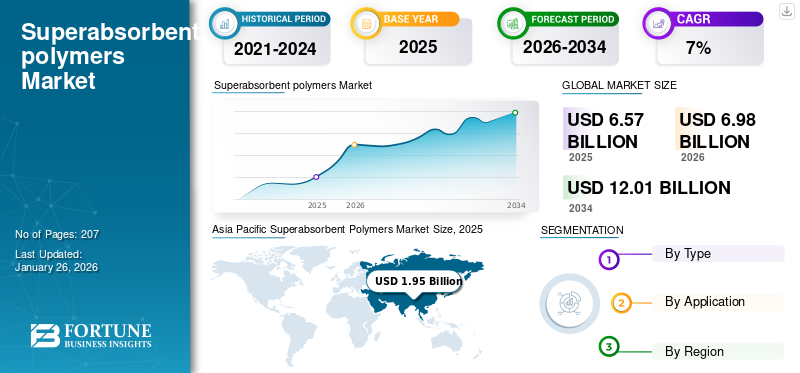
The global superabsorbent polymers market size was valued at USD 6.57 billion in 2025 and is projected to grow from USD 6.98 billion in 2026 to USD 12.01 billion by 2034 at a CAGR of 7% during the forecast period. Asia Pacific dominated the superabsorbent polymers market with a market share of 30% in 2025.
Superabsorbent Polymers (SAPs) are polymeric networks made of different monomeric units, including sodium polyacrylate, polyacrylamide, and other monomers. SAP absorbs up to 300 to 500 times of aqueous fluids compared to their weight. They are mainly used in fluid absorption applications such as personal hygiene, medicine, and agriculture. Rising demand for personal hygiene products, including baby diapers, adult incontinence products, and feminine hygiene products, is expected to drive the market growth.
Key players in the market include SUMITOMO SEIKA CHEMICALS CO., LTD., NIPPON SHOKUBAI CO., LTD., BASF SE, LG Chem, and Kao Corporation. These players focus on expanding their presence rapidly in order to gain maximum revenue from the market by investing heavily in R&D and new product development.
Download Free sample to learn more about this report.
SUPERABSORBENT POLYMERS MARKET KEY TAKEAWAYS
 Market Size & Forecast
- 2025 Market Size: USD 6.57 billion
- 2026 Market Size: USD 6.98 billion
- 2034 Forecast Market Size: USD 12.01 billion
- CAGR: 0.07% from 2026–2034
 Market Share
- Asia Pacific dominated the superabsorbent polymers market with a market share of 30% in 2025.
- The sodium polyacrylate segment is expected to lead the market, contributing 90.54% globally in 2026.
- The personal hygiene segment will account for 77.36% market share in 2026.
 Key Regional Highlights
North America
The North America market was valued at USD 1.35 billion in 2025, capturing 21.00% of global revenue, and is estimated to reach USD 1.43 billion in 2026.
Europe
In 2025, Europe held 23.00% of the global market, reaching a valuation of USD 1.49 billion, and is projected to grow to USD 1.59 billion in 2026.
Asia Pacific
The market in Asia Pacific reached USD 1.95 billion in 2025, representing 30.00% of total market revenue, and is expected to reach USD 2.08 billion in 2026.
U.S.
The U.S. accounts for significant market share and will reach a market size of USD 1.18 billion in 2026 due to rising consumer awareness, innovations in biodegradable SAPs, and increasing use in water retention in agriculture.
Japan
Japan is will achieve 0.27 billion.
Read More

Superabsorbent Polymers Market Trends
Sustainability Demands and Evolving Consumer Preferences Reshape Market
The market is evolving with changing consumer preferences and sustainability imperatives. Notably, there is a growing demand for SAPs derived from renewable, biodegradable sources, as opposed to petroleum-based materials. Eco-conscious consumers and businesses are seeking out these greener polymer solutions effectively.
Additionally, the personal care segment continues to drive SAP innovation, with a focus on improving absorbency, comfort, and leakage protection in products, including diapers and feminine hygiene items. Beyond personal care, the medical industry is emerging as a key growth area, leveraging SAP’s unique properties in advanced wound care and drug delivery systems. Latest technological advancements, such as high-performance gels & fibers, process optimization for greater absorbency, multi-functional nanocomposites, and responsive saps with advanced swelling control are fostering market growth. As manufacturers respond to these diverse market forces, the SAP industry is poised for steady growth in the coming years.
Download Free sample to learn more about this report.
Market Dynamics
Market Drivers
Increased Pediatric and Geriatric Population is Anticipated to Drive Market Growth
As SAP has excellent liquid absorption properties, it is extensively used in manufacturing baby diapers, feminine sanitary products, adult incontinence products, and other similar products. Among all these products, a larger share of SAP is used in the manufacturing of baby diapers, owing to a significant increase in the pediatric population. This rapid growth in the population is noticeable, especially in developing countries such as China and India. According to a report by the World Bank Group, the population of the 0 to 14 age group is anticipated to reach 2.08 billion by the end of 2050. Such an increase in the population is expected to result in higher demand for personal hygiene products, driving market growth.
Further, there is a significant increase in the geriatric population in the major economies, including the U.S., China, Japan, the U.K., Germany, and South Korea. Developing countries, including India, Brazil, and South Africa, are also expected to witness a significant increase in the geriatric population in the coming decades. The rising geriatric population globally is anticipated to drive the demand for adult incontinence products, resulting in increased consumption of superabsorbent polymers.
Expansion of Agriculture and Technological Advancements Drives Market Growth
The expansion of agriculture and technological advancements play a pivotal role in driving the growth of the market. In agriculture, it enhances the soil’s water retention capacity, particularly in dry regions or during droughts, thereby improving crop yield and reducing water usage. This efficiency in water management aligns with the increasing focus on sustainable agriculture practices globally. Further technological advancements have led to the development of innovative product formulations with enhanced properties, such as higher absorbency rates, improved biodegradability, and compatibility with various soil types and agricultural practices. These advancements expand the application areas of the product, making it more attractive to farmers and agriculture industries seeking to optimize water resources, increase productivity, and mitigate environmental impacts. This results in significant market growth.
Market Restraints
Growing Need for Innovation and Cost Pressure Challenges Evolving SAP Market
One significant challenge for the market is the need to innovate and differentiate products in a competitive landscape continually. As consumer preferences shift toward eco-friendly and high-performance SAPs, manufacturers are investing heavily in R&D to develop novel polymer formulations and applications. This requires significant capital expenditure and technical expertise.
Additionally, the market faces the challenges of price sensitivity, particularly in high-volume personal care and hygiene products segments. Consumers and businesses are increasingly becoming cost-conscious, which puts pressure on SAP suppliers to optimize production efficiency and maintain competitive pricing. This can be challenging, especially as raw material and energy costs fluctuate.
Lastly, the industry is also facing concerns around the disposal and end-of-life management of these polymers. As sustainability becomes a greater priority, there is a need to develop the impact of recycling or biodegradation on SAP-based products.
Market Opportunities
Technological Advancements and Agriculture Water Scarcity Create Growth Avenues for Market
The SAP market is witnessing emerging opportunities through advanced technological innovations in healthcare and medical applications. The development of specialized SAPs with antimicrobial properties is opening new avenues in wound care management, surgical pads, and advanced medical dressing. These medical-grade SAPs offer enhanced absorption capabilities while maintaining sterility, creating a high-value market segment with significant growth potential.
The escalating water scarcity concerns, particularly in agriculture, present substantial opportunities for SAP manufacturers. The application of SAPs in precision agriculture for improved water retention and controlled release of nutrients is gaining higher traction. This agricultural application is particularly promising in arid and semi-arid regions where water conservation is critical, leading to increased adoption of commercial farming practices.
The construction industry emerges as another promising frontier, with SAPs being increasingly utilized in concrete admixtures and waterproofing applications. These polymers enhance concrete durability and water resistance, creating new market opportunities in infrastructure development. Furthermore, the growing adoption of SAPs in water treatment applications, particularly in industrial wastewater management, presents an untapped market segment with significant growth potential.
Market Challenges
Supply Chain Volatility and Regulatory Complexities Hinder Market Expansion
The superabsorbent polymers market growth faces unique challenges. One significant hurdle is the lack of widespread consumer awareness. Despite their benefits, SAPs are not as well-known as other skincare ingredients, including retinol or hyaluronic. This knowledge gap can lead to slower adoption rates in consumer products, requiring substantial marketing efforts and education initiatives from the manufacturers.
Another challenge is the potential for allergic reactions or skin sensitivities in some individuals. As with any natural compound, SAPs may cause adverse reactions in a small percentage of users. This necessitates thorough testing and clear labeling, which can increase product development time and costs.
The market also deals with standardization issues. The concentration and purity of can vary depending on their source and extraction method, making it difficult for different suppliers. This variability can complicate formulation processes for cosmetic and Personal Hygieneceutical companies.
Additionally, the market faces challenges in expanding beyond its current primary applications. While it shows promise in skincare and some Personal Hygiene uses, broadening its application range requires substantial research and development investment, which smaller companies may find difficult to undertake.
Impact of COVID-19
Key pandemic impacts included heightened demand for SAP-based medical products, disrupted raw material supply chains, temporary manufacturing facility closures, and shifting consumer priorities toward essential hygiene products. The adult incontinence and medical sectors saw substantial growth, while industrial applications experienced temporary declines during the pandemic. Post-COVID recovery has demonstrated the industry’s resilience through restructured supply chains, emphasizing regional self-sufficiency, accelerated adoption of automation, and increased investments in R&D for antimicrobial products.
The market has shown remarkable recovery, with many companies reporting stronger positions than pre-pandemic levels. This recovery has been supported by restored manufacturing capabilities, stabilized supply chains, renewed focus on innovation, and adapted business models emphasizing digital solutions and healthcare applications.
Segmentation Analysis
By Type
Sodium Polyacrylate Dominated Market Due to Rising Demand for Personal Hygiene Applications
On the basis of type, the market is segmented into sodium polyacrylate, polyacrylamide, and others.
The sodium polyacrylate segment is expected to lead the market, contributing 90.54% globally in 2026, due to higher demand for personal hygiene and medical applications. Sodium polyacrylate products have superior absorption properties and also protect against skin irritation.
The polyacrylamide segment is anticipated to witness considerable growth in the near future. Polyacrylamide products have free swell absorption capacity, polymer permeability, and wicking capability. These properties of the polyacrylamide type are anticipated to witness significant demand from medical and agriculture applications. Other superabsorbent polymers include polyacrylonitrile, polysaccharide, and cross-linked copolymers of maleic anhydride, which are mainly used in medical, agricultural, and other applications.
By Application
To know how our report can help streamline your business, Speak to Analyst
Personal Hygiene Segment to Hold Dominant Market Share Owing to Rising Health Awareness
Based on application, the market is segmented into personal hygiene, medical, agriculture, and others.
The personal hygiene segment will account for 77.36% market share in 2026, owing to higher demand for SAPs. The rising population and increasing health awareness are driving the demand for personal hygiene products, including baby diapers, feminine sanitary napkins, adult incontinence products, and other similar products, resulting in increased demand for SAP.
Medical applications of superabsorbent polymers include the manufacturing of medical textiles and different types of gel products, including nano-gels. They are also used in drug delivery systems. The segment is expected to grow at a CAGR of 6.7%.
The agriculture segment is also anticipated to witness considerable growth during the forecast period. The agriculture sector has witnessed a significant increase in the applications of advanced materials to enhance productivity and meet the demand for rapid increase in domestic and export of various agricultural products. The ability of the superabsorbent polymers to enhance water use efficiency is the key factor driving the growth of the agriculture segment.
Other applications of SAP include cement modifiers in the construction industry, flood sacks, ice packs, wire and cable water blocking, industrial aqueous waste disposal, and artificial snow.
Superabsorbent Polymers Market Regional Outlook
Geographically, the market is studied across North America, Latin America, Europe, the Middle East & Africa, and Asia Pacific.
Asia Pacific
Asia Pacific Superabsorbent Polymers Market Size, 2025 (USD Billion)
To get more information on the regional analysis of this market, Download Free sample
The market in Asia Pacific reached USD 1.95 billion in 2025, representing 30.00% of total market revenue, and is expected to reach USD 2.08 billion in 2026. The region is expected to retain its position during the forecast period owing to the increasing population. Rapid industrialization in the region has resulted in a significant rise in consumer expenditure. The greater success of the programs run by the governments for childcare and women’s health is anticipated to play a key role in the market growth in the region's major economies, including China and India. These countries are expected to generate a revenue of USD 1 billion and USD 0.16 billion in 2026, while Japan is will achieve 0.27 billion.
To know how our report can help streamline your business, Speak to Analyst
North America
The North America market was valued at USD 1.35 billion in 2025, capturing 21.00% of global revenue, and is estimated to reach USD 1.43 billion in 2026 as the growth of SAPs in North America has accelerated significantly in recent years, driven by their versatility and effectiveness across various applications. These are primarily utilized in personal hygiene applications such as diapers, adult incontinence products, and feminine hygiene items. The growth is attributed to their superior absorption capabilities that enhance user comfort and hygiene. Additionally, the growing aging population in North America, coupled with increasing incidences of chronic health issues, has created a robust market for incontinence solutions, further bolstering the growth of SAPs in this segment. The U.S. accounts for significant market share and will reach a market size of USD 1.18 billion in 2026 due to rising consumer awareness, innovations in biodegradable SAPs, and increasing use in water retention in agriculture.
Europe
In 2025, Europe held 23.00% of the global market, reaching a valuation of USD 1.49 billion, and is projected to grow to USD 1.59 billion in 2026. In Europe, the growing agriculture industry will propel the demand for SAPs during the forecast period. With increasing regulatory pressures and a commitment to sustainable agriculture, SAPs are being used to enhance soil moisture retention, reduce water usage, and improve crop yields, aligning with the European Union’s goals for environmental sustainability and food security. Furthermore, the European market is characterized by a strong emphasis on innovation and research, leading to the development of biodegradable and environmentally friendly SAP options, which cater to the region's increasing demand for sustainable products. Backed by these factors, the U.K., Germany, and France will account for USD 0.27 billion, USD 0.32 billion, and USD 0.24 billion by 2032. The UK market is projected to reach USD 0.29 billion by 2026, while the Germany market is projected to reach USD 0.34 billion by 2026.
Latin America
Latin America maintained a strong presence in the global market, reaching USD 0.82 billion in 2025, accounting for 13.00% share, and is expected to reach USD 0.87 billion in 2026. The adoption and growth of SAPs in Latin America have been gaining momentum, particularly due to their diverse applications in personal hygiene, agriculture, and healthcare. The boom of the personal hygiene sector in the region due to increasing urbanization, coupled with rising disposable incomes and heightened awareness of health and hygiene, has fueled the demand for high-quality absorbent products. In addition, several manufacturers across the region are responding to this trend by incorporating advanced superabsorbent polymer formulations that enhance performance, providing consumers with better leakage protection and overall comfort. Hence, the growing personal hygiene sector will augment the market growth in the region.
Middle East & Africa
In 2025, the Middle East & Africa market stood at USD 0.95 billion, representing 15.00% of global demand, and is projected to grow to USD 1 billion in 2026. The growing expansion of the healthcare industry in the Middle East & Africa, increasing awareness of health and hygiene standards, growing personal care industry, rising disposable income, and rapid infrastructure development in countries such as Saudi Arabia and South Africa will accelerate the demand for super SAPs. These factors will help South Africa to achieve USD 0.35 billion in 2025. In the medical sector, the product is used in functional wound dressings that can bind to proteases and inactivate collagenase. It is also used in tissue engineering and drug administration. Hence, as the healthcare systems in the region develop and expand, the demand for superabsorbent polymers continues to rise.
Competitive Landscape
Key Market Players
Prominent Players are Investing Heavily to Increase Innovation Capabilities and Manufacture Relatively Sustainable Products
Key players in the market, including SUMITOMO SEIKA CHEMICALS CO., LTD., NIPPON SHOKUBAI CO., LTD., BASF SE, LG Chem, and Kao Corporation, are investing in research and development to manufacture products from bio-based raw materials with low environmental impact. Players in the market are also making combined efforts to use recycled raw materials in manufacturing the product. Major players in the market announced the price hike following the increased prices of raw materials.
List of Key Superabsorbent Polymer Companies
- Sumitomo Seika Chemicals Company, Limited. (Japan)
- NIPPON SHOKUBAI CO., LTD. (Japan)
- BASF SE (Germany)
- Kao Corporation (Japan)
- LG Chem (South Korea)
- FORMOSA PLASTICS CORPORATION (Taiwan)
- Yixing Danson Technology (China)
- Satellite Chemical Co., Ltd. (China)
- Qingdao SOCO New Material Co., Ltd. (China)
- Quanzhou Banglida Technology Industry Co., Ltd. (China)
KEY INDUSTRY DEVELOPMENTS
- June 2025: Nippon Shokubai Group acquired ISCC PLUS certification in the U.S. for locally produced acrylic acid (AA) and superabsorbent polymers (SAP). This acquisition enables Nippon Shokubai Group to supply AA and SAP globally with a net-zero carbon footprint.
- May 2025: Sumitomo Seika Chemicals Co. announced the completion of the dedicated pilot plant for super absorbent polymers at its Himeji Works (Himeji City, Hyogo Prefecture) in Japan. This plant is designed as a scaled-down model of its manufacturing plant, enabling medium-scale experiments under conditions similar to actual manufacturing environments.
- February 2025: BASF SE introduces the first polyacrylate-based superabsorbent polymer (SAP), HySorb B 6610 ZeroPCF, with a carbon footprint of zero. The SAP is marketed with a product carbon footprint (PCF) of zero for the hygiene industry. The zero PCF polymer expands BASFY’s sustainable portfolio. This has been achieved by utilizing renewable energy and the established biomass balance approach (BMB) in the production process at the Antwerp Verbund site. This ISCC PLUS-certified product offers a solution to help customers in the hygiene industry in Europe, the Middle East, and Africa achieve their sustainability targets by reducing their scope 3 footprint.
- February 2025: Univar Solutions announced an expanded distribution partnership with BASF Corporation (BASF), securing the exclusive right to distribute LuquaSorb Superabsorbent Polymers (SAPs) in the U.S. and Canada in industrial applications. This collaboration expands the availability of high-performance, non-hazardous SAP technology for various industrial applications in key market segments such as coatings, adhesives, sealants, elastomers (CASE), energy and mining, water treatment, and environmental remediation industries.
- February 2025: LG Chem is entering the global market with eco-friendly raw materials derived from vegetable oils. The company announced that it will commence the production of bio-acrylic acid in the second quarter of this year. Production capacity shall ramp up to 100 metric tons (MT) of prototype annually. Bio-acrylic acid can be applied to various materials, including cosmetic ingredients that directly contact the skin, super absorbent polymers (SAP) for diapers, adhesives for electronics and vehicles, coating materials, and eco-friendly paints.
REPORT COVERAGE
The research report provides qualitative and quantitative insights on the market share, growth rate, size, and regional analysis by different segments. The report also offers an elaborative analysis of the drivers, restraints, opportunities, and competitive landscape. Key insights such as Porter’s five force analysis and the regulatory scenario are also covered as part of the scope of the study.
Request for Customization to gain extensive market insights.
REPORT SCOPE & SEGMENTATION
|
ATTRIBUTE |
DETAILS |
|
Study Period |
2021-2034 |
|
Base Year |
2025 |
|
Estimated Year |
2026 |
|
Forecast Period |
2026-2034 |
|
Historical Period |
2021-2024 |
|
Unit |
Value (USD Billion) and Volume (Kiloton) |
|
Growth Rate |
CAGR of 7% from 2026 to 2034 |
|
Segmentation |
By Type
|
|
By Application
|
|
|
By Region
|
Frequently Asked Questions
Fortune Business Insights says that the global market size was valued at USD 6.57 billion in 2025 and is projected to reach USD 12.01 billion by 2034.
Recording a CAGR of 7%, the market is slated to exhibit steady growth during the forecast period.
The personal hygiene application segment led in 2026.
Increased pediatric and geriatric populations drive the baby diaper segment, leading global sap consumption to drive the growth of the market.
Technological advancements and agriculture water scarcity are anticipated to drive product adoption.
The rising awareness about the use of personal hygiene products serves as a key market trend.



- 2021-2034
- 2025
- 2021-2024
- 207
Get 30-60 hrs Free Customization
Expand Regional and Country Coverage, Segments Analysis, Company Profiles, Competitive Benchmarking, and End-user Insights.


















Related Reports
-
US +1 833 909 2966 ( Toll Free )
-
Get In Touch With Us