Vegan Cosmetics Market Size, Share & Industry Analysis, By Type (Skin Care, Hair Care, Makeup, and Others), By Gender (Male and Female), By Distribution Channel (E-commerce, Hypermarkets/Supermarkets, Departmental Stores, Specialty Stores, and Others), and Regional Forecast, 2026-2034
 Download Free Sample
(Offer valid till 15th Oct 2026)

KEY MARKET INSIGHTS
 Listen to Audio Version
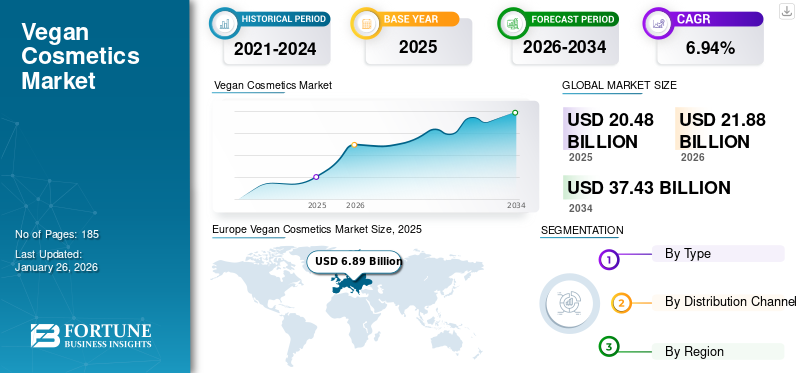
The global vegan cosmetics market size was valued at USD 20.48 billion in 2025 and is projected to grow from USD 21.88 billion in 2026 to USD 37.43 billion by 2034, registering a CAGR of 6.94% over the forecast period. Europe dominated the vegan cosmetics market with a market share of 33.63% in 2025.
Vegan cosmetics consist of chemical substances sourced from either natural or synthetic origins, without any animal-derived ingredients. The concept of veganism is rapidly becoming mainstream within the cosmetics sector due to an expanding group of consumers emphasizing sustainability. As a result, vegan cosmetics brands worldwide are encouraged to develop cruelty-free products. Furthermore, innovation in production is anticipated in the upcoming years, as cosmetic manufacturers focus on improving their sustainability practices, from raw material procurement to product distribution, thus driving market growth.
Key players operating in the global market include GABRIEL COSMETICS, PHB Ethical Beauty Ltd., Seraphine Botanicals, COTY INC., and G&M Cosmetics. The players significantly invest in the R&D activities of the vegan product formulations to provide skin-benefiting cosmetic solutions to the users.
Download Free sample to learn more about this report.
VEGAN COSMETICS MARKET KEY TAKEAWAYS
 Global Market Size & Forecast
- 2025 Market Size: USD 20.48 billion
- 2026 Market Size: USD 21.88 billion
- 2034 Forecast Market Size: USD 37.43 billion
- CAGR: 6.94% from 2026–2034
 Market Share
- Europe dominated the vegan cosmetics market with a 33.63% share in 2025.
- The skin care segment is projected to account for 40.45% of the market in 2026.
- The hypermarket/supermarket segment is expected to hold 31.99% of the global market in 2026.
 Key Regional Highlights
Europe
Europe the market reached USD 6.89 billion in 2025 and is projected to grow to USD 7.39 billion in 2026.
North America
North America the market was valued at USD 5.98 billion in 2025 and is expected to reach USD 6.33 billion in 2026.
Asia Pacific
Asia Pacific the market reached USD 4.28 billion in 2025 and is projected to grow to USD 4.65 billion in 2026.
U.S.
The market is projected to reach USD 4.59 billion in 2026.
Japan
The market is projected to reach USD 0.60 billion in 2026.
Read More

COVID-19 Impact
The COVID-19 outbreak caused unprecedented supply chain disruptions in the market. The imposition of social distancing mandates and the introduction of trade restrictions meant that most vegan beauty products were categorized as non-essential. In this regard, the COVID-19 pandemic created a significant shift from both consumer and product distribution perspectives. In the cosmetics sector, the pandemic contributed significantly to digital acceleration, most notably throughout 2020, with numerous online retailers demonstrating adaptability to rapidly changing situations.
Download Free sample to learn more about this report.
Vegan Cosmetics Market Trends
Launch of Vegan Cosmetic Product Lines by Celebrities to Augment Market Progress
Amid intense rivalry among market competitors, recent years have witnessed numerous celebrities from around the world entering the cruelty-free beauty space, thereby positively influencing global vegan cosmetics market trends. For instance, in November 2021, Harry Styles, a U.K.-based actor, songwriter, and singer, unveiled ‘Pleasing,’ his new and first vegan beauty brand, which includes a complete line of vegan skincare products and nail polishes. In another instance, in September 2022, Stella McCartney, a U.K.-based fashion designer, launched a vegan skincare line, including a cleanser, daily-use serum, and moisturizing cream. The brand was launched in collaboration with LVMH (Louis Vuitton). The increasing number of celebrity product launches highlights rising consumer interest in novel and innovative products.
MARKET DYNAMICS
Market Drivers
Rising Popularity of Plant-based Products in Line with Emerging Veganism to Favor Market Expansion
Consumers are increasingly embracing plant-based ingredients due to the rising global concerns regarding the production and sales of cosmetics containing synthetic ingredients. Manufacturers are entering into business segments to enlarge the reach of their products. This, in turn, is favoring the expansion of the market. For instance, in August 2022, a plant-based skin and hair care brand, OrgaGlo, entered India’s personal care and cosmetics segment, offering 18 unique products. It is divided into baby, hair, face, and body care. Moreover, these vegan and cruelty-free items are available on the brand’s website.
At a macro level, the emerging raw material sourcing destinations globally that supply vegan ingredients will significantly contribute to the product demand, as consumers seek innovative cosmetic products with considerable health benefits. In this regard, the manufacturers are likely to source ingredients from South Korea (such as yuzu citrus fruit), Australia (such as the Kakadu plum), and Indonesia & Malaysia (including rambutan) in the future. Furthermore, an evolving vegan lifestyle across many countries is expected to boost the vegan cosmetics market growth in the coming years.
Implementation of Bans on Animal-tested Cosmetics to Trigger Consumer Preference for Vegan Products
Animal testing is becoming a major consumer concern globally, most notably in North America and Europe. While animal-tested cosmetics are banned in Europe, an increasing number of states across the U.S. have been considering placing a ban on importing and distributing such cosmetics over the years. For instance, in March 2024, Washington officially becomes the 12th state in the U.S. to enact legislation prohibiting the sale of cosmetic products such as mascara, shampoo, and aftershave, which are tested on animals, followed by California, Hawaii, Illinois, Louisiana, Maine, Maryland, Nevada, New Jersey, New York, Oregon, and Virginia.
Moreover, testing cosmetics on animals is inhumane and unnecessary, as companies are engaged in developing advanced products using several ingredients that have a proven record of safety without needing further tests. Furthermore, contemporary testing methods, such as human cell-based testing and advanced computer models, can substitute for outdated animal testing methods. These alternatives to animal testing are frequently quicker, more cost-effective, and provide more accurate forecasts of human safety.
In recent years, more countries have passed laws banning animal-tested cosmetics. For instance, in December 2023, Canada officially banned animal-tested cosmetics and trade under the Budget Implementation Act. The ban also applies to misleading or false labeling of animal-tested products. This ended a ten-year campaign on the ban of cosmetics, animal testing, and trade countrywide.
Market Restraints
High Circulation of Counterfeit Products to Hamper Market Growth
Despite the rising popularity of vegan cosmetics across the globe, the growing availability of counterfeit products will impede the global market's growth. Furthermore, the high circulation of such products within the cosmetics industry makes it even more challenging for genuine vegan cosmetic brands to compete in domestic and international markets. Additionally, the growing e-commerce has resulted in a surge in sales of counterfeit or non-compliant cosmetics and personal care items, including numerous replicas of well-known brands. According to U.S. Customs and Border Protection (CBP), it is estimated that in FY 2023, 31% of seized counterfeit items were in the beauty and personal care category.
Market Opportunities
Innovations in Formulations and Packaging to Favor Market Growth
Advancements in biotechnology and consistent development of vegan skincare products with eco-friendly packaging materials, including upcycled ingredients and plant-based peptides, favor the global market expansion. In addition, the rising demand for personalized skincare items addressing users' specific skincare concerns is driving global market growth.
Market Challenges
Higher Product Cost and Shorter Lifecycle to Impact Market Development
Vegan formulation-based cosmetic products are often priced higher than their conventional counterparts. The higher cost of natural cosmetic items negatively impacts the key players’ product sales growth. In addition, the incidences of spoilage due to the shorter lifecycle of the preservative-free products increase product returns from the consumers, posing challenges to key players’ product revenue growth.
Segmentation Analysis
By Type
Vegan Skin Care Dominated Due to Emerging Trends of Sustainable Alternatives
On the basis of type, the market is classified into skin care, hair care, makeup, and others.
The skin care segment led the market, accounting for 40.45% of the global market share in 2026. Various studies suggest that vegan skin care products are popular across international markets. The rising concern about the impact on the environment and the welfare of animals has sparked increased interest in vegan skincare items, regarded as more sustainable and ethical options. This awareness has driven numerous consumers to change their habits and choose more considerate alternatives. Moreover, the continuous rise in popularity encourages various brands to study the possibilities of a diverse range of powerful plant and mineral-based components, including phytoglycogen, peptides, vitamin C, and algae, which offer remarkable advantages for the skin. These benefits of vegan skincare products have led the segment to hold a major share in the global industry.
The makeup segment will witness the most significant market growth in the coming years. Vegan makeup products include a variety of color cosmetics available in gel, powder, and cream forms. Brands such as Zao Organic Makeup, Clove + Hallow, Prime Beauty Cosmetics, River Organics, Habit Cosmetics, and MOB BEAUTY market their products as 100% vegan.
To know how our report can help streamline your business, Speak to Analyst
By Gender
Growing Consciousness about Beauty and Rising Awareness of Self-care among Women Boosted Female Segment Expansion.
On this basis of gender, the market is bifurcated into male and female.
The female segment dominated the vegan cosmetics market share in 2024. Due to the increasing consciousness of beauty products and a heightened awareness of self-care and personal hygiene, there has been a notable rise in demand for vegan cosmetic products. Additionally, the beauty industry has a powerful impact on women across the globe, offering a wide range of vegan products and services to improve their physical appearance. For instance, in March 2023, a survey conducted by 100,000 participants in 93 countries across the globe concluded that women spend an average of more than 2 hours and 40 minutes per week on appearance-enhancing activities compared to men. This segment is set to grow with a CAGR of 6.59% during the forecast period (2025-2032).
The men segment is anticipated to capture 29% of the market share in 2025.
By Distribution Channel
Hypermarkets/Supermarkets Segment Leads Through Surging Product Sales Owing to Easy Product Availability
Based on distribution channel, the market is segmented into e-commerce, hypermarkets/supermarkets, departmental stores, specialty stores, and others.
The hypermarket/supermarket distribution channel segment dominated with a 31.99% share in 2026. Hypermarkets/supermarkets remain a major distribution channel for vegan cosmetics worldwide, given the easy availability of products at discounted prices. Despite significant disruptions in the offline distribution space caused by the COVID-19 pandemic, recent developments and product distribution trends suggest that offline distribution will regain prominence post-COVID-19 pandemic. For instance, in March 2023, Plum, an Indian vegan beauty brand, opened its first store in New Delhi, India. The brand has exclusive outlets nationwide, including in Mumbai, Bengaluru, Lucknow, Kolkata, and Chandigarh, and plans to expand to more cities in India. This segment is expected to capture 32% of the market share in 2025.
Amazon is the world's most prominent online distributor of vegan cosmetics. Prospective brands will introduce their products across domestic and regional markets through internationally reputed e-commerce distribution platforms. They are also trying to establish their presence in the offline product distribution space, such as supermarkets/hypermarkets, departmental stores, and other physical retail establishments.
The COVID-19 outbreak triggered the expansion of the e-commerce sector across all cosmetics categories, a trend likely to sustain throughout the forecast timeframe. For instance, in May 2022, Lotte Duty-Free, a South Korean duty-free airport retail operator, launched various cosmetics online after the pandemic. The company introduced brands through the online store, including Grown Alchemist and Hunter Lab. The e-commerce segment is likely to grow with a CAGR of 7.67% during the forecast period (2025-2032).
VEGAN COSMETICS MARKET REGIONAL OUTLOOK
Regarding geography, the market is categorized into North America, Europe, Asia Pacific, South America, and the Middle East & Africa.
Europe
Europe Vegan Cosmetics Market Size, 2025 (USD Billion)
To get more information on the regional analysis of this market, Download Free sample
Europe contributed approximately USD 6.89 billion to the global market in 2025, accounting for 33.63% share, and is expected to reach USD 7.39 billion in 2026. Europe has consistently led the way in beauty and skincare trends, continually seeking innovative ingredients to satisfy consumer desires for natural and effective products. The U.K. market is expanding, predicted to be valued at USD 0.63 billion in 2025. Europe's major national markets for animal cruelty-free cosmetics are Germany, France, the U.K., Italy, and Spain. However, these countries are witnessing a growing interest in natural organic components in beauty products. As consumers become more mindful of their health and the environment, a movement toward clean beauty exists. For instance, in 2022, 52% of the population in Germany stated that they use natural and organic beauty products. The UK market is projected to reach USD 0.68 billion by 2026 and the Germany market is projected to reach USD 1.27 billion by 2026.
To know how our report can help streamline your business, Speak to Analyst
North America
The market in North America reached USD 5.98 billion in 2025, representing 28.90% of total market revenue, and is projected to reach USD 6.33 billion in 2026. The region is expected to witness considerable growth in the future. The North American market, led by the U.S., is driven by the rising popularity of natural ingredients in cosmetics. At a macro level, the increasing population of working women and the mushrooming growth of beauty clinics across North American countries will encourage cosmetic brands to achieve regional expansion. The U.S. houses many domestic brands, including Ama Sea Beauty, Clarisma, and Elevate CBD Cosmetics.
Higher consumer demand for vegan, cruelty-free skincare products and consistent brands’ introduction of social media campaigns promoting the skincare advantages of the innovative formulation-based products accelerate the product consumption rate across the U.S. For instance, in January 2022, Skin Proud, a cruelty-free skincare brand, launched a campaign to raise awareness about vegan items. The U.S. market is projected to reach USD 4.59 billion by 2026.
Asia Pacific
In 2025, the Asia Pacific market stood at USD 4.28 billion, representing 20.90% of global demand, and is projected to grow to USD 4.65 billion in 2026. The region is expected to witness the most significant growth over the forecast period. Emerging Asian markets will encourage new players' entry in the foreseeable future. China is estimated to reach a valuation of USD 0.94 billion in 2025. Furthermore, recent industry developments offer lucrative business opportunities for prospective and well-established brands in Asian countries. For instance, since October 21, 2019, Taiwan has banned animal testing of cosmetics. This new legislation also saw the country join the rapidly increasing global momentum against cruelty in cosmetics manufacturing. From a cosmetics manufacturing standpoint, bans on animal testing for cosmetics may translate into a significant demand for certified vegan products. The Japan market is projected to reach USD 0.60 billion by 2026, the China market is projected to reach USD 1.02 billion by 2026, and the India market is projected to reach USD 0.86 billion by 2026.
South America and Middle East & Africa
The South America market generated USD 1.47 billion in 2025, representing 7.20% of the global market landscape, and is expected to reach USD 1.55 billion in 2026. Although the South America and the Middle East & African markets currently account for a small portion of global sales turnover, they are poised for substantial expansion in the future due to increasing consumer awareness of synthetic ingredients in cosmetics. Middle East & Africa maintained a strong presence in the global market, reaching USD 1.92 billion in 2025, accounting for 9.38% share, and is expected to reach USD 2.03 billion in 2026. While targeting African markets is hindered by widespread poverty, substantial disposable income in Middle Eastern countries is expected to drive the adoption of premium and luxury cosmetic products in the years to come. The UAE market is increasing, projected to reach a valuation of USD 0.48 billion in 2025.
COMPETITIVE LANDSCAPE
Key Industry Players
Key Industry Participants Focus on Product Innovations and Mergers & Acquisitions to Stay Competitive
The global market is intensely competitive, with regional and international brands striving for product differentiation. The popularization of e-commerce marketing is causing a decline in the overall market share of international brands every year. This factor allows prospective and small vegan cosmetic brands to achieve a more significant market share, intensifying competitive rivalry.
Additionally, prospective cosmetic brands focus on obtaining the People for the Ethical Treatment of Animals (PETA) certification to build a more significant brand reputation and enable global expansion. PETA certification can serve as a tool for brands to educate consumers and shoppers that their cosmetic products are not tested on animals at any manufacturing stage. Cover FX, Arbonne, Pacifica Beauty, and Beauty Without Cruelty are major brands promoting their PETA-certified products.
LIST OF KEY VEGAN COSMETIC COMPANIES PROFILED
- GABRIEL COSMETICS (U.S.)
- PHB Ethical Beauty Ltd. (U.K.)
- Natur'Alley Ltd. (U.K.)
- GoNature Sp. z o.o. (Poland)
- Seraphine Botanicals (U.S.)
- Nutriglow Cosmetics (India)
- Plum (India)
- Disguise Cosmetics (India)
- COTY INC. (U.S.)
- G&M Cosmetics (Australia)
KEY INDUSTRY DEVELOPMENTS
- October 2023: Organic Harvest, an Indian vegan cosmetic brand, penetrated the color cosmetics sector by launching its new 100% vegan makeup collection featuring six product lines.
- March 2023: Fruit Works, an England-based company, introduced a new line of bath, body, and skin care vegan products, including face masks, body scrubs, glow mist, and body soufflé. These products are made from a 100% natural fruit complex derived from sugarcane, lemon, and orange. The company launched ten products across its hair, body, and skincare segments.
- February 2023: Kinder Beauty, a U.S.-based makeup brand, launched vegan facial serums with science-backed formulations that include Vitamin C, Bakuchiol, and Hyaluronic Acid. The products are available on the company’s website.
- September 2022: Raw Beauty Wellness, a U.S.-based brand, launched a new line of vegan skincare and haircare products. The vegan products include eye serum, antioxidant serum, exfoliating serum, leave-in serum, prebiotic gel deodorant, and lip oil.
- August 2022: OrgaGlo, an India-based company, launched vegan skin and hair care products in India that are available on the brand’s website and Flipkart. The company launched products under the baby, hair, face care, and skin care categories.
REPORT COVERAGE
The research report provides qualitative and quantitative insights into the market. It also offers a detailed market size and growth rate analysis for the vegan cosmetics market segmentation. The report presents key insights: an overview of related markets, competitive landscape, recent industry developments, such as mergers & acquisitions, SWOT analysis, regulatory scenario in critical countries, and key industry trends.
Request for Customization to gain extensive market insights.
Report Scope & Segmentation
|
ATTRIBUTE |
DETAILS |
|
Study Period |
2021-2034 |
|
Base Year |
2025 |
|
Estimated Year |
2026 |
|
Forecast Period |
2026-2034 |
|
Historical Period |
2021-2024 |
|
Growth Rate |
CAGR of 6.94% from 2026 to 2034 |
|
Unit |
Value (USD Billion) |
|
Segmentation |
By Type
|
|
By Gender
|
|
|
By Distribution Channel
|
|
|
By Region
|
Frequently Asked Questions
Fortune Business Insights says that the global market size was valued at USD 20.48 billion in 2025 and is projected to grow from USD 21.88 billion in 2026 to USD 37.43 billion by 2034.
Registering a CAGR of 6.94%, the market will exhibit promising growth during the forecast period of 2026-2034.
Based on type, the skin care segment led the market.
The rising popularity of plant-based ingredients in cosmetics, along with the emerging veganism trend, is the key factor driving market growth.
GABRIELCOSMETICS, G&M Cosmetics, PHB Ethical Beauty Ltd., Nutriglow Cosmetics, GoNature Sp. z o.o., and others are a few of the leading players in the market.
Europe dominated the market in terms of revenue in 2024.
The hypermarkets/supermarkets segment holds a major global market share based on the distribution channel.
Celebrities launching their vegan cosmetic product lines is a key market trend.



- 2021-2034
- 2025
- 2021-2024
- 185
-
(Offer valid till 15th Oct 2026)
Get 30-60 hrs Free Customization
Expand Regional and Country Coverage, Segments Analysis, Company Profiles, Competitive Benchmarking, and End-user Insights.



















Related Reports
-
US +1 833 909 2966 ( Toll Free )
-
Get In Touch With Us