Measles, Mumps, Rubella (MMR) Vaccines Market Size, Share & Industry Analysis, By Type (Standalone and Combination), By Product (M-M-R II, PRIORIX, M-M-RvaxPro, Tresivac, and Others), By Route of Administration (Intramuscular, Subcutaneous, and Others), By Age Group (Adult and Pediatric), By Distribution Channel (Hospital & Retail Pharmacies, Government Suppliers, and Others), and Regional Forecast, 2026-2034
 Download Free Sample
KEY MARKET INSIGHTS
 Listen to Audio Version
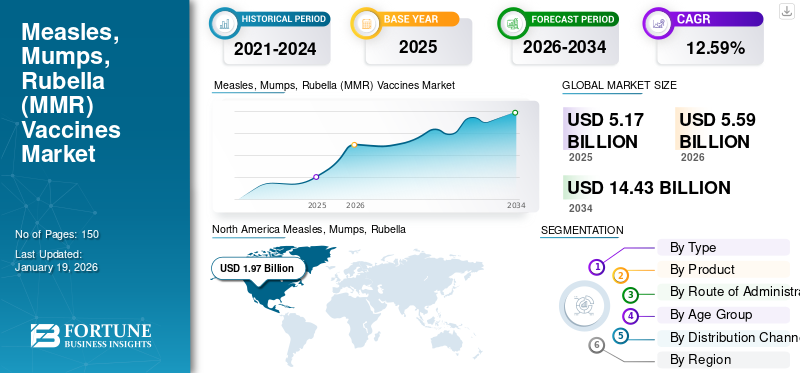
The global measles, mumps, rubella (MMR) vaccines market size was valued at USD 5.17 billion in 2025 and is projected to grow from USD 5.59 billion in 2026 to USD 14.43 billion by 2034, exhibiting a CAGR of 12.59% during the forecast period. North America dominated the measles, mumps, rubella (MMR) vaccines market with a market share of 38.02% in 2025.
The measles, mumps, rubella are three different types of viral, contagious, and life-threatening diseases. The measles, mumps, rubella (MMR) vaccines are combination vaccines that contain live but weakened versions of these three viruses. These vaccines are administered in two doses, mainly at 12 months of age and again at 4 years of age.
The market is experiencing substantial growth, primarily driven by increased incidence of these diseases. Additionally, an increase in awareness and growing support from international organizations, such as the World Health Organization (WHO) and UNICEF, are also promoting the overall market growth. The MMR vaccines have high potency, which increases their demand and further drives the market expansion during the forecast period.
- For instance, according to the data published by the Centers for Disease Control and Prevention, in January 2025, the first dose of the MMR vaccine is 93.0% effective against measles, 72% effective against mumps, and 97% effective against rubella.
The market is expected to show prominent growth in the future due to the high R&D investment by major players, such as GSK plc., Serum Institute of India Pvt. Ltd., and Merck & Co., Inc.
Download Free sample to learn more about this report.
Measles, Mumps, Rubella (MMR) Vaccines Market Key Takeaways
 Global Market Size & Forecast
- 2025 Market Size: USD 5.17 billion
- 2026 Market Size: USD 5.59 billion
- 2034 Forecast Market Size: USD 14.43 billion
- CAGR: 12.59% from 2026–2034
 Market Share
- North America dominated the market with a 38.02% share in 2025.
- Combination vaccines held the largest market share in 2024.
- Government suppliers accounted for the largest distribution channel share in 2024.
 Key Regional Highlights
North America
reached USD 1.97 billion in 2025, accounting for 38.02% of the global market.
Asia Pacific
was valued at USD 1.72 billion in 2025, capturing 33.29% of the global market.
Europe
Europe generated USD 1.25 billion in 2025, representing 24.20% of the global market.
U.S
Led the North American market with strong immunization programs.
Japan
Market growth is supported by expanding vaccination initiatives
Read More

MARKET DYNAMICS
MARKET DRIVERS
Rising Government Initiatives to Boost Market Growth
Government initiatives and awareness programs play an important role in driving the adoption and growth of the market. Many countries, such as India and the U.S., have incorporated MMR vaccines into their National Immunization Program (NIP). These programs provide free or subsidized vaccines to eligible children, which increases the product adoption rate and boosts the market growth. Government campaigns, which are supported by organizations such as the WHO and Gavi, increase vaccine alliance for the distribution of these products. Such initiatives support the immunization programs, further expanding the vaccine coverage across all age groups.
- For instance, the data published on the Gavi’s website in May 2025 indicate that, earlier when the MR vaccine was not introduced into the routine system, Gavi provided support to the measles-rubella vaccine catch-up campaigns for the Gavi-supported countries.
MARKET RESTRAINTS
Vaccine Hesitancy May Limit Market Growth
Measles, Mumps, and Rubella (MMR) vaccine hesitancy may significantly hinder the market growth during the forecast period. Several factors influence vaccine hesitancy, such as religious beliefs, misinformation, and distrust. These factors reduce the vaccine adoption rate and limit the market growth. The WHO defines vaccine hesitancy as the delay in acceptance or refusal of vaccines despite their availability.
- For instance, according to the data published by the National Center for Biotechnology Information, in October 2023, many parents refused to give the MMR vaccine to their young children because they believe that this vaccine presents a higher risk than the disease. This is due to the potential vaccine side effects, such as fever and local injection site pain.
MARKET OPPORTUNITIES
Technological Developments to Offer Lucrative Opportunity in the Future
Technological advancements, such as the use of microarray technology, significantly impact the market and provide lucrative growth opportunities. The measles, mumps, rubella (MMR) vaccines are traditionally given through the intramuscular or subcutaneous route, which may lead to lower patient compliance. The Microarray Patches (MAPs) offer a needle-free, thermostable, and easy-to-administer alternative to traditional needle-and-syringe methods. These factors are expected to improve public health outcomes and increase the product adoption rate, especially in low- and middle-income countries in the future.
- For instance, according to the data published by UNICEF, in June 2019, UNICEF, in collaboration with WHO and partners, developed microarray patches for vaccine delivery.
MARKET CHALLENGES
Cold Chain Maintenance Can Hinder Market Growth
Inadequate cold chain maintenance can hinder the growth of the MMR vaccine market. These vaccines are highly sensitive to temperature fluctuations, and exposure to heat or freezing temperatures can render them ineffective. Additionally, poor cold chain management can lead to increased MMR vaccine wastage and decreased vaccine availability. This leads to delayed or missed vaccinations, which lowers the vaccine uptake rate and hampers the Measles, Mumps, Rubella (MMR) vaccines market growth.
- For instance, according to the data published by the CDC Foundation, in September 2024, cold chain regulation and transportation play a crucial role in ensuring vaccine efficacy. The measles vaccine is a highly temperature-sensitive vaccine, and poor cold chain management may cause problems in vaccine distribution and hamper the market growth.
MEASLES, MUMPS, RUBELLA (MMR) VACCINES MARKET TRENDS
Rise in Public-Private Partnerships is a Key Market Trend
Increasing public-private partnerships are some of key market trends. These partnerships help to extend the reach of MMR vaccination programs by improving distribution logistics, especially in the underserved communities.
Additionally, these types of partnerships are often aligned with the global health initiatives aimed at eliminating or controlling vaccine-preventable diseases, such as measles, mumps, and rubella, which increases the product adoption rate. Moreover, the trend is growing because collaboration with local communities can improve vaccine acceptance and uptake by addressing concerns and building trust in the vaccines.
- For instance, according to the data published by the American Red Cross in May 2025, the resurgence of measles and persistent immunization gaps highlight the urgent need to strengthen immunization programs globally.
- For instance, according to the data published by GAVI in May 2025, Gavi provided USD 55 million for the Measles & Rubella Initiative for the 2013-2017 period. This funding helps in controlling measles & rubella disease outbreaks in the Gavi-supported countries.
Download Free sample to learn more about this report.
Segmentation Analysis
By Type
High Efficacy Drives Growth of the Combination Segment
On the basis of type, the market is segmented into standalone and combination.
The combination segment dominated the measles, mumps, rubella (MMR) vaccines market with the highest share in 2024. The segment's growth is attributed to its convenience, cost-effectiveness, and ability to provide broad protection with fewer injections. Combination vaccines, such as M-M-R II and PRIORIX, provide simultaneous protection against multiple diseases with two doses, which increases patient compliance and drives the segment growth. Additionally, the rise in R&D activities and product approval rate also supports the segment’s growth.
- For instance, in June 2022, GSK plc. received the U.S. FDA approval for Priorix, to prevent measles, mumps, and rubella (MMR) in individuals aged 12 months and older.
The standalone segment held a significant market share in 2024 due to its effectiveness against a single infectious disease, such as mumps, rubella, and others.
By Product
Extended Availability and Usage Immunization Programs Bolsters M-M-R II Product Adoption
Based on product, the market is segmented into M-M-R II, PRIORIX, M-M-RvaxPro, Tresivac, and others.
The M-M-R II segment held the leading measles, mumps, rubella (MMR) vaccines market share in 2024. This growth is due to its availability in the market for over four decades and it has been used in immunization programs across many countries, such as the U.S. Additionally, M-M-R II has played a crucial role in reducing measles and rubella cases and mortality rates globally. This increases its demand across the globe and boost the segment growth.
- For instance, according to the data published by Merck & Co. Inc., in the U.S., more than 231 million doses of M-M-R II vaccine have been sold in the past 30 years.
The PRIORIX segment is anticipated to witness a notable growth throughout the forecast period. This is because it is a U.S. FDA approved drug with strong clinical evidence, which supports its safety and efficacy. Additionally, PRIORIX has been licensed in more than 100 countries, such as Canada, Australia, and across Europe, which exhibits its widespread use and acceptance.
By Route of Administration
Preference for Subcutaneous Method from Clinical Trials Fosters Segment Growth
On the basis of the route of administration, the market is classified into intramuscular, subcutaneous, and others.
The subcutaneous segment dominated the market with the largest share in 2024. This dominance arises from its common preference in clinical trials and regulatory recommendations. Additionally, in children, Subcutaneous (SC) injections might be perceived as less painful than Intramuscular (IM) injections, leading to better patient cooperation during vaccination and promoting segment growth.
- For instance, as per the data published by the Center for Disease Control and Prevention, in May 2023, PRIORIX, and M-M-R II - both are widely used vaccines and are approved by the U.S. FDA, these vaccines are administered by the subcutaneous route.
The intramuscular segment held a significant share of the market in 2024 owing to its high immunogenicity and safety profile. Additionally, increase in key players' focus on the intramuscular route of administration also supports the growth.
By Age Group
High Susceptibility of Infants and Children to Diseases Propels Pediatric Segment Expansion
Based on age group, the market is segmented into adult and pediatric.
The pediatric segment dominated the market with highest share in 2024 driven by the high susceptibility of infants and children to these diseases, as early vaccination is crucial for their health and well-being. The MMR vaccine is included in the pediatric immunization schedules, which support the segment's growth.
- For instance, as per the data published by the Center for Disease Control and Prevention (CDC), in January 2021 the first dose of MMR vaccine should be given at the age of 12 to 15 months and the second dose at the age of 4 to 6 years.
The adult segment held a considerable market share in 2024 due to the increasing emphasis on adult MMR vaccination, especially for those who missed childhood immunizations.
By Distribution Channel
Public Health Initiatives Boost the Growth of Government Suppliers
Based on distribution channel, the market is segmented into hospital & retail pharmacies, government suppliers, and others.
The government suppliers segment held the largest share of the market in 2024. This dominance is due to their crucial role in the public health initiatives and large-scale procurement for the national immunization programs. These programs require significant quantities of vaccines, which are often procured through government channels. Additionally, government suppliers ensure the widespread availability and affordability of MMR vaccines and support the market growth.
- For instance, according to the data published by the UNICEF Supply Division, in October 2022, on behalf of 35 countries, UNICEF procured 181 million doses of measles-rubella vaccine (MR vaccine) in 2021.
The hospital & retail pharmacies segment is expected to grow significantly in the upcoming years. This growth is attributed to their accessibility, convenience, and increasing role in immunization programs. Traditionally, hospitals have been key vaccination sites and provide convenient access to vaccinations, which boosts the segment’s growth during the forecast period.
Measles, Mumps, Rubella (MMR) Vaccines Market Regional Outlook
By region, the market is categorized into North America, Europe, Asia Pacific, Latin America, and the Middle East & Africa.
North America
North America Measles, Mumps, Rubella (MMR) Vaccines Market Size, 2025 (USD Billion)
To get more information on the regional analysis of this market, Download Free sample
North America contributed 38.02% to the global market in 2025, with a valuation of USD 1.97 billion, and is projected to reach USD 2.15 billion in 2026. The high vaccination coverage rate drives the market growth in this region. Additionally, robust public health initiatives support the market growth in this region.
U.S.
The U.S. market held a major share of North America in 2024. The dominance is attributed to its well-established and robust immunization programs. The U.S. has a comprehensive immunization program supported by organizations such as the CDC and the American Academy of Pediatrics (AAP), which ensures widespread vaccination coverage. Additionally, the rise in incidence of mumps, a contagious disease spread through respiratory droplets, also drives the market growth.
- For instance, according to the data published by the Centers for Disease Control and Prevention, in June 2025, there is a 99% decrease in mumps cases after the U.S. started the mumps vaccination program in 1967. However, mumps outbreaks still occur, especially in universities and schools where people have close and prolonged contact.
Europe
Europe accounted for USD 1.25 billion in 2025, representing 24.20% of the global market share, and is projected to reach USD 1.31 billion in 2026. Europe held a significant share of the global measles, mumps, rubella (MMR) vaccines market. This growth is mainly attributed to implementing robust public health policies and vaccination efforts to promote MMR immunization. Additionally, a rise in the incidence of measles and favorable reimbursement policies are expected to support the market growth during the forecast period.
- For instance, according to the data published by the European Centre for Disease Prevention and Control, in March 2025, the two doses of the MMR vaccine were included in the national immunization schedule by all EU/EEA countries.
Asia Pacific
The Asia Pacific market was valued at USD 1.72 billion in 2025, capturing 33.29% of global revenue, and is estimated to reach USD 1.89 billion in 2026. Asia Pacific held a substantial share of the market in 2024 as this region is experiencing the fastest growth due to the rise in government programs. Additionally, an increase in awareness programs raises the demand for preventive vaccines and drives the market growth in this region.
- For instance, according to the data published by the Ministry of Health and Family Welfare, in April 2025, in India, both doses of the Measles-Rubella (MR) vaccine are provided free of cost under the Universal Immunization Programme (UIP).
Latin America and the Middle East & Africa
Latin America and the Middle East & Africa regions held comparatively lower shares in 2024. The rise in awareness about MMR vaccination, with an increase in demand for advanced vaccine delivery technology, supports regional growth. The market in Middle East & Africa reached USD 0.01 billion in 2025, representing 0.15% of total market revenue, and is projected to reach USD 0.01 billion in 2026. In 2025, the Latin America market stood at USD 0.23 billion, representing 4.35% of global demand, and is projected to grow to USD 0.23 billion in 2026.
COMPETITIVE LANDSCAPE
Key Industry Players
Strong R&D Capabilities and Launches by Key Companies Resulted in their Dominating Market Positions
The market is concentrated with companies such as GSK plc., Merck & Co. Inc., and Serum Institute of India Pvt. Ltd., accounting for a significant market share.
The GSK plc. held a significant share of the global market. The company's dominance is due to its robust vaccine portfolio targeting a wide range of infectious diseases, including MMR. The company’s key vaccine, such as PRIORIX, is a widely adopted product. Additionally, GSK plc. has a strong global presence and collaboration with other organizations, leading to driving the company’s growth in the market.
- For instance, in January 2021, GSK plc submitted a Biologics License Application (BLA) for PRIORIX to the U.S. FDA for approval against measles, mumps, and rubella (MMR) infection.
Merck & Co. Inc. accounted for a notable share in 2024. This growth is attributed to its early market entry and strong distribution networks. Additionally, the company has a robust global presence and broad portfolio of vaccines, supporting the company's growth.
Furthermore, Serum Institute of India Pvt. Ltd., Indian Immunologicals Limited, Zydus Lifesciences Limited, Takeda Pharmaceutical Company Limited, and BIOLOGICAL E. LIMITED are among the other key players in the market. These players focus on developing MMR vaccines and have significant investments in research & development, which supports the companies’ share of the market.
LIST OF KEY MEASLES, MUMPS, RUBELLA (MMR) VACCINES COMPANIES PROFILED
- GSK plc. (U.K.)
- Serum Institute of India Pvt. Ltd. (India)
- Merck & Co., Inc. (U.S.)
- Indian Immunologicals Limited (India)
- Zydus Lifesciences Limited (India)
- Takeda Pharmaceutical Company Limited (Japan)
- BIOLOGICAL E. LIMITED (India)
- Invivyd, Inc. (U.S.)
- Daiichi Sankyo Company, Limited (Japan)
KEY INDUSTRY DEVELOPMENTS
- April 2025: The National Zero Measles-Rubella (MR) Elimination Campaign 2025–26 was launched in India with an aim to eliminate Measles and Rubella by 2026.
- January 2025: Micron Biomedical secured a USD 43 million grant to improve measles and rubella vaccine coverage and encourage phase 2 trials of needle-free drug and vaccine technology in infants.
- November 2023: Indian Immunologicals Limited (IIL) partnered with Polyvac Institute of Vietnam to launch the measles and rubella vaccine for children as part of the 25th anniversary of the Human Biologicals Institute.
- March 2023: Merck & Co. Inc. received the U.S. FDA approval for the intramuscular administration of Merck’s M-M-R II (Measles, Mumps, and Rubella Virus Vaccine Live).
- March 2023: Indian Immunologicals Limited (IIL) received regulatory approval for the measles-rubella (MR) vaccine manufacturing from the Drugs Controller General of India and the State Drug Control Administration.
REPORT COVERAGE
The global measles, mumps, rubella (MMR) vaccines market analysis provides market size & forecast by all the segments included in the report. It includes details on the market dynamics and market trends expected to drive the market in the forecast period. It offers information on the prevalence of infectious diseases in key regions/countries, key industry developments, new product launches, details on partnerships, mergers & acquisitions in key countries. The market report covers a detailed competitive landscape with information on the market share and profiles of key players.
Request for Customization to gain extensive market insights.
Report Scope & Segmentation
|
ATTRIBUTE |
DETAILS |
|
Study Period |
2021-2034 |
|
Base Year |
2025 |
|
Estimated Year |
2026 |
|
Forecast Period |
2026-2034 |
|
Historical Period |
2021-2024 |
|
Growth Rate |
CAGR of 12.59% from 2026-2034 |
|
Unit |
Value (USD Billion) |
|
Segmentation |
By Type
|
|
By Product
|
|
|
By Route of Administration
|
|
|
By Age Group
|
|
|
By Distribution Channel
|
|
|
By Region
|
Frequently Asked Questions
Fortune Business Insights says that the global market value stood at USD 5.59 billion in 2026 and is projected to reach USD 14.43 billion by 2034.
In 2025, the North America market value stood at USD 1.97 billion.
The market is expected to exhibit a CAGR of 12.59% during the forecast period.
The combination segment led the market by type.
The key factors driving the market are the rise in the awareness about vaccine-preventable diseases and the rise in demand for MMR vaccines.
GSK plc., Merck & Co. Inc., and Serum Institute of India Pvt. Ltd. are the top players in the market.
North America dominated the measles, mumps, rubella (MMR) vaccines market with a market share of 38.02% in 2025.
Increasing government immunization initiatives, the robust pipeline of products, and a surge in the demand for vaccines in developing markets are some of the factors that are expected to favor product adoption.



- 2021-2034
- 2025
- 2021-2024
- 150
Get 30-60 hrs Free Customization
Expand Regional and Country Coverage, Segments Analysis, Company Profiles, Competitive Benchmarking, and End-user Insights.













.webp)






Related Reports
-
US +1 833 909 2966 ( Toll Free )
-
Get In Touch With Us