 Download Free Sample



Get a Quote
Receive a tailored pricing based on your needs.
- Choose license type
- Multiple user options
- Custom scope & coverage
- Fast turnaround
"Designing Growth Strategies is in our DNA"
 Listen to Audio Version
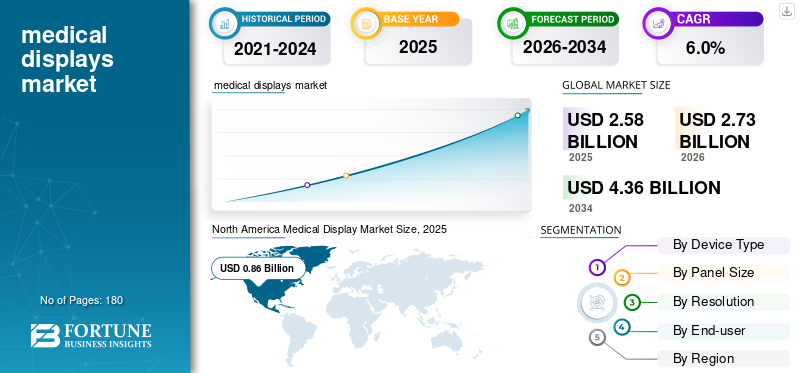
The global medical display market size was valued at USD 2.58 billion in 2025 and is projected to grow from USD 2.73 billion in 2026 to USD 4.36 billion by 2034, exhibiting a CAGR of 6.0% during the forecast period. North America dominated the medical display market with a market share of 33.33% in 2025. Growth is driven by increasing adoption of advanced medical imaging, rising demand for high-resolution diagnostic displays, and expanding healthcare infrastructure.
Medical displays are specialized monitors designed for diagnosis, clinical image viewing, surgery, and patient review, with performance features such as high brightness, grayscale accuracy, DICOM calibration, stable luminance, and long-term image consistency. The global market is growing rapidly, fueled mainly by the transition to digital image management systems that require large, high-brightness monitors in hospitals. As a result, healthcare facilities are upgrading from outdated CCFL and non-compliant screens to DICOM-calibrated LED or OLED displays to meet stringent image quality and regulatory requirements.
Furthermore, Barco, EIZO Inc., and Sony held the highest market share in 2025 due to their diversified portfolio and strong brand reputation.
Download Free sample to learn more about this report.
 Market Size & Forecast
 Market Share
 Key Regional Highlights
North America
North America accounted for the largest share of revenues in 2024, valued at USD 0.82 billion, and also dominated in 2025 with a value of USD 0.86 billion. Robust infrastructure in the region is leading to high volumes of diagnostic and surgical procedures.
Europe
Europe is projected to record a growth rate of 5.4% during the forecast period, reaching USD 0.77 billion by 2026 due to established radiology workflows and the widespread use of CT, MRI, and PET across advanced healthcare systems.
Asia Pacific
Asia Pacific is projected to attain USD 0.61 billion by 2026, supported by expanding healthcare infrastructure and increasing investments in digital healthcare.
U.S.
The market is anticipated to reach USD 0.78 billion in 2026, representing approximately 28.5% of the global market, supported by favorable reimbursement policies and rising procedure volumes.
Japan
The market is projected to generate USD 0.17 billion in revenue by 2026, accounting for nearly 6.2% of the global market, driven by continued healthcare technology adoption.
Read More

Shift toward High-Resolution, Workflow-Centric, and AI-Ready Displays to Emerge as a Key Trend
Currently, key players are emphasizing higher resolution, wider panels, and breast imaging optimization, multiview viewing, and AI-enabled surgical visualization. They are positioning displays as part of a larger clinical workflow that includes integration with PACS and image management systems, as well as future-ready operating room platforms.
Download Free sample to learn more about this report.
Growing Adoption of Advanced Medical Imaging Modalities to Fuel the Market Expansion
Over the past few years, there has been a significant surge in diagnostic imaging procedures, including MRI, mammography, CT, ultrasound, and endoscopy, driving strong demand for DICOM-compliant, high-resolution medical displays for accurate image review and diagnosis. In response, major manufacturers are developing new products and entering partnerships with imaging system manufacturers to expand their reach worldwide. These factors are expected to drive the global medical display market growth.
High Cost of Medical-Grade Displays to Restrict Market Growth
Despite strong demand for medical displays, the increased cost poses a major obstacle to broad adoption, especially in smaller hospitals and diagnostic centers. These displays must adhere to rigorous regulations and standards, which increases the overall production and calibration costs. Moreover, ongoing recalibration and maintenance needs increase total ownership costs, which is expected to hinder the market expansion in the forthcoming years.
Expansion of Telemedicine to Offer Lucrative Opportunities
In recent years, the rise of telemedicine, digital pathology, and AI-powered diagnostic imaging has unlocked substantial growth opportunities for medical displays. The growing need for high-resolution, color-accurate, and remotely accessible visualization tools is also driving the demand for cutting-edge OLED, 4K/8K, and cloud-enabled medical monitors. This is expected to drive market expansion in the coming years.
Technology Obsolescence, Integration Burden, and Price Pressure to Challenge Market Expansion
Rapid upgrades in panel technology, interface standards, and application-specific requirements may shorten the perceived relevance of products, forcing key companies to invest in R&D activities. Hospitals continuously must ensure compatibility among displays, graphics boards, PACS viewers, calibration software, and specialty workflows, further complicating deployment across large enterprises. Moreover, established brands and cost-focused domestic manufacturers are intensifying competition, which is expected to challenge market expansion.
Increasing Diagnostic Imaging Volumes to Boost the Diagnostic Displays Segment Growth
Based on device type, the market is segmented into diagnostic displays, surgical displays, dental displays, and others.
To know how our report can help streamline your business, Speak to Analyst
The diagnostic displays segment accounted for the largest global medical display market share in 2025. The segment’s growth is attributed to rising diagnostic imaging volumes and mandatory DICOM calibration requirements, which are expected to drive greater adoption of these displays in radiology departments.
Additionally, the surgical displays segment is projected to grow at a CAGR of 6.5% during the forecast period.
Increasing Number of Surgical Procedures to Drive the 23–26 Inches Segment Growth
By panel size, the market is segmented into up to 22 inches, 23–26 inches, and above 41 inches.
The 23–26 inches segment accounted for the largest market share in 2025. The segment’s growth is attributed to greater use of these displays in surgical procedures. Furthermore, the increasing number of surgical procedures is expected to drive the adoption of these displays. Moreover, the segment is estimated to hold a 45.1% share in 2026.
Additionally, the up to 22 inches segment is anticipated to grow at a CAGR of 5.0% over the forecast period.
High Usage of 2.1–4MP Displays in Radiology Departments to Boost the Segment’s Growth
By resolution, the market is classified into up to 2MP, 2.1–4MP, 4.1–8MP, and above 8MP.
The 2.1–4MP segment accounted for the largest market share in 2025. These resolutions fit general radiology, CT, MRI, and ultrasound applications well and are widely adopted in radiology departments. The adoption is due to their provision of sufficient pixel density for detailed image analysis at a lower cost than 5MP or 8MP alternatives. This affordability is expected to drive the segment’s expansion during the forecast period. Moreover, the segment is projected to hold a 36.2% share in 2026.
Additionally, the 4.1–8MP segment is expected to grow at a CAGR of 6.6% during the forecast period.
Increasing Surgical Volume in Hospitals & ASCs to Propel the Segment’s Growth
On the basis of end-user, the market is segmented into diagnostic imaging centers, hospitals & ASCs, dental clinics, and others.
In 2025, the hospitals & ASCs segment led the market by end-user. There has been a rise in surgical volumes in ASCs and hospitals, boosting medical display usage in these settings and contributing to the segment’s growth in the coming years. Furthermore, the segment is set to hold 59.9% share in 2026.
In addition, the diagnostic imaging centers segment is estimated to surge at a CAGR of 6.4% during the analysis period.
Based on geography, the market is classified into North America, Europe, Asia Pacific, Latin America, and the Middle East & Africa.
North America Medical Display Market Size, 2025 (USD Billion)
To get more information on the regional analysis of this market, Download Free sample
North America accounted for the largest share of revenues in 2024, valued at USD 0.82 billion, and also dominated in 2025 with a value of USD 0.86 billion. Robust infrastructure in the region is leading to high volumes of diagnostic and surgical procedures. Further, strong U.S. reimbursement policies are expected to boost display utilization by increasing procedure rates.
In 2026, the U.S. is anticipated to reach USD 0.78 billion, accounting for approximately 28.5% of the global market.
Europe is projected to record a growth rate of 5.4% during the forecast period, the third-highest globally, reaching USD 0.77 billion by 2026. The growth is attributed to established radiology workflows and the widespread use of CT, MRI, and PET across advanced healthcare systems in countries such as Germany, the U.K., and France.
The U.K. market is projected to reach USD 0.15 billion by 2026, representing approximately 5.4% of global revenues.
The Germany market is expected to reach USD 0.17 billion by 2026, accounting for approximately 6.2% of global revenue.
By 2026, the Asia Pacific market is projected to reach approximately USD 0.61 billion, making it the second-largest market worldwide. The growth is attributed to expanding healthcare infrastructure and growing investment in digital healthcare across China, India, Japan, South Korea, Australia, and Southeast Asia.
The Japan market is projected to generate approximately USD 0.17 billion in revenue by 2026, representing nearly 6.2% of the global market.
The China market is anticipated to reach around USD 0.22 billion by 2026, accounting for nearly 7.9% of global revenues.
The India market is expected to reach approximately USD 0.10 billion by 2026, accounting for around 3.7% of the global market revenue.
Both Latin America and the Middle East & Africa are anticipated to witness moderate growth, with the Latin America market estimated to reach approximately USD 0.26 billion by 2026. The growth is supported by the gradual expansion of private hospitals, diagnostic centers, and specialty care infrastructure, especially in urban areas.
By 2026, the GCC market is estimated to reach approximately USD 0.08 billion, representing around 2.8% of global revenues.
Strong Product Portfolios Paired with Extensive Distribution to Solidify Leading Companies' Market Dominance
In 2025, Barco, EIZO Inc., and Sony held the largest global market share. This share is attributed to their established presence in radiology and surgical visualization, extensive product portfolios, and long-standing relationships with hospitals and imaging centers.
Moreover, other major players are expanding their geographical presence through signing strategic partnerships and acquisition agreements. Further, they are launching new products to expand their product portfolio and strengthen market share.
The report offers a comprehensive analysis of all market segments, examining key drivers, evolving trends, growth opportunities, restraints, and challenges influencing the market landscape. It further provides insights into technological developments, key procedure volumes, major industry developments, market share analysis, and detailed profiles of leading companies.
Request for Customization to gain extensive market insights.
| ATTRIBUTE | DETAILS |
| Study Period | 2021-2034 |
| Base Year | 2025 |
| Estimated Year | 2026 |
| Forecast Period | 2026-2034 |
| Historical Period | 2021-2024 |
| Growth Rate | CAGR of 6.0% from 2026-2034 |
| Unit | Value (USD Billion) |
| Segmentation | By Device Type, Panel Size, Resolution, End-user, and Region |
| By Device Type |
|
| By Panel Size |
|
| By Resolution |
|
| By End-user |
|
| By Region |
|
Fortune Business Insights says that the global market value stood at USD 2.58 billion in 2025 and is projected to reach USD 4.36 billion by 2034.
In 2025, the North America market value stood at USD 0.86 billion.
The market is expected to exhibit a CAGR of 6.0% during the forecast period of 2026-2034.
The diagnostic displays segment led the market by device type in 2025.
A key factor driving the market is the growing adoption of advanced medical imaging modalities.
Barco, EIZO Inc., and Sony are the prominent players in the market.
North America dominated the market in 2025.

Get 30-60 hrs Free Customization
Expand Regional and Country Coverage, Segments Analysis, Company Profiles, Competitive Benchmarking, and End-user Insights.













.webp)






Related Reports
Get In Touch With Us
US +1 833 909 2966 ( Toll Free )
Receive a tailored pricing based on your needs.
Discuss your questions with our industry experts.
Have questions? Get quick answers before you purchase.

