Medical Elastomers Market Size, Share & Industry Analysis, By Type (Thermoset Elastomers and Thermoplastic Elastomers), By Application (Medical Devices & Equipment, Medical Packaging, and Others), and Regional Forecast, 2026-2034
 Download Free Sample
KEY MARKET INSIGHTS
 Listen to Audio Version
The global medical elastomers market size was valued at USD 18.16 billion in 2025 and is projected to grow from USD 19.3 billion in 2026 to USD 31.7 billion by 2034, exhibiting a CAGR of 6.40% during the forecast period. North America dominated the medical elastomers market with a market share of 48% in 2025.
Medical elastomers are flexible, rubber-like materials used in manufacturing various medical devices and components such as tubing, catheters, syringe plungers, seals, and gaskets. Their significance lies in their excellent biocompatibility, durability, chemical resistance, and ability to withstand sterilization. The market is witnessing considerable growth due to the rising demand for advanced healthcare solutions, increasing surgical procedures, and the growing elderly population requiring long-term medical care. Additionally, the surge in wearable medical devices and minimally invasive medical equipment drives further material adoption. The major manufacturers operating in the market include BASF, Dow, Kent Elastomer Products, Mitsubishi Chemical Group Corporation, and DuPont.
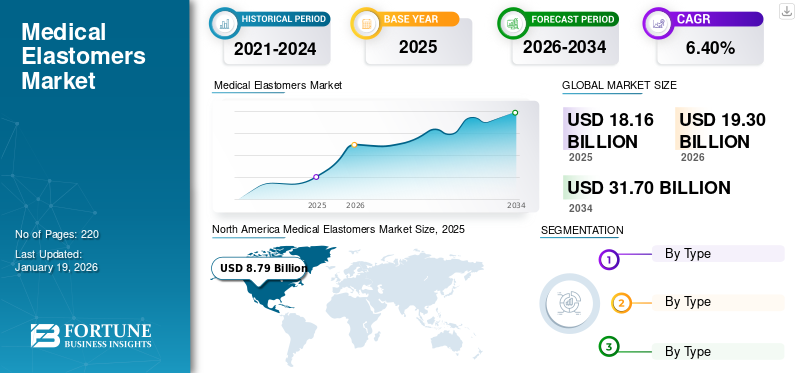
Download Free sample to learn more about this report.
Medical Elastomers Market Key Takeaways
 Market Size & Forecast
- 2025 Market Size: USD 18.16 Billion
- 2026 Market Size: USD 19.30 Billion
- 2034 Forecast Market Size: USD 31.70 Billion
- CAGR: 6.40% from 2026–2034
 Market Share
- North America dominated the medical elastomers market with a 48.00% share in 2025.
- Thermoplastic elastomers held the dominant market share by type in 2024.
- Medical devices & equipment accounted for the largest market share by application in 2024.
 Key Regional Highlights
North America
North America led the market with a value of USD 8.79 billion and a 48.00% share in 2025.
Asia Pacific
Asia Pacific accounted for USD 4.16 billion, representing 23.00% of global revenue in 2025.
Europe
Europe reached USD 4.11 billion and captured 23.00% of the global market share in 2025.
U.S.
Strong demand for minimally invasive procedures and wearable medical devices continues to support market growth.
Japan
Rising healthcare investments and increasing adoption of advanced medical technologies are driving market expansion.
Read More

MARKET DYNAMICS
MARKET DRIVERS
Expanding Medical Application to Drive Demand for Product
The growing range of medical applications is a key factor fueling the demand for medical elastomers. These materials are widely used in producing medical tubing, gaskets, surgical instruments, syringe plungers, respiratory masks, and drug delivery systems due to their flexibility, chemical resistance, and biocompatibility. As surgeries, hospital admissions, and diagnostic procedures continue to rise, the need for durable and safe materials in disposable and reusable medical devices increases significantly. Moreover, the rise in chronic disease and the growing demand for home healthcare products have expanded the use of elastomers. The increasing adoption of elastomer-based materials across a wide range of healthcare applications is expected to drive the global medical elastomers market growth.
MARKET RESTRAINTS
High Manufacturing Costs and Supply Chain Disruptions to Restrict Market Growth
The market faces significant restraints due to high production costs and supply chain variability. Manufacturing medical-grade elastomers requires expensive, biocompatible raw materials and complying with stringent regulatory standards. Manufacturers must invest in cleanroom facilities, rigorous testing, and quality assurance processes to meet the safety and performance requirements of the healthcare industry. These factors significantly increase overall production expenses. In addition, the supply chain for these materials is often unstable, affected by raw materials shortages and transportation delays. Such disruptions can lead to inconsistent supply and longer lead times, forcing manufacturers to maintain higher inventory levels and absorb additional costs.
MARKET OPPORTUNITIES
Rising Focus on Silicone and Bio-Based Elastomers to Boost Market Growth
The increasing emphasis on sustainability and material performance opens new opportunities in the market. Silicone elastomers are witnessing growing demand due to their superior biocompatibility, durability, and flexibility. Their ability to withstand sterilization and maintain performance under extreme conditions makes them ideal for various medical applications including catheters, seals, respiratory devices, and implantable components. Additionally, bio-based elastomers are emerging as a greener alternative, offering reduced environmental impact while meeting healthcare safety standards. As the industry moves toward more sustainable solutions, the adoption of both silicone and bio-based elastomers is expected to support strong growth in the near future.
MEDICAL ELASTOMERS MARKET TRENDS
Rising Adoption of Antimicrobial and Specialty-Grade Medical Elastomers to be a Market Trend
There is a growing shift in the market toward antimicrobial and specialty formulations aimed at improving patient safety and product performance. With increasing awareness around hospital-acquired infections, healthcare providers are prioritizing materials that can inhibit microbial growth on device surfaces such as catheters, tubes, and gaskets. In response, manufacturers are introducing elastomers with built-in antimicrobial properties to reduce contamination risks. Additionally, specialty-grade elastomers are designed to meet specific application needs, offering enhanced durability, chemical resistance, and flexibility. As hospitals and device manufacturers prioritize hygiene, safety, and performance, adopting these next-generation elastomers will accelerate in the coming years.
MARKET CHALLENGES
Strict Regulatory Norms and Growing Preference for Alternatives Challenge Market Growth
The market faces challenges due to strict regulatory standards and the rising adoption of alternative materials. Medical elastomers must meet rigorous biocompatibility, toxicity, and environmental safety requirements, which vary across countries and regulatory bodies. Complying these standards often involves high R&D costs, prolonged testing, and approval procedures. In addition, the growing preference for substitutes such as medical-grade silicones, thermoplastic polyurethanes, and biodegradable polymers is intensifying competition. As a result, this urges manufacturers to invest in innovation and enhance product quality to maintain their market position.
Download Free sample to learn more about this report.
Segmentation Analysis
By Type
Thermoplastic Elastomers Dominated Market Owing to High Flexibility and Rising Use in Advanced Medical Devices
Based on type, the market is segmented into thermoset elastomers and thermoplastic elastomers.
The thermoplastic elastomers (TPE) segment held a dominant global market share in 2024, primarily due to their excellent flexibility, ease of processing, and reusability. These properties make TPEs ideal for a wide range of medical applications such as tubing, catheters, syringe plungers, and IV systems. Their high biocompatibility and resistance to sterilization methods such as gamma radiation and autoclaving further enhance their suitability for medical use. The increasing demand for lightweight, flexible materials in minimally invasive devices and wearable medical technologies significantly contributes to the segment’s expansion. Furthermore, the rise in medical-grade innovations and the shift toward sustainable healthcare materials are boosting the use of TPEs across the industry.
The thermoset elastomers segment holds a considerable market share due to their superior durability, chemical resistance, and mechanical strength. These materials are especially suitable for long-term reliability applications, such as seals, gaskets, and implantable devices. Their ability to maintain performance under extreme conditions makes them ideal for complex surgical environments. The increasing focus on high-performance and long-lasting medical components is expected to support the steady growth of this segment in the coming years.
By Application
Medical Devices & Equipment Segment Led Market Growth with Rising Demand for Flexible and High-Performance Healthcare Solutions
Based on application, the market is segmented into medical devices & equipment, medical packaging, and others.
The medical devices & equipment segment held a dominant global medical elastomers market share in 2024, primarily due to the growing need for flexible, biocompatible, and durable materials in modern healthcare applications. They are widely used in products such as catheters, tubing, syringe plungers, valves, and seals owing to their excellent chemical resistance and compatibility with various sterilization methods. The growing demand for minimally invasive procedures, wearable medical devices, and home healthcare solutions is significantly boosting the segment’s growth. Additionally, advancements in medical technologies and the rising prevalence of chronic conditions further accelerate product adoption in device manufacturing.
The medical packaging segment is witnessing significant growth due to the rising focus on ensuring sterility, product integrity, and extended shelf life of pharmaceutical and medical products. They are widely used in closures, seals, stoppers, and flexible packaging solutions due to their excellent sealing properties and compatibility with sensitive drug formulations. As the pharmaceutical and healthcare industries face stricter hygiene regulations and quality standards, the need for high-performance elastomeric materials in medical packaging is expected to grow steadily.
Medical Elastomers Market Regional Outlook
By geography, the market is categorized into Asia Pacific, North America, Europe, Latin America, and the Middle East & Africa.
North America
North America Medical Elastomers Market Size, 2025 (USD Billion) To get more information on the regional analysis of this market, Download Free sample
North America dominated the market with a valuation of USD 8.79 billion in 2025 and is projected to reach USD 9.31 billion in 2026. The North America region dominates the global medical elastomers market, driven by a robust healthcare system, increasing demand for advanced medical technologies, and strong investment in research and development. The U.S. and Canada are witnessing increased adoption of minimally invasive procedures, wearable medical technologies, and home healthcare solutions requiring high-performance elastomeric components. Government support for medical innovation further accelerates market growth. Additionally, a surge in chronic diseases, an aging population, and ongoing technological advancements in medical device manufacturing continue to drive the demand for the product across the region.
Asia Pacific
The Asia Pacific market was valued at USD 4.16 billion in 2025, capturing 23.00% of global revenue, and is projected to reach USD 4.48 billion in 2026. The Asia Pacific region is experiencing steady growth, driven by rapid advancements in healthcare infrastructure, growing population, and increasing healthcare expenditure across countries such as China, India, Japan, and South Korea. The rising demand for medical devices, diagnostics, and consumables is significantly boosting the consumption of the product. Government initiatives to expand access to healthcare and rising investments from domestic and international medical device manufacturers are further accelerating market growth. Additionally, the region’s strong manufacturing base, low production costs, and growing adoption of advanced medical technologies continue to drive demand for high-performance elastomeric materials.
Europe
Europe accounted for USD 4.11 billion in 2025, representing 23.00% of the global market share, and is projected to reach USD 4.35 billion in 2026. In Europe, the market is shaped by strict regulatory standards, a strong focus on sustainability, and advanced healthcare infrastructure. The region’s emphasis on high-quality, biocompatible, and environmentally friendly materials drives the adoption of medical elastomers in a wide range of applications including diagnostic devices, surgical tools, and packaging. Countries including Germany, the U.K., and France invest heavily in healthcare innovation, medical technology advancements, and aging population care, boosting the demand for reliable and durable elastomeric components. Additionally, with well-established manufacturing capabilities and ongoing efforts to improve patient safety and product performance, Europe remains a key market for the product.
Latin America
In 2025, the Latin America market stood at USD 0.71 billion, representing 4.00% of global demand, and is projected to grow to USD 0.75 billion in 2026. In Latin America, the market is expanding due to improving healthcare infrastructure, growing demand for medical devices, and rising government investments in public health systems. Countries including Brazil and Mexico are witnessing increased production and import of medical equipment, supported by a growing middle-class population and rising awareness of advanced healthcare solutions. The demand for disposable medical products, such as tubing, catheters, and seals, further boosts elastomer consumption. Additionally, the growing presence of global medical device manufacturers and rising investments in domestic production are accelerating market expansions across the region.
Middle East & Africa
The market in Middle East & Africa reached USD 0.38 billion in 2025, representing 2.00% of total market revenue, and is projected to reach USD 0.4 billion in 2026. In the Middle East and Africa, the market is witnessing steady growth, driven by the expansion of healthcare infrastructure and increased investment in the medical sector. Countries including GCC and South Africa are leading this growth through major investments in hospitals, clinics, and healthcare innovation. The rising demand for disposable medical devices is further fueling the market growth. In addition, efforts to boost local manufacturing capabilities and reduce reliance on imports further contribute to the market’s expansion across the region.
COMPETITIVE LANDSCAPE
Key Industry Players
Continuous Investments in R&D to Introduce New Products by Key Companies to Maintain Their Dominating Position in Market
The global medical elastomers market is highly competitive, with key players focusing on technological advancements, mergers & acquisitions, and capacity expansion to increase their market presence. Global companies include BASF, Dow, Kent Elastomer Products, Mitsubishi Chemical Group Corporation, and DuPont. These companies compete based on purity levels, cost-effective processing techniques, supply chain integration, and regional dominance while investing in sustainable extraction technologies to address environmental concerns. While global leaders dominate in developed markets, regional players are expanding aggressively in emerging economies, intensifying competition in the industry.
LIST OF KEY MEDICAL ELASTOMER COMPANIES
- BASF (Germany)
- Dow (U.S.)
- Celanese Corporation (U.S.)
- Kent Elastomer Products (U.S.)
- Avient Corporation (U.S.)
- KURARAY CO., LTD. (Japan)
- Mitsubishi Chemical Group Corporation. (Japan)
- Trelleborg Group (Sweden)
- DuPont (U.S.)
- Teknor Apex (U.S.)
KEY INDUSTRY DEVELOPMENTS
- September 2021: DuPont expanded its Healthcare Industries Materials Site in Hemlock, Michigan, by inaugurating new medical elastomer mixers to boost in-house production of medical-grade silicone elastomers. This move supports growing demand in biopharmaceutical processing, medical devices, and topical blend solutions.
REPORT COVERAGE
Request for Customization to gain extensive market insights.
Report Scope & Segmentation
|
ATTRIBUTE |
DETAILS |
|
Study Period |
2021-2034 |
|
Base Year |
2025 |
|
Estimated Year |
2026 |
|
Forecast Period |
2026-2034 |
|
Historical Period |
2021-2024 |
|
Growth Rate |
CAGR of 6.40% from 2026-2034 |
|
Unit |
Value (USD Billion) and Volume (Kiloton) |
|
Segmentation |
By Type · Thermoset Elastomers · Thermoplastic Elastomers |
|
By Application · Medical Devices & Equipment · Medical Packaging · Others |
|
|
By Region · North America (By Type, By Application, and By Country) o U.S. (By Application) o Canada (By Application) · Europe (By Type, By Application, and By Country) o Germany (By Application) o U.K. (By Application) o Italy (By Application) o France (By Application) o Rest of Europe (By Application) · Asia Pacific (By Type, By Application, and By Country) o China (By Application) o India (By Application) o Japan (By Application) o South Korea (By Application) o Rest of Asia Pacific (By Application) · Latin America (By Type, By Application, and By Country) o Brazil (By Application) o Mexico (By Application) o Rest of Latin America (By Application) · Middle East & Africa (By Type, By Application, and By Country) o GCC (By Application) o South Africa (By Application) · Rest of Middle East & Africa (By Application) |
Frequently Asked Questions
Fortune Business Insights says that the global market value stood at USD 18.16 billion in 2025 and is projected to reach USD 31.7 million by 2034.
In 2025, the market value stood at USD 8.79 billion.
The market is expected to exhibit a CAGR of 6.40% during the forecast period of 2026-2034.
The key factors driving the medical elastomers market are rising healthcare demand and growing preference for biocompatible and flexible materials.
BASF, Dow, Kent Elastomer Products, Mitsubishi Chemical Group Corporation, and DuPont are the top players in the market.
North America dominated the market in 2025.
Rising demand for advanced medical devices, increasing healthcare spending, and the growing preference for minimally invasive procedures are some of the key factors expected to favor the adoption of medical elastomers.



- 2021-2034
- 2025
- 2021-2024
- 220
Get 30-60 hrs Free Customization
Expand Regional and Country Coverage, Segments Analysis, Company Profiles, Competitive Benchmarking, and End-user Insights.


















Related Reports
-
US +1 833 909 2966 ( Toll Free )
-
Get In Touch With Us