Vehicle Subscription Market Size, Share & Industry Analysis, By Service Provider (OEM and Independent Third Party Providers), By Subscription Type (Single-Vehicle Subscription And Multi-Vehicle Subscription), By Vehicle Type (Hatchback, SUV, and Commercial Vehicle), By Tenure (Less than 1 month, 1–6 months, 6–12 months, and More than 12 Months), By Propulsion Type (ICE and Electric), and Regional Forecast, 2026–2034
 Download Free Sample
(Offer valid till 30th Sep 2026)

Vehicle Subscription Market Size and Future Outlook
 Listen to Audio Version
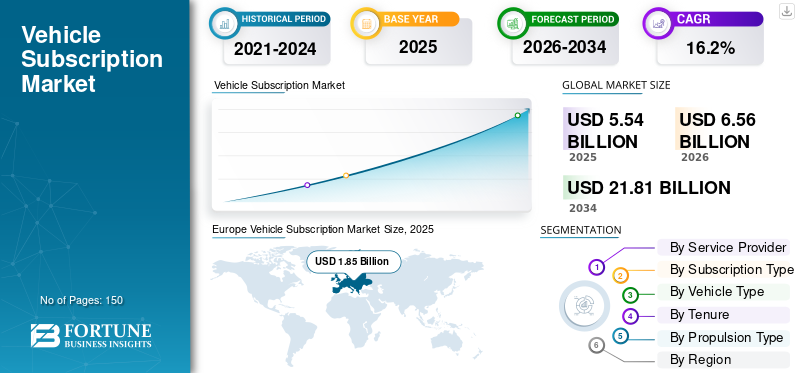
The global vehicle subscription market size was valued at USD 5.54 billion in 2025. The market is projected to grow from USD 6.56 billion in 2026 to USD 21.81 billion by 2034, exhibiting a CAGR of 16.2% during the forecast period. Europe dominated the vehicle subscription market with a market share of 33.39% in 2025.
The market is growing as consumers increasingly prefer flexible, short term mobility options over traditional vehicle ownership or leasing. Vehicle subscription services offer benefits such as insurance, maintenance, roadside assistance, and vehicle swapping under a single monthly fee. Rising urbanization, digital booking platforms, and demand for electric vehicle access are supporting adoption. OEMs, rental companies, and mobility startups are expanding subscription models to attract private and corporate users.
Key drivers of the global market include the rising demand for flexible mobility, growing preference for access over ownership, and increasing vehicle ownership costs. Bundled services such as insurance, maintenance, and roadside assistance make subscriptions attractive. Digital platforms, urban mobility needs, and expanding EV subscription contract offerings further support market growth.
Major players in the market include Volvo Cars, Porsche Drive, Sixt, and FINN. These companies are competing through flexible subscription plans, digital booking platforms, bundled insurance and insurance maintenance services, electric vehicle offerings, and customer-focused mobility solutions.
Download Free sample to learn more about this report.
VEHICLE SUBSCRIPTION MARKET Key Takeaways
 Market Size & Forecast
- 2025 Market Size: USD 5.54 Billion
- 2026 Market Size: USD 6.56 Billion
- 2034 Forecast Market Size: USD 21.81 Billion
- CAGR: 16.2% from 2026–2034
 Market Share
- Europe dominated the vehicle subscription market with a 33.39% share in 2025.
- The independent third party providers segment held the largest market share by service provider.
- The single-vehicle subscription segment accounted for the largest market share by subscription type.
 Key Regional Highlights
Europe
Europe led the market with a size of USD 1.85 billion in 2025, accounting for 33.39% of the global market.
North America
North America is the second-largest regional market and is projected to grow at a 15.4% CAGR during the forecast period.
Asia Pacific
Asia Pacific is the third-largest market, supported by rapid urbanization and increasing adoption of flexible mobility solutions.
U.S.
The market is projected to reach USD 1.78 billion in 2026, driven by strong demand for flexible vehicle access and EV subscriptions.
Japan
The market is projected to reach USD 0.21 billion in 2026, supported by rising demand for compact and electric vehicle subscription services.
Read More

VEHICLE SUBSCRIPTION MARKET TRENDS
Digital Platforms and App-Based Booking is a Major Market Trend
Digitalization is emerging as a major trend in the market, as providers increasingly use mobile apps and online platforms to simplify the customer journey. Customers can compare plans, select vehicles, upload documents, manage payments, schedule maintenance, and request vehicle swaps through digital channels. This improves transparency, reduces paperwork, and enhances convenience compared to traditional ownership or leasing processes. Subscription providers are also using data analytics to personalize offers, optimize fleet utilization, predict demand, and manage customer retention. The integration of digital payments, telematics, and connected vehicle data is further improving operational efficiency. As consumers become more comfortable with app-based services, digital-first subscription platforms are expected to gain stronger market traction.
MARKET DYNAMICS
MARKET DRIVERS
Download Free sample to learn more about this report.
Rising Preference for Flexible Mobility to Drive Subscription Adoption
The growing consumer shift from vehicle ownership to flexible mobility is a major driver for vehicle subscription market growth. Customers increasingly prefer access-based models that allow them to use vehicles without long-term financial commitments, down payments, resale concerns, or maintenance responsibilities. Subscription services offer a bundled monthly package that may include insurance, maintenance, registration, roadside assistance, and vehicle swapping options, making them attractive for urban users, young professionals, expatriates, and corporate employees. The model also supports changing mobility needs, as customers can upgrade, downgrade, or switch vehicles based on lifestyle, travel, or business requirements. As ownership costs continue to rise and consumers seek convenience, subscription-based mobility is gaining strong acceptance across developed and emerging markets.
MARKET RESTRAINTS
High Subscription Costs and Limited Consumer Awareness to Restrain Market Growth
High monthly subscription costs remain a key restraint for the market, particularly in price-sensitive regions. Although subscriptions offer convenience and bundled services, their overall cost can be higher than traditional leasing or financing when used for longer durations. Many consumers still compare subscriptions with ownership based on monthly payments rather than total cost of convenience, which limits adoption. In addition, the awareness of vehicle subscription models remains relatively low in several emerging markets, where consumers are more familiar with car loans, rentals, and leasing. The limited availability of subscription plans outside major urban areas further restricts market penetration. These factors may slow adoption among cost-conscious customers and delay the expansion of subscription-based mobility services.
MARKET OPPORTUNITIES
Growing Electric Vehicle Subscription Models to Create New Market Opportunities
The rising adoption of electric vehicles is creating strong opportunities for industry players. Many customers are interested in using EVs but hesitate to purchase them due to concerns over high upfront cost, battery life, charging access, resale value, and technology changes. Subscription models reduce these barriers by allowing consumers and businesses to experience EVs without long-term ownership risks. Providers can bundle charging support, maintenance, insurance, and flexible vehicle upgrades into monthly plans, making EV adoption easier and more attractive. Corporate fleets can also use subscriptions to test electric vehicles before large-scale fleet conversion. As governments promote clean mobility and OEMs expand EV portfolios, EV-focused subscription services are expected to become an important growth avenue.
MARKET CHALLENGES
Fleet Utilization and Residual Value Management to Create Challenges for Service Providers
Managing fleet utilization and residual vehicle value is a major challenge for subscription companies. Providers must maintain the right mix of vehicles across locations, price plans, and customer segments while avoiding idle inventory. Low utilization can increase operating costs, while limited vehicle availability can reduce customer satisfaction. In addition, frequent vehicle swaps, mileage variation, maintenance needs, and changing consumer preferences can affect resale value and fleet profitability. Subscription operators also face challenges in accurately forecasting the demand for vehicle types, including SUVs, premium cars, and electric vehicles. To remain profitable, companies must balance flexible customer offerings with disciplined fleet lifecycle management, pricing strategies, remarketing channels, and maintenance planning.
Segmentation Analysis
By Service Provider
Broad Vehicle Availability and Flexible Pricing to Propel Independent Third Party Providers Segmental Dominance
Based on service provider, the market is categorized into OEM and independent third party providers.
The independent third party providers segment holds a dominant vehicle subscription market share due to wider vehicle availability, flexible pricing models, and brand-neutral subscription offerings. These providers aggregate vehicles from multiple OEMs, leasing firms, rental companies, and fleet operators, allowing customers to compare different models, tenures, and monthly plans on a single platform. Their strong digital presence, simplified onboarding, bundled insurance and maintenance, and ability to serve both private individuals and corporate users support higher adoption. Independent providers are also better positioned to offer short-term and multi-brand subscriptions, making them attractive for urban consumers seeking flexibility without ownership commitments.
The OEM segment is expected to expand at a CAGR of 15.4% over the forecast period. Automakers are launching subscription programs to strengthen direct customer relationships, improve vehicle utilization, promote EV adoption, and create recurring revenue streams beyond traditional vehicle sales and leasing.
By Subscription Type
Convenience and Predictable Payment Options to Propel Single-Vehicle Subscription Segmental Dominance
Based on subscription type, the market is categorized into single-vehicle subscription and multi-vehicle subscription.
The single-vehicle subscription segment dominates the market as most customers prefer one dedicated vehicle for personal, family, or business use without the burden of ownership. This model offers predictable monthly payments, bundled insurance, maintenance, registration, and roadside assistance, making it simpler than traditional leasing or financing. Single-vehicle plans are especially popular among urban professionals, expatriates, and users with changing mobility needs. The segment benefits from easy digital onboarding, flexible tenure options, and access to different vehicle categories, supporting strong adoption among private individuals and small business users.
The multi-vehicle subscription segment is expected to expand at a CAGR of 17.3% over the forecast period. The segment growth is driven by corporate mobility needs, fleet flexibility, seasonal demand, and businesses seeking access to multiple vehicles without long-term ownership, maintenance, or resale responsibilities.
By Vehicle Type
Rising Consumer Preference to Propel SUV Segmental Dominance
Based on segmentation by vehicle type, the market is categorized into hatchback, SUV, and commercial vehicles.
The SUV segment dominates the market due to strong consumer preference for spacious, comfortable, and multi-purpose vehicles. SUVs are widely preferred by families, urban professionals, corporate users, and premium mobility customers seeking flexibility without ownership costs. Their higher seating capacity, road presence, safety features, and suitability for both city and leisure travel make them attractive under subscription models. Providers also prioritize SUVs due to higher monthly subscription values and strong demand across developed and emerging markets.
The hatchback segment is expected to expand at a CAGR of 15.5% over the forecast period. The segment growth is driven by affordability, ease of urban driving, lower subscription costs, and strong demand among first-time users, students, young professionals, and cost-conscious private individuals.
To know how our report can help streamline your business, Speak to Analyst
By Tenure
Flexible Medium-Term Mobility Needs to Propel 1–6 Months Segmental Dominance
Based on tenure, the market is categorized into less than 1 month, 1–6 months, 6–12 months, and more than 12 months.
The 1–6 months segment dominates the market as it offers an ideal balance between flexibility and cost efficiency. Customers prefer this tenure for temporary work assignments, relocation, business travel, seasonal mobility, and trial use before ownership or leasing decisions. Compared with very short-term rentals, 1–6 month subscriptions provide better pricing stability, bundled insurance, maintenance, and roadside assistance. The segment is also attractive for corporate users managing project-based mobility needs and private individuals seeking convenience without long-term financial commitment.
The more than 12 months segment is expected to expand at a CAGR of 16.7% over the forecast period. The segment growth is driven by users seeking ownership-like convenience with lower upfront costs, predictable monthly payments, bundled services, and flexibility compared with traditional leasing or financing models.
By Propulsion Type
Tech Familiarity and Lower Subscription Costs to Propel ICE Segment Dominance
Based on propulsion type, the market is categorized into ICE and electric.
The ICE segment dominates the market due to the wide availability of gasoline and diesel vehicles across subscription fleets. ICE vehicles remain preferred by many users due to familiar technology, strong refueling infrastructure, lower acquisition costs, and broader model options across hatchbacks, SUVs, and commercial vehicles. Subscription providers also benefit from easier fleet sourcing, predictable maintenance networks, and strong resale channels for ICE vehicles. These factors support wider adoption among private individuals and corporate users, especially in regions where EV charging infrastructure is still developing.
The electric segment is expected to expand at a CAGR of 18.3% over the forecast period. The segment growth is driven by rising EV adoption, government clean mobility policies, lower running costs, and customers using subscriptions to experience electric vehicles without concerns over battery life, charging access, or resale value.
Vehicle Subscription Market Regional Outlook
By geography, the market is categorized into Europe, North America, Asia Pacific, Latin America, and the Middle East & Africa.
Europe
Europe Vehicle Subscription Market Size, 2025 (USD Billion)
To get more information on the regional analysis of this market, Download Free sample
Europe dominates the global market due to strong consumer acceptance of flexible mobility, high urbanization, and the presence of established OEM-backed and independent subscription providers. Countries such as Germany, the U.K., France, and the Netherlands show strong adoption as users increasingly prefer access-based mobility over ownership. Supportive EV policies, high vehicle ownership costs, and mature leasing ecosystems further strengthen the regional market growth. Corporate mobility programs and EV subscriptions are also expanding across the region.
U.K. Vehicle Subscription Market
The U.K. market is estimated to reach a value of around USD 0.39 billion in 2026, driven by flexible mobility demand, mature leasing culture, urban professionals, EV subscriptions, and rising ownership costs.
Germany Vehicle Subscription Market
The Germany market is estimated to touch around USD 0.55 billion in 2026, supported by strong OEM presence, advanced leasing ecosystem, EV adoption, and consumer shift toward access-based mobility.
North America
North America holds the second-largest market share and is expected to expand at a CAGR of 15.4% over the forecast period. The regional market growth is driven by the rising demand for flexible car access, strong digital subscription platforms, and high consumer preference for convenience-based mobility. The U.S. leads regional adoption due to higher disposable income, strong SUV demand, and expanding EV subscription offerings. Corporate users and urban professionals increasingly use subscriptions as an alternative to leasing or ownership.
U.S. Vehicle Subscription Market
The U.S. market is estimated to hit a value of around USD 1.78 billion in 2026, driven by high disposable income, strong SUV demand, digital platforms, corporate mobility, and flexible car access.
Asia Pacific
Asia Pacific is the third-largest market, supported by rapid urbanization, growing middle-class income, and increasing demand for flexible mobility in countries such as China, Japan, India, and South Korea. The region is witnessing rising interest in subscription models among young professionals, expatriates, and corporate users. Expanding EV adoption, digital mobility platforms, and partnerships between OEMs and mobility providers are supporting market growth. However, affordability concerns and lower awareness still limit penetration in developing markets.
China Vehicle Subscription Market
In 2026, the China market is estimated to reach a value of around USD 1.03 billion, supported by rapid urbanization, EV penetration, digital mobility platforms, and growing consumer preference for flexible vehicle access.
Japan Vehicle Subscription Market
The Japan market is estimated to touch around USD 0.21 billion in 2026, driven by urban mobility demand, aging ownership patterns, OEM-backed programs, and interest in compact and electric vehicles.
Middle East & Africa
The Middle East & Africa market is growing steadily, supported by the rising demand for premium mobility, expatriate populations, tourism, and corporate fleet flexibility. The UAE and Saudi Arabia are key markets due to high urban mobility demand, strong luxury vehicle preference, and expanding digital leasing platforms. Subscription services are gaining traction among users seeking short- to medium-term access without ownership commitments. However, limited availability outside major cities may slow broader regional adoption.
UAE Vehicle Subscription Market
The UAE market is estimated to reach a valuation of around USD 0.08 billion in 2026, supported by expatriate demand, premium vehicle preference, tourism activity, and rising need for short-term flexible mobility.
Latin America
Latin America is an emerging market, driven by increasing urban mobility needs, rising vehicle ownership costs, and growing interest in flexible transport solutions. Brazil and Mexico are leading adoption due to expanding digital mobility services, corporate fleet requirements, and demand for cost-effective vehicle access. Subscription models appeal to users who want bundled maintenance, insurance, and predictable monthly payments. The market growth remains gradual as economic volatility and limited awareness affect wider consumer adoption.
Brazil Vehicle Subscription Market
The Brazil market is estimated to reach a value of around USD 0.13 billion in 2026, driven by rising vehicle ownership costs, urban mobility needs, corporate fleet flexibility, and growing digital subscription services.
COMPETITIVE LANDSCAPE
Key Industry Players
Major Players Focus on Digital Platforms, Fleet Expansion, and EV Subscription Models for a Strong Foothold
The global vehicle subscription market is moderately competitive, with OEMs, leasing companies, rental firms, and independent mobility platforms competing to capture the demand for flexible vehicle access. Key players focus on expanding subscription fleets, improving digital onboarding, offering bundled services, and introducing flexible tenure plans to attract private and corporate users. Independent providers compete through multi-brand vehicle access and affordable monthly packages, while OEMs leverage brand loyalty, certified vehicles, and direct customer relationships to strengthen their market positions. Partnerships with insurers, fleet operators, and technology providers are becoming important for service expansion.
Competition is increasingly shaped by electric vehicle subscriptions, customer experience, pricing transparency, and geographical coverage. Companies are differentiating their offerings through app-based booking, vehicle swapping options, maintenance-inclusive plans, and customized corporate mobility solutions. Established rental and leasing companies benefit from large vehicle fleets and strong operational networks, while startups focus on digital-first models and flexible plans. As consumers shift toward access-based mobility, market participants are expected to invest in EV portfolios, data-driven fleet management, and subscription models that balance affordability, convenience, and profitability.
LIST OF KEY VEHICLE SUBSCRIPTION COMPANIES PROFILED
- Porsche Drive / Porsche AG (Germany)
- Toyota KINTO / Toyota Motor Corporation (Japan)
- Hyundai Evolve+ / Hyundai Motor Company (South Korea)
- SIXT+ / SIXT SE (Germany)
- Enterprise Subscribe / Enterprise Mobility (U.S.)
- FINN (Germany)
- Flexcar (U.S.)
- Autonomy (U.S.)
- Onto (U.K.)
- Carly (Australia)
- Maruti Suzuki Subscribe / Maruti Suzuki India Ltd. (India)
- Quiklyz / Mahindra Finance (India)
- Mahindra Subscription / Mahindra & Mahindra Ltd. (India)
- Volvo Car Subscription / Care by Volvo (Sweden)
- Wagonex (U.K.)
- KINTO India (India)
KEY INDUSTRY DEVELOPMENTS
- May 2026: DriveItAway Holdings and Free2move introduced a shared fleet initiative allowing independent rental operators to access DriveItAway's subscription vehicles during idle times, increasing fleet capacity without upfront investment or risk. This program helps operators meet peak demand and reduce idle inventory by sharing vehicles across daily rentals and subscriptions, expanding fleet availability in key U.S. cities. The initiative aims to generate new revenue streams for operators and enhance utilization, with initial deployments targeting major markets such as California, Florida, and Texas.
- July 2025: Toyota’s mobility brand KINTO launched a car subscription service offering in Germany for private and business customers, bundling registration, insurance, taxes, maintenance, tires, and related services into one monthly fee.
- July 2025: DriveItAway partnered with Free2move to launch “Free2move Powered by DriveItAway,” a flexible lease-to-own subscription program. This program would enable dealers to offer vehicles without down payments, credit checks, or long-term commitments.
- February 2025: FINN secured up to EUR 1 billion (~USD 1.14 billion) in asset-backed security financing to expand its vehicle fleet in Germany and support European growth, strengthening its position in the car subscription market.
- December 2024: Free2move integrated INVERS CloudBoxx technology into its U.S. car-sharing fleets. The move would support reliable digital access and operations across its broader mobility platform, including rentals, subscriptions, parking, and car-sharing services.
- September 2024: Volvo ended its Care by Volvo subscription service in the U.S. and Europe, shifting focus toward operational efficiency, traditional sales, and leasing after previously offering flexible vehicle access with bundled services.
- January 2024: FINN raised USD 120 million in Series C funding led by Planet First Partners. The funding aimed at accelerating the growth of its electric fleet and supporting the expansion of its car subscription model platform.
REPORT COVERAGE
The global vehicle subscription market analysis provides an in-depth study of market size and forecast by all the market segments included in the report. It includes details on the market dynamics and trends expected to drive the market over the forecast period. It offers information on technological advancements, new product launches, key industry developments, and details on partnerships, mergers, and acquisitions. The market research report also encompasses a detailed competitive landscape, including the market share and profiles of key operating players.
Request for Customization to gain extensive market insights.
Report Scope & Segmentation
| ATTRIBUTE | DETAILS |
| Study Period | 2021-2034 |
| Base Year | 2025 |
| Estimated Year | 2026 |
| Forecast Period | 2026-2034 |
| Historical Period | 2021-2024 |
| Growth Rate | CAGR of 16.2% from 2026-2034 |
| Unit | Value (USD Billion) |
| Segmentation | By Service Provider, By Subscription Type, By Vehicle Type, By Tenure, By Propulsion Type, and By Region |
| By Service Provider |
|
| By Subscription Type |
|
| By Vehicle Type |
|
| By Tenure |
|
| By Propulsion Type |
|
| By Region |
|
Frequently Asked Questions
Fortune Business Insights says that the global market value stood at USD 5.54 billion in 2025 and is projected to reach USD 21.81 billion by 2034.
In 2025, the Europe market value stood at USD 1.85 billion.
The market is expected to exhibit a CAGR of 16.2% during the forecast period of 2026-2034
The ICE segment leads the market by propulsion type.
The rising preference for flexible mobility is a key factor driving the market.
Europe dominates the market in terms of share.



- 2021-2034
- 2025
- 2021-2024
- 150
-
(Offer valid till 30th Sep 2026)
Get 30-60 hrs Free Customization
Expand Regional and Country Coverage, Segments Analysis, Company Profiles, Competitive Benchmarking, and End-user Insights.




















Related Reports
-
US +1 833 909 2966 ( Toll Free )
-
Get In Touch With Us