Mobile Application Market Size, Share & Industry Analysis, By Platform (Google Play Store, Apple App Store, and Cross-Platform), By Monetization Model (Paid Apps, Subscription-based Apps, and In-app Purchases), By Application (Social Networking Apps, Gaming Apps, Productivity & Utility Apps, Entertainment & Media Apps, Health & Fitness Apps, Finance & Banking Apps, Education & E-learning Apps, and Others) and Regional Forecast, 2026 – 2034
 Download Free Sample
KEY MARKET INSIGHTS
 Listen to Audio Version
The global mobile application market size was valued at USD 298.40 billion in 2025, and the market is projected to grow from USD 330.02 billion in 2026 to USD 1,017.18 billion by 2034, exhibiting a CAGR of 15.1% during the forecast period. Asia Pacific dominated the mobile application market with a market share of 52.92% in 2025.
The market is experiencing substantial growth as consumers and enterprises increasingly rely on mobile platforms for communication, entertainment, commerce, and productivity. This expansion is driven by the rapid adoption of smartphones, enhanced internet connectivity, and the integration of advanced technologies, including artificial intelligence, augmented reality, and cloud computing. Mobile apps have become essential tools for businesses to engage customers, optimize operations, and deliver personalized digital experiences.
- In 2024, Global app downloads totaled around 136–137 billion, with TikTok ranking as the most downloaded app, followed by Instagram.
Leading industry players, including Apple Inc., Alphabet Inc. (Google), Meta Platforms, and Microsoft Corporation, continue to drive innovation through ecosystem integration, user-centric design, and powerful developer platforms. These companies are enhancing app store ecosystems, expanding subscription-based services, and leveraging AI-driven personalization to strengthen user retention.
- In September 2025, Microsoft removed the one-time USD 19 fee for publishing apps on its Windows Store, allowing individual developers in nearly 200 countries to submit apps using just a personal Microsoft account. Developers can now retain 100% of revenue from non-gaming apps and utilize their own in-app commerce systems, making the platform more accessible and inclusive.
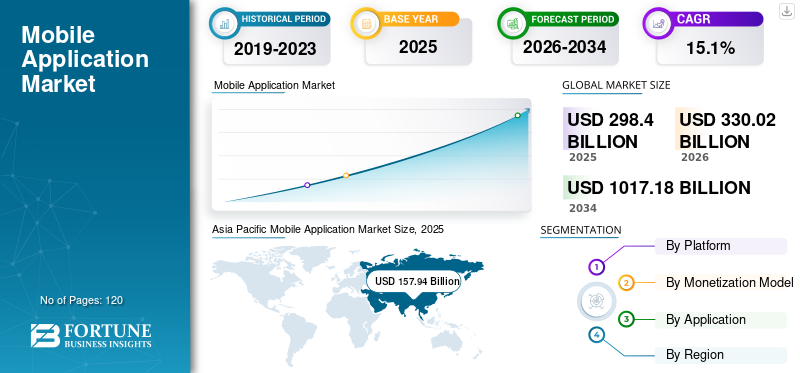
Download Free sample to learn more about this report.
Mobile Application MARKET KEY TAKEAWAYS
 Market Size & Forecast
- 2025 Market Size: USD 298.40 billion
- 2026 Market Size: USD 330.02 Billion
- 2034 Forecast Market Size: USD 1,017.18 billion
- CAGR: 15.10% from 2026–2034
 Market Share
- Asia Pacific dominated the mobile application market with a market share of 52.92% in 2025.
- In 2026, the Apple App store segment is anticipated to dominate with a 53.2% share.
- In 2026, the in-app purchases segment is expected to dominate with a 64.2% share.
 Key Regional Highlights
North American
North America held the second-largest market share, supported by advanced digital infrastructure and strong developer ecosystems.
Europe
Europe holds the third-largest share of the market and is projected to maintain steady growth, reaching USD 42.36 billion by 2026.
Asia Pacific
In 2025, Asia Pacific held a majority of the mobile application market share, valued at USD 157.94 billion.
U.S.
The U.S. market is projected to reach USD 69.63 billion by 2026.
Japan
Rising smartphone usage and expanding digital services are supporting continued growth in the mobile application market.
Read More

IMPACT OF GENERATIVE AI
Implementation of Generative AI Capabilities to Fuel the Growth of the Market
Generative AI is revolutionizing mobile applications by enabling advanced personalization, automation, and content creation. Apps can now generate tailored recommendations, dynamic content, and interactive experiences, enhancing user engagement and retention. For instance,
- In June 2025, Walmart launched Sparky, a generative AI assistant within its app, which offers personalized product recommendations, synthesizes reviews, and will soon handle reorders and service bookings. Users can get suggestions based on events, weather, or tasks, with step-by-step guidance and same-day delivery.
Additionally, generative AI streamlines app development through automated code generation, design suggestions, and testing, thereby reducing costs and shortening the time-to-market. Despite challenges such as ethical concerns and content moderation, its potential to deliver innovative, personalized, and intelligent app experiences makes generative AI a key growth driver in the market.
MARKET DYNAMICS
MOBILE APPLICATION MARKET TRENDS
Integration with IoT and Smart Devices to be a Key Trend in the Market
Mobile applications are becoming increasingly central to managing and controlling connected devices, marking a significant trend in the mobile app market. The rapid growth of the Internet of Things (IoT) ecosystem has led to the proliferation of smart devices, including wearables, home automation systems, health monitors, and automotive applications. For instance,
- An industry report reveals that over 80% of Indians now use health apps or wearable devices, with many turning to AI-driven tools for personalized nutrition and fitness guidance.
This integration enables seamless connectivity and enhances user convenience by providing instant feedback, remote access, and intelligent automation. For example, smart home apps enable users to control lighting, security systems, and appliances remotely, while wearable health devices provide real-time tracking of fitness and health.
Download Free sample to learn more about this report.
MARKET DRIVERS
Surge in Smartphone Adoption to Propel Market Growth
The rapid proliferation of smartphones is a key factor driving mobile application market growth. With global smartphone penetration steadily rising, more users are gaining access to apps for communication, entertainment, productivity, and shopping. For instance,
- According to The Hindu, Global smartphone shipments grew 2.6% in Q3 2025 to 322.7 million units, driven by strong demand for premium and AI-enabled devices. Apple’s iPhone 17 witnessed record pre-orders, while Samsung’s Galaxy Z Fold 7 and Z Flip 7 boosted the foldable segment. Samsung led shipments with 61.4 million units and Apple shipped 58.6 million units.
Importantly, the impact of smartphone adoption extends beyond urban centers. Rural and semi-urban regions are increasingly engaging with mobile technology, often relying on smartphones as their primary gateway to the internet and digital services. For instance,
- An ASER 2023 survey found that approximately 90% of rural Indian youth aged 14–18 have access to a smartphone and are familiar with its use.
This trend has created opportunities for mobile application developers to cater to diverse audiences with localized solutions, driving both demand and innovation in the mobile application ecosystem.
MARKET RESTRAINTS
Rising Cybersecurity Risks to Hinder Market Growth
Cybersecurity risks pose a significant challenge to the mobile application market growth. As mobile apps increasingly handle sensitive personal and financial data, users are becoming more cautious about potential threats such as data breaches, malware, and unauthorized access. For instance,
- In August 2025, the UAE Cybersecurity Council warned residents against downloading unverified mobile apps due to a rise in cyberattacks, with nearly 200,000 incidents reported daily. Citizens are urged to use official app stores, review permissions carefully, update their devices, and avoid suspicious links. The alert is part of the UAE’s National Cybersecurity Strategy, aiming to protect users from malware, data breaches, and financial theft.
Additionally, compliance with stringent data protection regulations, such as GDPR and CCPA, imposes significant operational and financial burdens on developers, particularly small and mid-sized enterprises. For instance:
- According to GDPR, Mobile apps must get explicit consent, ensure privacy by design, maintain transparency, respond to user requests, allow data deletion, secure data with encryption, and monitor third-party services.
Ensuring robust security measures, while maintaining a seamless user experience, requires continuous investment in technology and expertise. As a result, cybersecurity concerns remain a significant factor that can hinder adoption, slow innovation, and restrain overall market growth in the mobile application industry.
MARKET OPPORTUNITIES
Expansion of Mobile Commerce (mCommerce) to Create Lucrative Growth Opportunities
The rapid shift toward mobile-first shopping has positioned mobile commerce (mCommerce) as one of the most promising growth opportunities in the market. The increasing penetration of smartphones, widespread internet access, and the convenience of mobile platforms are encouraging consumers to make purchases directly through apps rather than traditional websites or physical stores. For instance,
- According to industry reports, in 2024, mobile shopping apps drove over USD 4 trillion in global transactions, highlighting the pivotal role of mobile platforms in worldwide commerce.
Brands and retailers are increasingly investing in mobile apps to deliver tailored experiences, including personalized product recommendations, loyalty programs, push notifications, and seamless checkout processes. For instance,
- In May 2025, Zara launched a new “travel mode” feature in its mobile app, enabling users to access travel guides, local recommendations, locate nearby stores, and shop online in select markets, even when offline. This aligns with Zara’s omnichannel strategy, enhancing the digital and in-store experience.
The growth of in-app purchases, subscription models, and integrated mobile wallets provides developers with multiple monetization channels, while also enhancing user engagement.
Segmentation Analysis
By Application
High User Engagement Segment Boost the Gaming Apps Segment Growth
Based on application, the market is classified into social networking apps, gaming apps, productivity & utility apps, entertainment & media apps, health & fitness apps, finance & banking apps, education & e-learning apps, and others.
To know how our report can help streamline your business, Speak to Analyst
The gaming apps segment dominate the mobile app market due to their high user engagement, immersive experiences, and broad appeal across various age groups and geographies. The rise of casual, hyper-casual, and competitive mobile games, along with features such as in-app purchases, multiplayer modes, and social integration, drives both downloads and revenue. For instance,
- According to SQ magazine, on average, mobile gamers have 2.7 gaming apps on their devices, while Gen Z players often install five or more.
The productivity & utility apps segment is expected to grow at a CAGR of 21.4% during the forecast period.
By Platform
Apple App Store Segment Led the Market due to Higher Disposable Incomes
In terms of platform, the market is categorized into Google Play Store, Apple App Store, and cross-platform.
The Apple App store segment captured the largest market share in 2025. In 2026, the segment is anticipated to dominate with a 53.2% share, as its users typically have higher disposable incomes and spend more on apps and subscriptions. For instance,
- In 2023, consumer spending on the Apple App Store reached USD 89.3 billion, representing a 2.8% increase from 2022.
The platform’s strict quality and security standards create a trusted, curated environment that fosters trust and encourages purchases.
The cross-platform segment is expected to grow at a CAGR of 17.3% over the forecast period.
By Monetization Model
In-App Purchases Segment Led the Market due to its Ability to Access Basic App Functionality for Free
In terms of monetization model, the market is categorized into paid apps, subscription-based apps, and in-app purchases.
The in-app purchases segment captured the largest share of the market in 2025. In 2026, the segment is expected to dominate with a 64.2% share, as it allows users to access basic app functionality for free while paying for premium features, virtual goods, or additional content. This model drives higher user engagement and recurring revenue, particularly in gaming, social, and lifestyle apps, making it the most profitable and widely adopted monetization strategy. For instance,
- According to industry reports, approximately 75% of Indian gamers now make in-app purchases, with more than 31% spending over USD 12 per month.
The subscription-based apps segment is expected to grow at a CAGR of 17.4% over the forecast period.
Mobile Application Market Regional Outlook
By geography, the market is categorized into Europe, North America, Asia Pacific, Latin America, and the Middle East & Africa.
Asia Pacific
Asia Pacific Mobile Application Market Size, 2025 (USD Billion) To get more information on the regional analysis of this market, Download Free sample
In 2025, Asia Pacific held a majority of the mobile application market share, valued at USD 157.94 billion. This leadership is mainly due to the region’s rapid digital transformation, high smartphone penetration, and widespread adoption of mobile-first strategies by enterprises and consumers. Countries such as China (USD 62.98 billion) and India (USD 13.00 billion) are at the forefront, supported by their robust app development ecosystems, expanding 5G infrastructure, and government initiatives promoting digital inclusion and innovation. For instance
- According to industry stats, China led the global mobile app market in 2023 with 113 billion downloads. India followed with 26 billion downloads, reflecting its growing digital economy.
North America
North America accounts for the second-largest share of the market, driven by its advanced digital infrastructure, strong developer community, and significant presence of major tech companies. The region benefits from early adoption of innovative app technologies such as AI integration, AR/VR experiences, and cloud-based mobile platforms. The market is projected to reach USD 78.77 billion by 2026, with the U.S. alone contributing USD 69.63 billion, highlighting its continued importance in global app innovation and enterprise mobility trends.
Europe
Europe holds the third-largest share of the market and is projected to maintain steady growth, reaching USD 42.36 billion by 2026. This growth is driven by the region’s rapid transition toward intelligent mobile ecosystems, strong data privacy regulations supporting secure app development, and increasing investments in smart infrastructure. Major contributors include the U.K. (USD 9.16 billion), Germany (USD 8.18 billion), and France (USD 5.50 billion), all of which play essential roles in regional adoption and innovation.
Middle East & Africa
The Middle East & Africa (MEA) region is expected to experience the highest compound annual growth rate (CAGR) over the forecast period, reaching USD 13.45 billion by 2026. Growth is driven by expanding mobile internet penetration, national digitalization programs, and increasing demand for enterprise and consumer apps across retail, travel, and government sectors. The GCC countries are projected to account for USD 3.89 billion, supported by modernization efforts and policy-driven innovation,
- According to industry stats, over 30 million new apps were downloaded in Saudi Arabia in 2022, up 30% year over year.
Latin America
Latin America is projected to reach USD 19.81 billion by 2026, driven by the region’s growing base of digital-first consumers and rising demand for mobile commerce, entertainment, and productivity applications. Increasing smartphone adoption and expanding fintech ecosystems across countries such as Brazil and Mexico continue to support market growth.
COMPETITIVE LANDSCAPE
Key Industry Players
Market Leaders Focus on Adopting AI Capabilities to Meet Consumers And Enterprises Needs
The market is driven by technology giants that continuously innovate through integrated ecosystems, cutting-edge technologies, and seamless user experiences. Leading companies such as Apple, Alphabet (Google), Meta, and Microsoft dominate the landscape by delivering diverse app portfolios, powerful development tools, and expansive distribution channels that reach billions of users worldwide.
These industry leaders distinguish themselves through comprehensive platforms that combine app stores, cloud services, artificial intelligence capabilities, and cross-device integration, catering to both consumers and enterprises. Their offerings emphasize personalized user experiences, enhanced security, and continuous innovation. For example, Apple’s robust App Store ecosystem, Alphabet’s extensive Google Play network, Meta’s social and messaging platforms, and Microsoft’s productivity and collaboration tools collectively define the market’s competitive edge.
LIST OF KEY MOBILE APPLICATION COMPANIES PROFILED
- Apple Inc. (U.S.)
- Alphabet Inc. (U.S.)
- Meta Platforms, Inc. (U.S.)
- Tencent Holdings Ltd (China)
- Microsoft Corporation (U.S.)
- com, Inc. (U.S.)
- Netflix, Inc. (U.S.)
- ByteDance Ltd. (China)
- Alibaba Group Holding Ltd. (China)
- Snap, Inc. (U.S.)
- Epic Games, Inc. (U.S.)
- Adobe (U.S.)
KEY INDUSTRY DEVELOPMENTS
- November 2025: The UIDAI launched a new Aadhaar mobile app for Android and iOS, designed to enhance the secure management and sharing of Aadhaar data. The app allows users to link up to five profiles per mobile number, view and share Aadhaar via QR codes or verifiable credentials, and use face authentication for verification.
- November 2025: CNN launched an immersive vertical video feed in its mobile app, featuring short, full-screen videos for easy scrolling on smartphones. The TikTok-inspired format highlights breaking news, condensed reports, and behind-the-scenes clips, enhancing engagement and connecting viewers with CNN personalities.
- November 2025: Tandem Diabetes Care received FDA approval for the Android version of its Tandem Mobi insulin pump app, enabling users to manage diabetes via compatible smartphones. The rollout is scheduled to begin in December 2025, with a full release expected in early 2026.
- June 2025: The Government of India launched the ‘GoIStats’ mobile app, developed by the National Sample Survey Office (NSO) under MoSPI, to provide easy, on-the-go access to official data. The app features an interactive “Key Trends” dashboard with visualized socio-economic indicators such as GDP, inflation, and employment.
- May 2025: Netflix announced updates to its mobile and TV apps aimed at improving content discovery. The mobile app would feature a vertical video feed similar to Instagram Reels, and an AI-powered conversational search. The TV app would receive a redesigned homepage featuring personalized recommendations, easier navigation, and smarter content suggestions, providing a more intuitive and engaging user experience.
REPORT COVERAGE
Request for Customization to gain extensive market insights.
Report Scope & Segmentation
| ATTRIBUTE | DETAILS |
| Study Period | 2021-2034 |
| Base Year | 2025 |
| Estimated Year | 2026 |
| Forecast Period | 2026-2034 |
| Historical Period | 2019-2024 |
| Growth Rate | CAGR of 15.1% from 2026-2034 |
| Unit | Value (USD Billion) |
| Segmentation | By Platform, Monetization Model, Application, and Region |
| By Platform |
|
| By Monetization Model |
|
| By Application |
|
| By Geography |
|
Frequently Asked Questions
Fortune Business Insights says that the global market value stood at USD 298.40 billion in 2025 and is projected to reach USD 1,017.18 billion by 2034.
In 2025, the market value stood at USD 157.94 billion.
The market is expected to exhibit a CAGR of 15.1% during the forecast period (2026-2032).
The gaming apps segment led the market by application.
Surge in smartphone adoption to propel the market growth.
Apple, Apple, Meta, and Microsoft are some of the prominent players in the market.
Asia Pacific dominated the market in 2025.
The productivity & utility apps are expected to grow with the highest CAGR.



- 2021-2034
- 2025
- 2021-2024
- 120
Get 30-60 hrs Free Customization
Expand Regional and Country Coverage, Segments Analysis, Company Profiles, Competitive Benchmarking, and End-user Insights.




















Related Reports
-
US +1 833 909 2966 ( Toll Free )
-
Get In Touch With Us