Metaverse in Healthcare Market Size, Share & Industry Analysis, By Type (Hardware, Software, and Services), By Technology (Augmented Reality/ Virtual Reality, Artificial Intelligence, Blockchain Technology, Internet of Things, and Others), By Application (Surgical Precision, Medical Training & Education, Medical Imaging & Diagnostic, Telemedicine, and Others), By End User (Hospitals and ASCs, Diagnostic Centers, Pharmaceutical & Biotechnology Companies, and Others), and Regional Forecast, 2026-2034
 Download Free Sample
Metaverse in Healthcare Market Overview
 Listen to Audio Version
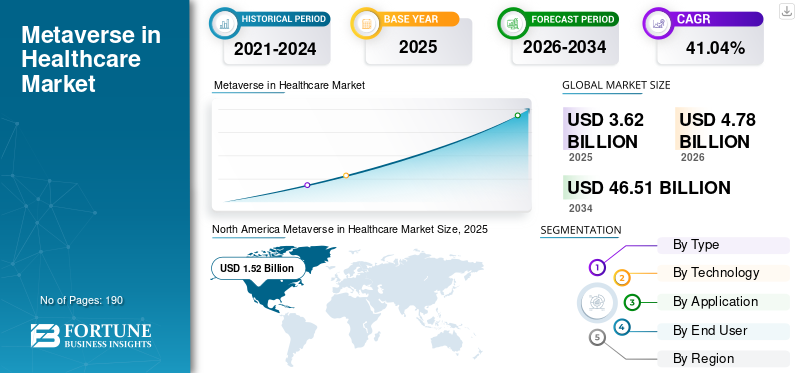
The global metaverse in healthcare market size was valued at USD 3.62 billion in 2025. The market is projected to grow from USD 4.78 billion in 2026 to USD 46.51 billion by 2034, exhibiting a CAGR of 41.04% during the forecast period. North America dominated the global market with a market share of 41.98% in 2025.
The global metaverse in healthcare market is projected to experience exponential growth with a significant CAGR during the forecast period. The metaverse in the healthcare market is growing due to various factors, including the increasing adoption of AI and ML, as well as the use of augmented reality devices and others. This metaverse technology blends physical and virtual realities to create an immersive experience for patients. These solutions are transforming the way virtual consultations, patient education, medical training, and drug development are carried out. Numerous key companies are focusing on these advanced technologies and streamlining their resources to launch new products, capitalizing on this innovative platform.
- For instance, in February 2023, Indegene launched metaverse capabilities to support life sciences organizations with a variety of use cases, including healthcare provider (HCP) interactions, HCP education, and patient education.
Furthermore, many key industry players, such as Siemens Healthcare Private Limited, ImmersiveTouch, Inc., and Aetsoft Inc., operating in the market, are focusing on developing various innovative healthcare solutions to support the growing global demand for the metaverse in healthcare and diversify their product offerings.
Download Free sample to learn more about this report.
METAVERSE IN HEALTHCARE MARKET KEY TAKEAWAYS
 Market Size & Forecast
- 2025 Market Size: USD 3.62 billion
- 2026 Market Size: USD 4.78 billion
- 2034 Forecast Market Size: USD 46.51 billion
- CAGR: 41.04% from 2026–2034
 Market Share
- North America dominated the metaverse in healthcare market with a 41.98% share in 2025.
- The software segment accounted for the largest share of the market in 2025.
- The augmented reality/virtual reality segment held the leading technology market share in 2025.
 Key Regional Highlights
North America
North America remained the leading regional market, supported by favorable policies, strong industry collaboration, and growing adoption of metaverse-based healthcare training solutions.
Europe
Europe is projected to be the second-fastest-growing region, reaching USD 1.23 billion in 2026, driven by increasing digital healthcare initiatives and regulatory support.
Asia Pacific
Asia Pacific is expected to reach USD 1.08 billion in 2026, benefiting from rising mobile connectivity, digital transformation programs, and government support for advanced healthcare technologies.
U.S.
The U.S. metaverse in healthcare market is estimated at USD 1.87 billion in 2026, representing approximately 39.16% of the global market and maintaining its position as the largest national market.
Japan
Japan’s market is projected to reach USD 0.28 billion in 2026, accounting for around 5.81% of global revenue, supported by ongoing investments in digital healthcare and immersive technologies.
Read More

METAVERSE IN HEALTHCARE MARKET TRENDS
Emergence of Mental Health Therapeutics Is a Prominent Trend Observed in Market
The global metaverse in healthcare market trend observed is the rise of extended reality-based digital therapeutics for mental health. These programs deliver evidence-based care, such as CBT and exposure therapy, in immersive environments, often as a hybrid approach. They increase access to health systems and assist them in keeping patients engaged, and scale support when therapist capacity is limited. Regulators are also paying closer attention to digital mental health tools, which supports broader adoption confidence over time of metaverse solutions.
- For instance, in December 2022, Accenture invested in BehaVR, a leading innovator in Virtual Reality (VR) digital wellness and digital therapeutics experiences, to expand access to mental and behavioral healthcare using virtual reality. Such developments support the growth of the global metaverse in the healthcare market.
Download Free sample to learn more about this report.
MARKET DYNAMICS
MARKET DRIVERS
Growing Use of VR/AR for Medical Training to Drive Market Growth
The increasing use of metaverse technologies, such as AR/VR, in training healthcare professionals is a major factor driving market growth. Using these technologies, learning and training have become faster in a safe, controlled environment. Healthcare providers are increasingly using these platforms to practice procedures and emergency scenarios without risk to patients. These developments not only reduce training time but also improve confidence and support the development of consistent skills. As more institutions invest in digital learning and simulation, the demand for metaverse-based training platforms and content also rises, thereby boosting market growth. To cater to this increasing demand, the market is witnessing numerous strategic collaborations aimed at enhancing their offerings.
- For instance, in April 2025, Elevate Healthcare partnered with SimX, the leader in Virtual Reality (VR) healthcare training, to transform the landscape of medical education and training. This collaboration aimed to bring together SimX’s innovative VR simulation platform and Elevate’s expertise in healthcare simulation and simulation center management.
MARKET RESTRAINTS
High Implementation Cost of Metaverse Solutions to Hamper Market Growth
A significant factor impeding the global metaverse in healthcare market growth is the high cost associated with implementing these solutions. Healthcare providers are required to invest in powerful tools, including VR/AR headsets, high-performance computers, secure connectivity, and software licenses. These solutions require 3D content, clinical validation, and regular updates, which are recurring and add up to the total implementation cost. Along with these factors, metaverse solutions are mandated to integrate with EHRs and imaging platforms to optimize features further and reduce IT costs. These factors can discourage smaller hospitals and clinics from investing in these metaverse technologies when compared to basic telehealth tools.
- For instance, in September 2025, QSS Technosoft published a blog that reported the cost of metaverse solutions in healthcare depended on the platform choice, ranging from USD 40,000 for basic MVPs to USD 300,000 for enterprise-grade solutions such high costs could restrict market growth.
MARKET OPPORTUNITIES
Integration of Robotics and Metaverse Offers Lucrative Market Growth Opportunities
The integration of robotics with the metaverse has created a strong growth opportunity for the market, as it enables various healthcare teams to control, guide, and monitor robotic systems in immersive 3D environments. Surgeons and specialists globally can utilize these AR/VR interfaces to view anatomy in 3D, plan procedures, and support robot-assisted surgeries with enhanced spatial understanding, thereby improving efficiency and patient care. These technologies also enabled experts to guide critical procedures from remote locations and provide real-time guidance on actions. As robotics becomes more common and hospitals seek automation, combining it with immersive collaboration platforms expands use cases and increases spending on advanced solutions, driving new revenue opportunities for key players.
- For instance, in February 2025, the European Economic and Social Committee (EESC) adopted an opinion addressing the integration of robotics and the metaverse in healthcare. The document defined the opportunities presented by these emerging technologies.
MARKET CHALLENGES
Regulatory and Data Privacy Challenges Surrounding Metaverse to Pose a Significant Challenge to Market Growth
One of the major factors hampering the market's growth is the numerous legal and regulatory challenges surrounding the application of the metaverse in healthcare. Ambiguity regarding the classification of AR/VR devices as medical devices, combined with a stringent regulatory environment, may hinder the market's growth. Additionally, data security concerns also restrict the market growth.
- For example, in September 2023, the French Data Protection Authority (the ‘CNIL’), through its Digital Innovation Laboratory (LINC), highlighted the risks associated with the exponential increase in data collection implied by the metaverse.
Segmentation Analysis
By Type
Real-time Experiences for Patients to Propel Software Segmental Growth
Based on type, the market is divided into hardware, software, and services.
The software segment accounted for the largest metaverse in healthcare market share. These metaverse software solutions incorporate real-time experiences for patients, allowing physicians to examine them in 3D form, consult with them in real-time, and discuss treatment courses. This software replicates the physical consultation experience with a 3D version of an online consultation where users can sense touch, hear, and feel gestures and movements as they would in a physical consultation. These benefits allow remote consultation and facilitate the exchange of expertise. Following these benefits, various established players are focusing on strategic collaboration to develop and introduce novel software that offers additional features.
- For instance, in February 2022, Epazz Inc. reported that its flagship software technology, DeskFlex Metaverse Virtual Office, is developing virtual clinics to take telemedicine to the next level. DeskFlex Metaverse Virtual Clinics enabled physicians to obtain real-time 3D images for conducting patient assessments and consultations, as well as upgrade their telemedicine programs. Such factors are expected to propel the growth of the segment in the market.
The services segment is expected to grow at a CAGR of 30.14% over the forecast period.
To know how our report can help streamline your business, Speak to Analyst
By Technology
New Product Launches and Technological Advancement to Drive Augmented Reality Segment Growth
Based on technology, the market is segmented into augmented reality/virtual reality, artificial intelligence, blockchain technology, the internet of things, and others.
In 2025, the augmented reality segment held a significant market share. The augmented reality accounted for the largest market share, attributed to continuous advancements and new product launches that blend virtual and physical realities. These solutions provided an immersive experience to patients.
Moreover, this wide potential has led to strategic collaborations among key established players in the market for research initiatives aimed at launching technologically advanced offerings.
- For instance, in June 2021, the Innovation Institute at Hospital for Special Surgery (HSS) and VR Electronics Ltd. partnered to develop movement wear and full-body suit-based technology, aiming to enhance human motion assessments for diagnostics, surgery training, and next-generation rehabilitation. The collaboration aimed to enhance human movement and physical rehabilitation by utilizing full-body sensors that cover 95.0% of the human body's muscle mass. The partnership aimed to advance personalized, real-time diagnostics, training, and physical rehabilitation. Such developments are likely to bolster the segmental growth.
The artificial intelligence segment is projected to grow at a CAGR of 41.33% during the forecast period for the global metaverse in healthcare market.
By Application
Increasing Adoption of Metaverse Technology for Training by Hospitals to Boost Demand and Drive Segmental Growth
Based on application, the market is segmented into surgical precision, medical training & education, medical imaging & diagnostic, telemedicine, and others.
In 2025, the medical training and education segment dominated the global market. The dominance of the segment was attributed to the increasing utilization of these platforms by hospitals and universities to train doctors, nurses, and other healthcare professionals. These developments overcame the limitations associated with healthcare training, such as a shortage of labs and expert trainers, and limited access to cadavers. These metaverse technologies also support continuous up skilling, making medical training and education the leading application segment.
- For instance, according to StatCounter’s global mobile OS tracking, Android held the majority share of the global mobile operating system user base between November 2024 and November 2025.
The surgical precision segment is projected to grow at a CAGR of 38.37% during the forecast period for the global metaverse in healthcare market.
By End User
Strategic Initiatives by Hospitals & ASCs Kept them in a Leading Position
Based on end user, the market is segmented into Hospitals and ASCs, diagnostic centers, pharmaceutical and biotechnology companies, and others.
Based on end-user, hospitals and ASCs held a major market share in the global market. Adopting these metaverse solutions by various hospitals and ambulatory surgical centers has facilitated virtual consultations, expanding their global reach. They also facilitate knowledge sharing, imitating real-life experiences, and providing patient care. These factors are expected to boost segmental growth in the projected years. These benefits are compelling various hospitals to expand their presence in virtual reality, thus propelling market growth.
- For instance, in June 2022, Yashoda Hospital became the first Healthcare group in India to be present on the metaverse platform. The hospital group purchased a plot of land on the Decentraland metaverse platform. Such developments are expected to drive the segmental growth.
Additionally, the other segment is projected to grow at a CAGR of 33.93% during the study period.
Metaverse in Healthcare Market Regional Outlook
By geography, the market is categorized into Europe, North America, Asia Pacific, Latin America, and the Middle East & Africa.
North America
North America Metaverse in Healthcare Market Size, 2025 (USD Billion)
To get more information on the regional analysis of this market, Download Free sample
North America held the dominant share in 2024, valued at USD 1.15 billion, and maintained its leading position in 2025, with a value of USD 1.52 billion. The market in North America is expected to increase significantly over the projected years. North America represents a leading market due to various factors, including encouragement from policymakers, a collaborative environment, and increasing adoption of metaverse applications for training purposes.
U.S Metaverse in Healthcare Market
Based on North America’s strong contribution and the U.S. dominance within the region, the U.S. market can be analytically approximated at around USD 1.87 billion in 2026, accounting for roughly 39.16% of the global metaverse in healthcare market.
Europe
Europe is projected to record a growth rate of 33.11% in the coming years, the second-highest among all regions, and reach a valuation of USD 1.23 billion by 2026. The region is expected to witness encouragement from policymakers, a collaborative environment, and an increasing adoption of metaverse applications for training purposes, which drives growth.
U.K Metaverse in Healthcare Market
The U.K. market in 2026 is estimated to be around USD 0.26 billion, representing roughly 5.37% of the global market in 2026.
Germany Metaverse in Healthcare Market
Germany’s market is projected to reach approximately USD 0.30 billion in 2026, equivalent to around 6.19 % of the global market.
Asia Pacific
Asia Pacific is estimated to reach USD 1.08 billion in 2026 and secure the position of the third-largest region in the market. The growth in the region is attributed to growing mobile connectivity in the region and government support for digitalization and technology adaption. These factors are leading market growth in Asia Pacific region.
Japan Metaverse in Healthcare Market
The Japan market in 2026 is estimated at around USD 0.28 billion, accounting for roughly 5.81% of the global market.
China Metaverse in Healthcare Market
China’s market is projected to be one of the largest globally, with 2026 revenues estimated at around USD 0.38 billion, representing roughly 7.86% of global metaverse technology sales.
India Metaverse in Healthcare Market
The Indian market in 2026 is estimated to be around USD 0.15 billion, accounting for roughly 3.24% of the global metaverse technology revenue.
Latin America and the Middle East & Africa
The Latin America and the Middle East & Africa regions are expected to witness moderate growth in this market space during the forecast period. The Latin America market is set to reach a valuation of USD 0.23 billion in 2026. The region is experiencing an increase in the adoption of the metaverse market, driven by advancements in mobile connectivity and government initiatives promoting digital health.
GCC Metaverse in Healthcare Market
The GCC is set to reach a value of USD 0.11 billion in 2026.
South Africa Metaverse in Healthcare Market
The South Africa market is projected to reach approximately USD 0.03 million by 2026, accounting for roughly 0.69% of the global metaverse technology revenue.
COMPETITIVE LANDSCAPE
Key Industry Players
Focus on Strategic Collaborations by Key Players to Propel Market Progress
The global metaverse in healthcare market has a semi-consolidated market structure, comprising prominent players such as Siemens Healthcare Private Limited, ImmersiveTouch, Inc., and Aetsoft Inc. The significant market share of these companies is due to strategic collaborations and capacity expansion activities that cater to increasing demand, along with new product launches, mergers, and acquisitions to diversify their product offerings and integrate innovative technologies.
- For instance, in June 2025, Siemens Healthcare Private Limited partnered with NVIDIA to accelerate the next era of industrial AI and digitalization. Similarly, in 2022, these companies partnered to connect technologies from the Siemens Xcelerator portfolio to the NVIDIA Omniverse platform.
Other notable players in the global market include EON Reality, AccuVein, Inc., and Avatar Medical SAS, among others. These companies are expected to prioritize new product launches and collaborations to advance their technologies and strengthen their market positions.
LIST OF KEY METAVERSE IN HEALTHCARE COMPANIES PROFILED
- Siemens Healthcare Private Limited (U.S.)
- ImmersiveTouch, Inc. (U.S.)
- Aetsoft Inc. (U.S.)
- EON Reality (U.S.)
- AccuVein, Inc. (U.S.)
- Avatar Medical SAS (U.S.)
- Shamlatech (U.S.)
- HypnoVR (U.S.)
KEY INDUSTRY DEVELOPMENTS
- October 2024: GOQii, in collaboration with BharatBox, launched a new platform that integrates fitness, mental health, and nutrition. BharatBox, a metaverse venture focused on India, and GOQii, a smart-tech health and wellness platform, launched a wellness platform in the metaverse. The partnership introduced an immersive digital experience combining physical wellness with metaverse technology, powered by the Universal Health Token (UHT).
- October 2024: The South Korean K-Metaverse Pavilion announced a collaboration with eight leading companies to showcase state-of-the-art technologies transforming industries globally at GITEX 2024. These companies introduced innovations across AI, AR, and XR fields, aimed at enhancing urban planning, healthcare, and digital experiences
- December 2022: Emirates Health Services launched a transformative project utilizing metaverse technology in healthcare delivery. The Emirates Health Services (EHS) has launched a metaverse-based virtual telemedicine solution using 3D virtual reality technology. The launch is part of transformative projects that leverage advanced technology and promote smart services such as remote health solutions and telemedicine.
- June 2022: UAE healthcare firm Thumbay Group launched the first metaverse hospital, where people can come with an avatar and consult with the doctor
- December 2021: HypnoVR raised USD 4.9 million. The funds enabled HypnoVR to accelerate the commercial launch of its virtual reality-based medical hypnosis solution in France and globally. The company also focused on expanding its R&D program to enhance the therapeutic efficacy of its solution further and broaden its scope of application to other medical and paramedical fields.
REPORT COVERAGE
Request for Customization to gain extensive market insights.
Report Scope & Segmentation
|
ATTRIBUTE |
DETAILS |
|
Study Period |
2021-2034 |
|
Base Year |
2025 |
|
Estimated Year |
2026 |
|
Forecast Period |
2026-2034 |
|
Historical Period |
2021-2024 |
|
Growth Rate |
CAGR of 41.04% from 2026-2034 |
|
Unit |
Value (USD Billion) |
|
Segmentation |
By Type, Technology, Application, End User, and Region |
|
By Type |
· Hardware · Software · Services |
|
By Technology |
· Augmented Reality/ Virtual Reality · Artificial Intelligence · Blockchain Technology · Internet of Things · Others |
|
By Application |
· Surgical Precision · Medical Training & Education · Medical Imaging & Diagnostic · Telemedicine · Others |
|
By End User |
· Hospitals & ASCs · Diagnostic Centers · Pharmaceutical & Biotechnology Companies · Others |
|
By Region |
· North America (By Component, Technology, Application, End User, and Country) o U.S. o Canada · Europe (By Component, Technology, Application, End User, and Country/Sub-region) o Germany o U.K. o France o Spain o Italy o Scandinavia o Rest of Europe · Asia Pacific (By Component, Technology, Application, End User, and Country/Sub-region) o China o Japan o India o Australia o Southeast Asia o Rest of Asia Pacific · Latin America (By Component, Technology, Application, End User, and Country/Sub-region) o Brazil o Mexico o Rest of Latin America · Middle East & Africa (By Component, Technology, Application, End User, and Country/Sub-region) o GCC o South Africa o Rest of Middle East & Africa |
Frequently Asked Questions
According to Fortune Business Insights, the global market value stood at USD 3.62 billion in 2025 and is projected to reach USD 46.51 billion by 2034.
In 2025, the market value stood at USD 1.64 billion.
The market is expected to exhibit a CAGR of 41.04% during the forecast period of 2026-2034.
By type, the software segment is expected to lead the market.
The rising applications of the metaverse for training and education are expected to drive market growth.
Siemens Healthcare Private Limited, ImmersiveTouch, Inc., Aetsoft Inc., and EON Reality are the major players in the global market.
North America dominated the market in 2025.



- 2021-2034
- 2025
- 2021-2024
- 190
Get 30-60 hrs Free Customization
Expand Regional and Country Coverage, Segments Analysis, Company Profiles, Competitive Benchmarking, and End-user Insights.













.webp)






Related Reports
-
US +1 833 909 2966 ( Toll Free )
-
Get In Touch With Us