Micro Tactical Ground Robot Market Size, Share & Industry Analysis, By Platform (Micro Tracked / Hybrid & Micro Wheeled), By Application (Infantry ISR & Urban Recon, EOD / IED Recon Support, Special Operations & Counter-Terror, CBRN & Hazardous Environment Inspection, Border Security, Critical Infrastructure Security, & Others), By Payload (ISR-Only (EO/IR + Audio), ISR + Light Manipulation, and ISR + CBRN / Specialized Sensors), By Mode of Operation (Semi-Autonomous, Teleoperated (Line-of-Sight / RF), and Highly Autonomous / Teaming-Ready), By End User, and Regional Forecast, 2026-2034
 Download Free Sample
Micro Tactical Ground Robot Market Size and Future Outlook
 Listen to Audio Version
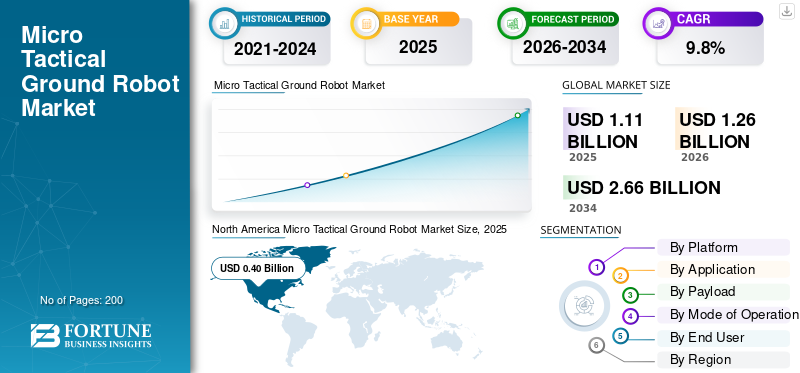
The global micro tactical ground robot market size was valued at USD 1.11 billion in 2025. The market is projected to grow from USD 1.26 billion in 2026 to USD 2.66 billion by 2034, exhibiting a CAGR of 9.8% during the forecast period. North America dominated the global micro tactical ground robot market with a market share of 36.03% in 2025.
Micro Tactical Ground Robots (MTGRs) are small, backpack-portable unmanned ground vehicles. They are designed for a single operator to carry and deploy for close-in tasks such as room clearing, inspecting trenches and tunnels, searching vehicles, conducting EOD/IED reconnaissance, and checking hazardous areas for CBRN threats. These systems usually offer rugged, all-terrain mobility and have day and night cameras, audio, and sometimes light updates according to missions. This allows soldiers, EOD teams, and law enforcement units to see, listen, and probe ahead without putting themselves at risk. The demand for these robots is increasing due to the shift toward urban and underground warfare. The ongoing threats from IEDs and CBRN, the need to reduce casualties, and a broader move toward using robots first in high-risk operations are driving the market growth.
Key players in the market include both specialized UGV manufacturers and larger defense electronics companies. Roboteam/Elbit Systems is a central figure in this segment with its MTGR platform, used by U.S. and Israeli forces, and is now being deployed in larger numbers by the US Marine Corps. In addition, a second tier of regional suppliers in Europe, Asia, and the Middle East is developing MTGR-class systems.
Download Free sample to learn more about this report.
Micro Tactical Ground Robot Market Key Takeaways
 Market Size & Forecast
- 2025 Market Size: USD 1.11 billion
- 2026 Market Size: USD 1.26 billion
- 2034 Forecast Market Size: USD 2.66 billion
- CAGR: 9.8% from 2026–2034
 Market Share
- North America dominated the global micro tactical ground robot market with a market share of 36.03% in 2025.
- Infantry ISR and urban recon segment dominates the market and is anticipated to be the fastest-growing segment during the forecast period with a CAGR of 10.5%.
- The micro wheeled segment is expected to grow at a CAGR of 7.0% over the forecast period.
 Key Regional Highlights
North America
North America remained the leading regional market, reaching USD 0.40 billion in 2025, supported by strong defense spending and extensive deployment of tactical robotic systems.
Europe
The market in Europe is estimated to be USD 0.32 billion in 2025 and the region is projected to have a growth rate of 10.3% during the forecast period.
Asia Pacific
Asia Pacific is anticipated to record strong growth due to increasing border security concerns, military modernization programs, and growing demand for ISR and EOD operations.
U.S.
The U.S. contributed over 92.90% share in 2025 of the North American market and is the top contributor due to large defense budgets and autonomous military system adoption.
Japan
Japan is among the key Asia Pacific countries driving demand for micro tactical ground robots through military modernization and defense capability enhancement.
Read More

MARKET DYNAMICS
MARKET DRIVERS:
Robot Goes First Policy is Driving Market Growth
The driving force for the micro tactical ground robot market growth is the increasing attitude of "robot goes first" in risky operations. Armies and security forces are now seeing small ground robots as essential tools for clearing trenches, rooms, tunnels, and explosive threats before sending in soldiers. This shift aims to reduce casualties in crowded urban and contested areas. This is no longer a limited EOD use case. Large programs are purchasing hundreds of micro UGVs at once, specifically so that robots, not people, lead the way into kill zones, minefields, or “no man’s land.” This trend directly supports ongoing demand and fleet growth.
MARKET RESTRAINTS
Budget Trade-offs with Drones and Counter-Drone Systems are Limiting Market Growth
Worldwide militaries funding is increasingly focused on drones and counter-drone systems. In many defense ministries, uncrewed money is directed primarily toward affordable UAVs, loitering munitions, and electronic warfare or counter-unmanned aerial systems. This leaves smaller and slower funding sources for ground robots. MTGR procurement often gets combined with larger explosive ordnance disposal, engineer, or infantry programs. This makes it easier to postpone or reduce spending when budgets get tight.
MARKET OPPORTUNITIES:
Eastern Front Conflict Accelerating MTGR Adoption and Export Demand
A key opportunity in the market is the fast integration of unmanned ground vehicles (UGVs) in war zones. This trend is leading to both increased domestic purchases and international export opportunities. Forces involved in conflicts are allocating dangerous tasks, such as surveillance, resupply, casualty evacuation, and even assault roles, to such machines. This helps armies use their personnel more effectively and lowers risk. The real-world success of these robots fuels demand and interest from allied nations and robotics manufacturers globally.
For instance, in February 2025, Ukraine’s Ministry of Defence announced plans to introduce dedicated robotic vehicle units for frontline units. This marks a significant increase in UGV purchases.
MARKET CHALLENGES:
Keeping Micro Robots Connected in Real Combat is Still a Major Challenge
Major challenges for the market are reliable communication in real battlefield conditions. These systems depend on radio links that buildings, terrain, and underground structures can block. In high-level conflicts, they also face electronic warfare. If connections fail, operators lose video and control, leaving an expensive robot either stranded or destroyed. This risk makes some forces hesitant to rely completely on MTGRs for important tasks. It also pushes manufacturers to invest heavily in strong communication technologies, such as mesh radios, repeaters, and fiber-optic tethers, instead of just focusing on the robot itself.
Russia-Ukraine War Impact
Russia–Ukraine War Is Transforming Micro Ground Robots from Experimental Gadgets into Core Battlefield Capability
The Russia-Ukraine war has rapidly advanced the micro tactical ground robot market by demonstrating that small unmanned ground vehicles can save lives and support operations in dangerous areas. Both sides are now using tracked and wheeled UGVs for tasks such as delivering ammunition, evacuating casualties, conducting reconnaissance in trenches, and breaching areas filled with FPV drones, artillery, and mines. This shift has transformed MTGRs from specialized EOD tools to essential capabilities in the design of Ukrainian and increasingly Russian forces. NATO is closely studying this trend, which is leading to new requirements, trials, and budget allocations for micro UGVs in other militaries.
- In February 2025, Ukraine’s defense minister announced a project aimed at expanding unmanned ground systems and creating fully operational robotic units. This initiative follows trials with frontline troops and is focused on logistics, assault, and support roles at the front.
- In June to August 2025, Ukrainian units reported using UGVs for casualty evacuation and logistics while under fire. Multiple articles also highlighted Ukraine’s plan to deploy around 15,000 robotic systems in 2025, showing that ground robots are becoming standard tools rather than temporary experiments.
Micro TACTICAL GROUND ROBOT MARKET TRENDS:
Micro Robots are Becoming Standard Infantry Gear, Fueling Market Growth
Major trend reshaping the MTGR market is the move from niche, specialist use to regular use at the infantry and small-unit level. Forces are no longer buying micro robots just for EOD teams or special operations. They are including them directly in squad kits for room entry, trench scouting, cave and tunnel checks, and blind-corner reconnaissance. As a result, armies are treating MTGRs the same way they treat optics, radios, and NVGs. They are now an essential gear that every frontline unit should carry as standard, not an optional add-on reserved for elite teams.
Download Free sample to learn more about this report.
Segmentation Analysis
By Platform
Surging Need for Reliability in Harsh Battlefield Terrain and High-Risk Missions Fosters Micro Tracked/Hybrid Segment Growth
In terms of platform, the market is categorized into micro tracked / hybrid and micro wheeled.
Micro tracked and hybrid platforms are becoming the clear leaders in the field. They can operate effectively in environments where MTGRs are used, such as rubble, trenches, basements, tunnels, blast-damaged streets, and steep urban areas. Wheeled robots still have a role in indoor and budget-sensitive missions. However, tracked and hybrid units have become the preferred choice for frontline forces that demand reliability in unpredictable terrain and hostile conditions.
The micro wheeled segment is expected to grow at a CAGR of 7.0% over the forecast period.
By Application
Infantry ISR & Urban Recon Dominates Due to Rising Urban Combat and Close-Quarters Threats
On the basis of application, the market is classified into infantry ISR & urban recon, EOD / IED recon support, special operations & counter-terror, CBRN & hazardous environment inspection, border security, critical infrastructure security, and others.
Infantry ISR and urban recon segment dominates the market and is anticipated to be the fastest-growing segment during the forecast period with a CAGR of 10.5%. Modern operations often focus on combat in dense and complex settings, such as trench systems, apartment blocks, basements, tunnels, and fortified urban positions. Small ground robots provide squads and tactical teams with a safe method to explore blind corners, corridors, culverts, and rubble-filled areas before sending in personnel. This makes them the top choice for both military and law enforcement. Other areas, such as EOD/IED support and Special Operations, are important, but the daily demands of urban ISR heavily influence their use.
CBRN & Hazardous environment inspection is the second fastest-growing segment in the market, expected to grow at a CAGR of 10.0% over the forecast period.
By Payload
ISR-Only Payloads Dominate Market Due to Expanding CBRNE and Hazardous-Material Threats
Based on payload, the market is segmented into ISR-Only (EO/IR + Audio), ISR + Light Manipulation, and ISR + CBRN / Specialized Sensors.
The ISR-only (EO/IR + audio) segment takes the lead in the market. Most mission, such as intelligence surveillance reconnaissance (ISR), explosive, tunnel, and trench reconnaissance, EOD support, hazmat sweeps, or border inspection, starts with gaining situational awareness before taking action. Operators use clean, low-latency images and audio to evaluate threats such as explosives and chemical, biological, radiological, nuclear, and explosives (CBRNE) hazards. Although intelligence surveillance reconnaissance (ISR) explosive combined with light manipulation, and ISR paired with CBRN or specialized sensors, are gaining traction in the Middle East and Africa, regions such as Latin America and South Korea are also expanding their use of multi-role robotic solutions. Due to the consistent demand for rapid, reliable vision keeps ISR-only payloads hold the largest market share.
The ISR + Light Manipulation segment is the fastest-growing segment in the market at a CAGR of 11.4% over the forecast period.
To know how our report can help streamline your business, Speak to Analyst
By Mode of Operation
Operational Need for Control in High-Threat Environments Boosts Tele-Operated Segment Growth
Based on mode of operation, the market is segmented into Semi-Autonomous, Teleoperated (Line-of-Sight / RF), and Highly Autonomous / Teaming-Ready.
Tele-operated (line-of-sight / RF) systems dominate the micro tactical ground robot market share as they provide the real-time precision, accountability, and human judgment needed for missions involving explosives, ISR in tight urban areas, and CBRNE or hazardous material assessments. Security forces prioritize direct operator control in high-risk infantry ISR, IED reconnaissance, and tactical breaching. Errors in these situations can have immediate consequences. Enhancing operational semi-autonomous and autonomous robotics industry is growing, especially in challenging terrain and manned-unmanned teaming concepts. The tactical ground robot industry still depends on tele-operated systems as the standard operational mode over the forecast period.
The highly autonomous / teaming-ready segment is expected to grow at a CAGR of 15.6% over the forecast period.
By End User
Army Infantry and Special Forces Segment Dominates Market Due to Rising Frontline ISR and Force-Protection Needs
By end user, the market is segmented into army infantry & special forces, law enforcement / HLS / SWAT, EOD & CBRN units, border security guards & paramilitary, and other.
Army Infantry and Special Forces are the main users and hold the largest market share and are anticipated to be the fastest-growing segment during the forecast period. Army Infantry and Special Forces need to clear explosives and navigate hazards such as chemical, biological, radiological, nuclear, and explosive (CBRNE) threats in complex terrains. This includes urban combat in Eastern Europe and counter-terror operations in the Middle East, Africa, and Latin America. Analysis of the ground robot market shows that tactical ground robotic solutions are being integrated directly into small-unit kits. Tethered, teleoperated, semi-autonomous, and autonomous micro tactical robots are used for room clearing, trench and tunnel reconnaissance, and standoff improvised explosive device (IED) inspection.
The law enforcement / HLS / SWAT segment is set to grow at a CAGR of 10.2% over the forecast period.
Micro Tactical Ground Robot Market Regional Outlook
North America Dominated Market Due to Massive Defense Budget and Early Fielding Programs
By geography, the market is categorized into Europe, North America, Asia Pacific, and the Rest of the World (Middle East & Africa and Latin America).
North America
North America Micro Tactical Ground Robot Market Size, 2025 (USD billion)
To get more information on the regional analysis of this market, Download Free sample
North America held the dominant share in 2024 valuing at USD 0.36 billion and also took the leading share in 2025, with USD 0.40 billion, led primarily by the U.S., which alone contributed over 92.90% share in 2025 of the regional share. Programs such as the U.S. Marine Corps MTGR fielding over 130 systems show that micro tactical robots are becoming standard tools. They are used for standoff explosives detection, ISR, and hazardous-material reconnaissance at the small-unit level. The U.S. is the top contributor to the market. This is mainly due to large defense budgets, for instance, U.S. Department of Defense's 2025 budget request was initially set at about USD 849.8 billion and a focus on using autonomous systems in military operations. Major U.S. defense contractors, including Northrop Grumman, General Dynamics, and Lockheed Martin, play a crucial role in developing and supplying these robots.
Europe
Other regions such as Asia Pacific, Europe, the Rest of the world (Middle East & Africa, and Latin America) are expected to see significant growth in the market in the coming years. During the forecast period, the European region is projected to have a growth rate of 10.3%. The market in Europe is estimated to be USD 0.32 billion in 2025, driven directly by the Russia-Ukraine war. In this region, both the U.K. and France are expected to reach USD 0.04 billion and USD 0.03 billion, respectively, in 2026.
Asia Pacific
In Asia Pacific, countries including China, India, Japan, and South Korea, rapid growth, border tensions, grey-zone competition, and major land forces modernization are increasing the need for micro tactical ground robot fleets in infantry ISR, EOD/IED support, and CBRNE/hazmat tasks. Based on these factors, countries such as China expect to reach a valuation of USD 0.10 billion, and India is set to reach USD 0.06 billion by 2026.
Rest of the World
Meanwhile, the Rest of the world (Middle East & Africa, and Latin America) contributes 11.33% in 2025. Middle East & Africa and Latin America have comparatively smaller share but are growing at a CAGR of 8.8%. Middle East & Africa, the opportunity exists where border security, counter-terrorism, and protection of critical infrastructure meet, such as oil and gas, ports, and airports. In Latin America, the segment for micro tactical robots is smaller but growing steadily. This growth is driven by law enforcement, homeland security, SWAT teams, EOD units, and border security forces.
COMPETITIVE LANDSCAPE
Key Industry Players:
Intense Global Competition is Shaping Micro Tactical Ground Robot Industry
The competitive landscape in the micro tactical ground robot market includes a small group of specialists and a few larger defense manufacturers. Key players include Roboteam, which recently received an order for over 130 units from the U.S. Marine Corps, valued at around USD 30 million. Other important companies are Teledyne FLIR Defense, which provides FirstLook and similar small unmanned ground vehicles under multi-year U.S. government contracts, and ReconRobotics, known for its Throwbot 2 family for SWAT and SOF ISR operations. QinetiQ also offers the Dragon Runner 10 micro UGV line. These companies set the standard for micro tactical robots, influencing pricing, capability expectations, and overall market analysis.
Surrounding this top tier is a growing group of regional and niche suppliers across Europe, Asia Pacific, the Middle East and Africa, and Latin America. These suppliers often provide mission-specific robotic solutions, such as border security, CBRNE sampling, and tunnel ISR, as well as locally produced versions of established designs. The Russia-Ukraine war has drawn new innovators into the tactical ground robot industry, particularly in Eastern Europe. Meanwhile, in areas such as South Korea, Israel, and parts of the Gulf, local electronics and defense companies are promoting more semi-autonomous and teaming-ready designs in the global micro tactical ground segment. Over the forecast period, competition will shift focus from basic mobility to sensors, autonomy software, integration into C2/C4ISR systems, and support packages, as end users aim to standardize their fleets rather than manage numerous unique platforms.
LIST OF KEY MICRO TACTICAL GROUND ROBOT COMPANIES PROFILED:
- Roboteam (Israel)
- Elbit Systems Ltd. (Israel)
- Teledyne FLIR Defense (U.S.)
- QinetiQ Group plc (U.K.)
- ReconRobotics, Inc. (U.S.)
- Mistral Inc. (U.S.)
- Northrop Grumman (U.S.)
- Ghost Robotics (U.S.)
- iRobot Corp (U.S.)
- Boston Dynamics (U.S.)
KEY INDUSTRY DEVELOPMENTS:
- In May 2025, Ukraine’s defence ministry officially approved the Krampus tracked UGV, a flamethrower-equipped assault robot, for military use. This decision is linked to an aim to deploy around 15,000 UGVs. It highlights how innovation driven by combat needs is speeding up the tactical ground robot industry and changing the competitive landscape.
- In February 2025, Ukraine’s defence minister confirmed plans to deploy dedicated robotic vehicle units at the front. UGVs will be used for offensive and defensive operations, logistics, casualty evacuation, and mine-laying or clearing. This formalizes unmanned ground systems as an essential part of the force structure instead of temporary experiments.
- In October 2024, Advanced Defense Technologies Inc. (ADTI), a top contract manufacturer of quality military and civilian electronics, announced that it had been subcontracted by Roboteam, a well-known developer of tactical unmanned platforms for defense and security missions. This partnership will support a major deal with the U.S. Marine Corps.
- In September 2024, Teledyne FLIR Defense was awarded two U.S. government contracts totaling up to USD 47 million. These contracts will support a variety of ground robots, from the approximately 3 kg FirstLook micro UGV to PackBot and Kobra. This shows ongoing investment in tactical ground robotic solutions instead of one-off purchases.
- In July 2024, the New York City Police Department signed a contract worth about USD 222,000 to acquire 14 Throwbot 2 micro-robots from ReconRobotics. This shows the growing demand for small tele-operated ISR robots from law enforcement, HLS, and SWAT units in dense urban and hazardous environments.
REPORT COVERAGE
The global micro tactical ground robot market analysis provides an in-depth study of market size, company profiling & forecast by all the market segments included in the report. It includes details on the market dynamics and market trends expected to drive the market in the forecast period. It offers information on the technological advancements, new product launches, key industry developments, and details on strategic partnerships, mergers & acquisitions. The market research report also encompasses detailed competitive landscape with information on the market share and profiles of key market players.
Request for Customization to gain extensive market insights.
Report Scope & Segmentation
| ATTRIBUTE | DETAILS |
| Study Period | 2021-2034 |
| Base Year | 2025 |
| Forecast Period | 2026-2034 |
| Historical Period | 2021-2024 |
| Growth Rate | CAGR of 9.8% from 2026 to 2034 |
| Unit | Value (USD Billion) |
|
Segmentation |
By Platform
By Application
By Payload
By Mode of Operation
By End User
By Region
|
Frequently Asked Questions
Fortune Business Insights says that the global market value stood at USD 1.11 billion in 2025 and is projected to reach USD 2.66 billion by 2034.
In 2025, the market value stood at USD 0.40 billion.
The market is expected to exhibit a CAGR of 9.8% during the forecast period of 2026-2034.
The micro tracked / hybrid segment led the market by platform.
Robot goes first policy is driving market growth
Roboteam (Israel), Elbit Systems Ltd (Israel), Teledyne FLIR Defense (U.S.), QinetiQ Group plc (U.K.), ReconRobotics, Inc. (U.S.), Roboteam / Mistral Inc. (U.S.), and others are the top companies in the market.
North America dominated the market.



- 2021-2034
- 2025
- 2021-2024
- 200
Get 30-60 hrs Free Customization
Expand Regional and Country Coverage, Segments Analysis, Company Profiles, Competitive Benchmarking, and End-user Insights.




















-
US +1 833 909 2966 ( Toll Free )
-
Get In Touch With Us