 Download Free Sample



Get a Quote
Receive a tailored pricing based on your needs.
- Choose license type
- Multiple user options
- Custom scope & coverage
- Fast turnaround
"Designing Growth Strategies is in our DNA"
 Listen to Audio Version
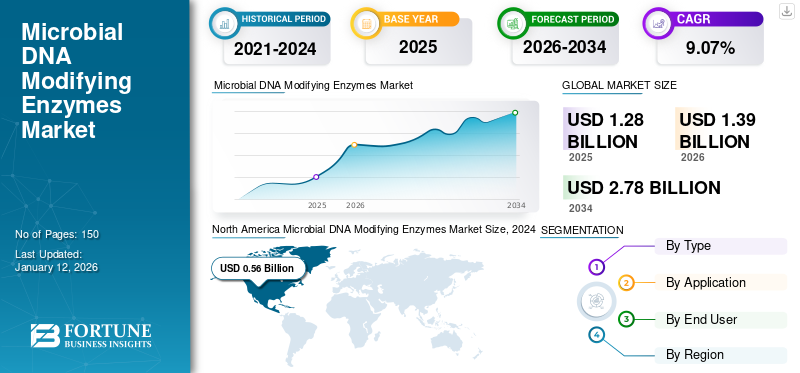
The global microbial DNA modifying enzymes market size was valued at USD 1.28 billion in 2025. The market is projected to grow from USD 1.39 billion in 2026 to USD 2.78 billion by 2034, exhibiting a CAGR of 9.07% during the forecast period. North America dominated the microbial DNA modifying enzymes market with a market share of 95.48% in 2025.
The market is a significant product segment within the biotechnology industry, primarily driven by advancements in genetic engineering, gene therapy, and molecular diagnostics. These enzymes, extracted from microorganisms, are essential for genetic manipulation, cloning, sequencing, and gene editing processes. Key enzymes include restriction enzymes, DNA ligases, nucleases, polymerases, and methyltransferases, each playing crucial roles in biotechnology and pharmaceutical applications. The market is expected to benefit from the increasing demand for gene editing tools, advancements in genetic research, and the rise of personalized medicine.
Some of the leading market players include Takara Bio Inc., Thermo Fisher Scientific, Inc., and New England Biolabs. The wide product portfolio coupled with a strong global presence of these companies has supported the dominance of these companies in the global market.
Download Free sample to learn more about this report.
 Global Market Size & Forecast
 Market Share
 Key Regional Highlights
North America
North America led the market with a 95.48% share in 2025, driven by strong biotechnology research.
Asia Pacific
Asia Pacific is expected to grow the fastest, fueled by expanding biotechnology investments.
Europe
Europe held the second-largest share, supported by advanced genetic research and biopharma development.
U.S.
Strong adoption of gene-editing technologies supports market growth.
Japan
Growing genetic research and molecular diagnostics drive market expansion.
Read More

Advancements in Gene Editing Technologies to Drive Market Growth
The most significant driver in the microbial DNA modifying enzymes market is the growing adoption of gene editing technologies, especially CRISPR-Cas9. This technique enables precise alterations to the DNA of living organisms, leading to a surge in the demand for nucleases and ligases. CRISPR's ability to target specific genes in both eukaryotic and prokaryotic organisms has revolutionized genetic research, including therapeutic applications, agricultural improvements, and environmental biotechnologies.
The emergence of synthetic biology, which combines principles of engineering and biology, has further led to innovations in enzyme design and application. Enzymes such as polymerases and restriction enzymes are being engineered to improve industrial processes such as biofuel production, biodegradable plastics, and new antibiotics. These advancements are the key factors contributing to the microbial DNA modifying enzymes market growth.
Stringent Regulatory Framework to Limit Market Expansion
DNA modifying enzymes, especially those used in genetic therapies and clinical diagnostics, face stringent regulatory requirements. Regulatory agencies such as the U.S. Food and Drug Administration and EMA (European Medicines Agency) impose rigorous testing and approval processes to ensure the safety and efficacy of genetically modified products. These regulatory challenges can delay product launches and impact the market potential for new enzyme applications.
Additionally, ethical concerns related to the use of gene editing tools raise concerns, particularly in areas such as germline editing, cloning, and human genetic modification. These concerns can lead to increased scrutiny from governmental bodies and impact public perception. This, in turn, may impose limitations on the adoption of these technologies, potentially restricting market growth.
Growing Adoption of Personalized Medicine is Expected to Positively Impact Market Growth
Personalized or precision medicine has offered lucrative growth opportunities and is expected to further shape the market growth in the near future. With growing efforts to provide individualized treatments based on genetic makeup, there has been an increased need for more refined DNA modifying enzymes, enabling the creation of tailored therapeutic options. This is particularly evident in oncology, where genetic profiling helps identify treatments based on the mutations present in cancer cells. Advancements in gene therapy and genome editing, particularly with technologies such as CRISPR, are driving the demand for DNA modifying enzymes as they provide tools for precise genetic alterations. Additionally, they are also crucial in diagnostic tools that identify genetic variations associated with diseases, aiding in early diagnosis and treatment planning.
Automation in Gene Editing is a Prominent Market Trend
Automation technologies have made gene editing faster and more efficient. As a result, there is a growing demand for enzymes that support high-throughput screening, large-scale genetic modification, and synthetic biology processes, propelling the market growth. Automated systems can streamline such as guide RNA design, plasmid construction, and high-throughput gene editing. Technologies such as microfluidics enable precise reagent delivery and mixing, while robotic systems facilitate automated cell manipulation and analysis. Key advantages of automation include high throughput editing, reduced labor & time, and enhanced reproducibility. These benefits have driven increased demand for microbial DNA modifying enzymes in recent years.
High Research & Development Costs to Hamper Market Growth
Research and development in the microbial DNA modifying enzymes market is often capital-intensive. Developing enzymes with enhanced specificity and activity requires substantial investment in both time and resources. The complex processes involved in enzyme discovery, optimization, and commercialization further add to the cost burden, potentially limiting the growth of new entrants. Furthermore, the microbial DNA modifying enzyme market is highly fragmented, with numerous players offering specialized products. This competition can lead to price sensitivity, especially among smaller players, and may impact profit margins for larger companies.
Download Free sample to learn more about this report.
DNA Polymerases Segment Led due to Growing Investments in Advanced Technologies
Based on type, the market is classified into DNA polymerase, DNA ligases, exonucleases, endonucleases, and others.
The DNA polymerase segment held the dominating position in the global microbial DNA modifying enzymes market in 2024. Key factors driving the segment growth include the extensive research activities conducted across the globe, with many leading biotech companies investing heavily in advanced technologies and research infrastructure. The introduction of new research equipment and products for polymerase chain reaction (PCR) and next-generation sequencing (NGS) with improved accuracy is also expected to fuel segment growth.
The endonucleases segment is expected to witness substantial growth during the projected period, driven by increasing R&D initiatives using molecular cloning. Additionally, increasing product availability and new launches are expected to boost the segment growth.
Genomics & Genetic Engineering Segment Dominated due to Significant Investments from Public and Private Sectors
In terms of application, the market is divided into genomics & genetic engineering, drug discovery & research, and others.
The genomics & genetic engineering segment accounted for the largest share of the market in 2024. The significant investments from both public and private sectors, advancements in gene editing technologies, cloning, gene modifications, and a supportive regulatory environment are the key factors driving the growth of the segment.
The drug discovery & research segment is expected to grow at a higher CAGR during the forecast period. The high prevalence of chronic diseases, such as cancer and cardiovascular conditions across the globally increases the demand for innovative treatments, including gene therapies along with extensive pre-clinical studies are projected to fuel segment growth.
Increase Investment in Research Activities Boosted Pharmaceutical & Biotechnology Companies Segment Growth
Based on end user, the market is segmented into pharmaceutical and biotechnology companies,
academic & research institutes, and others.
The pharmaceutical and biotechnology companies segment dominated the market in 2024. An increase in the demand for gene therapy and genome editing technologies is fueling the use of DNA modifying enzymes in pharmaceutical and biotechnology research. Additionally, companies are investing heavily in R&D initiatives and innovation that demand the use of these DNA modifying enzymes.
The academic & research institutes segment is anticipated to witness considerable growth in the coming years, fueled by increasing investments in research and development, government initiatives, and expanding collaborations between academia and industry.
By geography, the market is categorized into North America, Europe, Asia Pacific, Latin America, and Middle East & Africa.
North America Microbial DNA Modifying Enzymes Market Size, 2025 (USD Billion)
To get more information on the regional analysis of this market, Download Free sample
The North America market accounted for USD 0.6 billion in 2025, representing 95.48% of the global industry, and is expected to reach USD 0.65 billion in 2026. This dominance of the region can be attributed to a strong biotechnology industry, robust research infrastructure, and significant investment in gene editing and molecular biology.
The U.S. plays a particularly influential role, with major research institutions and private sector companies driving demand for DNA modifying enzymes in pharmaceuticals, diagnostics, and agricultural biotechnology. Additionally, the country is also at the forefront of adopting new technologies, including gene-editing tools such as CRISPR-Cas9, which rely on DNA modifying enzymes for precise genetic modifications. Furthermore, key strategic initiatives are expected to further support market growth.
Europe recorded a market size of USD 0.33 billion in 2025, capturing 96.27% of the global market share, and is projected to reach USD 0.36 billion in 2026. Europe is the second-largest market for microbial DNA modifying enzymes with countries such as Germany, the U.K., and France playing leading roles in genetic research and biotechnology. The presence of regulatory frameworks that support gene-editing research and biopharmaceutical development further drives the demand for microbial DNA modifying enzymes. Research collaborations and advancements in CRISPR technologies also fuel the market in this region.
In 2025, Asia Pacific represented USD 0.21 billion, accounting for 96.73% of the worldwide market, and is projected to grow to USD 0.23 billion in 2026. The Asia Pacific region is emerging as a key market for DNA modifying enzymes, contributing to the fastest CAGR in the global market. Countries such as China, Japan, and India are increasingly investing in genetic research and biotechnology industries. Additionally, improving healthcare infrastructure and government support for biotechnological advancements create a high demand for DNA modifying enzymes, particularly in diagnostics and therapeutics.
The Latin America market was valued at USD 0.05 billion in 2025, capturing 97.09% of global revenue, and is estimated to reach USD 0.05 billion in 2026. The market in the Latin America region is expected to witness relatively slower growth in the near future. Increasing prevalence of chronic disorders amongst adults due to growing age and lifestyle changes is thereby leading to the growth in demand for PCR, DNA sequencing, and other tools that use DNA modifying enzymes in these regions.
Middle East & Africa contributed 97.32% to the global market in 2025, with a valuation of USD 0.03 billion, and is projected to reach USD 0.03 billion in 2026.
Key Companies Focus on Investments to widen their Market Reach
The global market is semi-concentrated, with numerous small-to-mid-size companies actively operating across the globe.
Thermo Fisher Scientific Inc., Takara Bio Inc., and New England Biolabs are some of the top players in the market. The dominance of these companies is attributed to an advanced product portfolio of DNA modifying enzymes. Additionally, their strong geographical presence across North America, Europe, and other key regions is a major factor contributing to their dominance in the market.
Apart from this, other prominent players in the market include Merck KGaA, Promega Corporation, and Danaher Corporation. These entities are focused on investments in R&D and strategic partnerships to enhance their market presence.
Trade protectionism can impact the microbial DNA modifying enzymes market in several ways. Tariffs, export restrictions, and other trade barriers can disrupt the global supply chain of these enzymes, especially when key players are dependent on raw materials from other countries. Export restrictions imposed by certain governments may impact the availability of enzymes, hindering research activities. On the other hand, regions with trade-friendly policies are more likely to attract foreign investments and foster growth in the biotechnology sector.
The global microbial DNA modifying enzymes market report provides information on market size and segments. It includes details on the market dynamics and market trends expected to drive the market in the forecast period. It offers information on technological advancements, new product launches, key industry developments, and details on partnerships, mergers & acquisitions. The report covers a detailed competitive landscape with information on the market share and profiles of key players.
Request for Customization to gain extensive market insights.
|
ATTRIBUTE |
DETAILS |
|
Study Period |
2021-2034 |
|
Base Year |
2025 |
|
Estimated Year |
2026 |
|
Forecast Period |
2026-2034 |
|
Historical Period |
2021-2024 |
|
Growth Rate |
CAGR of 9.07% from 2026-2034 |
|
Unit |
Value (USD Billion) |
|
Segmentation |
By Type
|
|
By Application
|
|
|
By End User
|
|
|
By Region
|
Fortune Business Insights says that the global market value stood at USD 1.39 billion in 2026 and is projected to reach USD 2.78 billion by 2034.
In 2025, the market value stood at USD 0.60 billion.
The market is expected to exhibit a CAGR of 9.07% during the forecast period.
The DNA polymerases segment led the market by type.
The key factors driving the market are the increased use of NGS and growth in the PCR driven diagnostics.
Thermo Fisher Scientific Inc., Takara Bio Inc., and New England Biolabs are some of the top players in the market.
North America dominated the market in 2025.
Increased research and development activities, and advancements in genomics research are some of the factors that are expected to favor the product adoption.

Get 30-60 hrs Free Customization
Expand Regional and Country Coverage, Segments Analysis, Company Profiles, Competitive Benchmarking, and End-user Insights.













.webp)






Related Reports
Get In Touch With Us
US +1 833 909 2966 ( Toll Free )
Receive a tailored pricing based on your needs.
Discuss your questions with our industry experts.
Have questions? Get quick answers before you purchase.

