Middle East & Africa Artificial Intelligence Market Size, Share & Industry Analysis, By Component (Hardware, Software, & Services), By Deployment (On-premise & Cloud), By Enterprise Type (Large, Small & Medium-sized Enterprises), By Technology (ML, NLP, Computer Vision, Robotics & Automation, & Expert Systems), By Function (HR, Marketing & Sales, Product/Service Deployment, Service Operation, Risk, & Supply-chain Management), By Industry (Healthcare, Automotive, BFSI, Retail, Manufacturing, Agriculture, Government, IT & Telecom, Energy & Utilities, & Education), & Regional Forecast, 2025-2032
 Download Free Sample
KEY MARKET INSIGHTS
 Listen to Audio Version
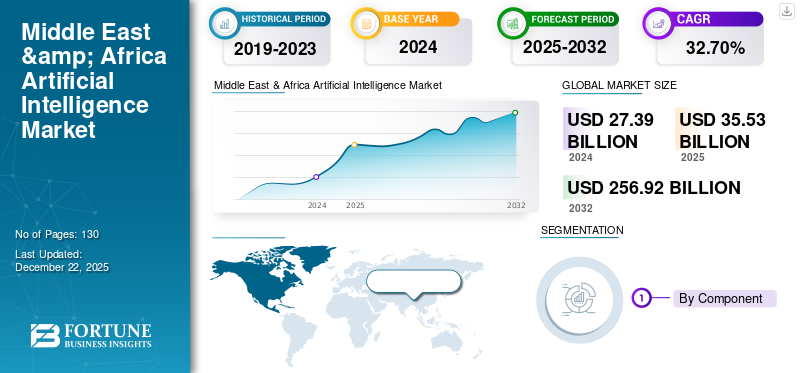
Middle East & Africa Artificial Intelligence market size was valued at USD 27.39 billion in 2024. The market is projected to grow from USD 35.53 billion in 2025 to USD 256.92 billion by 2032, exhibiting a growth at a CAGR of 32.70% during the forecast period.
The Middle East and Africa region is emerging as a dynamic hub for artificial intelligence adoption, characterized by strategic investments and a focus on digital transformation tailored to regional needs. Governments and private sectors are collaborating to leverage AI in sectors such as energy, healthcare, smart cities, and public services, aiming to boost economic diversification and improve quality of life. With initiatives to develop local AI talent, deploy advanced data infrastructure, and implement regulatory frameworks, the region is fostering an environment that supports innovation and sustainable growth. In 2025, MEA made notable progress by launching large-scale AI projects, expanding its AI-ready infrastructure, and strengthening partnerships with global technology leaders to accelerate AI integration across diverse industries.
Download Free sample to learn more about this report.
Impact of Generative AI
Generative AI is accelerating transformational capabilities across the Middle East and Africa by providing businesses the ability to produce customized digital content, improve consumer engagement, and automate complex tasks. It is of particular importance in addressing the diversity of languages spoken in the region through support for Arabic (amongst other regional languages). It allows brands and governments to offer a higher degree of personalized and accessible services.
Generative AI is giving power back to start-ups and local developers to build culturally relevant AI solutions to address the unique requirements of the region.
- According to MIT Sloan, Generative AI is gaining traction across the GCC, with 74 % of organizations already using it in at least one function, though only 7% are earning more than 5 % of their revenues from it.
Impact of Reciprocal Tariffs
Reciprocal tariffs in the Middle East and Africa market can impact the trade conditions between trading partners by increasing the cost of goods exchanged between the partners, impacting supply chains, and essentially reducing economic growth.
- For instance, if Saudi Arabia imposes a 10% tariff on imported textiles from Kenya to protect Saudi Arabia's manufacturing industry, Kenya may retaliate by imposing a 10% tariff on oil-related equipment that it exports to Saudi Arabia.
Essentially, these tariffs raise costs for the two trading partners that impact businesses and consumers in both countries, leading to reduced volumes of trade, and a search for companies to find additional suppliers or different markets.
Middle East & Africa Artificial Intelligence Market Trends
Rapid Expansion of AI-Optimized Data Centers to be Key Driver for Market Growth
The Middle East and Africa region is witnessing an acceleration and investment toward data center infrastructure to support artificial intelligence workloads.
- According to PwC, the Middle East is rapidly emerging as a global data centre hub, with regional capacity expected to grow from 1 GW in 2025 to 3.3 GW within the next five years, marking more than a threefold increase.
Both governments and market participants have partnered with global players to build the best-in-class facilities to meet the increased demands on compute and cloud services. Investment in dedicated AI data centers and AI workloads is becoming increasingly vital to support the multitude of use cases across industries from finance and health care to smart city applications.
Key takeaways
- The Middle East & Africa Artificial Intelligence Market is projected to be worth USD 256.92 billion in 2032.
- In the by component segmentation, Software accounted for around 46.2% of the Middle East & Africa Artificial Intelligence Market in 2024.
- In the by deployment segmentation, Cloud is projected to grow at a CAGR of 34.6% in the forecast period.
- In the by enterprise type segmentation, Large Enterprises accounted for around 61.6% of the market in 2024.
- In the by function segmentation, Risk is projected to grow at a CAGR of 35.4% in the forecast period.
- In the by technology, Machine Learning accounted for around 41.7% of the market in 2024.
- In the by industry segmentation, Healthcare is projected to grow at a CAGR of 39.1% in the forecast period.
- The Artificial Intelligence Market in the GCC was worth USD 11.75 billion in 2024.
- In the by-region segmentation, GCC is projected to grow at a CAGR of 35.5% in the forecast period.
Middle East & Africa Artificial Intelligence Growth Factors
National AI Strategies and Ecosystem Building to Boost Market Growth
The rise of various national AI strategies and ecosystem-building efforts that are being implemented by governments in the region is an important driver of the AI market in the Middle East and Africa. The United Arab Emirates, Saudi Arabia, and Bahrain have great ambitions and are proactively establishing longer-term visions with regulatory frameworks to make themselves leaders in artificial intelligence.
- In July 2025, Bahrain launched its National Policy for the Use of Artificial Intelligence, establishing a robust framework for ethical and secure AI adoption in both government and key sectors such as healthcare and education. The policy is built around four main pillars: legal compliance, responsible AI use, public education, and local and international cooperation.
The UAE's comprehensive AI Strategy 2031, seeks to integrate AI into priority sectors including healthcare, education, transport, and public services, while also working to create an AI-ready workforce and attracting global partners.
The Saudi Arabian authorities, including the Saudi Data and Artificial Intelligence Authority (SDAIA), are launching new initiatives to boost AI adoption with data governance, national platforms, and industry specific programs.
Middle East & Africa Artificial Intelligence Market Restraints
Infrastructure Limitations Hinder Market Growth
Infrastructure limitations are a major constraint on the Middle East & Africa artificial intelligence market growth. While there are many developing countries in the region, many are experiencing the dual challenges of limited digital connectivity and uneven distribution of data centers, which are limiting access and cloud computing.
Additionally, digital and power disruptions limit the scaling and deployment of AI technologies in rural geographies and in less urbanized areas where reliable access to the internet can be disrupted. Also, limited local supply and access to high-performance computing hardware, such as GPUs or chips designed for AI, limit innovation, along with the ability to process large and complex data.
Middle East & Africa Artificial Intelligence Market Segmentation Analysis
By Component
Based on component, the market is divided into hardware, software, and services.
Software holds the leading position in the Middle East and Africa artificial intelligence market as it is the first layer empowering the majority of AI applications. Many AI applications, from chatbots to predictive analytics, leverage software to enable actual real-world applications across several industries. Furthermore, its versatility and current digital environments where it can be easily integrated make software a popular option for entities seeking for an immediate impact.
Hardware emerges as the fastest-growing component as the region invests more in AI infrastructure. The rollout of data-intensive and resource-intensive applications such as computer vision and robotic applications will increase demand for advanced computing equipment in the form of processors, storage devices, and specialized chips that can perform complex computing tasks.
- In August 2025, Saudi Arabia’s Humain announced plans to build data centers in Riyadh and Dammam, set to open in early 2026, powered by advanced U.S. AI chips from Nvidia and AMD. The move underscores the kingdom’s push to secure cutting-edge AI hardware for its bid to become a global tech hub.
By Deployment
Based on deployment, the market is bifurcated into on-premise and cloud.
Cloud deployment holds the majority share in the artificial intelligence market in the Middle East and Africa, as it fits well with the region's digital accessibility and building innovation agenda. It provides organizations with the AI functionality without major capital spend on complex infrastructure, thus providing organizations the ability to prototype, scale, and adapt more easily.
- In May 2025, AWS and HUMAIN announced to invest over USD 5 billion to build Saudi Arabia’s groundbreaking AI Zone, combining top-tier AWS infrastructure and advanced semiconductors to accelerate AI innovation, training, and cloud adoption across the region.
By Enterprise Type
Based on enterprise type, the market is segmented into large enterprises and SMEs.
Large enterprises still dominate the AI market (in the region) due to their extended strategic overview and investment capacity. These organizations witness AI as part of their digital transformation strategies rather than a tool.
SMEs are expected to grow with the highest CAGR as they become more willing to harness emerging technologies. In the past, AI was largely disregarded as an option for smaller businesses. Now, due to the ability of the tools available to become easier to use, and the availability of modular and pay-as-you-go platforms, SMEs are beginning to incorporate AI into their daily operations.
By Function
Based on function, the market is segmented into human resources, marketing & sales, product/service deployment, service operation, risk, supply chain management, and others.
Service operations represent the largest share of AI adoption in the region, since businesses are paying great attention to improving efficiency, speeding up response times, and providing more personalized experiences. AI is being used to automate manual tasks, optimize customer services, and facilitate workflows with more accuracy.
Risk management is expected to grow with the highest CAGR as the awareness of operational vulnerabilities and external threats rises across organizations. AI technologies are gaining traction as organizations are evaluating how AI tools can help survey and assess for fraud, compliance, and real-time risk across complex systems.
By Technology
Based on technology, the market is segmented into machine learning, natural language processing, computer vision, robotics and automation, and expert systems.
Machine learning dominates in terms of share and is projected to grow at the fastest CAGR in the Middle East and Africa AI market. Its nature of learning from data to improve action beyond initial learning is a powerful technology for industries that want to improve decision-making and automate complex processes. As more businesses adopt AI, the need for more advanced and more efficient machine learning models is increasing and creating growth and opportunities for machine learning across the region.
By Industry
Based on industry, the market is segmented into healthcare, automotive, retail, BFSI, manufacturing, agriculture, government and public sector, IT & telecom, energy and utilities, and education.
The BFSI sector has the largest Middle East & Africa artificial intelligence market share. The growth is due to its dependence on AI in terms of: financial analytics; improved customer interactions and experiences; and security measures to combat cyber threats. The BFSI sector has an established digital infrastructure, as well as a large need to comply with rules and regulations, therefore, it results in a natural leader in AI adoption.
The automotive sector is rapidly emerging as the fastest-growing segment, primarily due to the growth of smart mobility solutions, as well as the integrating of AI into the manufacturing processes. Rapid investments in electric vehicles and the initiation of autonomous tech are creating fast growth and an enhanced way of working in the automotive sector across the region.
By Country
Based on country, the market is segmented into Turkey, Israel, GCC, North Africa, South Africa, and rest of the Middle East & Africa.
The GCC countries dominate the AI market in the region due to considerable government investment, a developed digital infrastructure, and a strong strategic commitment to innovation and smart city programs. As early adopters of AI technology in multiple sectors, including energy, finance, and government services, they collectively lead the regional landscape.
They will simultaneously have the highest rate of growth due to the development of their renewables and diversification strategy is ongoing; there are more and more AI startups being established.
- According to Kanebridge News, in 2025, the GCC is prioritizing AI and tech investments as part of its economic transformation, with one in four organizations increasing tech budgets and AI, including generative AI, as a top focus.
List of Key Companies in Middle East & Africa Artificial Intelligence Market
The Middle East and Africa AI market is gaining momentum with innovative companies driving region-specific AI solutions and fostering a unique technological landscape. Boby AI is making strides by delivering AI-powered automation tools tailored for local businesses, helping streamline operations across sectors such as retail and logistics.
OctoXlabs is emerging as a leader in advanced analytics and AI-driven decision-making platforms designed to meet the needs of the energy and finance industries. AI21 Labs is focusing on natural language processing and generative AI applications that support multilingual communication, particularly for Arabic and other regional languages.
Meanwhile, Sisense is expanding its presence by providing powerful AI-embedded analytics solutions that enable enterprises in the MEA region to harness data insights effectively. Together, these companies exemplify the region’s growing emphasis on customized AI innovation, talent development, and building AI ecosystems suited to regional challenges and opportunities.
LIST OF KEY COMPANIES PROFILED
- Ai (Turkey)
- AREYLight AI Solutions (Turkey)
- OctoXLabs (Turkey)
- Lumitech FZCO (Dubai)
- Singula (Dubai)
- Suffescom Solutions Inc (Dubai)
- AI21 Logo (Israel)
- BigPanda (Israel)
- Sisense (Israel)
- Warp Development (South Africa)
- Techling (South Africa)
KEY INDUSTRY DEVELOPMENTS
- May 2025: Cisco has announced key AI initiatives in the Middle East, including joining Saudi Arabia’s HUMAIN alliance to develop advanced AI infrastructure, expanding its partnership with G42 to boost AI innovation in the UAE, and collaborating with the AI Infrastructure Partnership to invest USD 30 billion in data centers globally.
- April 2025: 3AI, India’s largest AI platform, is expanding to the Middle East by launching an AI hub in Dubai in collaboration with the UAE government. The move aims to establish Dubai as a leading AI innovation center by building a strong AI ecosystem, hosting leadership events, and fostering business adoption of AI.
REPORT COVERAGE
The Middle East and Africa AI market report offers an in-depth overview of the region’s evolving AI ecosystem, emphasizing key growth drivers, and policy development and adoption shaping the landscape. It highlights the increasing integration of AI technologies in industries such as energy, healthcare, finance, and smart city initiatives, with a particular focus on localized solutions that address regional challenges. The report underscores the growing role of government-led AI strategies, investments in infrastructure, and efforts to nurture local talent and startups. The report also highlights the rise of homegrown AI startups, expanding R&D ecosystems, and increasing collaboration between public and private sectors to drive digital transformation and regional AI leadership.
Request for Customization to gain extensive market insights.
Report Scope & Segmentation
|
ATTRIBUTE |
DETAILS |
|
Study Period |
2019-2032 |
|
Base Year |
2024 |
|
Estimated Year |
2025 |
|
Forecast Period |
2025-2032 |
|
Historical Period |
2019-2023 |
|
Growth Rate |
CAGR of 32.70% from 2025 to 2032 |
|
Unit |
Value (USD Billion) |
|
Segmentation |
By Component · Hardware · Processors (GPU, FPGA, ASIC, and CPU) · Memory Systems · Storage Devices · Software · Services · AI Strategy Advisory/Consulting Services · System Integration and Deployment · AI Model Development · Process Automation and Optimization · AI Training · AI-powered Customer Experience · Support & Maintenance |
|
By Deployment · On-premise · Cloud · Public Cloud · Private Cloud · Hybrid Cloud |
|
|
By Enterprise Type · Large Enterprises · Small and Mid-sized Enterprises (SMEs) |
|
|
By Technology · Machine Learning · Supervised Learning · Unsupervised Learning · Reinforcement Learning · Deep Learning · Natural Language Processing (NLP) · Speech Recognition · Text Analytics · Language Translation · Computer Vision · Image Recognition · Object Detection · Robotics and Automation · Expert Systems · Rule-based Expert System · Knowledge-based System |
|
|
By Function · Human Resources · Marketing & Sales · Product/Service Deployment · Service Operation · Risk · Supply-Chain Management · Others (Strategy and Corporate Finance) |
|
|
By Industry · Healthcare · Diagnostic AI · Clinical AI · Hospital Management System · Automotive · Autonomous Vehicle · AI in Mobility-as-a-Service · BFSI · Fraud Detection · Risk Management · Algorithmic Trading · Retail · Customer Analytics · AI-powered Marketing and Sales · Supply Chain Automation · Manufacturing · Predictive Maintenance · AI-driven Robotics and Automation · Quality Control · Agriculture · Smart Farming · Yield Monitoring and Optimization · Crop Disease Detection · Government and Public Sector · Smart City Initiatives · Law Enforcement AI · Disaster Management · IT & Telecom · Network Optimization · AI Chatbots · Intelligent Call Routing · Energy & Utilities · Grid Management · AI in Renewable Energy Management · Education · Adaptive Learning Platform · AI-assisted Learning Tools |
|
|
By Country · Turkey · Israel · GCC · North Africa · South Africa · Rest of the Middle East & Africa |
Frequently Asked Questions
Fortune Business Insights says that the market was worth USD 27.39 billion in 2024.
The market is expected to exhibit a CAGR of 32.70% during the forecast period.
By industry, the BFSI segment is set to lead the market.
Boby. Ai, OctoXLabs, Lumitech FZCO, and AI21 Logo are the leading players in the market.



- 2019-2032
- 2024
- 2019-2023
- 130
Get 30-60 hrs Free Customization
Expand Regional and Country Coverage, Segments Analysis, Company Profiles, Competitive Benchmarking, and End-user Insights.




















Related Reports
-
US +1 833 909 2966 ( Toll Free )
-
Get In Touch With Us