Military Aircraft Avionics Market Size, Share & Industry Analysis, By Offering (Hardware, Software, and Services), By Aircraft Platform (Fixed-Wing Combat Aircraft, Trainer & Light-Combat Aircraft, Military Transport Aircraft, and Military Helicopters), By Avionics System (Flight-Control Systems, Cockpit Display & HMI, Navigation, Guidance & Positioning, Mission Computing, and Radar & RF Sensors), By Installation Type (Line-Fit, Retrofit & Modernization, and Mid-Life Upgrade), By End User (Air Forces, Naval Aviation Commands, and Army Aviation Commands), and Regional Forecast, 2026-2034
 Download Free Sample
Military Aircraft Avionics Market Size and Future Outlook
 Listen to Audio Version
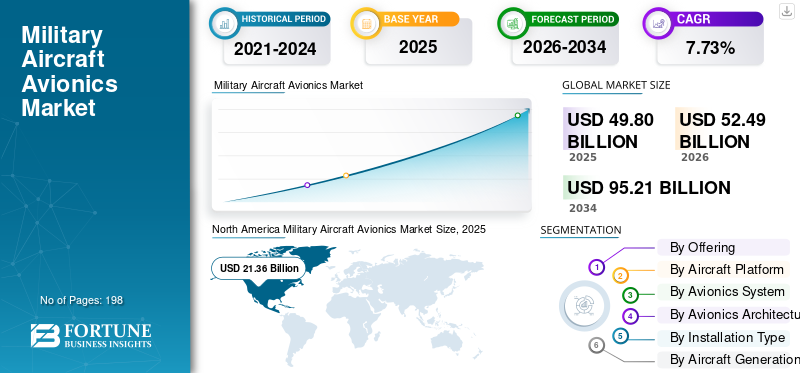
The global military aircraft avionics market size was valued at USD 49.80 billion in 2025. The market is projected to grow from USD 52.49 billion in 2026 to USD 95.21 billion by 2034, exhibiting a CAGR of 7.73% during the forecast period.
Military aircraft avionics covers mission-critical electronic systems installed in combat aircraft, military transports, helicopters, trainers, special-mission aircraft, and unmanned platforms. It includes flight controls, cockpit displays, mission computers, communication and navigation systems, surveillance sensors, electronic warfare equipment, data links, software, and associated upgrade and sustainment services.
Market growth is driven by aging-fleet modernization, procurement of next-generation aircraft, rising electronic warfare threats, and demand for improved situational awareness, secure connectivity, sensor fusion, autonomy, and high-performance mission computing. Adoption of Modular Open Systems Approach (MOSA) architectures is accelerating, as armed forces require faster technology insertion, interoperability, reduced vendor dependence, and lower lifecycle upgrade costs.
Major participants include Collins Aerospace, Honeywell International Inc., Thales Group, BAE Systems plc, and L3Harris Technologies, Inc. Key players are pursuing market growth through sustained R&D investments, open-architecture and software-defined avionics, AI-enabled mission systems, aircraft-OEM partnerships, fleet retrofit programs, localized production, and long-term predictive maintenance and readiness-support contracts.
Download Free sample to learn more about this report.
Military Aircraft Avionics Market Trends
Military Aircraft’s Shift Toward Software-defined, Open, AI-enabled, and Continuously Upgradeable Architectures is a Key Market Trend
Military aircraft are gradually shifting from tightly integrated proprietary systems toward common computing environments in which mission capabilities are delivered through software applications. Open Mission Systems, Future Airborne Capability Environment standards, government reference architectures, and MOSA-compliant hardware allow customers to replace individual applications or processors without redesigning the complete aircraft.
Moreover, artificial intelligence (AI) is becoming an important part of mission planning, sensor management, pilot decision support, autonomous navigation, electronic warfare, and crewed-uncrewed teaming. Avionics suppliers are therefore investing in high-performance processors, secure data buses, machine-learning software, advanced human-machine interfaces, and systems capable of processing information directly onboard the aircraft.
For instance, in July 2026, the U.S. Air Force Research Laboratory announced that modified VENOM F-16 aircraft had begun in-flight testing with additional hardware, software, instrumentation, and artificial-intelligence agents capable of controlling the aircraft.
Market Dynamics
MARKET DRIVERS
Download Free sample to learn more about this report.
Fleet Modernization and Increased Investments in Advanced, Connected, and Survivable Avionics to Boost Market Growth
Military forces are modernizing aging fighters, transport aircraft, helicopters, trainers, and special-mission fleets to maintain operational relevance against rapidly evolving threats. This is increasing demand for new mission computers, digital cockpits, secure communication systems, electronic warfare suites, data links, navigation equipment, and sensor-fusion systems. Modern combat operations require aircraft to exchange targeting, surveillance, and command information with land, maritime, space, and unmanned platforms in near real time. Growing GPS jamming, electronic attack, cyber threats, long-range air-defense systems, and low-observable threats are also pushing armed forces to install more capable radar-warning receivers, countermeasures, anti-jamming navigation, and encrypted communications.
The development of next-generation aircraft is creating additional demand for modular avionics that can support future sensors, weapons, autonomy software, and mission applications. Moreover, future Long Range Assault Aircraft and advanced airborne electronic-warfare platforms require higher processing capacity, open-system interfaces, improved power management, and software-upgradable mission systems. This is expected to boost the military aircraft avionics market growth in the coming years.
For instance, in April 2026, Collins Aerospace announced multiple contracts from Bell to provide five critical systems for the U.S. Army’s MV-75 FLRAA, which uses digital engineering and a Modular Open Systems Approach.
Market Drivers - Impact & CAGR Contribution (2026–2034)
| Rank | Market Drivers | Overall Impact Rank | CAGR Contribution (2026-2034) | Impact: 2026-2028 | Impact: 2029-2031 | Impact: 2032-2034 |
|---|---|---|---|---|---|---|
| 1 | Growing modernization, retrofit, and technology-refresh requirements across aging military aircraft fleets | High | 2.65% | High | High | High |
| 2 | Rising procurement and development of fifth-generation, sixth-generation, and military uncrewed aircraft | High | 2.20% | Medium | High | High |
| 3 | Expansion of network-centric and multi-domain operations driving tactical data links, sensor fusion, and secure connectivity | Medium-High | 1.85% | High | High | High |
| 4 | Growing adoption of software-defined avionics, MOSA, advanced mission computing, and open-system architectures | Medium | 1.55% | Medium | High | High |
| 5 | Higher defense spending and air-power recapitalization programs across the U.S., Europe, and Asia Pacific | Medium-Low | 1.45% | High | High | Medium-High |
| 6 | Others | Low | 0.93% | Low | Low | Low |
| Total Positive Growth Contribution | 10.63% | |||||
Source: Fortune Business Insights
MARKET RESTRAINTS
High Development, Integration, Certification, and Sustainment Costs are Slowing Avionics Upgrade Schedules
Military avionics systems must meet demanding safety, cybersecurity, electromagnetic compatibility, environmental, reliability, and airworthiness standards before they can enter operational service. Integrating new hardware and software into an existing aircraft can require changes to electrical power, cooling, wiring, antennas, cockpit displays, mission computers, and flight-control interfaces.
These activities involve extensive laboratory testing, ground testing, flight trials, software verification, and certification, significantly increasing program cost and duration. Proprietary legacy architectures also make it difficult to introduce equipment from alternative suppliers without redesigning large sections of the aircraft’s existing mission system.
Market Restraints - Impact & Negative CAGR Contribution (2026–2034)
| Rank | Market Restraints | Overall Impact Rank | Negative CAGR Contribution (2026-2034) | Impact: 2026-2028 | Impact: 2029-2031 | Impact: 2032-2034 |
|---|---|---|---|---|---|---|
| 1 | High avionics development, integration, qualification, flight-testing, and modernization costs | High | -1.05% | High | High | Medium |
| 2 | Supply-chain constraints, semiconductor/component shortages, long lead times, and electronic obsolescence | Medium-High | -0.78% | High | Medium | Medium |
| 3 | Increasing software complexity, cybersecurity requirements, interoperability issues, and integration delays | Medium | -0.67% | Medium | High | High |
| 4 | Others | Low | -0.40% | Low | Low | Low |
| Total Negative Growth Impact | -2.90% | |||||
Source: Fortune Business Insights
MARKET OPPORTUNITIES
Legacy-Aircraft Retrofits and Open Architectures Are Expanding the Addressable Market Beyond New Aircraft Production
The military aircraft fleet is expected to remain operational for several decades, creating a significant market for cockpit modernization, communication upgrades, navigation improvements, electronic warfare systems, mission computers, and replacement of obsolete components. Defense customers can improve aircraft capability without bearing the cost and long lead time associated with purchasing an entirely new fleet. Retrofit programs are particularly attractive for F-16s, F-15s, C-130s, Black Hawks, Chinooks, maritime patrol aircraft, trainers, and special-mission platforms. Demand will also expand for avionics repair, software support, cybersecurity updates, component replacement, training, and performance-based logistics throughout the aircraft lifecycle.
MOSA architectures provide suppliers with an opportunity to introduce third-party hardware, applications, sensors, and autonomy algorithms without redesigning the entire avionics suite. This is reducing vendor dependence and opening programs to specialist software companies, artificial-intelligence developers, sensor manufacturers, and non-traditional defense suppliers. Industry consolidation is also strengthening avionics portfolios.
For instance, in March 2026, the U.S. Air Force disclosed an F-16 communication-suite upgrade involving new hardware, an updated pilot interface, an additional radio, and improved line-of-sight and beyond-line-of-sight connectivity.
MARKET CHALLENGES
Cybersecurity Exposure, Component Obsolescence, Supply Constraints, And System Complexity Remain Major Execution Risks
As military aircraft become more connected and software dependent, their avionics systems face greater exposure to cyber intrusion, data manipulation, malicious software, electronic attack, and supply-chain compromise. Secure tactical networks, satellite communications, data links, mission-data files, maintenance systems, and ground-support equipment must be protected as one connected ecosystem.
Every new software release or third-party application must be tested to ensure that it does not affect flight safety, mission performance, or classified information. Maintaining cybersecurity across aircraft that remain in service for 30 to 50 years is difficult, as computing technologies, encryption methods, and threat techniques evolve far faster than military aircraft replacement cycles.
SEGMENTATION ANALYSIS
By Offering
Faster Capability Insertion Without Major Hardware Replacement to Fuel Software Segment Growth
By offering, the market is classified into hardware, software, and services.
The software segment is estimated to grow at the fastest CAGR of 9.49% during the forecast period. Modern military aircraft increasingly depend on software for sensor fusion, electronic warfare, communications, mission planning, autonomous functions, threat libraries, and cockpit applications. Defense forces can add or improve these capabilities through software updates without replacing complete avionics hardware, reducing upgrade time and allowing aircraft to respond more quickly to changing operational threats.
The hardware segment accounted for the largest market share of 62.46% in 2025 and is projected to grow at a CAGR of 7.72% during the forecast period.
By Aircraft Platform
Rapid Deployment of Autonomous and Mission-Intensive UAVs to Drive Military Uncrewed Aircraft Segment Growth
By aircraft platform, the market is classified into fixed-wing combat aircraft, trainer and light-combat aircraft, military transport and refueling aircraft, special-mission aircraft, military helicopters, and military uncrewed aircraft.
The military uncrewed aircraft segment is estimated to grow at the fastest CAGR of 9.99% during the forecast period. Armed forces are expanding the use of uncrewed aircraft for ISR, targeting, electronic warfare, communications relay, and increasingly collaborative combat missions. These platforms require advanced flight computers, navigation systems, secure data links, sensors, and autonomous mission-management systems, increasing avionics value per platform.
The fixed-wing combat aircraft segment accounted for the largest market share of 40.12% in 2025 and is projected to grow at a CAGR of 8.06% during the forecast period.
By Avionics System
Expansion of Network-Centric and Multi-Domain Operations to Boost Tactical Data Links and Networking Segment Growth
By avionics system, the global market is classified into flight-control and vehicle-management systems, cockpit display and human-machine interface, navigation, guidance, and positioning, military communications, tactical data links and networking, mission computing and processing, radar and radio-frequency sensors, electro-optical and infrared systems, and others.
The tactical data links and networking segment is estimated to grow at the fastest CAGR of 11.18% during the forecast period. Modern military aircraft are increasingly expected to operate as connected nodes within wider air, land, maritime, space, and unmanned networks. This is driving demand for secure, resilient, high-bandwidth data links that can exchange targeting, sensor, and command information in near real time.
The radar and radio-frequency sensors segment accounted for the largest market share of 18.59% in 2025 and is projected to grow at a CAGR of 9.27% during the forecast period.
By Avionics Architecture
Need for Faster Capability Upgrades to Propel Modular Open Systems Approach Avionics Segment Expansion
By avionics architecture, the global market is classified into federated avionics, integrated modular avionics, modular open systems approach avionics, distributed avionics, software-defined avionics, mixed-criticality avionics, safety-partitioned computing, and others.
The modular open systems approach avionics segment is estimated to grow at the fastest CAGR of 10.87% during the forecast period. Defense organizations are moving toward modular open architectures so individual avionics functions can be upgraded without redesigning the entire aircraft system. MOSA enables easier integration of new sensors, processors, weapons, and communications equipment from different suppliers. It also supports quicker technology insertion and can reduce lifecycle modernization costs for aircraft expected to remain operational for several decades.
The federated avionics segment accounted for the largest market share of 31.21% in 2025 and is projected to grow at a CAGR of 5.22% during the forecast period.
By Installation Type
Surging Focus on Enhancing Computing Performance, Cybersecurity, and Connectivity to Propel Technology Refresh Segment Growth
By installation type, the global market is classified into line-fit avionics, retrofit and modernization, replacement and spares, mid-life upgrade, and technology refresh.
The technology refresh segment is estimated to grow at the fastest CAGR of 9.21% during the forecast period. Many military fleets are remaining in service well beyond their original design lives, creating recurring demand to replace obsolete processors, displays, communications equipment, and navigation electronics. Technology refresh programs allow forces to improve computing performance, cybersecurity, connectivity, and mission capability without undertaking complete aircraft replacement. Shorter technology cycles in electronics are also making avionics upgrades more frequent over the platform lifecycle.
The line-fit avionics segment accounted for the largest market share of 33.48% in 2025 and is projected to grow at a CAGR of 8.16% during the forecast period.
By Aircraft Generation
Rise in Development & Demonstration Programs for Future Combat to Drive Next-Generation and Sixth-Generation Segment Growth
By aircraft generation, the global market is classified into legacy and third-generation aircraft, fourth-generation aircraft, 4.5-generation aircraft, fifth-generation aircraft, and next-generation and sixth-generation.
The next-generation and sixth-generation segment is estimated to grow at the fastest CAGR of 11.04% during the forecast period. Next-generation combat aircraft are being designed around advanced sensor fusion, distributed sensing, AI-assisted mission management, secure networking, electronic warfare, and cooperation with uncrewed systems. These requirements substantially increase the computing, communications, and software content of the avionics suite. Expanding development and demonstration programs for future combat aircraft are therefore generating avionics demand even before large-scale aircraft production begins.
The legacy and third-generation aircraft segment accounted for the largest market share of 28.06% in 2025 and is projected to grow at a CAGR of 5.45% during the forecast period.
By Procurement Route
Allied Fleet Modernization and Interoperability Requirements to Increase Foreign Military Sales of Avionics
By procurement route, the market is classified into aircraft OEM and prime-contractor, tier-1 avionics integrators, direct defense-ministry procurement, foreign military sales, and government-to-government.
The foreign military sales segment is estimated to grow at the fastest CAGR of 9.26% during the forecast period. More partner countries are modernizing aircraft fleets through U.S. Foreign Military Sales programs that often combine aircraft, avionics upgrades, communications equipment, mission systems, training, and sustainment support. The need for interoperability with U.S. and allied forces is encouraging procurement of compatible navigation, identification, data-link, and mission-system technologies. Moreover, rising security requirements in Europe, Asia Pacific, and the Middle East are also supporting larger aircraft modernization packages through the FMS channel.
The aircraft OEM and prime-contractor segment accounted for the largest market share of 40.86% in 2025 and is projected to grow at a CAGR of 7.66% during the forecast period.
By End User
To know how our report can help streamline your business, Speak to Analyst
Rapid Development of AI, Autonomy, and Advanced Mission Systems to Boost Military Research and Development Agencies Segment
By end user, the market is classified into air forces, naval aviation commands, army aviation commands, government flight-test organizations, and military research and development agencies.
The military research and development agencies segment is estimated to grow at the fastest CAGR of 10.14% during the forecast period. Military R&D organizations are investing heavily in technologies that will shape future combat aircraft, including autonomous flight, advanced mission computing, electronic warfare, sensor fusion, and software-defined avionics. Growing development activity around sixth-generation aircraft and collaborative uncrewed systems is therefore increasing avionics expenditure within defense research agencies.
The air forces segment accounted for the largest market share of 60.00% in 2025 and is projected to grow at a CAGR of 7.75% during the forecast period.
Military Aircraft Avionics Market Regional Outlook
By region, the market is categorized into Europe, North America, Asia Pacific, the Middle East & Africa, and Latin America.
North America
North America Military Aircraft Avionics Market Size, 2025 (USD Billion)
To get more information on the regional analysis of this market, Download Free sample
North America held the dominant military aircraft avionics market share in 2025, valued at USD 21.36 billion, and also maintained the leading share in 2026, with USD 22.35 billion. Market growth is driven by the fact that the U.S. is preparing its military aircraft for distributed, networked, and electronically contested operations. It is investing in advanced mission computers, secure data links, electronic-warfare systems, sensor fusion, and open-architecture avionics. Moreover, Canada’s NORAD modernization and procurement of 88 F-35A aircraft are further growing demand for surveillance integration of AI, threat communication, software upgrades, cybersecurity, and long-term avionics support.
U.S. Military Aircraft Avionics Market
Based on North America's strong contribution and the U.S. dominance within the region, the U.S. market reached USD 20.45 billion in 2025 and is estimated to have a CAGR of 6.70% during the forecast period.
Europe
Europe is projected to grow at the highest CAGR of 9.30% during the forecast period. In 2025, the market value stood at USD 12.81 billion. Market growth is driven by the fact that European air forces face increased missile, drone, electronic-warfare, and cyber threats. NATO members are upgrading military aircraft with resilient communications, enhanced situational awareness, secure identification, and interoperable command-and- flight control systems.
U.K. Military Aircraft Avionics Market
The U.K. market in 2025 was valued at USD 2.41 billion and is estimated to grow at a CAGR of 7.81% during the forecast period.
Germany Military Aircraft Avionics Market
The German market in 2025 was valued at USD 2.20 billion and is estimated to grow at a CAGR of 10.79% during the forecast period.
France Military Aircraft Avionics Market
The market in France in 2025 was valued at USD 2.11 billion and is estimated to grow at a CAGR of 8.61% during the forecast period.
Asia Pacific
The Asia Pacific market was valued at USD 10.55 billion in 2025 and secures the position of the second-largest region in the market. Asia Pacific air forces must monitor large maritime territories and respond rapidly in increasingly contested airspace. Countries are acquiring advanced avionics systems for fighters and upgrading airborne surveillance, electronic-warfare, navigation, and long-range targeting capabilities. Japan’s F-35 procurement, F-15 modernization, and E-767 upgrades, together with India’s Tejas program and long-term technology roadmap, are therefore growing demand for AESA radars, mission computers, data links, cockpit systems, and indigenous avionics production.
China Military Aircraft Avionics Market
The Chinese market in 2025 was valued at USD 3.43 billion and is estimated to grow at a CAGR of 6.51% during the forecast period.
India Military Aircraft Avionics Market
The Indian market in 2025 was valued at USD 2.12 billion and is estimated to grow at a CAGR of 11.14% during the forecast period.
Japan Military Aircraft Avionics Market
The Japanese market in 2025 was valued at USD 1.65 billion and is estimated to grow at a CAGR of 9.38% during the forecast period.
Middle East & Africa
The Middle East & Africa market was valued at USD 3.90 billion in 2025. Middle Eastern countries seek stronger air superiority, protection from missiles and drones, reduced dependence on imported defense technologies, and they are combining new aircraft purchases with indigenous fighter, trainer, and avionics-development programs.
Israel Military Aircraft Avionics Market
The market in Israel in 2025 was valued at USD 1.05 billion and is estimated to grow at a CAGR of 6.74% during the forecast period.
Saudi Arabia Military Aircraft Avionics Market
The market in Saudi Arabia in 2025 was valued at USD 0.81 billion and is estimated to grow at a CAGR of 3.99% during the forecast period.
UAE Military Aircraft Avionics Market
The UAE market in 2025 was valued at USD 0.52 billion and is estimated to grow at a CAGR of 5.37% during the forecast period.
Latin America
The market in Latin America was valued at USD 1.18 billion in 2025. Latin American air forces need to replace aging aircraft while improving border security, maritime surveillance, air defense, and multinational interoperability. They are prioritizing multirole aircraft, selective avionics upgrades, and locally supportable systems.
Brazil Military Aircraft Avionics Market
The market in Brazil in 2025 was valued at USD 0.63 billion and is estimated to grow at a CAGR of 3.27% during the forecast period.
COMPETITIVE LANDSCAPE
Key Industry Players
Top Companies Compete Through Open Avionics, Integrated Mission Systems, Portfolio Expansion, and Long-Term Modernization Programs
The competitive landscape is led by large aerospace and defense electronics companies such as Collins Aerospace, Honeywell, BAE Systems, L3Harris Technologies, Thales, Elbit Systems, Leonardo, and Lockheed Martin. Competition is shifting from supplying individual cockpit components toward delivering integrated avionics, electronic warfare, communication, navigation, sensor-fusion, and mission-computing solutions. Companies are investing in MOSA architectures, software-defined functions, artificial intelligence, digital engineering, and secure data links.
Market participants are also strengthening their positions through acquisitions, international partnerships, platform-OEM agreements, and long-term retrofit and sustainment contracts. Thales’ acquisition of Cobham Aerospace Communications expanded its secure cockpit communication and connectivity portfolio. At the same time, GCAP, FLRAA, and South Korea’s AEW&C program show how companies are forming multinational teams to combine aircraft integration, sensors, mission systems, communications, and local industrial capabilities.
LIST OF KEY MILITARY AIRCRAFT AVIONICS COMPANIES PROFILED
- Honeywell International Inc. (U.S.)
- Collins Aerospace business — RTX Corporation (U.S.)
- Thales S.A. (France)
- BAE Systems plc (U.K.)
- L3Harris Technologies, Inc. (U.S.)
- Lockheed Martin Corporation (U.S.)
- Leonardo S.p.A. (Italy)
- Saab AB (Sweden)
- Elbit Systems Ltd. (Israel)
- HENSOLDT AG (Germany)
- Safran S.A. (France)
- Bharat Electronics Limited (India)
- Hanwha Systems Co., Ltd. (South Korea)
- Indra Sistemas, S.A. (Spain)
- Diehl Stiftung & Co. KG (Germany)
KEY INDUSTRY DEVELOPMENTS
- July 2026: Northrop Grumman Systems Corporation secured a USD 60.44 million award from the U.S. Air Force Life Cycle Management Center to develop an enhanced Optical Detection and Identification Node sensor for the Large Aircraft Infrared Countermeasures system, improving aircraft detection of and protection against infrared-guided threats.
- June 2026: The U.S. Air Force Life Cycle Management Center selected Strategic Mission Systems LLC for a contract valued at up to USD 984.00 million to sustain and modernize E-4B aircraft communication and mission systems used for airborne national command-and-control operations.
- June 2026: The U.S. Naval Air Systems Command awarded Northrop Grumman Mission Systems a USD 61.33 million contract to produce processor assemblies, digital measurement receivers, and low-band receiver equipment for upgrading the AN/ALQ-218 tactical electronic-warfare receivers installed on EA-18G Growler aircraft.
- June 2026: The U.S. Naval Air Systems Command expanded its engagement with Boeing through a USD 21.62 million contract modification to supply engineering, hardware, and security components required to certify the MQ-25A mission-management computer’s multilevel-security switch and cross-domain information guard.
- June 2026: The U.S. Naval Air Systems Command awarded Raytheon a USD 12.03 million order to provide Italy with a Joint Precision Approach and Landing System, onboard repair parts, and installation and checkout equipment for secure, precision carrier-landing operations.
REPORT COVERAGE
The global military aircraft avionics market analysis includes a comprehensive study of the market size & forecast by all the market segments included in the report. It contains details on the market dynamics and market trends expected to drive the market over the forecast period. It provides information on key aspects, including an overview of technological advancements, pipeline candidates, the regulatory environment, and product launches. Additionally, it details partnerships, mergers & acquisitions, as well as key defense industry developments and prevalence by key regions. The global market research report also provides a detailed competitive landscape with information on the market share and profiles of key operating players.
Request for Customization to gain extensive market insights.
Report Scope and Segmentation
| ATTRIBUTE | DETAILS |
| Study Period | 2021-2034 |
| Base Year | 2025 |
| Forecast Period | 2026-2034 |
| Historical Period | 2021-2024 |
| Growth Rate | CAGR of 7.73% from 2026 to 2034 |
| Unit | Value (USD Billion) |
| Segmentation |
By Offering
By Aircraft Platform
By Avionics System
By Avionics Architecture
By Installation Type
By Aircraft Generation
By Procurement Route
By End User
By Region
|
Research Methodology
1. Bottom Up Approaches
Approach 1: Military Aircraft Fleet × Avionics Content Model
- Collect active military aircraft fleet, new deliveries, and planned procurement by country and aircraft type.
- Estimate average avionics content/value per aircraft platform.
- Separate line-fit, retrofit, replacement/spares, mid-life upgrades, and technology refresh.
- Multiply aircraft volumes by applicable avionics value and aggregate by country and region.
Approach 2: Military Program & Contract Aggregation
- Track aircraft avionics contracts, upgrade programs, modernization awards, and procurement budgets.
- Identify contract value attributable specifically to avionics, mission systems, communications, sensors, and computing.
- Annualize multi-year contracts across their delivery periods.
- Aggregate identified programs and adjust for smaller/unreported procurement.
Approach 3: Avionics Supplier Revenue Analysis
- Collect military avionics-related revenue from major OEMs and Tier-1 suppliers.
- Remove commercial aviation, space, naval, land-system, and unrelated electronics revenue.
- Map revenues by aircraft platform, avionics system, customer, and geography.
- Gross up uncovered smaller suppliers to estimate the total addressable market.
2. Top Down Approaches
Approach 4: Military Aviation Procurement & Modernization Spending Model
- Compile military aviation procurement and modernization budgets of major countries.
- Isolate expenditure related to combat aircraft, trainers, transports, helicopters, special-mission aircraft, and UAVs.
- Apply the estimated avionics share of aircraft acquisition and upgrade expenditure.
- Validate the resulting market against disclosed contracts and supplier revenues.
Approach 5: Defense Aerospace Electronics Allocation Model
- Estimate the broader defense aerospace electronics and military aircraft systems expenditure.
- Allocate the portion attributable to airborne avionics and mission electronics.
- Exclude weapons, engines, structures, ground systems, and non-aircraft electronics.
- Split the resulting value by offering, platform, avionics system, architecture, installation type, and region.
3. List of Key Sources
- S. Department of Defense budget documents
- S. Air Force, U.S. Navy, U.S. Army aviation procurement documents
- NATO and European Defense Agency
- National Ministries/Departments of Defense
- DSCA Foreign Military Sales notifications
- S. GAO program assessments
- SIPRI military expenditure and procurement data
- OEM annual reports, investor presentations, contract announcements, and program disclosures
- Aircraft OEM delivery and backlog information
- Avionics OEM product portfolios and contract releases
- Government procurement portals and parliamentary budget documents
- Military aviation and defense-program publications
4. Primary Interviews
Supply-Side Interviews: 60%
Key Respondents:
- Avionics OEMs
- Tier-1 avionics integrators
- Mission-system suppliers
- Communication and data-link suppliers
- Radar and sensor manufacturers
- Military aircraft OEMs
- MRO and avionics upgrade providers
- Distributors and authorized suppliers
Demand-Side Interviews: 40%
Key Respondents:
- Air Forces
- Naval Aviation Commands
- Army Aviation Commands
- Defense procurement agencies
- Military R&D and flight-test organizations
- Aircraft maintenance and modernization units
- Defense aviation consultants and technical experts
Frequently Asked Questions
Fortune Business Insights says that the global market value stood at USD 49.80 billion in 2025 and is projected to reach USD 95.21 billion by 2034.
In 2025, the European market value stood at USD 12.81 billion.
The market is expected to exhibit a CAGR of 7.73% during the forecast period.
By end user, the military research and development agencies segment is expected to grow at the highest CAGR over the forecast period.
Fleet modernization and increased investments in advanced, connected, and survivable avionics are driving market growth.
Collins Aerospace, Honeywell International Inc., Thales Group, BAE Systems plc, and L3Harris Technologies, Inc. are the key players in the market.
North America dominated the market in 2025.



- 2021-2034
- 2025
- 2021-2024
- 198
Get 30-60 hrs Free Customization
Expand Regional and Country Coverage, Segments Analysis, Company Profiles, Competitive Benchmarking, and End-user Insights.




















-
US +1 833 909 2966 ( Toll Free )
-
Get In Touch With Us