Milk Protein Market Size, Share & Industry Analysis, By Form (Dry and Liquid), By Product Type (Casein & Caseinates [Acid casein, Rennet casein, Sodium caseinate, Calcium caseinate, and Micellar casein] and Whey Protein [Whey Protein Concentrate (WPC), Whey Protein Isolate (WPI), Whey Protein Hydrolysate (WPH), and Native Whey Protein]), By Application (Food & Beverages, Dietary Supplements, Sports Nutrition, Infant Formula, Cosmetics & Personal Care, and Others), and Regional Forecast, 2026-2034
 Download Free Sample
(Offer valid till 15th Oct 2026)

Milk Protein Market Size and Future Outlook
 Listen to Audio Version
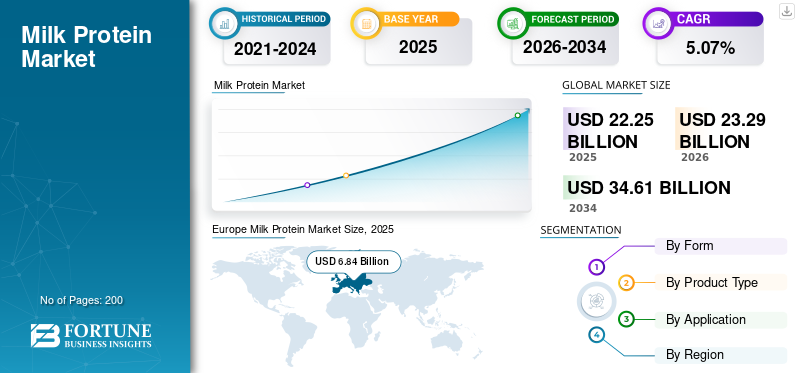
The global milk protein market size was valued at USD 22.25 billion in 2025. The market is projected to grow from USD 23.29 billion in 2026 to USD 34.61 billion by 2034, exhibiting a CAGR of 5.07% during the forecast period. Europe dominated the milk protein market with a market share of 30.74% in 2025.
Milk protein represents a structurally expanding ingredient category within the broader dairy ingredients and functional nutrition industry. Derived primarily from cow’s milk, milk proteins include casein, caseinates, Whey Protein Concentrate (WPC), Whey Protein Isolate (WPI), Whey Hydrolysates (WPH), and milk protein concentrates. These proteins are widely used in sports nutrition, dietary supplements, infant formula, baked goods, dairy products, and personal care formulations due to their high biological value, superior amino acid profile, emulsification capacity, and functional texturizing properties.
The global market demand is led by major players, including Arla Foods Ingredients Group, Fonterra Co-operative Group Limited, Glanbia plc, Lactalis Ingredients, and FrieslandCampina Ingredients.
Download Free sample to learn more about this report.
Milk Protein Market Key Takeaways
 Global Market Size & Forecast
- 2025 Market Size: USD 22.25 billion
- 2026 Market Size: USD 23.29 billion
- 2034 Forecast Market Size: USD 34.61 billion
- CAGR: 5.07% from 2026–2034
 Market Share
- Europe dominated the milk protein market with a 30.74% share in 2025.
- The liquid segment is projected to grow at a CAGR of 6.02% during the forecast period.
- The whey protein segment is projected to grow at a CAGR of 7.51%, driven by premium nutrition demand.
 Key Regional Highlights
Europe
Europe to Led the global market at USD 6.84 billion in 2025 and is projected to grow at a CAGR of 4.69%.
North America
North America Accounted for USD 6.38 billion in 2025, representing one of the most structurally mature markets.
Asia Pacific
Asia Pacific to Reached USD 5.71 billion in 2025 and is projected to record the fastest CAGR of 6.13%.
U.S.
The market was valued at approximately USD 5.47 billion in 2025, accounting for the majority share in North America.
Japan
Market growth is supported by increasing demand for milk protein products and premium nutrition solutions.
Read More

Milk Protein Market Trends
Rising Demand for High-Quality Dairy Proteins to be Prominent Industry Trend
Consumers are increasingly prioritizing high-biological-value proteins with complete amino acid profiles, supporting sustained demand for dairy-based proteins over synthetic or lower-digestibility plant proteins in specific applications. Whey protein, in particular, has gained prominence due to its rapid absorption kinetics and muscle protein synthesis benefits. The expansion of strength training, endurance sports, and aging population nutrition is structurally supporting milk protein products and inclusion across Ready-to-Drink (RTD) beverages, protein bars, and medical nutrition formulations. Clean-label and minimally processed dairy ingredients are further enhancing product positioning in developed markets.
- According to the International Food Information Council (IFIC), in 2025, around 71% of U.S. consumers actively seek protein in their diets, with dairy protein ranking among the most recognized sources.
MARKET DYNAMICS
Market Drivers
Download Free sample to learn more about this report.
Expanding Dairy Production and Functional Nutrition Adoption to Support Market Expansion
Global growth in milk production has strengthened the availibilty of milk as raw material for milk protein extraction and fractionation. Technological advancements in membrane filtration and spray drying have improved yield efficiency and functional customization. Moreover, rising demand for protein-fortified beverages, infant nutrition in the Asia Pacific, and medical nutrition products catering to Europe and North America is accelerating ingredient-level global milk protein market growth.
- According to the Food and Agriculture Organization (FAO), global milk production exceeded 940 million metric tons in 2023, with Asia accounting for the fastest growth.
Market Restraints
Volatility in Dairy Prices and Supply Chain Pressures to Limit Profit Margins
Milk protein pricing remains sensitive to raw milk price volatility, feed costs, climatic variability, and trade regulations. Dairy supply fluctuations in key exporting countries such as the U.S., EU, and New Zealand directly affect whey and casein pricing. Energy-intensive drying processes and global trade logistics further impact cost structures.
Moreover, the global market faces growing competition from plant-based alternatives such as pea, soy, and almond proteins, driven by rising veganism and flexitarian diets. These plant-based options challenge milk protein's dominance by mimicking its nutritional profile and functionality while appealing to consumers prioritizing health, ethics, and sustainability.
- According to the United States Department of Agriculture, data and related agricultural research confirm that feed costs constitute the largest operating expense for dairy farms, generally representing 50–60% of total operating costs.
Market Opportunities
Expansion of High-Purity Whey Isolates and Specialized Functional Blends to Boost Product Demand
The growing demand for high-purity Whey Protein Isolates (WPI) and Whey Protein Hydrolysates (WPH) is creating a strong opportunity for global milk protein market growth. These forms of whey protein are more refined compared to regular whey protein concentrate. They contain a higher percentage of protein (around 90% or more in isolates), very little lactose, and minimal fat. Hydrolysates go one step further; the protein is partially broken down into smaller components, making it easier and faster for the body to absorb.
Overall, as consumers move toward high-protein, low-sugar, and easy-to-digest nutrition products, demand for premium whey ingredients is rising faster than standard whey products. This shift is not only increasing usage volumes but also improving profit margins for manufacturers offering high-purity and specialized whey formulations.
SEGMENTATION ANALYSIS
By Form
Dry Form Dominated Due to Extended Shelf Life and Superior Formulation Flexibility
Based on form, the market is segmented into dry and liquid.
The dry segment dominated the global milk protein market share, valued at USD 18.05 billion in 2025, due to extended shelf life, ease of bulk transportation, lower microbial risk, and superior formulation flexibility. Powdered milk proteins are widely used in bakery, dairy processing, infant formula, sports nutrition powders, and protein fortification blends. Dry formats enable precise protein standardization, better storage economics, and global trade efficiency, making them the preferred format for large-scale industrial buyers.
The liquid market segment is projected to grow at a faster CAGR of 6.02% during the forecast period.
By Product Type
Casein & Caseinates Led Due to Strong Demand from Food Processing and Dairy Applications
Based on product type, the market is segmented into casein & caseinates and whey protein.
The casein & caseinates segment dominated, valued at USD 17.20 billion in 2025 was supported by extensive usage in cheese production, processed foods, bakery, confectionery, dairy beverages, and industrial emulsification applications. Casein’s slow-digesting properties and strong water-binding capacity makes it highly functional in food systems requiring texture stability and moisture retention. Sub-types such as sodium caseinate and calcium caseinate are widely incorporated in processed cheese and nutritional formulations.
The whey protein segment is projected to grow at a higher CAGR of 7.51% during the forecast period, driven by premium nutrition demand.
By Application
To know how our report can help streamline your business, Speak to Analyst
Broad Functional Integration of Milk Protein Across Processed Foods Propelled Food & Beverages Segment’s Leadership
Based on application, the market is segmented into food & beverages, dietary supplements, sports nutrition, infant formula, cosmetics & personal care, and others.
The food & beverages segment dominated, valued at USD 10.13 billion in 2025, as milk proteins are widely incorporated into bakery products, dairy beverages, confectionery, ready meals, soups, and protein-fortified foods. Functional health benefits such as emulsification, foaming, gelation, and texture enhancement make milk proteins essential ingredients in processed food manufacturing.
The sports nutrition segment, valued at USD 3.14 billion in 2025, is projected to grow at the fastest CAGR of 6.60% from 2026 to 2034, supported by expanding gym penetration, active lifestyle adoption, and performance-focused consumption globally.
Milk Protein Market Regional Outlook
Regionally, the report covers the North America, Europe, Asia Pacific, South America, and the Middle East & Africa.
North America
Europe Milk Protein Market Size, 2025 (USD Billion)
To get more information on the regional analysis of this market, Download Free sample
North America accounted for USD 6.38 billion in 2025, representing one of the most structurally mature markets. The region is projected to grow at a CAGR of 4.38%, slightly below the global average supported by steady sports nutrition, infant formula, and functional dairy demand. High whey processing capacity, advanced membrane filtration technology, and strong export infrastructure support sustained growth of the region.
U.S. Milk Protein Market
The U.S. market was valued at approximately USD 5.47 billion in 2025, accounting for the majority share. The country’s dominance is supported by large-scale cheese production, which generates substantial whey streams for further protein processing.
Europe
Europe led the global market in value terms, reaching USD 6.84 billion in 2025, and is projected to grow at a CAGR of 4.69% (2026–2034). The region benefits from strong cheese production, casein manufacturing, and infant formula exports.
Germany Milk Protein Market
Germany’s market was valued at approximately USD 1.39 billion in 2025, making it one of Europe’s largest country-level markets. Germany’s strong dairy processing base, combined with advanced membrane filtration technologies, supports the production of caseinates, milk protein concentrates, and whey derivatives.
U.K. Milk Protein Market
The U.K. market was valued at approximately USD 0.71 billion in 2025. Growth is supported by rising protein-fortified dairy products, private-label sports nutrition brands, and increasing health-conscious consumer preference.
Asia Pacific
Asia Pacific reached USD 5.71 billion in 2025 and is projected to grow at the fastest CAGR of 6.13% during the forecast period, outperforming all other regions. Rising disposable income, expanding middle-class populations, and increasing protein awareness are key structural drivers for region’s market growth.
China Milk Protein Market
China’s market reached approximately USD 1.90 billion in 2025, representing the largest share within the Asia Pacific region. The country’s strong demand for infant formula, expanding sports nutrition consumption, and increasing protein fortification in dairy beverages boosts demand for the product. China remains highly import-dependent for high-quality whey protein isolates and specialty casein products.
India Milk Protein Market
India’s milk protein market was valued at approximately USD 1.61 billion in 2025. While India is one of the largest milk producers globally, ingredient-level processing into high-value protein concentrates remains underdeveloped. Rising middle-class income population and increasing protein awareness are gradually expanding demand for fortified dairy products and supplements.
South America and the Middle East & Africa
South America reached USD 1.83 billion in 2025, growing at a CAGR of 5.46%. The region benefits from improving dairy infrastructure and rising sports nutrition adoption.
The Middle East and Africa market was valued at USD 1.49 billion in 2025 along with a CAGR of 5.01% (2026–2034). Region’s growth is supported by increasing dairy imports and expanding protein supplement retail penetration.
Brazil Milk Protein Market
Brazil’s market was valued at approximately USD 1.03 billion in 2025, accounting for the majority of South America’s market. The country benefits from a strong dairy production base and increasing sports supplement demand. Brazil is both producer and consumer of milk protein ingredients.
COMPETITIVE LANDSCAPE
Key Industry Players
Key Players are Focusing on Whey Fraction Expansion, Infant-Grade Quality Systems, and Long-Term Milk Sourcing to Maintain Competitive Advantage
Leading companies are investing in WPC/WPI capacity, hydrolysates, filtration technology, infant-grade specifications, traceability, and sustainability-linked sourcing. This strategy is increasingly shaped by demand for premium whey proteins in Asia and high-growth sports nutrition channels, supported by USDA-reported trade momentum for high-protein whey.
Key Players in the Market
|
Rank |
Company Name |
|
1 |
Arla Foods Ingredients |
|
2 |
FrieslandCampina Ingredients |
|
3 |
Fonterra Co-operative Group Limited |
|
4 |
Glanbia plc |
|
5 |
Lactalis Ingredients |
List of Key Milk Protein Companies Profiled
- Arla Foods Ingredients (Denmark)
- FrieslandCampina Ingredients (Netherlands)
- Fonterra Co-operative Group Limited (New Zealand)
- Glanbia plc (Ireland)
- Lactalis Ingredients (France)
- Kerry Group (Ireland)
- Dairy Farmers of America, Inc. (U.S.)
- Saputo Inc. (Canada)
- Schreiber Foods, Inc. (U.S.)
- Sodiaal / Eurial Ingredients & Nutrition (France)
KEY INDUSTRY DEVELOPMENTS
- November 2025: Arla Foods Ingredients announced new high-protein food and beverage concepts to showcase its milk and whey protein innovation expertise at Fi Europe 2025 in Paris. Key products include high-protein transparent yoghurt, carbonated milk drink, gluten-free high-protein cookies, and 25% protein brownie (no added sugar, fudgy texture).
- November 2023: Valio, one of the leading Finnish dairy companies, launched a new Milk Protein Concentrate (MPC), Valio Eila MPC 65. The product combines natural whey and casein from dairy milk, enabling short ingredient lists without added flavor maskers or sweeteners.
- June 2022: Fonterra's NZMP launched Pro-Optima, a Grade A functional Whey Protein Concentrate (fWPC), through a joint venture with Tillamook County Creamery Association and Three Mile Canyon Farms. It supports clean-label innovation amid rising U.S. yogurt demand, where 96% of consumers plan to maintain or increase intake.
- February 2021: Lactalis Ingredients launched Pronativ Native Micellar Casein, as a minimally processed, native protein extracted directl y from milk via gentle cold filtration, preserving its natural structure without chemicals or additives. This high-protein (87-88%) isolate offers low viscosity, heat stability, neutral taste, low spores, and micellar calcium, making it ideal for enriching functional foods, beverages, and medical nutrition targeting active lifestyles, muscle health, and healthy aging.
- December 2020: Ingredia, a French dairy ingredients specialist, developed functional milk proteins such as the Promilk and ProDiet ranges to enhance health-focused snacking with improved texture, nutrition, and indulgence. These proteins target on-the-go dairy products such as high-protein yogurts, beverages, and creamy snacks, addressing consumer demand for high protein, clean-label, and health-driven options.
REPORT COVERAGE
The global milk protein market industry report analyzes the market in depth and highlights crucial aspects such as global market trends, market dynamics, prominent companies, investment in research and development, and end-use. Besides this, the report also provides insights into the global market analysis and highlights significant industry developments.
Request for Customization to gain extensive market insights.
Report Scope & Segmentation
| ATTRIBUTE | DETAILS |
| Study Period | 2021-2034 |
| Base Year | 2025 |
| Estimated Year | 2026 |
| Forecast Period | 2026-2034 |
| Historical Period | 2021-2024 |
| Growth Rate | CAGR of 5.07% from 2026 to 2034 |
| Unit | Value (USD Billion) |
|
Segmentation |
By Form
|
|
By Product Type
|
|
|
By Application
|
|
|
By Region
|
Frequently Asked Questions
Fortune Business Insights says that the global market was valued at USD 22.25 billion in 2025 and is anticipated to reach USD 34.61 billion by 2034.
At a CAGR of 5.07%, the global market will exhibit steady growth over the forecast period.
By form, the dry segment led the market.
Europe held the largest market share in 2025.
Expanding dairy production and functional nutrition adoption to support market expansion.
Arla Foods Ingredients Group, Fonterra Co-operative Group Limited, Glanbia plc, Lactalis Ingredients, and FrieslandCampina Ingredients are the leading companies in the market.
Rising demand for high-quality dairy proteins to shape industry trends.



- 2021-2034
- 2025
- 2021-2024
- 200
-
(Offer valid till 15th Oct 2026)
Get 30-60 hrs Free Customization
Expand Regional and Country Coverage, Segments Analysis, Company Profiles, Competitive Benchmarking, and End-user Insights.




















Related Reports
-
US +1 833 909 2966 ( Toll Free )
-
Get In Touch With Us