Minimalist Packaging Market Size, Share & Industry Analysis, By Material (Plastics, Paper & Paperboard, Glass, Metals and Others), By Packaging Type (Boxes & Cartons, Bags & Pouches, Bottles & Jars, Trays & Clamshells, Others), By End-use Industry (Food & Beverages, Personal Care & Cosmetics, Fashion & Apparel, Household, Healthcare, and Others) and Regional Forecast, 2026-2034
 Download Free Sample
(Offer valid till 31st Oct 2026)

KEY MARKET INSIGHTS
 Listen to Audio Version
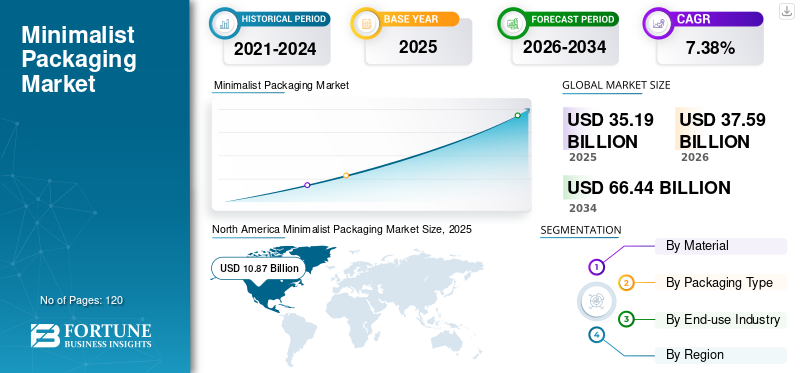
The global minimalist packaging market size was valued at USD 35.19 billion in 2025. The market is projected to grow from USD 37.59 billion in 2026 to USD 66.44 billion by 2034, exhibiting a CAGR of 7.38% during the forecast period. North America dominated the global minimalist packaging market with a market share of 30.89% in 2025.
Minimalist packaging denotes a packaging strategy that emphasizes simplicity by utilizing the minimal amount of materials, components, and visual elements required to safeguard and convey a product, all while ensuring functionality, sustainability, and effective brand communication. One of the primary drivers of the global market is the growing emphasis on sustainability and the implementation of stringent environmental regulations. Governments across regions are enacting stricter mandates regarding packaging waste and policies aimed at reducing plastic usage, thereby urging manufacturers to embrace simplified designs that utilize fewer materials and facilitate easier recycling.
Key industry players, such as Smurfit Kappa, Mondi, DS Smith, and Graphic Packaging International, operating in the market, are focusing on developing various innovative products and conducting R&D activities.
Download Free sample to learn more about this report.
Minimalist Packaging Market Key Takeaways
 Global Market Size & Forecast
- 2025 Market Size: USD 35.19 billion
- 2026 Market Size: USD 37.59 billion
- 2034 Forecast Market Size: USD 66.44 billion
- CAGR: 7.38% from 2026–2034
 Market Share
- North America dominated the minimalist packaging market with a 30.89% share in 2025.
- Paper & paperboard segment led due to strong sustainability and recyclability advantages.
- Boxes & cartons segment held the largest share due to material efficiency and versatility.
 Key Regional Highlights
North America
North America reached USD 10.87 billion in 2025, accounting for 30.89% of global market share.
Asia Pacific
Asia Pacific recorded USD 9.48 billion in 2025, emerging as the second-largest regional market.
Europe
Europe is projected to reach USD 8.57 billion in 2025, driven by circular economy regulations.
U.S.
Market reached approximately USD 9.43 billion in 2025, representing around 26.80% of global sales.
Japan
Market reached approximately USD 1.82 billion in 2025, accounting for around 5.18% of global revenue.
Read More

MINIMALIST PACKAGING MARKET TRENDS
Eco-centric Design and Circular Economy Integration Are the Prominent Trends Observed in the Market
Minimalist packaging is progressively aligned with the principles of a circular economy, emphasizing the reduction of materials, recyclability, and models for reuse or refilling. Concurrently, a clean aesthetic characterized by minimal graphics and packaging materials is being embraced to convey brand authenticity and a premium market position, particularly within the personal care, luxury, and sustainable product sectors. Thus, eco-centric design, functional simplicity, and integration of the circular economy are emerging as key trends shaping the market.
Download Free sample to learn more about this report.
MARKET DYNAMICS
MARKET DRIVERS
Shifting Consumer Preferences Toward Eco-Conscious Brands is Hastening Market Growth
Modern consumers, particularly Millennials and Generation Z, are increasingly associating the product with environmental responsibility and brand authenticity. Studies show a significant consumer inclination toward products that reduce waste and minimize environmental impact, positioning minimalist design as a strategic asset for brands aiming to stand out and foster loyalty in highly saturated markets. This shift in consumer behavior is particularly evident in industries such as personal care, food and beverage, and e-commerce, where packaging choices have a significant influence on purchasing decisions. Henceforth, the growing preference for eco-conscious brands and sustainable packaging choices is driving the global minimalist packaging market growth.
MARKET RESTRAINTS
High Initial Investment and Material Costs to Restrict Market Growth
Although minimalist packaging offers long-term advantages, its adoption often necessitates a significant initial investment. Shifting to innovative materials, such as biopolymers, advanced paperboard, or recyclable substrates, requires funding for new production lines, materials testing, and process redesign. This financial burden can be particularly challenging for smaller companies, hindering their ability to penetrate the market more widely. Furthermore, sustainable materials typically come with a higher price tag compared to traditional plastics, which further limits product adoption in regions sensitive to pricing.
MARKET OPPORTUNITIES
Innovation in Sustainable Materials and Smart Packaging to Offer Market Growth Opportunities
The continuous progress in material science offers considerable prospects for the market. Innovations in biodegradable materials, enhanced paper coatings, and advanced smart packaging technologies (such as RFID and QR codes) enable brands to achieve simplicity, functionality, and traceability seamlessly. These advancements enhance environmental performance and provide greater consumer engagement and insights into the supply chain, thereby creating new value propositions for brands.
MARKET CHALLENGES
Fragmented Global Standards and Practices Pose a Critical Challenge to Market Growth
The worldwide availability of advanced sustainable materials is still inconsistent, characterized by a geographic concentration of primary suppliers and competition with other industrial applications for feedstocks. Discrepancies in packaging standards, recycling protocols, and labeling requirements among different regions introduce challenges for multinational brands. This fragmentation heightens compliance efforts and expenses, as companies are required to tailor packaging solutions to align with various regulatory environments, thereby hindering market scalability and growth.
Segmentation Analysis
By Material
Paper & Paperboard Segment to Lead due to Its Robust Alignment With Sustainability Goals
Based on material, the market is divided into paper & paperboard, plastics, glass, metals, and others.
The paper & paperboard segment is anticipated to account for the largest share of the market. The segment leads the global market, primarily due to its robust alignment with sustainability objectives, adherence to regulations, and minimalist design principles. These materials are extensively recyclable, biodegradable, and sourced from renewable resources, making them the preferred option for brands seeking to minimize their environmental impact while complying with increasingly stringent packaging waste regulations, particularly in Europe and North America. Additionally, their mono-material composition facilitates recycling processes, which is a fundamental aspect of minimalist packaging strategies.
The plastics segment is expected to grow at a CAGR of 7.46% over the forecast period.
By Packaging Type
Versatility, Protection, and Material Efficiency Boosted Boxes & Cartons Segment Growth
Based on packaging type, the market is segmented into boxes & cartons, bags & pouches, bottles & jars, trays & clamshells, and others.
In 2025, the boxes and cartons segment dominated the global market. The segment leads the global industry owing to its remarkable versatility, structural efficiency, and alignment with minimalist and sustainable design principles. Boxes & cartons can be crafted with reduced materials while still ensuring robust product protection, making them ideal for brands seeking to strike a balance between simplicity and functionality. Their capacity to remove unnecessary layers, inserts, and secondary packaging directly supports the goals of minimalist packaging.
The bags & pouches segment is projected to grow at a CAGR of 7.56% over the forecast period.
By End-use Industry
To know how our report can help streamline your business, Speak to Analyst
High Packaging Consumption to Drive Food & Beverages Segment Growth
Based on end-use industry, the market is segmented into food & beverages, personal care & cosmetics, fashion & apparel, household, healthcare, and others.
The food & beverages segment is expected to hold a dominant market share over the forecast period. The food & beverage leads the global market, primarily due to its substantial packaging consumption volume and regular, daily usage. Food and beverage items require packaging at various stages of processing, storage, transportation, retail, and consumption, resulting in considerably greater material usage compared to other sectors. Even minor decreases in material per unit can result in significant cost savings and waste reduction on a large scale, which makes minimalist packaging especially beneficial for this industry.
The personal care & cosmetics segment is projected to grow at a CAGR of 7.77% over the forecast period.
Minimalist Packaging Market Regional Outlook
By geography, the market is categorized into Europe, North America, Asia Pacific, Latin America, and the Middle East & Africa.
North America
North America Minimalist Packaging Market Size, 2025 (USD Billion)
To get more information on the regional analysis of this market, Download Free sample
North America held the dominant minimalist packaging market share in 2024, valued at USD 10.16 billion, and maintained its leading position in 2025, with a value of USD 10.87 billion. In North America, a major factor driving the adoption of the product, however, it is mainly influenced by commitment to sustainability for brands, pressures from ESG reporting, and the need for cost optimization. Consumer preferences for clean, transparent, and environmentally friendly packaging, particularly among Millennials and Generation Z, also contribute significantly to this trend.
U.S Minimalist Packaging Market
Based on North America’s strong contribution and the U.S. dominance within the region, the U.S. market can be analytically approximated at around USD 9.43 billion in 2025, accounting for roughly 26.80% of global minimalist packaging sales. In the U.S., the product is influenced by corporate ESG objectives, the optimization of e-commerce, and significant consumer scrutiny regarding excessive packaging.
Europe
Europe is projected to record a growth rate of 7.06% in the coming years, which is the third highest among all regions, and reach a valuation of USD 8.57 billion by 2025. The market in the region is significantly influenced by regulatory enforcement and mandates related to the circular economy. Policies established by the EU concerning the reduction of packaging waste, recyclability, extended producer responsibility (EPR), and targets for recycled content are compelling brands to remove superfluous elements and streamline material compositions.
U.K Minimalist Packaging Market
The market in the U.K. reached around USD 1.55 billion in 2025, representing approximately 4.40% of global minimalist packaging revenues.
Germany Minimalist Packaging Market
Germany’s market reached approximately USD 1.82 billion in 2025, equivalent to around 5.16% of global minimalist packaging sales.
Asia Pacific
Asia Pacific stood at USD 9.48 billion in 2025 and secured the position of the second-largest region in the market. In the region, India and China are both estimated to reach USD 2.50 billion and USD 3.04 billion, respectively, in 2025. In the Asia Pacific region, the expansion of the market is driven by rapid urbanization, substantial product volumes, and heightened sensitivity to costs, particularly in developing economies. Consumers increasingly embrace minimalist packaging as a means to lower material expenses and enhance manufacturing efficiency on a larger scale.
Japan Minimalist Packaging Market
The Japanese market in 2025 reached around USD 1.82 billion, accounting for roughly 5.18% of global minimalist packaging revenues. In Japan, the preference for minimalist packaging is influenced by cultural values that emphasize simplicity, efficient use of space, and outstanding functional minimalist packaging design.
China Minimalist Packaging Market
China’s market is projected to be one of the largest worldwide, with 2025 revenues standing at around USD 3.04 billion, representing roughly 8.64% of global Minimalist Packaging sales.
India Minimalist Packaging Market
The market in India in 2025 reached around USD 2.50 billion, accounting for roughly 7.11% of global minimalist packaging revenues.
Latin America and the Middle East & Africa
The Latin America and the Middle East & Africa regions are expected to witness moderate growth in this market during the forecast period. The Latin America market is set to reach a valuation of USD 3.55 billion in 2025. In Latin America, there is an increasing trend toward minimalist packaging, driven by heightened concerns regarding reducing waste management, advancements in retail infrastructure, and a growing consumer demand for sustainability among urban consumers.
In the Middle East & Africa, South Africa is set to reach a value of USD 0.78 billion in 2025.
Saudi Arabia Minimalist Packaging Market
The Saudi Arabian market reached approximately USD 0.88 billion in 2025, accounting for roughly 2.49% of global minimalist packaging revenues.
COMPETITIVE LANDSCAPE
Key Industry Players
Focus on Expanding Product Launch and Acquisitions by Key Players to Advance Research Activities
The global market holds a semi-consolidated market structure, constituting prominent players such as Smurfit Kappa, Mondi, and DS Smith. The significant market share of these companies is due to numerous strategic activities, including collaboration among operating entities to advance research activities.
- For instance, in January 2025, Hindustan Unilever Limited (HUL) declared that it has entered into a definitive agreement to purchase the premium actives-led beauty brand Minimalist. This represents a further advancement in the transformation journey of its Beauty & Wellbeing portfolio, aimed at adapting to evolving and higher-growth demand sectors.
Other notable players in the global market include Graphic Packaging International, Virospack, and Quadpack. These companies are expected to prioritize new product launches and collaborations to increase their global market share during the forecast period.
LIST OF KEY MINIMALIST PACKAGING COMPANIES PROFILED
- Smurfit Kappa (Ireland)
- Mondi (U.K.)
- DS Smith (U.K.)
- Graphic Packaging International (U.S.)
- Virospack (Spain)
- Quadpack (Spain)
- APackaging Group (U.S.)
- AptarGroup (U.S.)
- Huhtamaki Oyj (Finland)
- EPL Limited (India)
- Refine Packaging (U.S.)
- Golden Arrow, Inc. (U.S.)
- Oliver Inc. (U.S.)
- Lipack Packaging (China)
- Richpack (China)
KEY INDUSTRY DEVELOPMENTS
- June 2025: ATP introduced its innovative eco-friendly packaging, which features natural cardboard and a single-color design aimed at reducing its environmental impact. This strategic initiative is driven by a distinct goal: to lessen the environmental footprint associated with the production and distribution of each product.
- April 2025: Mondi collaborated with Evonik to launch a recyclable, pre-made paper bag designed for storing chemical powders. A minimal spot coating is used, enabling the bags to be securely sealed after filling. According to the company, they comply with the recycling standards set forth by CEPI, version 3, and 4Evergreen guidelines.
- September 2022: Mondi developed a paper packaging solution designed to wrap and transport PET beverage bottles, serving as an alternative to plastic shrink wrap. Hug&Hold is a fully recyclable solution made entirely of paper, consisting of two components: a kraft paper sleeve and a corrugated clip. This innovative solution, developed internally by Mondi's expert teams, has been validated for use in automated packing processes.
- September 2021: NIVEA launched its newest skincare innovation, namely NIVEA Naturally Good. This is a completely new range of healthy and sustainable skincare products that contains over 95% natural origin ingredients and utilizes eco-friendly packaging.
- April 2021: Beiersdorf introduced its inaugural climate-neutral Nivea skincare products. This initiative, set to be available in 30 countries, will be expanded with additional products in the future, and comes on the heels of a new sustainable packaging innovation that incorporates certified renewable plastic.
REPORT COVERAGE
Request for Customization to gain extensive market insights.
Report Scope & Segmentation
|
ATTRIBUTE |
DETAILS |
|
Study Period |
2021-2034 |
|
Base Year |
2025 |
|
Estimated Year |
2026 |
|
Forecast Period |
2026-2034 |
|
Historical Period |
2021-2024 |
|
Growth Rate |
CAGR of 7.38% from 2026-2034 |
|
Unit |
Value (USD Billion) |
|
Segmentation |
By Material, Packaging Type, End-use Industry, and Region |
|
By Material |
· Paper & Paperboard · Plastics · Glass · Metals · Others |
|
By Packaging Type |
· Boxes & Cartons · Bags & Pouches · Bottles & Jars · Trays & Clamshells · Others |
|
By End-use Industry |
· Food & Beverages · Personal Care & Cosmetics · Fashion & Apparel · Household · Healthcare · Others |
|
By Region |
· North America (By Material, Packaging Type, End-use Industry, and Country) o U.S. o Canada · Europe (By Material, Packaging Type, End-use Industry, and Country/Sub-region) o Germany o U.K. o France o Italy o Spain o Russia o Poland o Romania o Rest of Europe · Asia Pacific (By Material, Packaging Type, End-use Industry, and Country/Sub-region) o China o Japan o India o Australia o Southeast Asia o Rest of Asia Pacific · Latin America (By Material, Packaging Type, End-use Industry, and Country/Sub-region) o Brazil o Mexico o Argentina o Rest of Latin America · Middle East & Africa (By Material, Packaging Type, End-use Industry, and Country/Sub-region) o Saudi Arabia o UAE o Oman o South Africa o Rest of Middle East & Africa |
Frequently Asked Questions
According to Fortune Business Insights, the global market value stood at USD 35.19 billion in 2025 and is projected to reach USD 66.44 billion by 2034.
In 2025, the market value stood at USD 10.87 billion.
The market is expected to exhibit a CAGR of 7.38% during the forecast period (2026-2034).
By material, the paper and paperboard segment is expected to lead the market.
Shifting consumer preferences toward eco-conscious brands are the key factors driving market growth.
Smurfit Kappa, Mondi, DS Smith, and Graphic Packaging International are the major players in the global market.
North America dominated the market in 2025.



- 2021-2034
- 2025
- 2021-2024
- 120
-
(Offer valid till 31st Oct 2026)
Get 30-60 hrs Free Customization
Expand Regional and Country Coverage, Segments Analysis, Company Profiles, Competitive Benchmarking, and End-user Insights.







-
US +1 833 909 2966 ( Toll Free )
-
Get In Touch With Us