Mobile Banking Market Size, Share & Industry Analysis, By Type (Account Management, Fund Transfers, Bill Payments, Loan Services, Deposits & Investments, Card Services, Insurance & Wealth Management, Others), By Deployment Type (On-Premises and Hybrid), By End User (Retail and Corporate Banks, Digital Banks and Fintech Companies, Government Banks, and Others), and Regional Forecast, 2026-2034
 Download Free Sample
MOBILE BANKING MARKET SIZE AND FUTURE OUTLOOK
 Listen to Audio Version
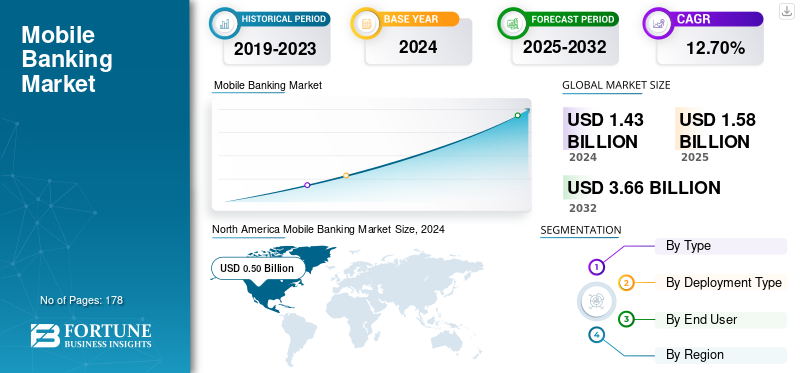
The global mobile banking market size was valued at USD 1581.1 million in 2025. The market is projected to grow from USD 1758.2 million in 2025 to USD 4,861.30 million by 2034, exhibiting a CAGR of 13.60% during the forecast period. North America dominated the global mobile banking market with a market share of 35.20% in 2026.
Mobile banking is referred to a service that allows consumers to perform different financial transactions and manage their accounts with the use of mobile devices. This offers an easy and secure way for accessing bank accounts and performing a wide range of banking transactions without the need for physically visiting banks.
The market for mobile banking is noticing a rapid growth due to increase in demand for traditional banking services and growing smartphone penetration. For instance, mobile technologies and services generate around 5.8% of global GDP, a contribution that amounts to USD 6.5 trillion of economic value added. By 2030, this figure will rise to almost USD 11 trillion, or 8.4% of GDP. Additionally, higher flexibility aligning with busy and non-standard schedules of modern customers, also augments the market growth.
Key players operating in the market include Temenos AG, Bankingly, Infosys EdgeVerve, nCino Inc., Zafin, Sarvatra Technologies Pvt. Ltd., Skaleet, Natech Banking Solutions, and others. these companies are adopting different key strategies such as partnerships, new launches and others to sustain competition.
Download Free sample to learn more about this report.
MOBILE BANKING MARKET KEY TAKEAWAYS
 Global Market Size & Forecast
- 2025 Market Size: USD 1581.1 million
- 2026 Market Size: USD 1758.2 million
- 2034 Forecast Market Size: USD 4,861.30 million
- CAGR: 13.60% from 2026–2034
 Market Share
- North America dominated the global mobile banking market with a market share of 35.20% in 2026.
- In 2026, fund transfers segment will hold the largest mobile banking market share of 28.04%.
- Among these, hybrid segment is estimated to dominate the market with a market share of 66.32% in 2026.
 Key Regional Highlights
North America
North America is projected to reach USD 626.17 million in 2026, after accounting for 35.17% of the global market in 2025.
Europe
Europe is expected to reach USD 467.09 million in 2026, following a 27.40% global market share in 2025.
Asia Pacific
Asia Pacific is projected to reach USD 493.94 million in 2026, after holding 27.50% of the global market in 2025.
U.S.
The U.S. market is projected to reach USD 472.4 million by 2026.
Japan
The Japan market is projected to reach USD 82.4 million by 2026.
Read More

MARKET DYNAMICS
Market Drivers
Growing Smartphone Penetration and Internet Access Drives the Market Development
The increasing smartphone penetration and growing access to internet are a major drivers of mobile banking market growth. With affordable smartphones and low-cost data plans becoming highly accessible to customers particularly across the emerging economies, consumers are able to connect with the digital finance services. This has enabled an increase in connectivity, allowing banks to offer a user-friendly convenient mobile platform that reaches the remote or underserved populations. Moreover, as people rely on smartphones for everyday activities, mobile banking adoption is rising crucially. This has encouraged financial institutions to invest in different advanced features and expand their digital service offerings.
Market Restraints
Cybersecurity and Data Privacy Risks Deters the Market Growth
Cybersecurity and data privacy risks tend to restraint the growth of market. With increase in incidents of data breaches, financial frauds and identify thefts, end users are hesitating to fully adopt mobile banking services. Banks are also required to make significant investments in advanced security systems, fraud detection technologies and encryption, thus leading to an increased operational cost. Moreover, the dynamic regulatory needs demand a continuous updates and compliance efforts. Any error in safeguarding sensitive customer information could damage the brand trust and reputation.
Market Opportunities
Expansion in Emerging Economies and Rural Banking Offers Lucrative Growth Opportunities
Emerging economies and rural regions offer a substantial growth potential for the market. With Large unbanked populations, government based digital financial inclusion initiatives and increasing in smart phone penetration, a favorable condition for market expansion has been created. Banks are capable of leveraging low-cost and mobile first solutions to reach remote communities, thus reducing the dependence on physical branches. Additionally, collaborations with fintech companies also enhance the accessibility, thus allowing for a secure digital payment, savings products and micro loans tailored to rural needs.
MOBILE BANKING MARKET TRENDS
Rise of AI-Powered and Personalized Banking Has Emerged as a Prominent Market Trend
A key trend reshaping the market is rapid growth of AI-powered and customized banking services. With growing smartphone penetration and low cost mobile data, consumers are inclined toward mobile banking. This enables banks to reach underserved population. Similarly, AI technologies are also enhancing the user experience through personalized recommendations, fraud detection, automated financial management and intelligent customer support. Collectively, these factors tend to accelerate the adoption of mobile banking and drive innovation in the market.
Download Free sample to learn more about this report.
SEGMENTATION ANALYSIS
By Type
Growing Use of Real-Time Payment Systems Boosts Fund Transfers Segment Growth
Based on type, the market is segmented into account management, fund transfers, bill payments, loan services, deposits & investments, card services, insurance & wealth management and others.
In 2026, fund transfers segment will hold the largest mobile banking market share of 28.04%. This growth is driven by growing use of real-time payment systems, rapid interbank transactions, and Peer-To-Peer (P2P) transfers. With consumers growingly relying on the mobile app for secure, quick and convenient money transfers. Additionally, the growing awareness of digital wallets, cross-border remittance and UPI-based systems. Additionally, the increase in demand for cashless payments and ongoing innovation in payment gateways are further accelerating this expansion.
By Deployment Type
Increasing Demand to Balance Regulatory Compliance and Digital Innovation Drives Hybrid Segment Growth
The market is divided into on premise and hybrid, based on deployment.
Among these, hybrid segment is estimated to dominate the market with a market share of 66.32% in 2026. This segment combines on premise infrastructure with cloud based services. They tend to allow the banks to maintain the control over the sensitive data, thus gaining advantage from flexibility, scalability and cost efficiency of the cloud. Additionally, financial institutions are adopting flexible architectures to balance regulatory compliance and digital innovation. These approaches allow a faster update, seamless integration and improved security with fintech ecosystems.
By End User
Extensive Customer Base of Retail and Corporate Banks Drive Segment Growth
The market is divided retail and corporate banks, digital banks and fintech companies, government banks, and others, based on end user.
Among these, the retail and corporate banks segment will dominate the market with a market share of 51.83% in 2026. This growth is due to its extensive customer base, strong digital infrastructure and established trust. These ongoing investments in mobile platforms also enhance the customer engagement and service efficiency across the segment.
Digital banks and fintech companies segment held highest CAGR of 13.6% in 2024. This segmental growth is due to its agility, mobile first and innovation strategy. These focuses on seamless onboarding, lower cost operations and personalized user experiences attracts the tech-savvy and underserved customers across the globe.
To know how our report can help streamline your business, Speak to Analyst
MOBILE BANKING MARKET REGIONAL ANALYSIS
Geographically the market is segmented into North America, Europe, Asia Pacific, South America and Middle East & Africa.
North America
The North America market accounted for USD 556.11 Million in 2025, representing 35.17% of the global industry, and is expected to reach USD 626.17 Million in 2026. This regional market growth is due to its advanced digital infrastructure, strong presence of established banking and fintech, as well as high smartphone penetration. Additionally, focus of the U.S. on improved cybersecurity, innovation and seamless digital experiences drives the adoption of mobile banking across the country. The U.S. market is projected to reach USD 472.4 million by 2026.
North America Mobile Banking Market Size, 2025 (USD Million)
To get more information on the regional analysis of this market, Download Free sample
Europe
Europe recorded a market size of USD 432.49 Million in 2025, capturing 27.40% of the global market share, and is projected to reach USD 467.09 Million in 2026. This growth is owing to higher smartphone penetration, astringent regulatory frameworks including PSD2 and dynamic digital infrastructure. Additionally, customers are also demanding secure and convenient digital financial services, thus pushing banks to adopt advanced mobile features, seamless payment solutions and AI driven personalization across the region. The UK market is projected to reach USD 89.9 million by 2026, while the Germany market is projected to reach USD 92.9 million by 2026.
Asia Pacific
In 2025, Asia Pacific represented USD 434.42 Million, accounting for 27.50% of the worldwide market, and is projected to grow to USD 493.94 Million in 2026. This growing is attributed to the rapid urbanization, widespread use of mobile payments including UPI and e-wallets, and government based digital inclusion programs. Additionally, the expanding internet connectivity and tech-savvy population also accelerates the regional market growth. The Japan market is projected to reach USD 82.4 million by 2026, the China market is projected to reach USD 174.1 million by 2026, and the India market is projected to reach USD 82.4 million by 2026.
Middle East & Africa and Latin America
Middle East & Africa contributed 6.40% to the global market in 2025, with a valuation of USD 100.42 Million, and is projected to reach USD 109.54 Million in 2026. The regional market growth is due to growing smartphone penetration, limited access to traditional banking, and affordable data plans. The Latin America market was valued at USD 57.63 Million in 2025, capturing 3.60% of global revenue, and is estimated to reach USD 61.49 Million in 2026.
GCC countries are predicted to have a market share of USD 0.04 billion by 2025.
COMPETITIVE LANDSCAPE
Key Industry Players
Key Players Are Focusing on Innovation to Sustain their Market Positions
The mobile banking industry is combined with key players including Temenos AG, Bankingly, Infosys EdgeVerve, nCino Inc., Zafin, Sarvatra Technologies Pvt. Ltd., Skaleet, Natech Banking Solutions and others operating in it. These firms are focusing on rapid innovations, regulatory compliance, security, and technology adoption to sustain the competition and maintain their market positions.
LIST OF KEY MOBILE BANKING COMPANIES PROFILED
- Temenos AG (Switzerland)
- Bankingly (Uruguay)
- Infosys EdgeVerve (India)
- nCino Inc. (U.S.)
- Zafin (Canada)
- Sarvatra Technologies Pvt. Ltd. (India)
- Skaleet (France)
- Natech Banking Solutions (Greece)
- ApPello (Hungary)
- Ailleron (Poland)
- Backbase (Netherlands)
- Finastra (U.K.)
KEY INDUSTRY DEVELOPMENTS
- In September 2025, Equitas Small Finance Bank introduced an upgraded mobile banking application, 'Equitas 2.0'. The new app offers features such as online account opening, fixed and recurring deposit management, access to IPOs and mutual funds, card management, utility payments, and service request tracking. The bank aims to evolve this platform into a comprehensive super app, integrating e-commerce, ticketing, and entertainment services in the future.
- In July 2025, CaixaBank has launched a generative AI-based agent to help users of the entity's mobile banking application learn details about products, compare the different available options, and choose which one best suits their needs. Built on Google Cloud’s AI technology, it is an AI agent that interacts directly with the customer, a pioneering tool in Spanish banking.
- In May 2025, BBVA launched a new version of its app in Spain, with a unique native code that is scalable and exportable to all countries where the bank operates. This technological overhaul, which includes an ambitious artificial intelligence (AI) integration, marks a turning point in digital banking. It represents a decisive commitment to personalization, with a radically enhanced user experience. The new app multiplies the benefits of being a customer: direct access to cards and Bizum to make fast, simple payments, personalized savings plans and a financial coach to help manage finances, among other new developments.
- In September 2024, Vision Bank, which claims to be the first Sharia-compliant digital bank in Saudi Arabia, has launched its mobile app after two years in development. This achievement represents the culmination of over two years of relentless dedication, innovation, and collaboration for the company.
- In January 2024, Bank of America announced the launch of CashPro Insights, a digital tool that analyzes information flowing through the CashPro platform. Through data-driven intelligence, clients are presented with insights that empower them to make more informed treasury decisions and drive cost savings and efficiencies.
REPORT COVERAGE
The global report provides a detailed analysis of the market and focuses on key aspects such as prominent companies, deployment modes, types, and end users of the product. Besides this, it offers insights into the mobile banking market trends and highlights key industry developments and market share analysis for key companies. In addition to the aforementioned factors, the report encompasses several factors that have contributed to the growth of the market over recent years.
Request for Customization to gain extensive market insights.
Report Scope & Segmentation
| Attrbute | Details |
| Study Period | 2021-2034 |
| Base Year | 2025 |
| Forecast Period | 2026-2034 |
| Growth Rate | CAGR of 13.60% from 2026-2034 |
| Historical Period | 2021-2024 |
| Unit | Value (USD Million) |
| Segmentation | By Type, Deployment type, End User and Region |
| By Type |
|
| By Deployment type |
|
| By End User |
|
| By Region |
|
Frequently Asked Questions
Fortune Business Insights says that the global market stood at USD 1581.1 million in 2025 and is projected to reach USD 4,861.30 million by 2034.
The market is expected to exhibit steady growth at a CAGR of 13.60% during the forecast period.
Growing smartphone penetration and internet access drives the market growth.
Temenos AG, Bankingly, Infosys EdgeVerve, nCino Inc., Zafin, Sarvatra Technologies Pvt. Ltd., Skaleet, Natech Banking Solutions, and others are some of the top players in the market.
The North America region held the largest market share.
North America was valued at USD 556.1 million in 2025.



- 2021-2034
- 2025
- 2021-2024
- 178
Get 30-60 hrs Free Customization
Expand Regional and Country Coverage, Segments Analysis, Company Profiles, Competitive Benchmarking, and End-user Insights.







Related Reports
-
US +1 833 909 2966 ( Toll Free )
-
Get In Touch With Us