 Download Free Sample



Get a Quote
Receive a tailored pricing based on your needs.
- Choose license type
- Multiple user options
- Custom scope & coverage
- Fast turnaround
"Designing Growth Strategies is in our DNA"
 Listen to Audio Version
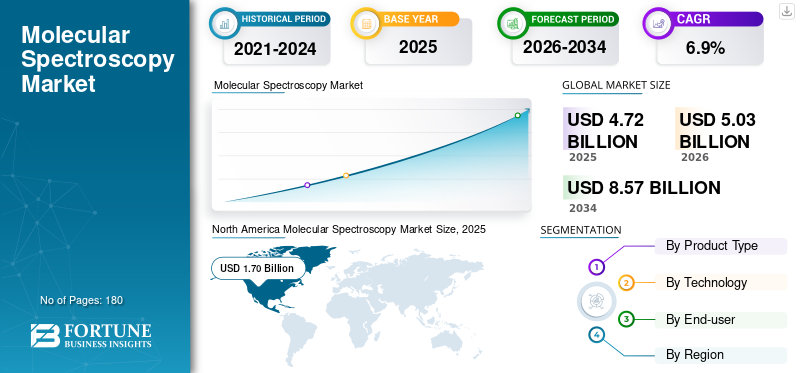
The global molecular spectroscopy market size was valued at USD 4.72 billion in 2025 and is projected to grow from USD 5.03 billion in 2026 to USD 8.57 billion by 2034, exhibiting a CAGR of 6.9% during the forecast period. North America dominated the global molecular spectroscopy market with a market share of 36.01% in 2025.
Molecular spectroscopy is an analytical technique used to identify, quantify, and characterize materials using electromagnetic radiation in various industries, including pharmaceuticals and biotechnology, as well as academic and research institutes, for process monitoring and regulatory documentation. The market growth is attributed to the increasing demand for spectroscopy instruments and consumables, driven by the growing need for QA/QC automation and R&D workflows.
Furthermore, the market is led by major players, including Bruker, Thermo Fisher Scientific Inc., and Agilent Technologies Inc. These players' portfolios of advanced instruments, incorporating new technologies and a strong global reach, contribute to their market share.
Download Free sample to learn more about this report.
 Market Size & Forecast
 Market Share
 Key Regional Highlights
North America
North America led the global market with a valuation of USD 1.70 billion in 2025.
Asia Pacific
Asia Pacific is expected to reach USD 1.47 billion in 2026.
Europe
Europe is projected to reach USD 1.49 billion in 2026.
U.S.
The market projected to reach USD 1.63 billion in 2026, accounting for approximately 32.4% of global revenue.
Japan
The market projected to reach USD 0.38 billion in 2026, representing approximately 7.6% of the global market.
Read More

AI-enabled Spectral Analytics and Multimodal Workflows to Emerge as a Key Market Trend
Currently, there has been an increasing integration of spectroscopy hardware with stronger software, AI/chemometrics, and imaging. Companies are integrating AI-powered evaluation and multimodal imaging into their IR imaging microscope workflows.
Moreover, key players are expanding their portfolio with Raman spectroscopy instruments and software that enable faster measurements, improved sensitivity, and greater sampling flexibility, thereby improving overall performance.
Download Free sample to learn more about this report.
Standard Regulations for Quality Assurance (QA)/Quality Control (QC) and Process Analytical Technology (PAT) to Drive the Market Growth
The increasing R&D initiatives by pharmaceutical & biotechnology companies, along with standard regulations for manufacturing, are driving the demand for molecular spectroscopy in rapid identity testing, impurity checks, release decisions, and process analytical technology (PAT), to reduce cycle time and avoid destructive testing.
In response, key players are launching new instruments to support their operations. Additionally, the growing production of biologics and complex formulations is driving the need for rapid and standardized solutions such as spectroscopy systems. This is projected to drive the global molecular spectroscopy market growth during the forecast period.
High Cost and Skills Gap to Restrict Market Growth
Despite the strong use of molecular spectroscopy instruments and consumables, their adoption is hindered by key factors, including high capital costs, ongoing calibration/validation burdens, and limited availability of experts, especially for Raman/NMR and imaging workflows.
The higher costs of service, compliance, training, and method development are particularly delaying upgrades or limiting deployment beyond core QC for many smaller laboratories, which is expected to hinder market growth.
Shift toward High-throughput Spectroscopy to Offer Lucrative Growth Opportunities
In recent years, there has been a growing shift from single-point measurements to high-throughput screening and chemical imaging, particularly for tablets, tissues, microplastics, and heterogeneous materials.
As a result, major players are capitalizing on these opportunities through new launches, such as a high-throughput Raman screening instrument and molecular fingerprinting tools.
Standardization across Instruments, Samples, and Methods to Challenge Market Growth
In recent years, reproducibility and transferability have posed a persistent challenge in sample preparation, instrument configurations, and chemometric models, thereby complicating the transfer of methods across sites and suppliers.
Although the instruments are designed for productivity, laboratories worldwide still require robust validation and consistent reference materials, which are challenging their adoption and market growth.
Increasing New Purchase Rate of Instruments to Drive Segmental Growth
Based on segmentation by product type, the market is classified as instruments, accessories & consumables, and software.
To know how our report can help streamline your business, Speak to Analyst
The instrument segment accounted for the major market share of molecular spectroscopy in 2025. The growth is primarily driven by an increasing new purchase rate of high-priced instruments and multi-year replacement cycles, which are fueled by performance upgrades, compliance needs, and expanding applications.
In addition, the accessories & consumables segment is projected to grow at a CAGR of 7.3% during the forecast period.
New Product Launches to Drive the Infrared (IR) Spectroscopy Segment’s Growth
Based on technology, the market is segmented into infrared (IR) spectroscopy, UV-visible spectroscopy, Raman spectroscopy, nuclear magnetic resonance (NMR) spectroscopy, and others.
The infrared (IR) spectroscopy segment held the largest market share in 2025. The segment’s growth is attributed to new product innovations such as relatively fast and cost-effective IR spectroscopy instruments. These instruments are in an increasing demand in the fields of chemicals, pharmaceutical solids, and forensics. Furthermore, the segment is expected to hold a share of 31.5% in 2026.
In addition, the nuclear magnetic resonance (NMR) spectroscopy segment is projected to grow at a CAGR of 6.9% during the forecast period.
Increasing QA/QC and R&D Requirements of Pharmaceutical & Biotechnology Companies to Propel the Segment Growth
In terms of end-user, the market is categorized into pharmaceutical & biotechnology companies, academic & research institutes, clinical & diagnostic laboratories, and others.
In 2025, the pharmaceutical & biotechnology companies segment dominated the market in terms of end-users. The segment’s growth is attributed to the increasing number of pharmaceutical & biotechnology companies that require spectroscopy instruments for quality control/quality assurance, drug discovery and development, as well as research initiatives worldwide. Furthermore, the segment is set to hold 38.4% share in 2026.
In addition, the academic & research institutes segment is projected to grow at a CAGR of 7.1% during the forecast period.
Based on geography, the market is classified into North America, Europe, Asia Pacific, Latin America, and the Middle East & Africa.
North America Molecular Spectroscopy Market Size, 2025 (USD Billion) To get more information on the regional analysis of this market, Download Free sample
North America accounted for the largest market share in 2024 with a value of USD 1.60 billion and continued its dominance in 2025 with a value to USD 1.70 billion. The regional growth is attributed to the region’s strong pharmaceutical & biotechnology base, high R&D spending, and early adoption of advanced analytical technologies. In 2026, the U.S. market is projected to reach USD 1.80 billion.
In 2026, the U.S. market is expected to reach a value of USD 1.63 billion, accounting for 32.4% of the global market revenue.
Europe is projected to register a growth rate of 6.1% in the coming years, the second-highest worldwide, reaching a market size of USD 1.49 billion by 2026. The growth is primarily driven by strong academic and industry collaboration, as well as stringent regulatory frameworks, which are expected to increase the utilization of spectroscopy instruments and consumables.
The U.K. market is expected to reach USD 0.26 billion by 2026, accounting for approximately 5.1% of the global market revenue.
The Germany market is projected to reach about USD 0.41 billion by 2026, representing roughly 8.1% of the global market.
In 2026, the Asia Pacific market is forecasted to reach USD 1.47 billion, ranking as the third-largest region in the market, with India and China expected to contribute USD 0.15 billion and USD 0.65 billion, respectively.
Japan is estimated to reach USD 0.38 billion in 2026, holding approximately 7.6% of the global market.
China is projected to reach USD 0.65 billion by 2026, representing 12.9% of the global market.
India’s market is anticipated to account for USD 0.15 billion by 2026, holding around 3.0% of the global industry.
Latin America and the Middle East & Africa regions are expected to experience moderate growth in this market over the forecast period. Latin America is set to reach USD 0.16 billion by 2026, driven by an increasing demand for routine FTIR and UV-Vis systems in the region. Meanwhile, the GCC in the Middle East & Africa market is predicted to reach a value of USD 0.06 billion by 2026.
Wide Range of Innovative Product Offerings to Strengthen the Market Position of Key Players
In 2025, Bruker, Thermo Fisher Scientific Inc., and Agilent Technologies Inc. accounted for the highest global molecular spectroscopy market share. Their dominance is attributed to a portfolio of high-end spectroscopy technologies, particularly Raman, NMR, and advanced IR imaging systems, which these companies offer.
Other major companies, including HORIBA and Shimadzu Corporation, among others, are expected to hold a significant share of the market due to their strong footprint in pharmaceutical research, life sciences, materials science, and academic institutions.
The global molecular spectroscopy market report delivers a thorough analysis of the market across all segments, covering key drivers, trends, opportunities, challenges, and restraints. It provides essential insights on technological advancements, new product launches and approvals, significant industry developments, market share breakdowns, regulations for QA/QC, and the profiles of leading companies.
Request for Customization to gain extensive market insights.
|
ATTRIBUTE |
DETAILS |
|
Study Period |
2021-2034 |
|
Base Year |
2025 |
|
Estimated Year |
2026 |
|
Forecast Period |
2026-2034 |
|
Historical Period |
2021-2024 |
|
Growth Rate |
CAGR of 6.9% from 2026-2034 |
|
Unit |
Value (USD Billion) |
|
Segmentation |
By Product Type, Technology, End-user, and Region |
|
By Product Type |
· Instruments · Accessories & Consumables · Software |
|
By Application |
· Infrared (IR) Spectroscopy · UV-visible Spectroscopy · Raman Spectroscopy · Nuclear Magnetic Resonance (NMR) Spectroscopy · Others |
|
By End-user |
· Pharmaceutical & Biotechnology Companies · Academic & Research Institutes · Clinical & Diagnostic Laboratories · Others |
|
By Geography |
· North America (By Product Type, Technology, End-user, and Country) o U.S. (Product Type) o Canada (Product Type) · Europe (By Product Type, Technology, End-user, and Country/Sub-region) o Germany (Product Type) o U.K. (Product Type) o France (Product Type) o Spain (Product Type) o Italy (Product Type) o Scandinavia (Product Type) o Rest of Europe (Product Type) · Asia Pacific (By Product Type, Technology, End-user, and Country/Sub-region) o China (Product Type) o Japan (Product Type) o India (Product Type) o Australia (Product Type) o Southeast Asia (Product Type) o Rest of Asia Pacific (Product Type) · Latin America (By Size, Procedure, End-user and Country/Sub-region) o Brazil (Product Type) o Mexico (Product Type) o Rest of Latin America (Product Type) · Middle East & Africa (By Product Type, Technology, End-user, and Country/Sub-region) o GCC (Product Type) o South Africa (Product Type) o Rest of the Middle East & Africa (Product Type) |
Fortune Business Insights says that the global market value stood at USD 4.72 billion in 2025 and is projected to reach USD 8.57 billion by 2034.
In 2025, the North America market value stood at USD 1.70 billion.
The market is expected to exhibit a CAGR of 6.9% during the forecast period of 2026-2034.
The instrument segment led the market by product type in 2025.
Standard regulations for QA and QC in pharmaceutical & biotechnology companies worldwide is a key factor driving the market.
Bruker, Thermo Fisher Scientific Inc., and Agilent Technologies Inc. are some of the major players in the market.
North America dominated the market in 2025.

Get 30-60 hrs Free Customization
Expand Regional and Country Coverage, Segments Analysis, Company Profiles, Competitive Benchmarking, and End-user Insights.













.webp)






Related Reports
Get In Touch With Us
US +1 833 909 2966 ( Toll Free )
Receive a tailored pricing based on your needs.
Discuss your questions with our industry experts.
Have questions? Get quick answers before you purchase.

