Motorcycle Clutch Market Size, Share & Industry Analysis, By Clutch Type (Wet Clutch, Dry Clutch, Slipper Clutch, and Automatic Clutch), By Motorcycle Type (Cruiser & Touring Motorcycles, Adventure Motorcycles, Sports Motorcycles, and Commuter Motorcycles), By Installation Type (OEM and Aftermarket), By Engine Capacity (Below 150cc, 150cc–450cc, 451cc–800cc, and Above 800cc), and Regional Forecast, 2026–2034
 Download Free Sample
(Offer valid till 30th Sep 2026)

Motorcycle Clutch Market Size and Future Outlook
 Listen to Audio Version
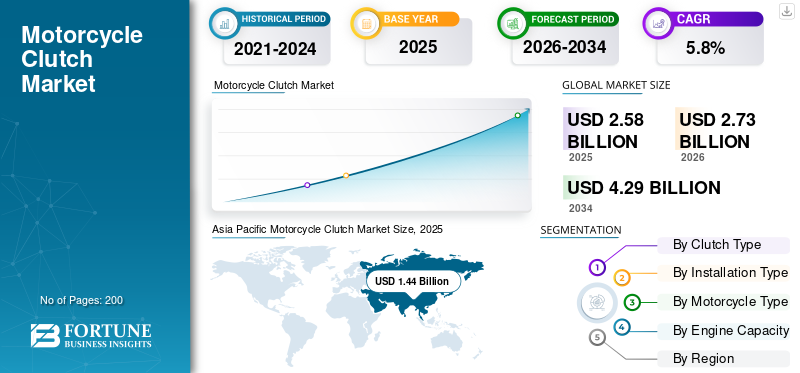
The global motorcycle clutch market size was valued at USD 2.58 billion in 2025. The market is projected to grow from USD 2.73 billion in 2026 to USD 4.29 billion by 2034, exhibiting a CAGR of 5.8% during the forecast period. Asia Pacific dominated the motorcycle clutch market with a market share of 55.81% in 2025.
A motorcycle clutch is a mechanical power transfer component that connects or disconnects the engine from the transmission, enabling smooth gear shifting, controlled clutch engagement, efficient acceleration, and stable riding experiences across different motorcycle categories and engine capacities.
The global market growth is driven by rising motorcycle sales, demand for high performance models, and stronger consumer preference for better clutch performance. Other factors include expansion of commuter transportation solutions, and adoption of advanced clutch systems that improve fuel efficiency, durability, safety, and smoother riding control globally. Major market players in the global market include F.C.C. Co., Ltd., EXEDY, Schaeffler, ZF/TRW, Rekluse, and Barnett. The competitive landscape focuses on wet clutch dominance, dry clutch niches, automatic clutch adoption, lightweight materials, OEM partnerships, and electric motorcycle-ready clutch technologies to strengthen market share.
Download Free sample to learn more about this report.
MOTORCYCLE CLUTCH MARKET KEY TAKEAWAYS
 Global Market Size & Forecast
- 2025 Market Size: USD 2.58 billion
- 2026 Market Size: USD 2.73 billion
- 2034 Forecast Market Size: USD 4.29 billion
- CAGR: 5.8% from 2026–2034
 Market Share
- Asia Pacific dominated the market with a 55.81% share in 2025.
- The Below 150cc segment held the largest market share in 2025.
- The Commuter Motorcycles segment held the largest market share in 2025.
 Key Regional Highlights
Asia Pacific
Asia Pacific the region maintains a strong position, supported by the world's largest motorcycle production base, extensive commuter fleets, and high daily two-wheeler usage.
North America
North America growth is supported by strong aftermarket replacement demand and high ownership of cruiser, touring, sports, and off-road motorcycles.
Europe
Europe consistent growth is supported by strong demand for sports, adventure, touring, and mid-to-high-capacity motorcycles, along with established aftermarket networks.
U.S.
The market is estimated to reach USD 0.21 billion in 2026, driven by premium cruiser and touring motorcycles, performance-focused aftermarket demand, and advanced clutch technologies.
Japan
The market is estimated to reach USD 0.06 billion in 2026, supported by advanced motorcycle manufacturing, premium product development, exports, and adoption of high-performance clutch technologies.
Read More

MOTORCYCLE CLUTCH MARKET TRENDS
Electronic Clutch Control Improves Riding Experiences and Market Trends
Automated and electronically controlled clutch systems are becoming a key market trend as motorcycle manufacturers focus on smoother clutch engagement, easier city riding, and improved riding experiences without removing manual gear control. This trend supports demand for advanced motorcycle clutch technologies, especially in premium and mid-capacity motorcycle categories where riders want comfort, safety, and high performance.
- In October 2023, Honda previewed Honda E-Clutch, an automatic clutch control system for multi-gear manual motorcycle transmissions that enables starting, shifting, and stopping without clutch lever operation.
MARKET DYNAMICS
MARKET DRIVERS
Download Free sample to learn more about this report.
Premium Motorcycle Demand Strengthens Market Growth
Rising demand for premium, sports, touring, and adventure motorcycles is supporting motorcycle clutch market growth as these motorcycles require stronger clutch systems, smoother power transfer, and higher clutch performance under heavy torque and frequent gear changes. Growing consumer preference for high performance motorcycles increases demand for wet clutch, slipper clutch, and advanced assist systems.
- In January 2025, BMW Motorrad reported its strongest sales result in company history, selling 210,408 motorcycles in 2024, supported by Europe, the U.S., Asia, and Latin America.
MARKET RESTRAINTS
Raw Material Volatility Limits Cost Stability
Raw material and input cost pressure restrain the market as clutch plates, springs, baskets, hubs, and pressure plates depend heavily on steel, aluminum, friction materials, and precision machining. Fluctuations in material availability and pricing can reduce supplier margins or increase aftermarket clutch kit prices, especially in cost-sensitive commuter markets.
- In October 2024, the World Steel Association forecast global steel demand to decline by 0.9% in 2024 before rebounding by 1.2% in 2025, showing an unstable steel demand environment.
MARKET OPPORTUNITIES
Wider Electronic Clutch Fitment Creates New Market Opportunity
Expansion of electronic and automatic clutch systems creates an opportunity for clutch suppliers to provide compact actuators, control-linked clutch modules, sensors, and upgraded friction systems for future motorcycles. This opportunity is important as OEMs can improve comfort and fuel efficiency without fully shifting riders away from manual transmissions. It also supports new demand from premium motorcycles and selected electric motorcycles or hybrid-ready platforms.
- In November 2025, Honda announced that E-Clutch would become available as an option on five more models, including XL750 Transalp, NX500, and CBR500R.
MARKET CHALLENGES
Counterfeit Aftermarket Parts Challenge Brand Trust
Counterfeit aftermarket products remain a major challenge as low-quality clutch plates, cables, springs, and related parts can weaken clutch engagement, reduce safety, damage genuine brand reputation, and distort the competitive landscape. This issue is more serious in large replacement markets where independent workshops and informal parts channels are common. It can also reduce demand for genuine dry clutch, wet clutch, and automatic clutch components.
Segmentation Analysis
By Installation Type
Large Motorcycle Parc and Recurring Replacement Needs Sustain Aftermarket Segment Growth
On the basis of installation type, the market is bifurcated into OEM and aftermarket.
The aftermarket segment held the largest market share and is also projected to develop at the fastest CAGR over the forecast period. In 2025, it generated USD 2.03 billion, supported by the large motorcycle parc, recurring friction-plate wear, intensive commuter use, and demand from independent workshops. Complete clutch kits and performance upgrades further strengthen replacement revenue.
The OEM segment is projected to grow at a CAGR of 5.1% over the forecast period, supported by new motorcycle production and factory fitment of wet, slipper, and automatic clutch systems.
- In May 2025, F.C.C. outlined active sales expansion to motorcycle OEMs in India.
By Clutch Type
Broad OEM Fitment and Oil-Cooled Durability Sustain Wet Clutch Segment Growth
Based on clutch type, the market is segmented into wet clutch, dry clutch, slipper clutch, and automatic clutch.
The wet clutch segment dominated in 2025, generating USD 2.02 billion, as oil cooling, smooth engagement, durability, and compact multi-plate construction suit commuter, sports, adventure, and touring motorcycles. Broad OEM fitment and recurring replacement demand sustain revenue globally.
The slipper clutch segment is projected to grow at a CAGR of 9.7% during the forecast period, making it the fastest-growing segment as motorcycles increasingly require smoother downshifts globally.
- In August 2025, Yamaha launched the MT-15 Version 2.0 with an assist and slipper clutch.
By Engine Capacity
High Commuter Production and Affordable Mobility Sustain Below 150cc Segment Demand
Based on engine capacity, the market is segmented into below 150cc, 150cc–450cc, 451cc–800cc, and above 800cc.
The below 150cc segment dominated in 2025, generating USD 1.17 billion, as high-volume commuter production, affordable ownership, fuel efficiency, and intensive urban use sustain OEM and replacement clutch demand.
- In August 2025, Hero MotoCorp launched the Glamour X 125 and described the 125cc category as an industry growth engine.
The 451cc–800cc segment is projected to grow at a CAGR of 6.8% during the forecast period, making it the fastest-growing segment as middleweight sports and adventure motorcycles require stronger, higher-value clutch systems.
By Motorcycle Type
To know how our report can help streamline your business, Speak to Analyst
High Daily-use Production Volumes and Broad Wet-clutch Fitment Sustain Commuter Motorcycle Segment Demand
Based on motorcycle type, the market is segmented into cruiser & touring motorcycles, adventure motorcycles, sports motorcycles, and commuter motorcycles.
The commuter motorcycles segment dominated in 2025, generating USD 1.81 billion, owing to large daily-use fleets, high production volumes, frequent clutch operation in urban traffic, and broad wet-clutch fitment. Affordable ownership and extensive service networks sustain OEM and aftermarket demand.
The adventure motorcycles segment is projected to grow at a CAGR of 8.2% over the forecast period. Further, making it the fastest-growing segment as rising touring interest, multi-terrain capability, and premium mid-capacity launches expand clutch demand.
Motorcycle Clutch Market Regional Outlook
By region, the market is categorized into Asia, North America, Europe, South America, and the Middle East & Africa.
Asia Pacific
Asia Pacific Motorcycle Clutch Market Size, 2025 (USD Billion)
To get more information on the regional analysis of this market, Download Free sample
Asia Pacific is projected to retain a strong position in the market, supported by the world’s largest motorcycle production base, extensive commuter fleets, and high daily two-wheeler usage. China, India, Indonesia, Vietnam, Thailand, and Japan generate substantial OEM and aftermarket demand. Wet clutch systems remain widely used, while slipper and automatic clutch adoption is increasing in premium commuter, sports, and adventure models. Urbanization, rural transport needs, delivery applications, affordability, and expanding mid-capacity motorcycle sales continue to strengthen regional market demand.
China Motorcycle Clutch Market
China accounts for approximately 34.1% of the Asia Pacific market in 2026, supported by large-scale motorcycle manufacturing, extensive domestic demand, and significant export activity. A broad mix of commuter, utility, electric-compatible, and premium motorcycles supports demand for wet, automatic, and advanced clutch systiems across OEM and aftermarket channels.
India Motorcycle Clutch Market
India is projected to grow at a CAGR of 6.1% during the forecast period, supported by its large commuter motorcycle base, intensive daily usage, rural mobility demand, and expanding sales of premium commuter and adventure motorcycles. Frequent clutch engagement in congested traffic also supports recurring demand for replacement plates, kits, and components.
Japan Motorcycle Clutch Market
Japan’s market is estimated to reach USD 0.06 billion in 2026, supported by advanced motorcycle manufacturing, premium product development, exports, and adoption of high-performance clutch technologies. Domestic demand is smaller than in China or India, but higher-value sports, touring, and technologically advanced motorcycles strengthen market revenue and supplier innovation.
North America
North America is projected to record steady growth in the market, supported by a large motorcycle parc, strong aftermarket replacement demand, and high ownership of cruiser, touring, sports, and off-road motorcycles. The U.S. and Canada contribute higher-value demand through premium wet clutch, slipper clutch, and performance systems, while Mexico supports volume through commuter and utility motorcycles. Established service networks, performance upgrades, and regular replacement of friction plates and clutch kits continue to support regional market expansion during the forecast period.
U.S. Motorcycle Clutch Market
The U.S. market is estimated to reach USD 0.21 billion in 2026, supported by extensive motorcycle ownership, premium cruisers, touring motorcycles, off-road models, and performance-focused aftermarket demand. Higher clutch system prices, frequent component replacement, and consumer preference for advanced slipper and wet clutch technologies strengthen market value.
Europe
Europe is expected to show consistent growth in the market, supported by strong demand for sports, adventure, touring, and mid-to-high-capacity motorcycles. Premium wet clutch, slipper clutch, dry clutch, and hydraulic actuation systems contribute higher value per vehicle. Germany, Italy, France, Spain, and the U.K. remain important demand centers due to established motorcycle culture and developed aftermarket networks. Replacement demand, technological upgrades, and consumer preference for high-performance motorcycles sustain growth, although mature ownership levels keep regional expansion relatively stable.
U.K. Motorcycle Clutch Market
The U.K. market is projected to reach USD 0.05 billion in 2026, supported by demand for adventure, road-sport, touring, and commuter motorcycles. Strong aftermarket activity, regular clutch replacement, premium upgrade kits, and consumer interest in smoother clutch engagement and improved riding performance continue to support market growth.
Germany Motorcycle Clutch Market
Germany accounts for approximately 16.3% of the European market in 2026, supported by high motorcycle ownership and strong demand for adventure, touring, sports, and premium motorcycles. The market benefits from higher-value clutch systems, branded replacement components, established service networks, and consumer preference for durable, technologically advanced motorcycle components.
South America
South America is expected to expand steadily in the market, supported by affordable personal transportation, delivery services, commercial motorcycle use, and a growing installed vehicle base. Brazil contributes the greatest regional demand, while Colombia, Argentina, Peru, and Chile add meaningful aftermarket volume. Wet clutch systems remain widely used in commuter motorcycles, while slipper clutch adoption is gradually increasing in sports and adventure models. Fuel-price sensitivity, urban congestion, extensive repair networks, and rising motorcycle production continue to support regional market growth.
Brazil Motorcycle Clutch Market
Brazil is set to account for approximately 66.4% of the South America market in 2026, supported by concentrated motorcycle production, strong commuter demand, a large installed fleet, and extensive aftermarket activity. Frequent motorcycle use for personal mobility and delivery services strengthens replacement demand for wet clutch assemblies, friction plates, springs, and complete clutch kits.
Middle East & Africa
The Middle East & Africa region is projected to record steady growth in the market, supported by increasing use of motorcycles for commuting, delivery, informal transport, and utility applications. African markets generate strong demand for durable and repairable wet clutch systems, while Gulf countries and South Africa contribute higher-value demand for sports, touring, and adventure motorcycles. Intensive vehicle usage supports aftermarket replacement, although affordability constraints and fragmented distribution remain challenges. Young urban populations, commercial mobility, and expanding service networks continue to strengthen regional demand.
South Africa Motorcycle Clutch Market
South Africa is projected to grow at a CAGR of 6.4% during the forecast period, supported by commuter demand, delivery applications, leisure motorcycle ownership, and a developed aftermarket network. Demand for sports, touring, adventure, and premium motorcycles increases the use of higher-value wet and slipper clutch systems across major urban markets.
COMPETITIVE LANDSCAPE
Key Industry Players
Technology Innovation, OEM Partnerships, and Aftermarket Expansion Define Competitive Landscape
The motorcycle clutch market is moderately fragmented, with global OEM-focused suppliers and specialized aftermarket brands competing across different motorcycle categories. F.C.C., EXEDY, Rekluse, Barnett, EBC, STM, Surflex, and Hinson differentiate through proprietary friction materials, wet, automatic, and slipper clutch technologies, torque capacity, durability, and model-specific fitment. Competitive intensity is highest in OEM contracts and premium aftermarket kits, where quality consistency, engineering support, pricing, and delivery reliability influence selection. Companies strengthen their edge through regional manufacturing, distributor networks, motorsport validation, product upgrades, and closer collaboration with motorcycle manufacturers. F.C.C. benefits from integrated development spanning friction materials to complete clutch assembly and reports the world’s top share in motorcycle clutches, while performance specialists target enthusiast and off-road demand.
- In May 2025, F.C.C. reported that motorcycle-clutch expansion helped it achieve medium-term revenue, operating-profit, and ROE targets one year early, while its India share increased from 69% to 71%.
LIST OF KEY MOTORCYCLE CLUTCH COMPANIES PROFILED
- C.C. Co., Ltd. (Japan)
- EXEDY Corporation (Japan)
- Schaeffler AG (Germany)
- ZF Friedrichshafen AG (Germany)
- BorgWarner Inc. (U.S.)
- Rekluse Motor Sports, Inc. (U.S.)
- Barnett Tool & Engineering (U.S.)
- EBC Brakes (U.K.)
- STM Italy S.r.l. (Italy)
- Surflex S.r.l. (Italy)
- Newfren / Endurance Two Wheelers S.p.A. (Italy)
- Hinson Clutch Components (U.S.)
- DP Brakes / DP Clutches (U.K.)
- AIM Corp. / AIM Clutches (U.S.)
- Suter Racing Products AG (Switzerland)
KEY INDUSTRY DEVELOPMENTS:
- June 2026: Rekluse released TorqDrive, APEX, and RadiusCX 4.0 clutch options for Ducati’s Desmo450 MX and Desmo450 EDX. The portfolio includes manual performance upgrades, an auto-clutch permitting stop-and-go riding without lever use, and billet accessories, expanding premium aftermarket fitment for Ducati’s newly established off-road motorcycle platform across global markets.
- June 2026: Ducati launched the Desmo250 MX with a five-speed gearbox, upshift quickshifter, and Brembo hydraulically operated seven-plate clutch using a disc spring. Ducati said the configuration maintains precise, progressive acceleration despite motocross wear, highlighting growing OEM use of compact hydraulic clutch components in high-revving competition motorcycles in global racing applications.
- June 2026: Honda Motorcycle & Scooter India expanded its premium lineup with the 2026 CB750 Hornet E-Clutch and XL750 Transalp E-Clutch. The 755cc models use Honda’s E-Clutch to automate clutch operation during starts, stops, and shifts, while bookings opened through BigWing and Topline dealerships across India for premium middleweight motorcycle customers.
- May 2026: Honda’s overseas patent filing indicated development of a simulated clutch system for electric motocross motorcycles based on the CR Electric Proto. The electronic setup could vary motor output through lever input, deliver torque-assisted launches, and generate haptic feedback to reproduce engine vibration and a conventional clutch biting point.
- March 2026: Honda detailed the CB400 Super Four E-Clutch Concept and CBR400R Four E-Clutch Concept, two new 400cc motorcycles combining electronically assisted clutch technology with distinct naked and fully faired designs. Both concepts use newly developed four-cylinder engines and reflect Honda’s effort to blend heritage, functionality, and rider-focused innovation.
REPORT COVERAGE
The global motorcycle clutch market analysis provides an in-depth study of the market size & forecast by all the market segments included in the market report. It includes details on the market dynamics and trends expected to drive the market over the forecast period. It offers information on technological advancements, new product launches, key automotive industry developments, and details on partnerships, mergers, and acquisitions. The market report scope also encompasses a detailed competitive landscape with information on the market share and profiles of key operating players.
Request for Customization to gain extensive market insights.
Report Scope & Segmentation
| ATTRIBUTE | DETAILS |
| Study Period | 2021-2034 |
| Base Year | 2025 |
| Estimated Year | 2026 |
| Forecast Period | 2026-2034 |
| Historical Period | 2021-2024 |
| Growth Rate | CAGR of 5.8% from 2026 to 2034 |
| Unit | Value (USD Billion) |
| Segmentation | By Clutch Type, By Installation Type, By Motorcycle Type, By Engine Capacity, and By Region |
| By Clutch Type |
|
| By Installation Type |
|
| By Motorcycle Type |
|
| By Engine Capacity |
|
| By Region |
|
Frequently Asked Questions
Fortune Business Insights says that the global market share value stood at USD 2.58 billion in 2025 and is projected to reach USD 4.29 billion by 2034.
In 2025, the market value stood at USD 1.44 billion.
The market forecast is expected to exhibit a CAGR of 5.8% during the forecast period.
The aftermarket segment led the market by installation type.
Rising motorcycle sales, demand for high performance models, stronger consumer preference for better clutch performance, and expansion of commuter transportation solutions are driving the market.
Major players in the market are F.C.C. Co., Ltd., EXEDY, Schaeffler, ZF/TRW, Rekluse, and Barnett.
Asia Pacific holds the largest share of the market.



- 2021-2034
- 2025
- 2021-2024
- 200
-
(Offer valid till 30th Sep 2026)
Get 30-60 hrs Free Customization
Expand Regional and Country Coverage, Segments Analysis, Company Profiles, Competitive Benchmarking, and End-user Insights.




















Related Reports
-
US +1 833 909 2966 ( Toll Free )
-
Get In Touch With Us