Motorcycle Instrument Cluster Market Size, Share & Industry Analysis, By Cluster Type (Analog Instrument Cluster, Semi-Digital Instrument Cluster, Fully Digital LCD Instrument Cluster, and TFT Instrument Cluster), By Connectivity Level (Non-Connected Instrument Cluster, Bluetooth-Connected Cluster, Navigation-Enabled Cluster, Telematics-Enabled, and Fully Connected Smart Instrument Cluster), By Propulsion (ICE and Electric Motorcycles), By Motorcycle Type (Standard, Sports, Cruiser, Touring, Off-Road Motorcycles), By Sales Channel (OEM and Aftermarket), and Regional Forecast, 2026-2034
 Download Free Sample
(Offer valid till 30th Sep 2026)

Motorcycle Instrument Cluster Market Size and Future Outlook
 Listen to Audio Version
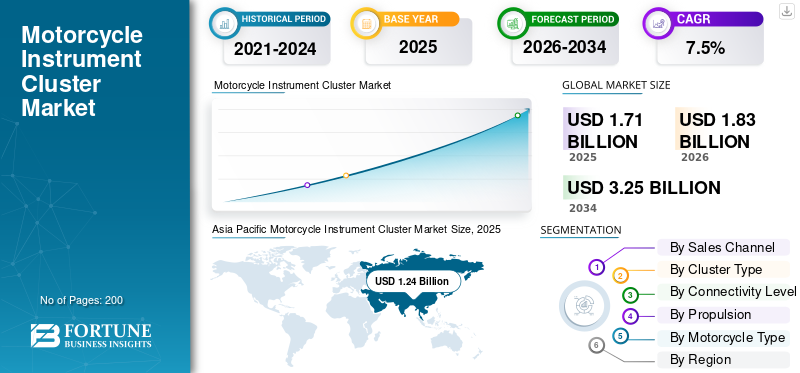
The motorcycle instrument cluster market size was valued at USD 1.71 billion in 2025 and is projected to grow from USD 1.83 billion in 2026 to USD 3.25 billion by 2034, exhibiting a CAGR of 7.5% during the forecast period. Asia Pacific dominated the motorcycle instrument cluster market with a market share of 72.51% in 2025.
A motorcycle instrument cluster is an integrated dashboard system that displays speed, engine status, fuel level, distance, warnings, navigation, connectivity, and other essential riding information to the rider during operation. The market growth is driven by rising two-wheeler production, adoption of TFT and LCD displays, smartphone connectivity, navigation integration, premiumization, safety features, and aftermarket upgrades across the globe.
Major players in the market include Robert Bosch GmbH, Denso Corporation, Visteon Corporation, Nippon Seiki Co., Ltd., and Pricol Limited, competing through TFT and LCD technologies, connected dashboards, navigation integration, customizable interfaces, and rider-safety features.
Download Free sample to learn more about this report.
Motorcycle Instrument Cluster Market KEY TAKEAWAYS
 Global Market Size & Forecast
- 2025 Market Size: USD 1.71 billion
- 2026 Market Size: USD 1.83 billion
- 2034 Forecast Market Size: USD 3.25 billion
- CAGR: 7.5% from 2026–2034
 Market Share
- Asia Pacific dominated the motorcycle instrument cluster market with a 72.51% share in 2025.
- TFT instrument clusters are the fastest-growing segment, with an 8.6% CAGR from 2026–2034.
- The aftermarket sales channel is the fastest-growing channel, advancing at an 8.2% CAGR from 2026–2034.
 Key Regional Highlights
Asia Pacific
Asia Pacific led the market in 2025 and is projected to remain the fastest-growing region, driven by high motorcycle production and ownership.
Europe
Europe held the second-largest market share in 2025 and is projected to grow at a 6.4% CAGR from 2026–2034.
North America
North America held the third-largest market share in 2025, supported by rising adoption of premium motorcycles and connected TFT dashboards.
U.S.
U.S. The market is estimated at USD 0.07 billion in 2026, representing roughly 3.7% of global revenues.
Japan
Japan Demand is supported by established motorcycle manufacturers and increasing adoption of advanced digital instrument clusters.
Read More

MOTORCYCLE INSTRUMENT CLUSTER MARKET TRENDS
Expanding Full-Color TFT Adoption Transforming Rider Information Interfaces is Reshaping Market
Motorcycle manufacturers are replacing conventional analog gauges with full-color TFT and advanced LCD interfaces across premium and increasingly mid-range models. Larger screens, configurable themes, improved brightness, optical bonding, and split-screen layouts help riders view speed, navigation, warnings, and vehicle status more clearly. This shift strengthens market trends by raising display value per vehicle and encouraging suppliers to develop scalable platforms that can support different screen sizes, resolutions, and motorcycle categories without redesigning the complete electronic architecture globally.
- In July 2025, Suzuki launched its 2026 motorcycle lineup, led by the GSX-8T and GSX-8TT, featuring five-inch full-color TFT instrument panels, anti-reflective coatings, automatic brightness adjustment, real-time motorcycle information display, rider-assistance integration, and USB Type-C connectivity for enhanced usability globally.
Growing Smartphone Connectivity Converts Clusters into Digital Cockpits is an Emerging Market Trend
Instrument clusters are evolving from isolated information panels into connected rider interfaces linked with smartphones, applications, navigation platforms, music, calls, and message notifications. Bluetooth, Wi-Fi, USB, and vehicle-network integration allow manufacturers to deliver richer functionality while retaining handlebar-based controls. Voice interaction and over-the-air software capability are also emerging in advanced instrument clusters systems. This trend expands the cluster’s role within the digital cockpit and increases demand for software, cybersecurity, application compatibility, and continuous user-interface development throughout the motorcycle lifecycle over time globally.
- In December 2023, NXP launched a connected digital instrument cluster reference platform for mass-market two-wheelers, combining TFT graphics, Wi-Fi 6, Bluetooth, OTA updates, cloud connectivity, secure access, navigation, fleet management, and vehicle-location capabilities to accelerate development of smart motorcycle
MARKET DYNAMICS
MARKET DRIVERS
Download Free sample to learn more about this report.
Increasing Rider-Assistance Content Drives Market Growth
Motorcycles now incorporate microcontrollers to adopt more electronic functions, including riding modes, traction control, ABS status, cruise control, Tire Pressure Monitoring System (TPMS), blind-spot alerts, and collision warnings. Riders need these functions presented quickly and without distraction, making a capable instrument cluster essential rather than optional. Growing integration of assistance and safety technologies therefore increases display content, processing requirements, and interface complexity. This supports motorcycle instrument cluster market growth for high resolution screens, stronger graphics capability, intuitive warning prioritization, and communication with multiple control units and sensors.
- In December 2025, Pioneer announced Pioneer Ride Connect, a connected motorcycle UX platform integrating HERE SDK, BLE-based screen projection, voice control, edge AI, navigation, real-time traffic, offline capability, and software updates to enhance rider safety, comfort, connectivity, and cluster affordability.
Expanding Electric Two-Wheeler Adoption Augments Market Expansion
The expansion of electric motorcycles and scooters is creating information requirements that favor digital instrument clusters. Electric two-wheelers must communicate battery state of charge, remaining range, energy consumption, regeneration, charging status, power mode, and system warnings in a clear format. Unlike basic analog gauges, configurable LCD and TFT displays can present these variables dynamically. As electrification spreads across urban mobility and motorcycles, cluster suppliers gain content opportunities through dedicated EV interfaces, energy-management graphics, and integration with charging and connected-service ecosystems.
- According to International Energy Agency (IEA), India two wheeler sales reached to 1.3 million units in 2024, from 0.9 million units in 2024. This demand of electric two wheelers with a rise of 44% year-on-year, drives the need for advanced instrument cluster in two wheelers.
MARKET RESTRAINTS
High Component and Validation Costs Limit Entry-Level Penetration and Market Growth
Advanced TFT clusters requires costly displays, processors, memory, graphics software, connectivity modules, optical bonding, protective glass, and validation. These requirements raise the bill of materials and engineering expenditure compared to basic analog or segmented LCD units. The impact is particularly significant in price-sensitive commuter motorcycles, where small increase in vehicle cost can affect purchasing decisions. Consequently, manufacturers may restrict premium clusters to higher trims or selected models, slowing penetration across high-volume entry level categories despite growing consumer interest in digital features.
MARKET OPPORTUNITIES
Scalable Modular Platforms Offers Lucrative Market Opportunities
Suppliers can expand beyond premium motorcycles by developing modular cluster families for commuter and mid-capacity models. Shared hardware, scalable software, standardized vehicle adaptive user interface, and selectable features can help OEMs in offering digital displays without absorbing the cost of a fully customized system. Local-language menus, navigation, reminders, and smartphone pairing can improve relevance in high-volume markets. This creates an opportunity to market growth through affordable LCD and compact TFT solutions designed for regional price points and rider preferences.
- In July 2022, TVS Motor updated the Radeon commuter motorcycle in India with a first-in-segment multi-color reverse LCD instrument cluster displaying real-time mileage, clock, top speed, and low-battery alerts, strengthening digital dashboard adoption across affordable, high-volume entry-level motorcycle models nationwide.
Software-Enabled Services Create Post-Sale Revenue Potential for Market
Connected clusters can become platforms for post-sale services rather than remaining fixed hardware components. Secure software updates, downloadable display themes, navigation enhancements, diagnostic functions, service alerts, theft notifications, and cloud-linked vehicle information can extend product value after sales. Suppliers and OEMs may use these capabilities to strengthen customer engagement and create service revenue. The approach supports faster feature improvement without replacing the cluster, provided manufacturers maintain application compatibility, data protection, and software support across the vehicle lifecycle.
- In June 2025, Royal Enfield detailed its software-defined Flying Flea electric motorcycles, featuring an interactive connected instrument cluster, 4G, Bluetooth, Wi-Fi, smartphone keys, customizable ride modes, over-the-air updates, voice control, remote monitoring, navigation, vehicle diagnostics, and cloud-enabled personalization for riders globally.
MARKET CHALLENGES
Harsh Operating Conditions Complicate Display Reliability and Readability
Motorcycle clusters operate in harsher conditions than many passenger-vehicle display technology, facing direct sunlight, rain, dust, vibration, engine temperature variation, chemical exposure, and frequent outdoor parking. Manufacturers must preserve readability, touch or switch responsiveness, sealing, color stability, and electronic reliability without making the unit excessively bulky. Achieving these targets requires specialized glass, optical bonding, robust housings, thermal management, and rigorous testing. Balancing durability with thin styling, high brightness, low power consumption, and competitive cost remains a major engineering challenge for cluster suppliers.
Segmentation Analysis
By Sales Channel
Factory Fitment and Integrated Digital Cockpits Leads to OEM Segment Dominance
Based on the sales channel, the market is segmented into OEM and aftermarket.
The OEM segment held the largest motorcycle instrument cluster market share in 2025. This growth is supported by factory-fit adoption of digital LCD and TFT clusters, rising motorcycle production, platform-level integration with electronics, and stronger demand for connectivity, navigation, diagnostics, and rider-assistance displays. Long-term supply agreements, vehicle-specific validation requirements, and OEM control over dashboard architecture further sustain volumes, while premium and electric two-wheelers increase content value per motorcycle across manufacturing sectors.
- In January 2025, Honda launched the updated Livo commuter motorcycle in India with a fully digital instrument cluster displaying real-time mileage, distance-to-empty, service reminders, gear position, and eco indicators, strengthening advanced dashboard adoption in affordable, high-volume motorcycle segments across the country.
The aftermarket segment is the fastest-growing sales channel, expanding at an 8.2% CAGR from 2026 to 2034. This demand is driven by the replacement of damaged clusters, digital retrofit consumer preferences, customization, the aging motorcycle parc, and availability of model-compatible LCD and TFT solutions.
By Cluster Type
Broad Digital Adoption and Cost Efficiency Leads to Fully Digital LCD Instrument Cluster Growth
Based on cluster type, the market is segmented into analog instrument cluster, semi-digital instrument cluster, fully digital LCD instrument cluster, and TFT instrument cluster.
The fully digital LCD instrument cluster segment accounted for the largest market share in 2025. Its dominance is supported by growing adoption across commuter, mid-range, and premium motorcycles, where LCD systems provide visibility, information, and lower costs than TFT alternatives. Integration of fuel indicators, trip data, gear position, diagnostics, and connectivity strengthens OEM fitment, while scalable designs enable manufacturers to use display platforms across motorcycle models and price categories.
- In March 2025, Microchip launched its Electric Two-Wheeler ecosystem, featuring pre-validated reference designs for battery management, charging, motor control, telematics, safety, and a 720x720 connected LCD instrument cluster, helping manufacturers accelerate development of intelligent, efficient, next-generation e-scooters and e-bikes globally.
The TFT instrument cluster is the fastest-growing segment, advancing at an 8.6% CAGR from 2026 to 2034. Growth reflects rising premium motorcycle sales, full-color interfaces, navigation, smartphone pairing, customizable layouts, and increasing adoption of connected and electric two-wheelers worldwide.
To know how our report can help streamline your business, Speak to Analyst
By Connectivity Level
Large Installed Base and Cost-Sensitive Models Sustain Non-Connected Instrument Cluster Demand
Based on connectivity level, the market is segmented into non-connected instrument cluster, bluetooth-connected instrument cluster, navigation-enabled instrument cluster, telematics-enabled instrument cluster, and fully connected smart instrument cluster.
The non-connected instrument cluster segment held the largest market share in 2025. Its dominance is supported by extensive fitment across entry-level and commuter motorcycles, particularly in cost-sensitive markets where basic speed, fuel, trip, and warning information remains sufficient. Lower component costs, simpler vehicle integration, dependable operation, and broad compatibility with conventional motorcycle electrical architectures continue to support high OEM volumes and replacement demand across established two-wheeler fleets.
The fully connected smart instrument cluster segment is the fastest-growing category, expanding at a 10.9% CAGR during the forecast period. This growth is driven by navigation, cloud connectivity, smartphone applications, remote diagnostics, over-the-air updates, and rising premium and electric motorcycle adoption.
- In April 2024, NXP and Tessolve launched a production-ready digital connected cluster platform for two- and three-wheelers, combining TFT graphics, Wi-Fi 6, Bluetooth, secure access, smartphone connectivity, OTA updates, navigation, fleet management, and EV-focused information in a scalable, cost-effective design.
By Propulsion
Large Installed Base and Continued Commuter Demand Sustain ICE Motorcycle Segment Growth
Based on propulsion, the market is bifurcated into ICE motorcycles and electric motorcycles.
The ICE motorcycles segment accounted for largest market share in 2025. This is due to the extensive global installed base, high production volumes, mature supply chains, and continued demand for commuter and performance motorcycles. Broad availability across price categories, established service networks, and strong adoption in emerging markets sustain OEM cluster fitment and replacement volumes. Ongoing digitalization of conventional motorcycles further supports advanced LCD and TFT instrument cluster integration.
- In May 2026, Hero MotoCorp launched the Super Splendor XTEC 2.0 with a fully digital Bluetooth-enabled instrument cluster, offering call and SMS alerts, caller identification, phone battery status, real-time mileage, fuel gauge for low-fuel warning, USB Type-C charging, and improved commuter-focused connectivity features.
The electric motorcycles is the fastest-growing segment, expanding at a 10.1% CAGR over the forecast period. Growth is driven by electrification policies, urban mobility demand, battery-status visualization, connected features, and digital interfaces designed for range and charging information.
By Motorcycle Type
High Production Volumes and Broad Commuter Adoption Strengthens Standard Motorcycle Segment Growth
Based on motorcycle type, the market is segmented into standard motorcycles, sports motorcycles, cruiser motorcycles, touring motorcycles, and off-road motorcycles.
The standard motorcycles segment dominated the market in 2025. Its dominance is supported by high production volumes, widespread commuter use, affordable vehicle pricing, and strong demand across Asia Pacific, Latin America, and other developing markets. Extensive OEM fitment of analog, semi-digital, and LCD clusters, combined with a large installed motorcycle base and recurring replacement requirements, sustains consistent demand across entry-level and mid-range models.
The touring motorcycles is the fastest-growing segment, expanding at a 9.9% CAGR from 2026 to 2034. This growth is driven by rising premium touring demand, long-distance riding, navigation integration, larger TFT displays, connectivity, and advanced rider-information features.
Motorcycle Instrument Cluster Market Regional Outlook
By geography, the market is categorized into Asia Pacific, North America, Europe, South America, and Middle East & Africa.
Asia Pacific
Asia Pacific Motorcycle Instrument Cluster Market Size, 2025 (USD Billion)
To get more information on the regional analysis of this market, Download Free sample
Asia Pacific dominated the market in 2025 and is also the fastest-growing region, globally. Its leadership reflects exceptionally high motorcycle production and ownership across China, India, Indonesia, Vietnam, Thailand, and other regional markets. Large commuter motorcycle volumes sustain demand for analog, semi-digital, and LCD clusters, while rising incomes and premiumization accelerate TFT and connected display adoption. Expanding electric two-wheeler production, localized component manufacturing, and cost-efficient supply chains further strengthen the region’s position throughout the forecast period, globally.
- In April 2026, Bajaj highlighted the Discover 125’s digital instrument cluster in Bangladesh, offering speed, fuel level, gear position, battery status, trip data, mileage information, and shift guidance, improving ride awareness, efficiency, visibility, and everyday usability for family-focused commuter riders.
China Motorcycle Instrument Cluster Market
The China market in 2026 is estimated at around USD 0.44 billion, accounting for roughly 23.9% of global market revenues. Growth is driven by large motorcycle production, rapid electric two-wheeler adoption, expanding TFT and LCD integration, localized electronics manufacturing, connected mobility demand, and rising midrange motorcycle sales across cities.
India Motorcycle Instrument Cluster Market
The India market in 2026 is predicted at around USD 0.47 billion, accounting for roughly 25.7% of global market sales. Market expansion is owing to high commuter motorcycle volumes, increasing digital clusters fitment, electric scooter growth, affordable LCD adoption, domestic supplier capabilities, premiumization, and expanding connected feature demand among younger urban riders.
North America
North America held the third-largest market share in 2025. This growth is supported by rising adoption of premium, touring, and sports motorcycles equipped with TFT displays, navigation, Bluetooth connectivity, and rider-assistance interfaces. Strong demand for connected motorcycles in the U.S. and Canada encourages OEMs to introduce larger, customizable dashboards. Replacement of aging analog clusters and increasing aftermarket personalization also supports product demand.
- In November 2024, NXP unveiled an advanced digital connected cluster concept for premium two-wheelers, powered by its i.MX 95 processor and integrating AI, multi-camera safety, voice commands, smartphone projection, helmet communication, fall detection, wireless connectivity, and partitioned safety displays globally.
U.S. Motorcycle Instrument Cluster Market
The U.S. market in 2026 is estimated at around USD 0.07 billion, accounting for roughly 3.7% of global market revenues. Market development is driven by premium cruiser and touring motorcycle demand, high value TFT installations, aftermarket upgrades, smartphone connectivity, navigation adoption, and growing interest in advanced rider information systems nationwide.
Europe
Europe secured the second-largest market share in 2025 and is projected to expand at a 6.4% CAGR from 2026 to 2034. Regional growth is driven by strong demand for premium, touring, sports, and electric motorcycles featuring advanced TFT displays and integrated navigation. Stringent safety expectations, widespread adoption of rider-assistance systems, and high consumer preference for connected features supports value growth. Established motorcycle brands and technology suppliers further accelerate digital cockpit integration across new vehicle platforms and segments.
- In May 2026, Hero MotoCorp launched the XPulse 200 4V and XPulse 200 Pro in the U.K., featuring Bluetooth-enabled LCD instrument clusters with turn-by-turn navigation, three ABS modes, LED lighting, and adventure-focused hardware, expanding connected motorcycle offerings across European markets.
Germany Motorcycle Instrument Cluster Market
The Germany market in 2026 is estimated at around USD 0.03 billion, accounting for roughly 1.4% of global market share. This demand is supported by premium motorcycle manufacturing, strong touring and sports segments, advanced TFT adoption, rider assistance integration, connectivity preferences, and sustained investment in digital cockpit technologies across leading brands.
U.K. Motorcycle Instrument Cluster Market
The U.K. market in 2026 is estimated at around USD 0.01 billion, accounting for roughly 0.8% of global market sales. Growth benefits from strong touring motorcycle ownership, premium model sales, aftermarket customization, navigation enabled clusters, smartphone connectivity, and consumer preference for feature-rich dashboards during long-distance leisure travel journeys.
South America
South America accounted for the least market share in 2025. The regional market growth is supported by motorcycles’ importance as affordable personal mobility and commercial delivery vehicles, particularly in Brazil and Argentina. High commuter motorcycle usage sustains demand for durable analog, semi-digital, and cost-effective LCD clusters. Gradual fleet modernization, expansion of app-based delivery services, and increasing availability of mid-range motorcycles create opportunities for digital upgrades. However, economic volatility, import costs, and uneven purchasing power moderate advanced cluster adoption regionally.
Brazil Motorcycle instrument cluster Market
The Brazil market in 2026 is estimated at around USD 0.06 billion, accounting for roughly 3.5% of global market sales. Expansion stems from large commuter motorcycle fleets, delivery service growth, rising digital LCD fitment, local production, replacement demand, and improved affordability of feature enabled instrument clusters for urban commercial riders.
Middle East & Africa
The Middle East & Africa region held fourth-largest market share in 2025. Growth is shaped by expanding motorcycle use for commuting, delivery, tourism, and recreational riding across Turkey, South Africa, Gulf countries, and developing African markets. Basic analog and LCD clusters remain prominent due to affordability and harsh operating requirements, while premium motorcycles support selective TFT adoption. Rising urbanization, growing delivery fleets, and gradual two-wheeler electrification improve long-term product demand, although fragmented distribution networks constrain faster regional expansion.
Turkey Motorcycle Instrument Cluster Market
The Turkey market in 2026 is estimated at around USD 0.05 billion, accounting for roughly 2.5% of global market sales. Growth is encouraged by rising motorcycle use for urban commuting and delivery, expanding local production, increasing LCD cluster adoption, tourism-related riding, and gradual demand for advanced features, connected features across cities.
COMPETITIVE LANDSCAPE
Key Industry Players
Display Innovation, Connectivity, and OEM Integration by Key Players Define Competitive Landscape
The market is moderately fragmented, with global electronics suppliers, motorcycle OEM affiliates, and regional cluster manufacturers competing across analog, LCD, and TFT platforms. Key players such as Robert Bosch GmbH, Denso Corporation, Visteon Corporation, Nippon Seiki Co., Ltd., and Pricol Limited differentiate through connected dashboards, navigation, smartphone integration, customizable interfaces, and rider-assistance visualization. To strengthen competitiveness, companies are developing modular platforms, improving software capabilities, and localizing production for cost-sensitive markets. OEM partnerships, long-term supply contracts, cybersecurity upgrades, and electric motorcycle-specific interfaces further shape competitive positioning across premium and high-volume segments during the market forecast period worldwide.
- In July 2023, FPT Software partnered with Nippon Seiki to develop software platforms and applications for motorcycle instrument clusters, combining FPT’s automotive software expertise with Nippon Seiki’s hardware capabilities to accelerate HMI innovation, address engineering shortages, and support OEM programs.
LIST OF KEY MOTORCYCLE INSTRUMENT CLUSTER COMPANIES PROFILED
- Nippon Seiki Co., Ltd. (Japan)
- Pricol Limited (India)
- Robert Bosch GmbH (Germany)
- AUMOVIO SE (Germany)
- Visteon Corporation (U.S.)
- Minda Corporation Limited - Spark Minda (India)
- DENSO Corporation (Japan)
- JNS Instruments Ltd. - JP Minda Group (India)
- Tong Yah Electronic Technology Co., Ltd. - KOSO (Taiwan)
- COBO Group (Italy)
KEY INDUSTRY DEVELOPMENTS
- October 2025: AUMOVIO announced its EICMA motorcycle technology portfolio, featuring a 6.3-inch TFT LCD instrument cluster with optical bonding, customizable interfaces, anti-reflective coating, and Traveo II control, alongside connected infotainment, OTA updates, navigation, voice assistance, and smartphone-independent connectivity capabilities.
- May 2025: Revolt Motors highlighted the RV400’s digital instrument cluster, displaying speed, battery level, riding mode, time, ambient temperature, and motor temperature, alongside GPS tracking, geofencing, smart locking, app connectivity, battery monitoring, and theft-prevention features for connected electric mobility.
- February 2025: NXP highlighted its advanced i.MX 95-based digital connected cluster for premium two-wheelers, integrating AI, multicamera safety, voice interaction, Android Auto, Apple CarPlay, helmet communication, fall detection, Wi-Fi, Bluetooth, secure access, and partitioned safety displays for enhanced riding.
- November 2024: Bosch presented its TFT Connect motorcycle platform at EICMA, offering 7-inch and 10.25-inch high-brightness displays, glove-compatible touch control, voice commands, smartphone integration, wireless Apple CarPlay, navigation, OTA updates, customizable interfaces, and advanced cybersecurity-focused central gateway architecture globally.
- October 2023: NXP introduced a connected digital cluster reference platform for mass-market two-wheelers, combining TFT graphics, Wi-Fi 6, Bluetooth, OTA updates, smartphone projection, cloud connectivity, secure access, vehicle tracking, fleet management, navigation, audio, and EV charging information capabilities globally.
- October 2023: Harman announced plans to supply instrument clusters and infotainment solutions to Indian electric two-wheeler OEMs, leveraging navigation, connectivity, telematics, HMI expertise, and software capabilities to enhance rider safety and convenience while expanding within India’s growing EV market.
- July 2021: Cerence and Visteon announced an integrated voice-enabled motorcycle cockpit solution combining conversational AI, natural-language understanding, text-to-speech, and Visteon SmartCore technology to power instrument cluster, infotainment, telematics, connected apps, OTA updates, and a 12-inch display for global deployment.
REPORT COVERAGE
The motorcycle instrument cluster market analysis provides an in-depth study of the market size & forecast by all the market segments included in the market report. It includes details on the market dynamics and trends expected to drive the market over the forecast period. It offers information on technological advancements, new product launches, key automotive industry developments, and details on partnerships, mergers, and acquisitions. The market report scope also encompasses a detailed competitive landscape with information on the market share and profiles of key operating players.
Request for Customization to gain extensive market insights.
Report Scope & Segmentation
| ATTRIBUTE | DETAILS |
| Study Period | 2021-2034 |
| Base Year | 2025 |
| Estimated Year | 2026 |
| Forecast Period | 2026-2034 |
| Historical Period | 2021-2024 |
| Growth Rate | CAGR of 7.5% from 2026 to 2034 |
| Unit | Value (USD Billion) and Volume (Units) |
| Segmentation | By Cluster Type, By Sales Channel, By Connectivity Level, By Propulsion, By Motorcycle Type, and By Region |
| By Cluster Type |
|
| By Sale Channel |
|
| By Connectivity Level |
|
| By Propulsion |
|
| By Motorcycle Type |
|
| By Region |
|
Frequently Asked Questions
Fortune Business Insights says that the global market value stood at USD 1.71 billion in 2025 and is projected to reach USD 3.25 billion by 2034.
In 2025, the Asia Pacific market value stood at USD 1.24 billion.
The market is expected to exhibit a CAGR of 7.5% during the forecast period of 2026-2034.
The fully digital LCD instrument cluster segment led the market by cluster type.
Increasing rider-assistance content drives advanced display requirements.
Major players in the market include Robert Bosch GmbH, Denso Corporation, Visteon Corporation, Nippon Seiki Co., Ltd., and Pricol Limited.
Asia Pacific holds the largest share of the market.



- 2021-2034
- 2025
- 2021-2024
- 200
-
(Offer valid till 30th Sep 2026)
Get 30-60 hrs Free Customization
Expand Regional and Country Coverage, Segments Analysis, Company Profiles, Competitive Benchmarking, and End-user Insights.




















Related Reports
-
US +1 833 909 2966 ( Toll Free )
-
Get In Touch With Us