Movie Projectors Market Size, Share & Industry Analysis, By Product Type (Home Theater Projectors, Portable/Mini Projectors, Ultra-Short Throw (UST) Projectors, and Professional/Commercial Cinema Projectors), By Resolution (HD (720p), Full HD (1080p), 4K/UHD, and Others), By Distribution Channel (Online and Offline), By Screen Type (2D, 3D, and 4DX), By End-user (Residential, Cinema Theatres, Event Venues, Hospitality, and Institutions), and Regional Forecast, 2026 – 2034
 Download Free Sample
MOVIE PROJECTORS MARKET SIZE AND FUTURE OUTLOOK
 Listen to Audio Version
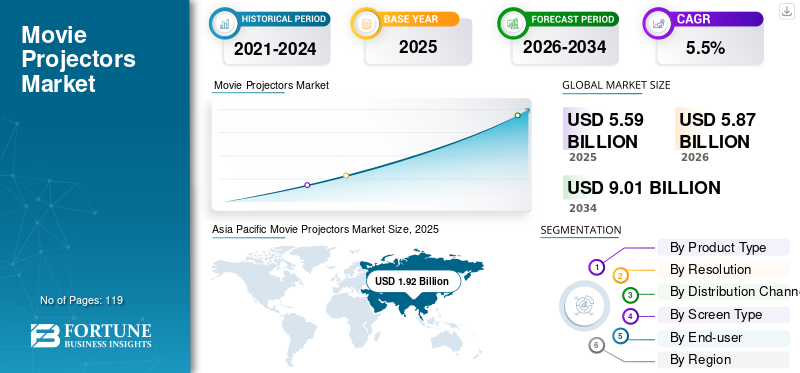
The global movie projectors market size was valued at USD 5.59 billion in 2025. The market is projected to grow from USD 5.87 billion in 2026 to USD 9.01 billion by 2034, exhibiting a CAGR of 5.5% during the forecast period. Asia Pacific dominated the movie projectors market with a market share of 34.35% in 2025.
The global market refers to the revenue generated from projector hardware and related optical, imaging, and connectivity components designed to display video content on large screens for entertainment and commercial viewing environments. These projectors play a critical role in enabling high-quality visual experiences by converting digital media into projected images with the required brightness, resolution, color accuracy, and contrast across different viewing conditions.
Key players in the market include Seiko Epson Corporation, Sony Group Corporation, Panasonic Holdings Corporation, BenQ Corporation, Optoma Corporation, ViewSonic Corporation, LG Electronics Inc., Samsung Electronics Co., Ltd., Hisense Co., Ltd., and JVCKENWOOD Corporation. These companies offer a broad range of movie projector solutions that address varied performance requirements across home entertainment, cinema exhibition, and large venue applications.
Download Free sample to learn more about this report.
Movie Projectors Market KEY TAKEAWAYS
 Global Market Size & Forecast
- 2025 Market Size: USD 5.59 billion
- 2026 Market Size: USD 5.87 billion
- 2034 Forecast Market Size: USD 9.01 billion
- CAGR: 5.5% from 2026–2034
 Market Share
- Asia Pacific dominated the movie projectors market with a 34.35% share in 2025.
- The home theater projectors segment accounted for the largest market share of 35.7% in 2025.
- The 4K/UHD segment held the largest share of 49.0% in 2025.
 Key Regional Highlights
Asia Pacific
Asia Pacific Led the market in 2025, driven by strong electronics manufacturing and rising demand for home entertainment.
North America
North America Held the second-largest share, supported by high consumer spending and widespread streaming adoption.
Europe
Europe Registered significant market growth, driven by strong demand for premium home entertainment and commercial projectors.
U.S.
U.S. USD 1.18 billion in 2025, supported by high broadband penetration and strong demand for home theater systems.
Japan
Japan USD 0.19 billion in 2025, accounting for approximately 3.4% of global market revenue.
Read More

MOVIE PROJECTORS MARKET TRENDS
Increasing Adoption of Laser-Based Projection Technology is Transforming the Global Market
Laser projectors offer higher brightness, improved color accuracy, enhanced image stability, and longer operational life than traditional lamp-based systems, supporting adoption across commercial and residential applications. In the cinema segment, laser projection enables premium large-format and 4K viewing experiences while reducing maintenance requirements and lowering lamp replacement costs for operators. In residential applications, these systems improve viewing quality across varying lighting conditions and offer greater reliability through extended light-source life. Manufacturers such as Sony, Christie Digital, and Epson are expanding their laser projector portfolios across multiple price tiers, improving product accessibility and market penetration. Continuous technological advancements and gradual cost optimization are further accelerating the transition toward laser-based projection systems and influencing long-term product development strategies across the global market.
MARKET DYNAMICS
MARKET DRIVERS
Download Free sample to learn more about this report.
Rising Demand for Immersive Home Entertainment Driving Growth in the Market
Consumer preference for cinema-like home viewing is driving demand for movie projectors, as households seek larger screens and better visual quality than conventional televisions. Rising home entertainment spending, supported by the expansion of streaming platforms, 4K content, and HDR formats, is encouraging consumers to invest in advanced display solutions. Ultra-short-throw and laser projectors are gaining traction due to space efficiency, high brightness, and enhanced color accuracy, making them suitable for modern residential setups. Improving disposable incomes and higher discretionary spending are further supporting demand for premium audiovisual systems, including projection screens and surround sound solutions. This shift toward immersive and premium home entertainment is expected to strengthen adoption across home theater and portable projector segments.
MARKET RESTRAINTS
High Initial Cost and Competitive Alternatives are Limiting Market Expansion
High upfront investment continues to restrain the movie projector market, particularly in the premium home theater, ultra-short-throw, and professional cinema projector categories. These systems often require additional spending on projection screens, audio equipment, installation, and integration, increasing the total cost of ownership. Price-sensitive consumers may prefer large-screen 4K smart TVs, which offer built-in features, high brightness, and easier setup at lower prices. This limits residential adoption of projection-based systems despite rising demand for immersive home entertainment. In the commercial segment, cinema operators face capital-intensive upgrade cycles for laser and 4K projection systems, which can delay modernization and expansion plans. As a result, cost barriers are expected to hinder the movie projectors market growth.
MARKET OPPORTUNITIES
Expansion of Ultra Short-Throw and Smart Laser Projectors Creating Significant Growth Opportunities
The rising adoption of ultra-short-throw and smart laser projectors is creating strong growth opportunities in the market. These products address key limitations of conventional projectors, including space constraints, complex installation, and sensitivity to ambient light. Their ability to deliver large-screen viewing in compact residential spaces makes them attractive for urban households. The integration of smart operating platforms, built-in streaming applications, and wireless connectivity is further enhancing product appeal. Consumers are increasingly preferring all-in-one entertainment solutions that combine display performance with direct access to content. Gradual price moderation in 4K laser projectors, along with higher brightness, longer lifespan, and lower maintenance needs, is strengthening adoption potential across the residential segment.
SEGMENTATION ANALYSIS
By Product Type
Home Theater Projectors Segment Led Due to Rising Demand For Cinema-Like Home Entertainment Experiences
Based on product type, the market is divided into home theater projectors, portable/mini projectors, Ultra-Short-Throw (UST) projectors, and professional/commercial cinema projectors.
Home theater projectors segment led with a 35.7% share in 2025, driven by rising consumer demand for cinema-like home viewing experiences and the growing adoption of large-screen entertainment systems. These projectors offer flexibility in screen size and enhance the overall viewing experience compared to conventional televisions.
Ultra-short-throw projectors are expected to grow at the highest CAGR of 7.4% over the forecast period, as they deliver large-screen projection in compact spaces with easier installation. Their space efficiency, smart features, and suitability for urban households are supporting faster adoption.
By Resolution
4K/UHD Led Due to Increasing Adoption of High-Quality Visual and Streaming Content
Based on resolution, the market is divided into HD (720p), Full HD (1080p), 4K/UHD, and others.
The 4K/UHD segment held the largest share of 49% in 2025, due to its strong adoption across home theater and commercial cinema applications. The segment benefits from the increasing availability of 4K content through streaming platforms and digital cinema formats.
The others segment, including 8K, is expected to grow at the highest CAGR of 6.7% over the forecast period, as premium consumers and professional users demand next-generation image quality. Growing interest in advanced visual experiences is expected to support the adoption of higher-resolution projectors.
By Distribution Channel
Offline Channels Led Due to Strong Consumer Preference for In-Store Product Demonstrations and Comparisons
Based on the distribution channel, the market is bifurcated into online and offline.
In 2025, offline channels led the market in terms of share due to strong consumer preference for product demonstrations, expert guidance, and in-store comparison before purchasing high-value projector systems. Physical stores help buyers assess brightness, image quality, throw distance, and installation requirements more effectively.
Online channels are expected to record the highest CAGR of 7.2% over the forecast period, driven by growing e-commerce penetration and broader product availability. Competitive pricing, customer reviews, and convenient product comparison are further strengthening online sales.
By Screen Type
2D Segment Led Due to Widespread Adoption Across Residential and Commercial Applications
Based on screen type, the market is trifurcated into 2D, 3D, and 4DX.
The 2D segment held the largest share of 83.4% in 2025, due to its widespread use across residential, commercial, and cinema applications. It remains the standard projection format due to lower setup complexity, broad content availability, and cost efficiency.
The 4DX segment is expected to grow at the highest CAGR of 6.7% over the forecast period, as demand for immersive, multisensory cinema experiences increases. Its use of motion seats, environmental effects, and enhanced audience engagement is supporting adoption in premium theatres.
By End-user
To know how our report can help streamline your business, Speak to Analyst
Residential Segment Led Due to Growing Investment in Home Theater and Premium Entertainment Setups
By end-user, the market is segmented into residential, cinema theatres, event venues, hospitality, and institutions.
The residential segment held the largest share of 60.2% in 2025, due to increasing adoption of home theater systems, premium audiovisual setups, and smart projection solutions. It is also expected to grow at the highest CAGR of 6.3% over the forecast period, as consumers continue investing in large-screen entertainment and compact projector technologies.
Cinema theatres hold the second-largest share at 22.4%, driven by sustained demand for professional projection systems across multiplexes and premium cinema formats. Ongoing upgrades to laser and 4K projection systems are supporting projector demand across cinema theatres.
Movie Projectors Market Regional Outlook
By region, the market is categorized into North America, South America, Europe, the Middle East & Africa, and Asia Pacific.
Asia Pacific
Asia Pacific Movie Projectors Market Size, 2025 (USD Billion)
To get more information on the regional analysis of this market, Download Free sample
Asia Pacific holds the largest movie projectors market share due to its wide consumer base, strong electronics manufacturing ecosystem, and high adoption of home entertainment devices. Factors such as rapid urbanization and a growing middle class population is increasing demand for affordable large-screen viewing, particularly through home theater and portable projector models. The region also benefits from strong penetration of streaming platforms and mobile-led content consumption, which support residential demand. According to “The Mobile Economy Asia Pacific 2025” (GSMA), Asia Pacific mobile operators invested USD 220 billion in network infrastructure from 2019 to 2024, and the mobile sector contributed USD 950 billion in value in 2024. Further, supporting strong connectivity and mobile-led content consumption that underpins residential large-screen viewing demand.
Japan Movie Projectors Market
The Japan market in 2025 was estimated at around USD 0.19 billion, accounting for roughly 3.4% of global revenues.
China Movie Projectors Market
China’s market is projected to be one of the largest worldwide, with 2025 revenues estimated at around USD 0.61 billion, representing roughly 10.9% of global sales.
India Movie Projectors Market
The India market in 2025 was estimated at around USD 0.39 billion, accounting for roughly 6.9% of global revenues.
North America
North America holds the second-largest share due to high adoption of premium home entertainment products and strong consumer spending capacity. Households show a strong preference for large-screen viewing, supported by widespread broadband access and high use of streaming platforms. This drives steady demand for home theater and ultra-short-throw projectors, especially in the mid- to premium-price ranges. According to the U.S. Census Bureau’s “Computer and Internet Use in the United States”, over 90% of U.S. households have broadband internet subscriptions. Further, supporting widespread streaming adoption and strong demand for large-screen home entertainment solutions in North America.
U.S. Movie Projectors Market
The U.S. market was analytically approximated at around USD 1.18 billion in 2025, accounting for roughly 21.0% of sales.
Europe
Europe holds a significant share of the global market due to steady demand across both residential and commercial segments. Households in several countries show a strong preference for premium home entertainment, supported by high broadband penetration and widespread streaming adoption. This drives consistent demand for home theater and ultra-short-throw projectors, particularly in the mid- to premium-price ranges. According to Eurostat’s “Digital economy and society statistics, households and individuals”, EU countries report very high household internet connectivity, with leading markets such as the Netherlands and Luxembourg at 99% household internet access, supporting widespread streaming usage that sustains demand for mid to premium home theater and ultra-short-throw projectors.
U.K. Movie Projectors Market
The U.K. market in 2025 was estimated at around USD 0.18 billion, representing roughly 3.2% of global revenues.
Germany Movie Projectors Market
Germany’s market reached approximately USD 0.16 million in 2025, equivalent to around 2.8% of global sales.
Middle East & Africa
The Middle East & Africa region is expected to register the second-highest CAGR, driven by expanding urban entertainment infrastructure and rising demand for premium home-viewing experiences. Several countries are investing in new cinemas, malls, and mixed-use developments, which support commercial projector installations. Improving internet penetration and growing streaming consumption are also increasing household interest in large-screen viewing at home. According to Omdia’s “MENA cinema poised for major growth, led by a surge in Saudi Arabia”, the Middle East cinema market added around 1,000 new screens since 2019 and is expected to reach nearly 2,500 screens by the end of 2024, supporting projector installations from expanding cinema and mixed-use entertainment infrastructure.
GCC Movie Projectors Market
The GCC market reached around USD 0.18 billion in 2025, representing roughly 3.3% of global revenues.
South America
South America is expected to grow at an average pace, driven by moderate consumer spending power and higher price sensitivity in the discretionary electronics market. Adoption of premium home theater and ultra-short-throw models is comparatively slower as total setup costs remain a key barrier for many households. Currency volatility and import dependence can also affect pricing and availability, thereby delaying purchase decisions. According to the World Bank's World Development Indicators, several major South American economies report lower GDP per capita levels than North America and Western Europe. Further, reflecting comparatively lower purchasing power that can constrain the adoption of premium discretionary electronics such as high-end home theater and ultra-short-throw projector systems.
Brazil Movie Projectors Market
The Brazil market in 2025 was estimated at around USD 0.23 billion, accounting for roughly 4.2% of global revenues.
COMPETITIVE LANDSCAPE
Key Industry Players
Major Players Introduce New Technological Solutions to Improve Market Standing
Market players are introducing new solutions to strengthen their competitive positioning by integrating advanced technologies, addressing evolving consumer requirements, and differentiating themselves from competitors. Major players, including Seiko Epson Corporation, Sony Group Corporation, Panasonic Holdings Corporation, and BenQ Corporation, are focusing on portfolio expansion, strategic collaborations, acquisitions, and partnerships to enhance their offerings. These initiatives enable companies to sustain and expand their market share in a rapidly evolving business landscape.
LIST OF KEY MOVIE PROJECTORS COMPANIES PROFILED
- Seiko Epson Corporation (Japan)
- Sony Group Corporation (Japan)
- Panasonic Holdings Corporation (Japan)
- BenQ Corporation (Taiwan)
- Optoma (Coretronic Corp) (Taiwan)
- ViewSonic Corporation (Taiwan)
- LG Electronics (South Korea)
- SAMSUNG ELECTRONICS CO., LTD (South Korea)
- Hisense Co., Ltd. (China)
- JVCKENWOOD Corporation (Japan)
KEY INDUSTRY DEVELOPMENTS
- February 2026: Optoma Technology launched the UHZ36, a true 4K UHD laser home entertainment projector, delivering 3,500 lumens brightness and a 1,500,000:1 contrast ratio. Designed for big-screen viewing from 50 to 300 inches, it features HDR support, PureEngine and PureMotion technologies, and FILMMAKER MODE for accurate, cinematic visuals.
- October 2025: Seiko Epson launched four new portable smart projectors featuring six high-power color LEDs from the ams OSRAM OSTAR Projection Power family. The new Lifestudio Pop EF 61 and 62 and Lifestudio Flex EF 71 and 72 models use an upgraded 3LCD light engine to enhance 4K image quality and brightness. The latest OSTAR LEDs deliver about 15 % higher brightness and improved thermal performance compared to the previous generation.
- August 2025: Epson America, Inc. introduced four new 3 Chip 3LCD portable projectors for home entertainment and modern workspaces. Two models, the Home Cinema 1100 and Pro EX9270, include built-in Apple AirPlay support for seamless wireless streaming from Apple devices.
- June 2025: Panasonic Projector & Display Corporation announced the launch of a new sub-brand to transform the media and entertainment industry through innovative visual solutions. The initiative focuses on strengthening its projector and display business with advanced technologies and creative solutions tailored for entertainment applications.
- May 2025: Sony Europe B.V. resumed shipping its BRAVIA home cinema and business projectors across Europe after a two-month pause caused by EU export control amendments. The company will also introduce the BRAVIA Projector 7 to the European market this summer, expanding its home cinema lineup alongside the BRAVIA Projector 8 and 9.
- April 2025: Epson launched the QS100 4K PRO-UHD HDR ultra-short-throw laser projector and stated it can project up to 160 inches from inches away, with 4,500 lumens of color and white brightness, targeting modern living spaces and custom integration.
- January 2025: Dangbei announced plans to present two new projector models at CES 2025, the MP1 Max 4K home theater and the Freedo ultra-portable, demonstrating active product development efforts that heighten competition in both value-oriented and lifestyle segments.
REPORT COVERAGE
The global movie projectors market analysis provides an in-depth study of the size & forecast by all the market segments included in the report. It includes details on the market dynamics and market trends expected to drive the market in the forecast period. It offers information on the technological advancements, key developments, and details on partnerships, mergers & acquisitions. The market research report also includes a detailed competitive landscape, providing market share and profiles of key players.
Request for Customization to gain extensive market insights.
REPORT SCOPE & SEGMENTATION
| ATTRIBUTE | DETAILS |
| Study Period | 2021-2034 |
| Base Year | 2025 |
| Estimated Year | 2026 |
| Forecast Period | 2026-2034 |
| Historical Period | 2021-2024 |
| Growth Rate | CAGR of 5.5% from 2026-2034 |
| Unit | Value (USD Billion) |
| Segmentation | By Product Type, By Resolution, By Distribution Channel, By Screen Type, By End-user, and By Region |
| By Product Type |
|
| By Resolution |
|
| By Distribution Channel |
|
| By Screen Type |
|
| By End-user |
|
| By Region |
|
Frequently Asked Questions
Fortune Business Insights says that the global market value stood at USD 5.59 billion in 2025 and is projected to reach USD 9.01 billion by 2034.
In 2025, the market value stood at USD 1.92 billion.
The market is expected to grow at a CAGR of 5.5% over the forecast period.
By end-user, the residential sector led the market in 2025.
Key factors driving the market include the growing demand for high-quality visual experiences, advancements in digital, DLP projectors, 4K projectors, laser light sources, and LED projection technologies, the rise of immersive cinema formats, increasing preference for energy efficient projection systems, and the shift from traditional to digital content distribution.
Seiko Epson Corporation, Sony Group Corporation, Panasonic Holdings Corporation, and BenQ Corporation are some of the prominent players in the market.
Asia Pacific dominated the market in 2025.
Major factors expected to favor product adoption include advancements in projection technology offering better image quality, reduced maintenance costs, increasing demand for immersive cinema experiences, and the shift to digital content distribution in the film industry.



- 2021-2034
- 2025
- 2021-2024
- 119
Get 30-60 hrs Free Customization
Expand Regional and Country Coverage, Segments Analysis, Company Profiles, Competitive Benchmarking, and End-user Insights.




















Related Reports
-
US +1 833 909 2966 ( Toll Free )
-
Get In Touch With Us