Movie Theater Market Size, Share & Industry Analysis, By Theater Type (Multiplex, Independent Cinema Theaters, IMAX, and Drive-In Cinema), By Screen (2D, 3D, and 4DX), and Regional Forecast, 2026-2034
 Download Free Sample
(Offer valid till 30th Sep 2026)

KEY MARKET INSIGHTS
 Listen to Audio Version
The global movie theater market was valued at USD 68.37 billion in 2025 and is projected to grow from USD 73.17 billion in 2026 to USD 108.86 billion by 2034, exhibiting a Compound Annual Growth Rate (CAGR) of 5.09% over the forecast period. North America dominated the movie theater market with a market share of 33.12% in 2025.
Movie theater is a key segment of the entertainment & film industry, driven by a mix of blockbuster releases, technological advancements, and consumer demand for immersive experiences. Enhanced safety measures and the resurgence of in-person entertainment have supported post-pandemic recovery. Trends include the adoption of premium formats such as IMAX, Dolby Cinema, and 4D, alongside the integration of luxury amenities, including reclining seats and gourmet dining. Streaming platforms pose competition, but theaters remain pivotal for big-screen experiences. Key growth factors include rising urbanization, increasing disposable income, and innovation in audiovisual technology. Challenges include high operational costs and fluctuating box office revenues, influenced by economic conditions and shift in audience behavior toward diital alternatives.
Major movie theater players such as Cinemark Holdings, Inc., IMAX Corporation, Regal Cinemas, PVR INOX, and Wanda Cinema are employing loyalty programs and rewards, themed nights and special events, community building, and cross-promotion with other businesses. Players are also engaging in social media campaigns and online and SEO marketing to boost visibility and engage with potential customers.
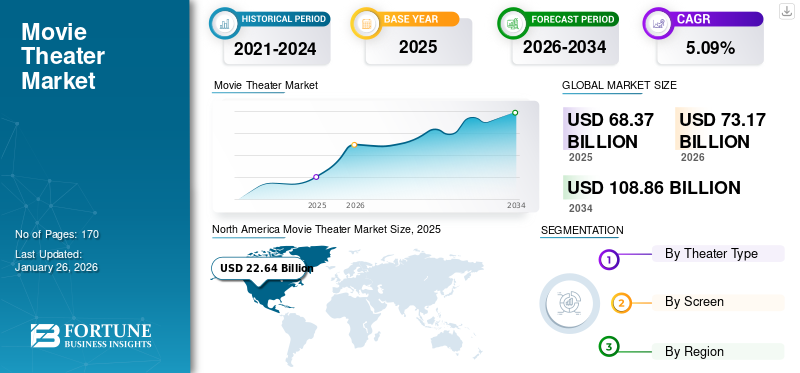
Download Free sample to learn more about this report.
GLOBAL MOVIE THEATER MARKET TAKEAWAYS
 Global Market Size & Forecast
- 2025 Market Size: USD 68.37 billion
- 2026 Market Size: USD 73.17 billion
- 2034 Forecast Market Size: USD 108.86 billion
- CAGR: 5.09% from 2026–2034
 Market Share
- North America dominated the movie theater market with a 33.12% share in 2025.
- Multiplex segment held a dominant market share of 72.37% in 2026.
- 2D screens segment is anticipated to hold a dominant market share of 66.59% in 2026.
 Key Regional Highlights
North America
The North America market accounted for USD 22.64 billion in 2025, representing 33.12% of the global industry, and is expected to reach USD 24.08 billion in 2026.
U.S.
The U.S. market is anticipated to stand at USD 20.11 billion in 2026.
Europe
Europe recorded a market size of USD 21.12 billion in 2025, capturing 30.89% of the global market share, and is projected to reach USD 22.58 billion in 2026.
Asia Pacific
In 2025, Asia Pacific represented USD 20.18 billion, accounting for 29.52% of the worldwide market, and is projected to grow to USD 21.79 billion in 2026.
Japan
Japan’s likely market size is USD 2.24 billion in 2026.
Read More

MOVIE THEATER MARKET TRENDS
Premiumization and Diversification to Augment Market Growth
The movie theater market is increasingly focusing on premium experiences and diversified offerings to attract audiences in the streaming era. Luxury seating, enhanced sound systems, and immersive technologies such as IMAX and 4DX are driving customer appeal. Additionally, theaters are expanding into non-traditional screenings, such as live sports, concerts, and gaming events, to diversify revenue streams. Food and beverage options have also shifted toward gourmet menus and dine-in experiences. These strategies aim to provide a unique, value-added outing, setting the theater experience apart from at-home entertainment. This trend reflects a push toward personalization and exclusivity to regain and retain audience interest.
Download Free sample to learn more about this report.
MARKET DYNAMICS
Market Drivers
Increased Consumer Demand for Immersive Experiences to Amplify Market Growth
Individuals watching movies are increasingly seeking immersive cinematic experiences that can not be replicated at home. Premium formats such as IMAX, 4DX, and Dolby Atmos provide enhanced visuals, surround sound, and sensory effects that elevate the movie-watching experience. These technological advancements, paired with larger screens and recliner seating, create a high-quality entertainment environment that attracts audiences. Blockbuster releases and franchise films also play a significant role in driving ticket sales, encouraging theaters to invest in these premium offerings. As consumers seek unique and memorable outings, the theaters’ ability to deliver a superior experience remains a crucial market driver.
Content Diversity and Regional Localization to Consolidate Market Dynamics
The growing diversity in film content, including local-language films and international releases, attracts a broader audience base. Cinemas have increasingly tailored their offerings to include regional content, catering to cultural and linguistic preferences. This strategy helps theaters appeal to underserved markets and expands their consumer reach. Additionally, the rise of niche genres, special event screenings, and live broadcasts of concerts or sports events has diversified revenue streams. By providing a wide range of content that caters to varied tastes, movie theaters maintain consistent footfall and appeal to audiences seeking both mainstream and specialized entertainment options.
Market Restraints
Competition From Streaming Platforms to Restrain Market Growth
The growing popularity of streaming online platforms such as Netflix, Disney+, and Amazon Prime Video is hampering the movie theater market growth. These platforms offer on-demand access to a vast library of movies and exclusive content at a lower cost, allowing consumers to enjoy entertainment from the comfort of their homes. Additionally, streaming services release high-quality original content, further reducing the need to visit theaters. This shift in consumer preferences, exacerbated by the pandemic’s impact on in-person gatherings, has led to declining footfalls in cinemas, challenging the sustainability of traditional movie theater business models.
Market Opportunities
Advanced Sound Technologies and Luxury Feel of Theaters to Offer Lucrative Growth Opportunities
The movie theater industry presents a robust market opportunity driven by evolving consumer preferences for immersive entertainment experiences. The rise of premium large-format screens, advanced sound technologies, and luxury seating options has elevated theaters' appeal. Cutting-edge technology such as 3D, panoramic screens, 4D motion seats, and Dolby Atmos audio systems has drastically elevated the sound and sight of movies. These advancements make the theater atmosphere more spectacular and experiential, setting movie theaters apart from viewing films at home.
Post-pandemic, audiences seek unique social and cinematic outings, fostering demand for event-based screenings and blockbuster releases. Additionally, emerging markets and urbanization offer untapped potential for theater expansion. Integration of dining, gaming, and AR/VR experiences further enhances customer engagement. With growing global box office revenues and a shift toward experiential leisure, the industry is primed for innovation and sustained growth.
Market Challenges
Rising Cost of Operations to Pose Significant Challenge
One significant challenge for the market is the rising cost of operations. Expenses such as property rent, maintenance, utilities, and staff wages continue to increase, putting pressure on profit margins. Additionally, the cost of upgrading technology, such as high-quality projection systems or immersive sound equipment, to meet audience expectations can be substantial. These financial burdens are often passed on to consumers through higher ticket and concession prices, which may deter potential moviegoers. Balancing operational costs while maintaining affordability and delivering a premium experience remains a critical challenge for theaters seeking long-term sustainability.
Impact of COVID-19
The COVID-19 pandemic severely impacted the global market. Widespread closures, social distancing mandates, and health concerns significantly reduced audience attendance. Studios delayed blockbuster releases or shifted them to streaming platforms, further eroding theater revenues. Prolonged shutdowns caused many theaters to face bankruptcy or permanent closure. Additionally, the rise of streaming services during the pandemic altered consumer habits, making home viewing more appealing than returning to theaters, creating a lasting impact on the industry’s profitability and relevance.
SEGMENTATION ANALYSIS
By Theater Type
Technological Superiority and Immersive Storytelling Aspect to Drive IMAX Segment Growth
The market is segmented into multiplex, independent cinema theaters, IMAX, and drive-in cinema.
The IMAX segment is forecasted to grow at the fastest CAGR between 2025 and 2032. The factors driving the segment growth include superior visual and audio technology, immersive experience, exclusive content, premium pricing models, and global expansion. Additionally, IMAX is known for its high quality, making it a preferred choice for moviegoers seeking premium outings, supplementing the segment growth.
The multiplex segment is anticipated to hold a dominant market share of 72.37% in 2026, and is expected to continue its prominent position during the forecasted years. Multiplexes revolutionized theaters by providing a more modern, convenient, and diverse experience with multiple screens, enhanced amenities, and economic efficiency, along with global trends and investments, further driving their popularity.
To know how our report can help streamline your business, Speak to Analyst
By Screen
Accessibility, Affordability and Versatility Make 2D Segment Dominant
The market is segmented by screen into 2D, 3D, and 4DX.
2D screens dominate the global market as they cater to a wider audience. The majority of films, including dramas, comedy, and independent films, are released primarily in 2D, while ticket prices of 2D screenings are much lower when compared to 3D and 4DX, contributing to its higher market share. Moreover, all types of theaters, including mainstream multiplexes and small independent cinema theaters, predominantly feature 2D screens. 2D screens segment is anticipated to hold a dominant market share of 66.59% in 2026.
The 3D segment is poised for strong growth at the fastest CAGR of 5.63% during the forecast period. 3D offers a heightened sense of immersion and depth by presenting separate images to each eye. The added sense of space makes action scenes more impactful and draws the viewer deeper into fantasy worlds, which in turn is driving its craze among young millennials, especially for blockbuster franchises or animated movies.
Global Movie Theater Market Regional Outlook
Geographically, the market is divided into North America, South America, Europe, Asia Pacific, and the Middle East & Africa.
North America
North America Movie Theater Market Size, 2025 (USD Billion)
To get more information on the regional analysis of this market, Download Free sample
The North America market accounted for USD 22.64 billion in 2025, representing 33.12% of the global industry, and is expected to reach USD 24.08 billion in 2026. Despite competition from streaming platforms, theaters remain popular for blockbuster releases, IMAX, and 3D experiences. Post-pandemic recovery has driven investments in luxury seating, enhanced concessions, and premium formats to attract audiences. The market is also adapting to changing consumer preferences while leveraging event-based screenings to sustain growth. The U.S. market is anticipated to stand at USD 20.11 billion in 2026.
Moreover, in the U.S., a new trend of watching concert films in theaters has gained immense popularity, making arena concerts more accessible to larger audiences. For instance, in August 2023, pop singer Taylor Swift announced that her Eras Tour would be hitting North American theaters in collaboration with the esteemed theater chain AMC.
Europe
Europe recorded a market size of USD 21.12 billion in 2025, capturing 30.89% of the global market share, and is projected to reach USD 22.58 billion in 2026. It is highly developed, with diverse offerings ranging from mainstream blockbusters to arthouse films. Countries such as Germany, France, and the U.K. dominate, while demand for immersive formats, including IMAX and 4DX. The market in U.K. is estimated to be USD 3.03 billion in 2026.
The Germany’s market size is foreseen to be valued at USD 4.1 billion in 2026 and France’s likely to be USD 2.14 billion in 2025.
Asia Pacific
In 2025, Asia Pacific represented USD 20.18 billion, accounting for 29.52% of the worldwide market, and is projected to grow to USD 21.79 billion in 2026. The Asia Pacific market is projected to grow at the fastest CAGR from 2025 to 2032 due to the rapidly growing population, resulting in a sizeable consumer base for the movie theater industry. Rising disposable income and a growing middle-class population in China, India, Japan, South Korea, and other South Asian countries have boosted the demand for entertainment and leisure activities such as movie theater experiences. Rapid urbanization in the region has bolstered large metropolitan areas with dense populations, commercial establishments, and increased entertainment alternatives. Urban centers serve a huge audience base and provide easy access to cinemas, creating a favorable environment for market growth. The market in China is estimated to be USD 6.08 billion in 2026.
India’s market size is foreseen to be valued at USD 5.36 billion and Japan’s likely to be USD 2.24 billion in 2026.
South America and Middle East & Africa
Middle East & Africa contributed 2.24% to the global market in 2025, with a valuation of USD 1.53 billion, and is projected to reach USD 1.62 billion in 2026, as it benefits from strong cinema cultures, with countries such as Brazil and Argentina hosting multiplexes and local film industries. The Middle East witnesses’ rapid expansion, with the GCC states investing heavily in luxury cinema experiences supported by a young, entertainment-seeking population. Africa’s market is yet in a nascent stage, led by countries such as Nigeria and South Africa, where Nollywood and local file industries are popular. The UAE market is likely to hold USD 0.15 billion in 2025. South America contributed approximately USD 2.89 billion to the global market in 2025, accounting for 4.23% share, and is expected to reach USD 3.1 billion in 2026.
Competitive Landscape
Key Market Players
Innovation in Design and Sustainability to Drive the Competition among Key Players
The movie theater market is highly competitive, driven by technological advancements and changing consumer preferences. Premium formats such as IMAX and 4DX vie for audiences alongside traditional screens. Streaming platforms add pressure, making theaters focus on immersive experiences, luxury seating, and gourmet concessions to retain customers. Major chains, including Regal and AMC, compete with boutique cinemas that offer personalized services. Pricing wars and loyalty programs further intensify competition. Additionally, rising ticket prices and a push for sustainable operations create both challenges and opportunities for companies operating in the movie. As consumer demand evolves, theaters innovate constantly to differentiate themselves in an increasingly dynamic entertainment landscape.
LIST OF KEY MOVIE THEATER COMPANIES PROFILED
- AMC Entertainment Holdings Inc. (U.S.)
- Cineworld Group Plc (U.K.)
- Cinemark Holdings, Inc (U.S.)
- IMAX Corporation (Canada)
- Regal Cinemas (U.S.)
- PVR INOX (India)
- Wanda Cinema (China)
- CJ CGV (South Korea)
- Cineplex Inc. (Canada)
- Vue International (U.K.)
Key Industry Developments
- June 2024: Wanda Film, China's largest exhibitor, and IMAX Corporation collaborated to form a strategic partnership agreement spanning content and technology. Under this partnership, Wanda Film is all set to upgrade 61 of its top-performing locations to state-of-the-art IMAX with Laser technology. Moreover, Wanda Film is also renewing up to 37 of its existing IMAX locations for another five years.
- May 2024: IMAX Corporation and French exhibition company MEGARAMA announced an agreement for three new state-of-the-art IMAX with laser system installations across France. Under this deal, one system will be added in the main urban area north of France, set to open in 2025 and two other locations in the suburbs of the country scheduled to open in 2026.
- May 2023: IMAX Corporation and Kinepolis announced a global expansion of their longstanding partnership with eight state-of-the-art IMAX installations across Europe and North America. The agreement encompasses four new locations in Europe, including Belgium, France, Spain, and the first-ever IMAX system in Luxembourg, as well as new locations in Michigan and Ontario and two upgraded systems in Ontario.
- April 2023: CJ CGV, the largest multiplex cinema chain in South Korea, signed an exclusive agreement to acquire hundreds of CineLife+™ Series cinema projectors. These projectors feature the most energy-efficient illumination systems on the market for CGV’s multiplexes located across South Korea, China, Vietnam, and Indonesia over the next three years. With this acquisition, Christie will supply CGV with state-of-the-art projection systems that bring advanced format capabilities to both premium large-format (PLF) venues and mainstream theatres.
- February 2023: Well-established multiplex chain PVR Pictures was renamed PVR INOX Pictures after a merger between PVR and Inox Leisure. Both players together serve as a single entity operating 361 cinemas with 1,689 screens across 115 cities till the end of FY 2023 in India and Sri Lanka. PVR also reported that 168 screens had been added in FY23 between Inox (71 screens) and PVR (97 screens). With this merger, PVR INOX Pictures aims to increase investments in content acquisition for the Indian market and create further opportunities for independent and under-represented creators and storytellers.
Investment Analysis and Opportunities
Strategic Partnerships and Acquisition Programs to Boost Market Growth
The movie theater market offers promising opportunities despite challenges from streaming platforms. Premium experiences, digital transformations, and demand for localized content drive growth. Emerging markets, particularly in Asia Pacific, provide expansion potential due to rising disposable incomes. Diversified offerings such as live events, gaming, and drive-in cinemas create additional revenue streams. Sustainability-focused theaters and partnerships with local filmmakers can enhance the profitability of market players. Thus, investors are prioritizing markets with growing urbanization, adopting innovative technologies, and exploring hybrid business models to remain competitive. With strategic positioning, the sector offers high-growth potential, especially in regions with untapped demand for immersive and community-driven entertainment experiences.
REPORT COVERAGE
The market research report provides a detailed analysis of the market and focuses on key aspects such as the competitive landscape, services, and leading product types. It also offers global market trends and insights and highlights key industry developments. In addition to the aforementioned factors, it includes several factors that have contributed to the market's growth in recent years.
Request for Customization to gain extensive market insights.
Report Scope & Segmentation
|
ATTRIBUTE |
DETAILS |
|
Study Period |
2021-2034 |
|
Base Year |
2025 |
|
Estimated Year |
2026 |
|
Forecast Period |
2026-2034 |
|
Historical Period |
2021-2024 |
|
Growth Rate |
CAGR of 5.09% from 2026 to 2034 |
|
Unit |
Value (USD Billion) |
|
Segmentation
|
By Theater Type
|
|
By Screen
|
|
|
By Region
|
Frequently Asked Questions
According to Fortune Business Insights, the global market size was USD 68.37 billion in 2025.
In 2025, the North America market stood at USD 22.64 billion.
The market will grow at a CAGR of 5.9% and exhibit a steady growth rate during the forecast period of 2026-2034.
By theater type, the multiplex segment dominated the market.
Increased consumer demand for immersive experiences and content diversity, along with growing regional cinema, are the key factors driving the market growth.
AMC Entertainment Holdings Inc., Cineworld Group Plc, Cinemark Holdings, Inc., IMAX Corporation, Regal Cinemas, and PVR INOX are among a few significant players in the global market.
North America dominated the movie theater market with a market share of 33.12% in 2025.
Premiumization and diversification, along with technological advancements in theaters, are likely to drive the growth of the market.



- 2021-2034
- 2025
- 2021-2024
- 170
-
(Offer valid till 30th Sep 2026)
Get 30-60 hrs Free Customization
Expand Regional and Country Coverage, Segments Analysis, Company Profiles, Competitive Benchmarking, and End-user Insights.



















Related Reports
-
US +1 833 909 2966 ( Toll Free )
-
Get In Touch With Us