mRNA Therapeutics Market Size, Share & Industry Analysis, By Type (Prophylactic (Vaccines) {COVID-19 Vaccines, Non-COVID-19 Vaccines} and Drugs/Medications), By Application (Oncology, Infectious Diseases, and Others), By Distribution Channel (Hospital Pharmacies, Drug Stores & Retail Pharmacies, and Others), and Regional Forecast, 2026-2034
 Download Free Sample
(Offer valid till 15th Oct 2026)

mRNA Therapeutics Market Size and Industry Overview
 Listen to Audio Version
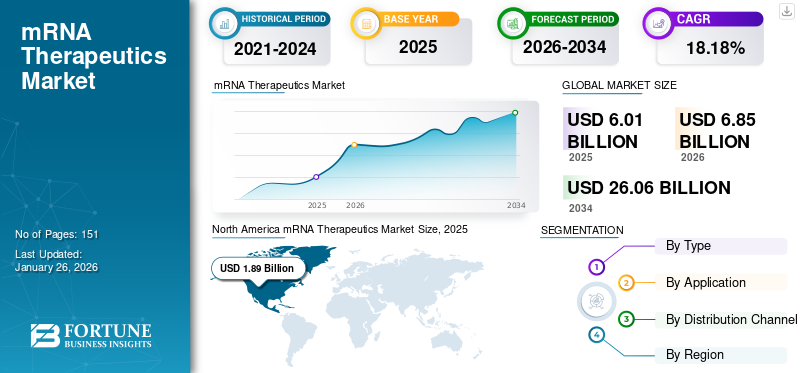
The global mRNA therapeutics market size was valued at USD 6.01 billion in 2025 and is projected to be worth USD 6.85 billion in 2026 and reach USD 26.06 billion by 2034, exhibiting a CAGR of 18.18% during the forecast period. North America dominated the mRNA therapeutics market with a market share of 31.47% in 2025.
The first mRNA drug is expected to be launched in 2027. The mRNA drugs/medications market is estimated to reach USD 2 billion by 2032, registering a CAGR of 118.7% over the forecast period of 2027 to 2032.
The market has experienced significant growth and transformation in recent years, driven by advancements in biotechnology and the successful application of mRNA technology in vaccine development, notably during the COVID-19 pandemic. This comprehensive analysis delves into the market's current landscape, emerging trends, challenges, key players, regional insights, and future projections. The market is expected to witness a strong upward growth trajectory, with projections indicating continued strong growth in the coming years. Moderna Inc., BioNTech, Pfizer Inc., and GSK plc are some of the leading entities operating in the market.
The COVID-19 pandemic drastically boosted the field of mRNA therapeutics, with companies such as Moderna Inc. and BioNTech launching mRNA-based vaccines against the COVID-19 virus. Along with this, several other players have also entered this space with their potential candidates for the treatment of other infectious diseases and cancer. This robust growth is attributed to the increasing adoption of mRNA-based vaccines and therapeutics across various medical fields.
In conclusion, the market is poised for substantial growth, driven by several factors. However, addressing challenges such as high production costs, specific requirements for storage & transport, and others will be crucial for sustained expansion.
Download Free sample to learn more about this report.
mRNA Therapeutics Market Key Takeaways
 Market Size & Forecast
- 2025 Market Size: USD 6.01 billion
- 2026 Market Size: USD 6.85 billion
- 2034 Forecast Market Size: USD 26.06 billion
- CAGR: 18.18% from 2026–2034
 Market Share
- Asia Pacific dominated the mRNA therapeutics market with a 39.95% share in 2025.
- The prophylactic (vaccines) segment is projected to dominate the market with a 100% share in 2026.
- The hospital & retail pharmacies segment will account for 63.62% market share in 2026.
 Key Regional Highlights
North America
North America held 31.47% share in 2025, valued at USD 1.89 billion.
Asia Pacific
Asia Pacific market valued at USD 2.40 billion in 2025.
Europe
Europe market valued at USD 1.26 billion in 2025.
U.S.
The market in the U.S. is projected to reach USD 2.16 billion by 2026.
Japan
The market in Japan is projected to reach USD 0.63 billion by 2026.
Read More

MARKET DYNAMICS
MARKET DRIVERS
Advantages of mRNA Therapeutics to Boost Market Growth
The mRNA therapeutic products, especially vaccines, have demonstrated their potential in offering a powerful alternative to the traditional conventional vaccines. This is achieved due to several advantages offered by the products, such as high potency, safety, and efficacy. Some of the key advantages of mRNA technology include high efficacy in preventing severe illness, reduced development timelines, adaptability to different strains and pathogens, a positive safety profile, and fewer side effects.
Owing to the advantages above, the demand for mRNA-based therapies is constantly growing, and this trend is anticipated to continue in the near future.
MARKET RESTRAINTS
Challenges of Storage and Stability of mRNA-Based Therapeutics Create Growth Hurdles
In spite of the high demand for mRNA-based products, challenges associated with storage & stability create hurdles for the overall market growth. Scaling up production while ensuring quality and managing cold chain logistics remains a significant hurdle. The global use of currently mRNA-based vaccines is limited by ultra-cold storage requirements. Most countries with limited resource settings lack the necessary infrastructure to execute mass vaccination programs. This affects the adoption of mRNA-based vaccines, which, in turn, limits the market growth.
MARKET OPPORTUNITIES
Advancements in Drug Delivery Technologies Offer Lucrative Growth Opportunities
Ongoing research is enhancing mRNA stability, delivery mechanisms, and manufacturing processes, making therapies more effective and accessible. Prompt advancements in drug delivery technologies, such as the introduction of polymeric nanoparticles, lipid nanoparticles (LNPs), and cationic nanoparticles, have offered lucrative opportunities for the operating players to advance their clinical pipeline for mRNA therapeutics. Several vectors that have been recently developed provide enhanced efficiency of mRNA delivery. This has led to improved development and commercialization of the mRNA-based products.
MARKET CHALLENGES
High Manufacturing Cost to Hinder Market Growth
One major factor limiting the mRNA therapeutics market growth is the high manufacturing cost of these products. The large-scale production of mRNA vaccines requires multiple steps of purification, which is a tedious and time-consuming process. The challenges related to issues in production lead to insufficient production volume, in turn increasing overall production costs.
Other Challenges
Regulatory Frameworks
Navigating the evolving regulatory landscapes across different regions requires strategic planning and adaptability. The regulatory bodies across the world have a very stringent regulatory framework for the assessment of mRNA-based vaccines and therapies.
Public Perception and Acceptance
Addressing vaccine hesitancy and building public trust in mRNA technologies is crucial for widespread adoption. Several research studies have demonstrated that mRNA vaccines are received with a high level of acceptance.
mRNA THERAPEUTICS MARKET TRENDS
Growing Adoption of mRNA Technology in Therapeutics Identified as One of the Significant Market Trends
In recent years, pharmaceutical companies have shifted their focus to the development of innovative therapies for life-threatening diseases using advanced technologies. One such technology is mRNA technology for drug development. mRNA therapeutics offer the potential for personalized treatments, particularly in cancer care, by tailoring therapies to individual genetic profiles. This technology has a strong potential in treating various diseases. Vaccines developed using mRNA technology offer several benefits over DNA vaccines in terms of manufacturing, distribution, safety, and efficiency. The products have shown promising results in human clinical trials. Thus, an increasing number of clinical trials show the growing adoption of mRNA technology in vaccine and drug development.
- For instance, as per a research study published in September 2022, out of the total number of clinical trials based on mRNA, around 40% are in phase I.
Download Free sample to learn more about this report.
IMPACT OF COVID-19
The COVID-19 pandemic resulted in a significant acceleration in mRNA-based research & development of various therapeutic products. Basically, the use of mRNA technology in vaccine development has not disrupted the vaccine market space. However, it has broadened the scope of the vaccine world. COVID-19 vaccines developed by Moderna Inc. and BioNTech/Pfizer Inc. were the first mRNA vaccines approved by the regulatory bodies during the pandemic period.
Segmentation Analysis
By Type
Expansion of Product Offerings, Coupled with High Demand for These Products, Supported the Dominance of Prophylactic (Vaccines) Segment
On the basis of type, the mRNA therapeutics market is segmented into prophylactic (vaccines) and drugs/medications. The prophylactic (vaccines) segment is further divided into COVID-19 vaccines and non-COVID-19 vaccines.
In 2026, the prophylactic (vaccines) segment is estimated to dominate the market with the highest share of 100.00%. The segment is likely to hold its leading position throughout the forecast period. SpikeVax, Comirnaty, and mRESVIA are the only approved prophylactic vaccines that are currently on the market. Vaccines for other infectious diseases such as influenza, malaria, Mpox, and others are expected to contribute to segment growth over the coming years.
- For instance, in February 2023, Moderna Inc. announced the positive results from its Phase 3 trial for mRNA-1010, a seasonal influenza vaccine candidate.
On the other hand, the drugs/medications segment is projected to witness a strong growth rate over the forecast period. While mRNA technology gained prominence through COVID-19 vaccines, its potential applications are expanding into oncology, rare genetic disorders, and other therapeutic areas. A rapidly growing pipeline of products for various life-threatening diseases, especially different types of cancers and rare genetic diseases, is anticipated to drive the segment growth in the coming years. In addition, increasing R&D investments, advancements in technology, and growing acceptance & awareness of mRNA therapies have further propelled the segment growth. The COVID-19 vaccines segment is projected to dominate the market with a share of 37.75% in 2026.
- For instance, in November 2023, Sanofi, in partnership with Griffith University, opened a new mRNA research site to boost R&D in this space.
To know how our report can help streamline your business, Speak to Analyst
By Application
Increasing Number of Approved Products to Propel Infectious Diseases Segment Expansion
Based on application, the market is divided into oncology, infectious diseases, and others.
The infectious diseases segment is expected to lead the market, contributing 100% globally in 2026. As of January 2025, mRNA therapeutics have been approved only for infectious diseases. This factor has resulted in the dominance of the segment in the overall market.
- For instance, as of January 2025, COVID-19 and respiratory syncytial virus (RSV) are the only infectious diseases for which the regulatory bodies have approved mRNA-based vaccines.
Contrastingly, the oncology segment is expected to grow at a significant rate in the near future. mRNA technology has gained remarkable adoption in the past few years, especially in the development of therapeutics to manage oncological conditions. Several leading biopharmaceutical companies are actively involved in the development of mRNA therapies for different types of cancers.
- For instance, in August 2024, BioNTech initiated global trials for its mRNA vaccine, BNT116, that can be potentially used to treat non-small cell lung cancer (NSCLC).
By Distribution Channel
Easy Availability of Products through Hospital Pharmacies to Impel Segment Expansion
Based on distribution channel, the market is categorized into hospital pharmacies, drug stores & retail pharmacies, and others.
The hospital & retail pharmacies segment is estimated to accounting for the largest global mRNA therapeutics market share with market share of 63.62% in 2026. The easy availability of mRNA-based vaccines, such as COVID-19 vaccines, through hospital pharmacies has supported the segment's growth. Also, the requirement of healthcare professionals for the administration of these vaccines further supplements the segmental growth.
On the other hand, the drug stores & retail pharmacies segment is expected to witness a considerable growth rate in the coming years. Supportive government initiatives to increase the availability of mRNA-based products are anticipated to propel the segment's growth.
mRNA THERAPEUTICS MARKET REGIONAL ANALYSIS
By region, the market is divided into Europe, North America, Asia Pacific, and the Rest of the World.
North America
North America mRNA Therapeutics Market Size, 2025 (USD Billion)
To get more information on the regional analysis of this market, Download Free sample
North America recorded a market size of USD 1.89 billion in 2025, capturing 31.47% of the global market share, and is projected to reach USD 2.28 billion in 2026. In 2025, North America generated a revenue of USD 1.89 billion and dominated the global market. Key factors contributing to the regional dominance include substantial research funding, federal initiatives, and a high number of clinical trials. In North America, the U.S. holds a dominant position in the market, accounting for a significant portion of the regional market. This leadership is attributed to factors such as substantial investments in R&D, strong presence of well-established as well as emerging entities, and a favorable regulatory environment. The U.S. market is estimated at USD 2.16 billion by 2026.
- For instance, in May 2024, Moderna Inc. received the U.S. FDA approval for its mRNA respiratory syncytial virus (RSV) vaccine named mRESVIA.
Europe
In 2025, Europe represented USD 1.26 billion, accounting for 20.87% of the worldwide market, and is projected to grow to USD 1.39 billion in 2026. The European region is expected to witness remarkable growth in the coming years. Factors such as government initiatives, efforts by the operating players to develop and introduce new products, and a strong pipeline of products under development have supplemented the regional market growth. The UK market is expected to reach USD 0.15 billion by 2026, while the Germany market is anticipated to account for USD 0.37 billion by 2026.
- For example, in August 2024, Moderna Inc. received approval from the European Commission (EC) for its mRNA respiratory syncytial virus (RSV) vaccine named mRESVIA.
Asia Pacific
The Asia Pacific market generated USD 2.4 billion in 2025, representing 39.95% of the global market landscape, and is expected to reach USD 2.67 billion in 2026. The Asia Pacific market is projected to grow at the fastest rate in the near future. Rising investments in research & development of mRNA therapeutics, especially in China, and increasing applications of mRNA technology in oncology & rare genetic disorders have majorly driven the regional market growth. The Japan market is forecast to attain USD 0.63 billion by 2026, the China market is poised to reach USD 0.58 billion by 2026, and the India market is set to achieve USD 0.27 billion by 2026.
- For instance, in March 2023, China approved the first home-produced mRNA COVID-19 vaccine.
Rest of the World
Due to the relatively lower adoption of mRNA technology, Latin America and the Middle East & Africa regions experienced a lesser market share in 2024. However, with improving healthcare infrastructure, the market is anticipated to witness sustainable growth in the coming years. Rest of the world accounted for USD 0.46 billion in 2025, representing 7.7% of the global market share, and is projected to reach USD 0.50 billion in 2026.
COMPETITIVE LANDSCAPE
Key Market Players
Strong Focus on Research & Development and Pipeline Candidates to Boost Market Presence of Leading Companies
The market is highly competitive owing to the constantly increasing number of new entrants in the market. The presence of both established pharmaceutical giants and innovative biotech firms characterizes the market. In recent years, the market has witnessed a strong growth trajectory as several biopharmaceutical companies have shifted their focus to the development of vaccines and drugs using mRNA technology.
Pfizer Inc., BioNTech, and Moderna Inc. are the prominent players in the market. In 2024, these entities collectively held a significant share of the global market. Some of the factors contributing to the leading position of the above companies include a substantial number of approved products, a strong focus on advancing clinical products in the pipeline, and active engagement in the development of innovative therapies based on mRNA technology.
- For instance, in September 2023, Moderna Inc. expanded its mRNA research across various fields, including rare diseases, respiratory & oncology.
Other entities operating in the market include CureVac SE, GSK plc., Sanofi, Omega Therapeutics, Strand Therapeutics, and others. These companies are focusing on undertaking various strategic initiatives such as collaboration & partnerships, investments in new therapy developments, and others.
LIST OF KEY mRNA THERAPEUTICS COMPANIES PROFILED
- Moderna Inc. (U.S.)
- BioNTech (Germany)
- Pfizer Inc. (U.S.)
- CureVac SE (Germany)
- GSK plc. (U.K.)
- Sanofi (France)
- Omega Therapeutics (U.S.)
- Strand Therapeutics (U.S.)
- Immunomic Therapeutics (U.S.)
KEY INDUSTRY DEVELOPMENTS
- January 2025: The U.S. Department of Health and Human Services (HHS) provided funding of USD 590 million to Moderna Inc. to boost the development of mRNA-based pandemic influenza vaccines. This funding is also aimed at improving mRNA platform capabilities in the U.S.
- August 2024: The U.S. FDA granted emergency use authorization (EUA) for updated mRNA COVID-19 vaccines (2024-2025 formula).
- July 2024: Harvard Medical School researchers developed two technologies to make mRNA vaccines more potent and long-lasting with fewer side effects and smaller doses.
- September 2023: Moderna Inc. announced that its flu vaccine candidate, mRNA-1010, has shown positive clinical results in a phase 3 trial.
- July 2023: Moderna Inc. signed a USD 1 billion agreement with Chinese officials for the research, development, and manufacturing of mRNA medicines in the country.
REPORT COVERAGE
The global mRNA therapeutics market report provides a detailed analysis of the industry. It emphasizes key aspects, such as major companies, approved products, pipeline analysis, and a few others. In addition to the market forecast, it includes detailed insights into market dynamics, new product approvals, and key industry developments such as mergers, partnerships, & acquisitions.
Request for Customization to gain extensive market insights.
Report Scope & Segmentation
|
ATTRIBUTE |
DETAILS |
|
Study Period |
2021-2034 |
|
Base Year |
2025 |
|
Estimated Year |
2026 |
|
Forecast Period |
2026-2034 |
|
Historical Period |
2021-2024 |
|
Growth Rate |
CAGR of 18.18% from 2026-2034 |
|
Unit |
Value (USD billion) |
|
Segmentation
|
By Type
By Application
By Distribution Channel
By Region
|
Frequently Asked Questions
Fortune Business Insights says that the global market stood at USD 6.01 billion in 2025 and is projected to reach USD 26.06 billion by 2034.
In 2025, the North America market value stood at USD 1.89 billion.
The market is expected to exhibit steady growth at a CAGR of 18.18% during the forecast period of 2026-2034.
By type, the prophylactic segment led in 2025.
The growing research & development for mRNA-based drugs and vaccines is one of the major factors boosting market growth.
Moderna Inc., Pfizer Inc., and BioNTech are some of the major players in the market.
North America dominated the market with a share of 31.47% in 2025.



- 2021-2034
- 2025
- 2021-2024
- 151
-
(Offer valid till 15th Oct 2026)
Get 30-60 hrs Free Customization
Expand Regional and Country Coverage, Segments Analysis, Company Profiles, Competitive Benchmarking, and End-user Insights.













.webp)






Related Reports
-
US +1 833 909 2966 ( Toll Free )
-
Get In Touch With Us