Nanofabrics Market Size, Share & Industry Analysis, By Material Type (Polymer Nanofabrics, Composite Nanofabrics, Metal-Based Nanofabrics, and Others), By End-Use Industry (Filtration & Separation, Medical & Healthcare, Industrial Textiles, Smart Wearables, and Others), and Regional Forecast, 2026-2034
 Download Free Sample
Nanofabrics Market Size and Future Outlook
 Listen to Audio Version
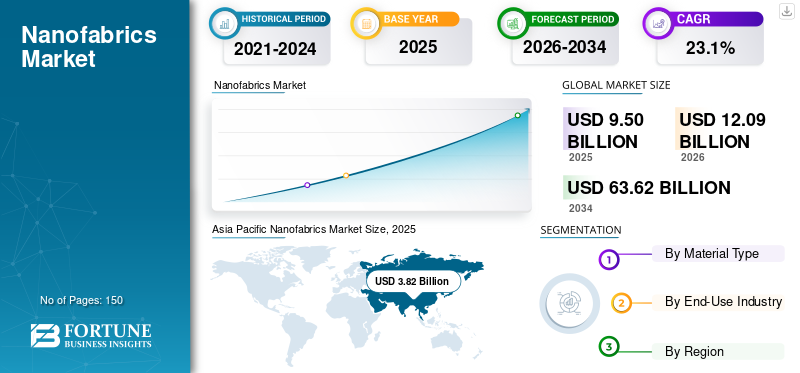
The global nanofabrics market size was valued at USD 9.50 billion in 2025. The market is projected to grow from USD 12.09 billion in 2026 to USD 63.62 billion by 2034, exhibiting a CAGR of 23.1% during the forecast period. Asia Pacific dominated the nanofabrics market with a market share of 40.21% in 2025.
Nanofabrics are advanced textiles made with nanoscale fibers or nano-coatings that improve performance without adding bulk. They can deliver higher filtration efficiency, antimicrobial protection, better barrier properties, improved strength, and UV resistance. The product demand is mainly linked to technical textile uses such as medical and hygiene products, protective clothing, masks and respirators, air and liquid filtration media, and sports or outdoor apparel. The market growth is steady rather than explosive, shaped by the ability to scale manufacturing, maintain consistent quality, meet safety and regulatory expectations for skin-contact uses, and justify the cost premium versus conventional fabrics.
The market is dominated by a small group of integrated nanomaterials and performance textile producers with scalable manufacturing assets and established nano-fiber and coating technologies. Major players such as DuPont, E-Spin NanoTech Pvt. Ltd., TORAY INDUSTRIES, INC., and Hengli Group Co., Ltd., and other regional producers focus on high-performance fabric platforms, process control, and consistent technical service support. This results in a moderately consolidated market characterized by steady demand, long qualification cycles, high switching costs, and controlled capacity.
Download Free sample to learn more about this report.
NANOFABRICS MARKET KEY TAKEAWAYS
 Market Size & Forecast
- 2025 Market Size: USD 9.50 billion
- 2026 Market Size: USD 12.09 billion
- 2034 Forecast Market Size: USD 63.62 billion
- CAGR: 23.1% from 2026–2034
 Market Share
- Asia Pacific dominated the market with a 40.21% share in 2025.
- Filtration & separation accounted for the largest market share in 2025.
- The composite segment is projected to grow at a CAGR of 22.6% during the forecast period.
 Key Regional Highlights
North America
North America generated USD 2.23 billion in 2025.
Europe
Europe reached USD 2.08 billion in 2025.
Asia Pacific
Asia Pacific reached USD 3.82 billion in 2025 and is projected to grow to USD 4.92 billion in 2026.
U.S.
The market reached USD 1.91 billion in 2025.
Japan
The market is supported by advanced textile manufacturing, healthcare innovation.
Read More

NANOFABRICS MARKET TRENDS
Shift toward Scalable, Continuous Manufacturing to Reshape the Market
A clear trend in the market is the shift from small, pilot-scale production to more scalable, continuous manufacturing, such as roll-to-roll processing and commercial electrospinning systems. Companies are making this shift to improve cost control, output consistency, and supply reliability as customers expect repeatable performance at larger volumes. It is also driven by the need to achieve uniform fiber structure and coating quality, which is harder to maintain with lab-style methods. From a business perspective, investments in scalable production are becoming strategic as they reduce process variability, accelerate customer qualification, and enhance competitiveness in technical textile supply chains.
- According to the U.S. EPA, there are approximately 135 major source facilities in the U.S. under the printing, coating, and dyeing of fabrics and other textiles source category, which supports the shift toward more controlled and cleaner textile finishing processes.
Download Free sample to learn more about this report.
MARKET DYNAMICS
MARKET DRIVERS
Stricter Filtration Standards to Increase Product Use in Filter Media
The nanofabrics demand is supported by rising filtration requirements in industrial and consumer applications, where higher particle capture is needed without restricting airflow. In air filtration (HVAC systems, cleanrooms, industrial ventilation), nano-fiber layers help improve efficiency for fine particles while keeping pressure drop under control, which supports better energy performance during use. In masks and respirators, nanofabric-based webs can enhance filtration without making products too thick or uncomfortable. As filtration standards become stricter and buyers expect stable, repeatable performance, the adoption of advanced filtration media directly increases the product demand, driving nanofabrics market growth.
- According to the U.S. EPA, the primary (health-based) annual PM2.5 standard was strengthened from 12.0 µg/m³ to 9.0 µg/m³ (finalized on February 7, 2024), reflecting tighter air-quality expectations that can increase the demand for higher-efficiency filtration media that use nanofabrics.
MARKET RESTRAINTS
Dependence on Cyclical End-Use Sectors Can Make Product Demand Unstable
Nanofabrics demand is limited by its strong link to end-use sectors that can slow down quickly, especially filtration projects, industrial and protective textiles, and premium performance apparel. When industrial activity weakens, companies may delay HVAC upgrades, cleanroom investments, or higher-spec filtration purchases, which reduces the near-term demand for nano-enabled fabrics. In apparel, slower consumer spending can also reduce the demand for premium functional textiles. Compared with standard fabrics, nanofabrics often require testing and approval. Hence, buyers may postpone adoption when budgets tighten, making the demand more sensitive to economic uncertainty.
MARKET OPPORTUNITIES
Shift toward Reusable Medical Textiles to Create Growth Opportunities for the Market
Nanofabrics have an opportunity as hospitals and healthcare suppliers increase the use of reusable gowns, drapes, and hospital linens to reduce waste and improve supply reliability. Nano-enabled coatings and structures can help these products maintain barrier protection, fluid resistance, and antimicrobial performance even after repeated washing and sterilization, which is a common weakness of many conventional finishes. As buyers set higher durability and compliance requirements for reusable medical textiles, nanofabrics are poised for wider adoption in high-volume product categories, creating growth opportunities through higher-value specifications and longer-term supply contracts.
- According to NHS England, NHS providers in England generate 156,000 tonnes of clinical waste every year, which supports the push toward reuse (including reusable medical textiles).
MARKET CHALLENGES
High Cost Sensitivity and Difficult Pass-Through of Nano-Inputs Pressure Product Margins
Nanofabrics suppliers face a margin challenge as key inputs and processing steps are cost-sensitive. Prices for nanomaterials and specialty chemicals can vary with purity requirements and supplier availability, while energy, solvent handling, and quality testing add conversion cost. Many customers buy through long-term contracts or competitive bidding, making price changes not readily accepted. Even when volumes are stable, sudden increases in input or compliance costs can compress margins. This makes procurement planning, multi-sourcing, and process efficiency critical for maintaining profitability.
Segmentation Analysis
By Material Type
Polymer Nanofabrics Segment Dominated the Market with Rising Consumption
Based on material type, the market is segmented into polymer nanofabrics, composite nanofabrics, metal-based nanofabrics, and others.
To know how our report can help streamline your business, Speak to Analyst
The polymer nanofabrics segment accounted for the largest nanofabrics market share in 2025. Polymer-based fabrics lead consumption as they are easier to scale, lighter, and more flexible to engineer for end-use requirements such as breathability, filtration efficiency, softness, and barrier performance. They are widely used in filtration media, medical and hygiene textiles, and protective apparel, where consistent performance and comfort are critical. The demand for these applications is largely specification-driven, especially in filtration and healthcare, creating a strong pull-through effect for polymer nanofabrics volumes. As technical textiles continue to shift toward higher performance with practical manufacturability, the product remains the most structurally anchored material type for the market.
The composite segment is expected to grow at a steady CAGR of around 22.6% over the forecast period, driven by the rising demand for filtration and protective textiles. These applications need multi-functional performance, combining strength, barrier protection, and durable surface functionality.
By End-Use Industry
Tighter Filtration Standards to Propel Filtration and Separation Segment Growth
By end-use industry, the market is segmented into filtration & separation, medical & healthcare, industrial textiles, smart wearables, and others.
The filtration & separation segment accounted for the largest share in 2025. Filtration and separation drive product demand as nanostructured webs provide higher particle capture and large surface area while keeping materials lightweight and breathable, which is critical for air and liquid filtration performance. As filtration standards become stricter across HVAC, industrial ventilation, clean environments, and personal protection, buyers increasingly prefer high-efficiency media that deliver performance without a heavy pressure drop. This creates a specification-driven demand base that supports consistent consumption of nanofabrics in filter media beyond short-term replacement cycles.
The medical & healthcare segment is expected to grow at a CAGR of 23.1% over the forecast period.
Nanofabrics Market Regional Outlook
Asia Pacific Nanofabrics Market Size, 2025 (USD Billion)
To get more information on the regional analysis of this market, Download Free sample
By geography, the market is categorized into North America, Europe, Asia Pacific, Latin America, and the Middle East & Africa.
Asia Pacific held the dominant position in 2025, valued at USD 3.82 billion, and is expected to retain its leading role in 2026, reaching USD 4.92 billion. The region’s leadership is supported by its large textile and nonwovens manufacturing base, strong scale-up capabilities, and high-volume production for export-oriented supply chains. Robust demand from filtration and separation, medical and healthcare textiles, and industrial technical textiles sustains product consumption, particularly in cost-sensitive applications that require consistent performance at commercial volumes.
China Nanofabrics Market
Based on Asia Pacific’s strong contribution and China’s large-scale textile and nonwovens manufacturing footprint, the China market reached a value of USD 1.66 billion in 2025, accounting for approximately 43.5% of global revenues. The product demand is supported by extensive production of filtration media, medical and hygiene textiles, and industrial technical textiles, along with a well-developed supply chain for polymer fibers, functional coatings, and high-volume fabric processing.
India Nanofabrics Market
The India market touched a value of around USD 0.75 billion in 2025. Growth is supported by the rising demand for air and water filtration, expanding healthcare and hygiene consumption, wider use of technical textiles in industry, and the gradual scale-up of domestic nonwovens capacity and textile finishing capabilities.
North America
North America remains a significant market, which reached a value of USD 2.23 billion in 2025. Filtration and separation media, medical and protective textiles, and selected industrial technical textile uses anchor demand. The region benefits from established nonwovens capacity, advanced materials R&D, and strong quality standards that support repeatable performance. Replacement-driven purchasing in HVAC and industrial filtration adds stability, although growth remains moderate as major end uses are mature.
U.S. Nanofabrics Market
The U.S. market touched a revenue of USD 1.91 billion in 2025, representing approximately 85.5% of regional revenues. Consumption is driven by filtration and separation media for HVAC and industrial uses, medical and protective textiles, where performance specifications are strict, and selected industrial technical textile applications that require high efficiency, durability, and consistent functional performance.
Europe
The Europe market is projected to record modest growth over the forecast period and reached a valuation of USD 2.08 billion by 2025. The region is characterized by stringent chemical and product safety regulations, high energy costs, and a strong focus on sustainable and compliant textile processing, which influences how the product is manufactured and qualified. Despite these constraints, continued demand from filtration media, medical and protective textiles, and industrial technical textiles supports the ongoing product consumption.
Germany Nanofabrics Market
The Germany market reached approximately USD 0.47 billion in 2025, equivalent to around 22.5% of the global market. Strong industrial manufacturing, a well-developed technical textiles and nonwovens base, and steady use of high-performance filtration media and protective textiles in automotive, industrial, and healthcare-related applications support demand.
U.K. Nanofabrics Market
The U.K. market reached USD 0.41 billion in 2025, accounting for roughly 19.8% of global revenues. Consumption is concentrated in filtration and separation applications, medical and protective textiles, and selected industrial technical textile uses where performance, compliance, and consistent product quality are critical.
Latin America and the Middle East and Africa
The Latin America and the Middle East and Africa regions are expected to witness moderate growth during the forecast period. The Latin America market reached a valuation of USD 0.79 billion in 2025, supported by the rising demand for air and water filtration, expanding healthcare and hygiene consumption, and the gradual adoption of technical textiles for industrial applications. In the Middle East and Africa, the demand is driven by HVAC and industrial filtration needs, healthcare textiles, and the steady build-out of local nonwovens converting and finishing capability. The market reached USD 0.59 billion in 2025. Import reliance remains high in both the regions.
GCC Nanofabrics Market
The GCC market accounted for around USD 0.27 billion in 2025, representing approximately 46.8% of regional revenues. The product demand is supported by construction and infrastructure activity that raises HVAC filtration needs, expanding healthcare capacity, and the region’s role as a hub for imported technical textiles.
COMPETITIVE LANDSCAPE
Key Industry Players
Stringent Safety Compliance and High Capital Requirements to Shape Market Competition
The market is relatively consolidated and technology-intensive, as complex manufacturing processes, requirements for high investment, and strict product performance and safety compliance create significant entry barriers. These aspects limit new entrants and concentrate supply among a small group of global performance textile and advanced materials producers with established process expertise and integrated operations.
Key players such as DuPont, E-Spin NanoTech Pvt. Ltd., TORAY INDUSTRIES, INC., and Hengli Group Co., Ltd., focus primarily on platform optimization existing platforms and strengthening process consistency and application support instead of aggressive capacity expansion. The recent activities undertaken by these industry players underscore a strategic emphasis on cost competitiveness, operational efficiency, and the gradual scale-up of more controllable and cleaner production routes for supporting market positioning in the long term.
LIST OF KEY NANOFABRICS COMPANIES PROFILED
- (U.S.)
- Nanotex (U.S.)
- E-Spin NanoTech Pvt. Ltd. (India)
- BASF (Germany)
- TORAY INDUSTRIES, INC. (Japan)
- TEIJIN LIMITED (Japan)
- Hengli Group Co., Ltd. (China)
- Oripol (India)
- Lenzing AG (Austria)
REPORT COVERAGE
The global market analysis provides an in-depth study of market size & forecast by all the market segments included in the report. It contains details on the market dynamics and market trends expected to drive the market over the forecast period. It offers information on technological advancements, new product launches, key industry developments, and partnerships, mergers & acquisitions. The market research report also encompasses a detailed competitive landscape, including market share and profiles of key operating players.
Request for Customization to gain extensive market insights.
Report Scope & Segmentation
| ATTRIBUTE | DETAILS |
| Study Period | 2021-2034 |
| Base Year | 2025 |
| Estimated Year | 2026 |
| Forecast Period | 2026-2034 |
| Historical Period | 2021-2024 |
| Growth Rate | CAGR of 23.1% from 2026-2034 |
| Unit | Value (USD Billion) |
| Segmentation | By Material Type, End-Use Industry, and Region |
| By Material Type |
|
| By End-Use Industry |
|
| By Region |
|
Frequently Asked Questions
Fortune Business Insights says that the global market size was valued at USD 9.50 billion in 2025 and is projected to reach USD 63.62 billion by 2034.
The market is slated to exhibit steady growth at a CAGR of 23.1% during the forecast period of 2026-2034.
The filtration & separation segment led the market in 2025.
Asia Pacific held the highest market share in 2025.
Stricter filtration standards and air quality needs are key factors driving market expansion.



- 2021-2034
- 2025
- 2021-2024
- 150
Get 30-60 hrs Free Customization
Expand Regional and Country Coverage, Segments Analysis, Company Profiles, Competitive Benchmarking, and End-user Insights.


















Related Reports
-
US +1 833 909 2966 ( Toll Free )
-
Get In Touch With Us