Nanotextiles Market Size, Share & Industry Analysis, By Product Type (Nano Fabric, Nanofiber Textiles, Nano Composite Textiles, Nano-Engineered Smart Textiles, and Others), By Application (Apparel, Medical & Healthcare, Industrial, Home Textiles, Smart Wearables, and Others), and Regional Forecast, 2026-2034
 Download Free Sample
Nanotextiles Market Size and Future Outlook
 Listen to Audio Version
The global nanotextiles market size was valued at USD 18.28 billion in 2025. The market is projected to grow from USD 23.09 billion in 2026 to USD 114.18 billion by 2034, exhibiting a CAGR of 22.1% during the forecast period. Asia Pacific dominated the nanotextiles market with a market share of 39.98% in 2025.
Nanotextiles are high-performance fabrics enhanced using nanotechnology to improve strength, lightweight structure, water resistance, antimicrobial protection, and thermal regulation. They are increasingly used in medical textiles, filtration materials, protective clothing, industrial fabrics, and smart wearables, where functionality and durability are critical. Their demand is driven more by technical performance requirements than by conventional apparel consumption. Rising hygiene standards, industrial safety needs, and innovation in advanced materials support growth. Globally, the market expands through specialized applications and product upgrades rather than through mass-volume textile production, reflecting its performance-oriented, value-added positioning.
The market is dominated by a small group of specialized material innovators and advanced textile manufacturers with strong R&D capabilities and established nanotechnology platforms. Toray Industries, Nano-Tex (Crypton), Schoeller Textil AG, BASF, Hengli Group Co., Ltd., and regional technical textile producers focus on functional finishes, performance coatings, and consistent technical support. These factors result in a moderately consolidated market characterized by innovation-driven demand, high development costs, strong customer validation requirements, and controlled capacity expansion.
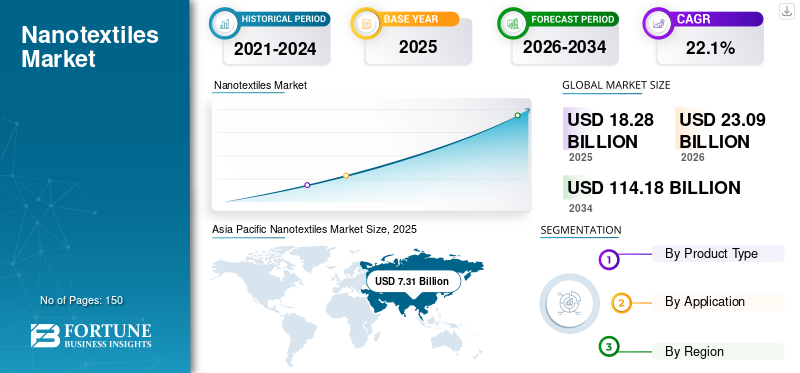
Download Free sample to learn more about this report.
NANOTEXTILES MARKET KEY TAKEAWAYS
 Global Market Size & Forecast
- 2025 Market Size: USD 18.28 billion
- 2026 Market Size: USD 23.09 billion
- 2034 Forecast Market Size: USD 114.18 billion
- CAGR: 22.10% from 2026–2034
 Market Share
- Asia Pacific dominated the market with a 39.98% share in 2025.
- The Nano Fabric segment is expected to dominate the market in 2026.
- The Apparel segment is expected to dominate the market in 2026.
 Key Regional Highlights
Asia Pacific
The market reached USD 7.31 billion in 2025 and is projected to grow to USD 9.36 billion in 2026.
North America
The market reached USD 4.39 billion in 2025, supported by growing adoption of advanced textiles in medical, defense, industrial filtration, and performance apparel applications.
Europe
The market reached USD 4.02 billion in 2025 and is expected to witness steady growth, driven by strong sustainability standards, technical textile innovation, and demand from medical and industrial applications.
U.S.
The market reached USD 3.77 billion in 2025.
Japan
The market is projected to witness steady growth by 2026.
Read More

NANOTEXTILES MARKET TRENDS
Rising Integration of Smart and Functional Features is Transforming Product Development
A key trend is the increasing integration of smart and multifunctional features directly into fabric structures. Manufacturers are embedding conductive fibers, nanosensors, antimicrobial nanoparticles, and moisture-management layers to create textiles that go beyond traditional performance properties. This reflects a shift from single-function fabrics to multi-functional material platforms. From a commercial standpoint, companies are focusing more on product differentiation and technology-driven value-addition, as buyers increasingly seek textiles that combine comfort, protection, monitoring capabilities, and durability within a single integrated solution.
- According to the U.S. National Nanotechnology Initiative (NNI), federal agencies invested over USD 1.7 billion in nanotechnology R&D in FY 2023, supporting continued innovation in nanoscale materials and smart applications relevant to nanotextiles.
MARKET DYNAMICS
MARKET DRIVERS
Download Free sample to learn more about this report.
Growing Adoption of High-Performance and Functional Textiles Drives Market Expansion
Nanotextiles are gaining high demand primarily driven by the increasing need for high-performance, multifunctional fabrics across medical, industrial, defense, sportswear, and smart-wearable applications. Advanced textile solutions are specified for antimicrobial protection, fluid resistance, lightweight strength, and thermal regulation, particularly in healthcare garments, filtration systems, and protective clothing. Rising hygiene standards and workplace safety regulations further strengthen this demand. As manufacturers integrate nanotechnology to enhance durability and integrate value-added features, the increased production of functional textiles directly translates into greater adoption of nanotextile-based materials across specialized end-use industries.
- According to the Press Information Bureau (PIB), Government of India, the National Technical Textiles Mission has an outlay of approximately USD 180 million for 2020–2026, including about USD 62 million for 168 R&D projects supporting advanced and high-performance textiles, such as nanotextiles.
MARKET RESTRAINTS
High Costs and Technical Complexity Limit Large-Scale Adoption
Higher nanotextiles production costs restrain demand compared to conventional fabrics. The use of nanomaterials, specialized coatings, and advanced finishing technologies increases manufacturing expenses and requires skilled processing and quality control. This makes adoption challenging in price-sensitive segments such as everyday apparel. In addition, longer product testing, certification, and regulatory approval processes, especially in medical and protective applications, can slow commercialization. Unlike traditional textiles with well-established large-scale supply chains, nanotextiles are often concentrated in niche, high-value segments, making broader market growth dependent on cost reduction and scalable production capabilities.
MARKET OPPORTUNITIES
Integration of Nanotechnology into Sustainable and Mainstream Textiles Creating Growth Potential
The broader integration of nanotechnology into sustainable, performance-driven textiles is creating new opportunities for the nanotextiles market. Manufacturers are developing recyclable fabrics, bio-based nanofibers, and durable functional finishes that meet both performance and environmental standards. Improvements in scalable production technologies are also helping to reduce costs and expand commercial feasibility. As brands and end users focus more on sustainability, durability, and added functionality, nanotextiles are expected to move beyond niche technical uses into broader apparel, home textiles, and industrial applications, supporting long-term nanotextiles market growth.
- According to the U.S. Environmental Protection Agency (EPA), the U.S. generated 17 million tons of textile waste in 2018, reinforcing the need for durable, sustainable textile solutions and creating opportunities for advanced materials such as nanotextiles.
MARKET CHALLENGES
Standardization and Performance Validation Remain Key Industry Challenges
Nanotextile producers face challenges in maintaining consistent quality and ensuring long-term performance at scale. Nanoscale coatings and materials require precise processing, and small variations can affect durability and functionality. In medical, defense, and industrial applications, products must undergo extensive testing and certification before approval, which can lengthen commercialization timelines. These validation requirements increase costs and slow market entry. Even during high demand, delays in certification and standardization can limit faster adoption, making quality control, technical reliability, and regulatory compliance critical for sustained market competitiveness.
Segmentation Analysis
By Product Type
Nano Fabric’s Functional Finishing Drives its Dominance
Based on product type, the market is sub-segmented into nano fabric, nanofiber textiles, nano composite textiles, nano-engineered smart textiles, and others.
To know how our report can help streamline your business, Speak to Analyst
The nano fabric segment accounted for the largest nanotextiles market share in 2025. Nano fabrics lead the market in consumption, as they integrate nanotechnology-based coatings and surface treatments into conventional textiles to enhance properties such as water resistance, stain repellence, antimicrobial protection, and durability without altering fabric comfort. The product’s demand is largely driven by apparel, medical textiles, and home furnishings, where functional enhancement is increasingly preferred over complete material replacement. As brands focus on value-added features and product differentiation, nano fabrics remain the most commercially established and widely adopted product category within the market.
The nanofiber textiles segment is expected to grow at a steady CAGR of 21.9%, driven by rising filtration demand as medical and protective applications require high surface area and enhanced performance.
By Application
Performance Enhancement in Apparel Positions It as the Primary Demand Anchor
By application, the market is segmented into apparel, medical & healthcare, industrial, home textiles, smart wearables, and others.
The apparel segment accounted for the largest share in 2025 as nano-enabled fabrics enhance stain resistance, moisture management, odor control, UV protection, and durability without compromising comfort. As consumers increasingly prefer performance-driven, long-lasting clothing, brands are integrating nanotechnology to differentiate their products and add functional value. This creates a volume-driven and commercially scalable demand base, positioning apparel as the primary consumption anchor for nanotextiles across both premium and mass-market segments.
The medical & healthcare segment is expected to grow at a CAGR of 22.4% over the forecast period.
Nanotextiles Market Regional Outlook
By geography, the market is categorized into North America, Europe, Asia Pacific, Latin America, and the Middle East & Africa.
Asia Pacific
Asia Pacific Nanotextiles Market Size, 2025 (USD Billion)
To get more information on the regional analysis of this market, Download Free sample
Asia Pacific held the dominant position in 2025, valued at USD 7.31 billion, and is expected to retain its leading position in 2026 with USD 9.36 billion. The region’s leadership is driven by its large-scale textile manufacturing base, strong apparel production capacity, and expanding technical textile industry. Robust demand from performance apparel, medical textiles, industrial fabrics, and protective applications supports sustained nanotextile consumption, particularly in high-volume manufacturing hubs such as China, India, Japan, and South Korea. Continuous investment in advanced materials and export-oriented textile production further strengthens the region’s market position.
China Nanotextiles Market
Based on Asia Pacific’s strong contribution and China’s large-scale textile manufacturing footprint, the Chinese market estimation for 2025 is USD 3.27 billion, accounting for approximately 44.8% of global revenues. The country’s demand is supported by extensive apparel production, expanding technical textile capacity, growing adoption of functional fabrics in medical, industrial, and protective applications, and a well-established advanced materials and export-oriented textile ecosystem.
India Nanotextiles Market
In 2025, India’s market value was USD 1.42 billion driven by expanding apparel manufacturing, rising demand for performance and protective textiles and increasing healthcare applications. Other factors include gradual expansion of domestic technical textile production serving both consumer and industrial end-use segments.
North America
North America achieved USD 4.39 billion in 2025 supported by strong adoption of advanced textiles in medical, defense, industrial filtration, and performance apparel applications. The region benefits from established research institutions, technological innovation, and high-value manufacturing capabilities. However, overall growth remains moderate due to market maturity, relatively higher production costs, and steady but replacement-driven demand patterns.
U.S. Nanotextiles Market
The U.S. captured USD 3.77 billion in 2025 representing approximately 85.8% of global revenues. The country’s strong growth is backed by the product’s demand for performance apparel, medical and healthcare textiles, advanced filtration materials, and defense applications requiring durable, multifunctional, and technology-integrated fabric systems.
Europe
Europe hit USD 4.02 billion in 2025 and is projected to record modest growth over the forecast period. Stringent environmental regulations, strong sustainability standards, and advanced technical textile innovation characterize the region. Despite higher production costs and regulatory complexity, continued demand from medical textiles, performance apparel, industrial filtration, and protective applications supports steady nanotextiles consumption.
Germany Nanotextiles Market
Germany’s market was at USD 1.05 billion in 2025, accounting for around 26.2% of global revenues. Advanced technical textile manufacturing, medical applications, industrial filtration, and increasing adoption of high-performance functional fabrics across automotive and protective sectors drive demand.
U.K. Nanotextiles Market
The U.K. market garnered USD 0.80 billion in 2025, accounting for roughly 19.9% of global revenues. Consumption is concentrated in performance apparel, medical and healthcare textiles, industrial filtration materials, and selected smart textile and protective fabric applications.
Latin America and the Middle East & Africa
The Latin America and the Middle East & Africa regions are expected to witness moderate growth during the forecast period. Latin America gained USD 1.46 billion in 2025 with expanding apparel production, rising demand for performance fabrics, and gradual adoption of medical and industrial textiles. Growing awareness of functional and protective clothing is also driving market growth.
In the Middle East & Africa, product demand is driven by rising healthcare textile requirements, the adoption of protective workwear, and the development of technical textile capabilities. The MEA market reached USD 1.10 billion in 2025, reflecting steady yet emerging growth.
GCC Nanotextiles Market
The GCC market accounted for around USD 0.50 billion in 2025, representing approximately 45.4% of regional revenues. The adoption of protective workwear drives demand, expanding healthcare infrastructure, rising consumption of performance apparel, and the gradual development of technical textile trading and distribution capabilities.
COMPETITIVE LANDSCAPE
Key Industry Players
High Capital Intensity and Strategic Asset Management Shape Competition in the Market
The nanotextiles market is relatively specialized and technology-intensive, as advanced material engineering, precision processing requirements, and continuous R&D investment create significant barriers to entry. These factors limit new participation and concentrate supply among a small group of established textile technology companies and advanced material producers with proprietary expertise.
Key players such as Toray Industries, Nano-Tex (Crypton), Schoeller Textil AG, BASF, and Hengli Group Co., Ltd., and other technical textile innovators focus primarily on optimizing product performance and strengthening innovation capabilities rather than pursuing aggressive volume expansion. Recent activities across these companies highlight a strategic emphasis on functional differentiation, sustainability alignment, and gradual scaling of advanced textile technologies to support long-term market positioning.
LIST OF KEY NANOTEXTILES COMPANIES PROFILED
- TORAY INDUSTRIES, INC. (Japan)
- FibeRio Technology (U.S.)
- Oripol (India)
- Schoeller Textil AG (Switzerland)
- BASF (Germany)
- Lenzing AG (Austria)
- Nanotex (U.S.)
- (U.S.)
- Hengli Group Co., Ltd. (China)
- E-Spin NanoTech Pvt. Ltd. (India)
KEY INDUSTRY DEVELOPMENTS
- February 2026: Lenzing AG announced that it would become the majority owner of TreeToTextile AB to accelerate the industrialization of new cellulose-based fibers, strengthening its advanced fiber innovation capabilities and supporting the development of next-generation performance textile materials.
REPORT COVERAGE
The global market analysis provides an in-depth study of market size & forecast by all the market segments included in the report. It contains details on the market dynamics and market trends expected to drive the market in the forecast period. It offers information on technological advancements, new product launches, key industry developments, and partnerships, mergers & acquisitions. The market research report also encompasses a detailed competitive landscape, including market share and profiles of key operating players.
Request for Customization to gain extensive market insights.
Report Scope & Segmentation
| ATTRIBUTE | DETAILS |
| Study Period | 2021-2034 |
| Base Year | 2025 |
| Estimated Year | 2026 |
| Forecast Period | 2026-2034 |
| Historical Period | 2021-2024 |
| Growth Rate | CAGR of 22.1% from 2026-2034 |
| Unit | Value (USD Billion) |
| Segmentation | By Product Type, Application, and Region |
| By Product Type |
|
| By Application |
|
| By Geography |
|
Frequently Asked Questions
Fortune Business Insights says that the global market size was valued at USD 18.28 billion in 2025 and is projected to reach USD 114.18 billion by 2034.
The market is anticipated to record a substantial CAGR of 22.1% during the forecast period.
Apparel segment is the leading application and dominated in 2025.
Asia Pacific leads and held the highest market share in 2025.
Growing adoption of high-performance and functional textiles across medical, industrial, and apparel applications are the key driving factors.



- 2021-2034
- 2025
- 2021-2024
- 150
Get 30-60 hrs Free Customization
Expand Regional and Country Coverage, Segments Analysis, Company Profiles, Competitive Benchmarking, and End-user Insights.


















Related Reports
-
US +1 833 909 2966 ( Toll Free )
-
Get In Touch With Us