Natural Fiber Market Size, Share & Industry Analysis, By Type (Cotton, Jute & Kenaf, Coir, Sisal, Linen, and Others), By Application (Textiles & Apparel, Industrial & Packaging, Home Textiles & Furnishings, Construction & Insulation, and Others), and Regional Forecast, 2026-2034
 Download Free Sample
Natural Fiber Market Overview
 Listen to Audio Version
The global natural fiber market size was valued at USD 62.87 billion in 2025. The market is projected to grow from USD 66.87 billion in 2026 to USD 99.31 billion by 2034, exhibiting a CAGR of 5.1% during the forecast period. Asia Pacific dominated the natural fiber market with a market share of 50.96% in 2025.
The market is supported by the steady demand across construction, automotive, textiles, packaging, personal care, and consumer goods industries, where sustainable and renewable materials are increasingly preferred. This product is derived from plant and animal sources and is valued for its biodegradability, low environmental impact, lightweight nature, and good mechanical performance. They are widely used in textiles, home furnishings, insulation materials, composite reinforcements, hygiene products, and eco-friendly packaging, where durability and environmental compliance are important. In addition, the growing awareness of sustainability, rising use of bio-based materials, and supportive government initiatives promoting renewable resources are driving the market growth.
A limited number of established companies with long operating histories and strong production capabilities primarily lead the market. Key players such as Grasim Industries Limited, Sateri, Lenzing AG, Vardhman Textiles Limited, and Oji Fiber Co., Ltd. maintain their positions through large-scale manufacturing, integrated sourcing and processing networks, and reliable product quality.
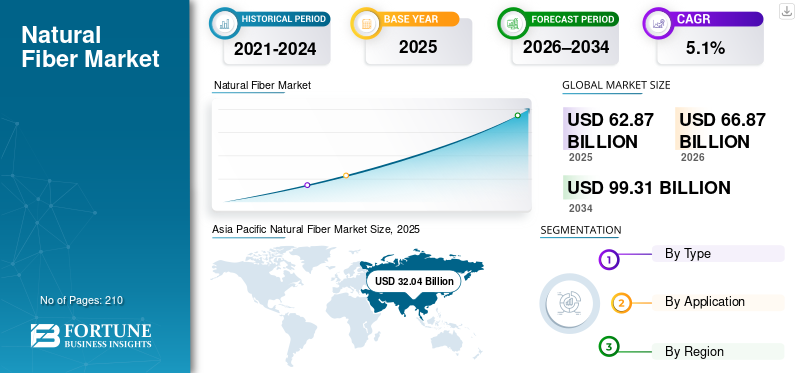
Download Free sample to learn more about this report.
Natural Fiber Market KEY TAKEAWAYS
 Global Market Size & Forecast
- 2025 Market Size: USD 62.87 billion
- 2026 Market Size: USD 66.87 billion
- 2034 Forecast Market Size: USD 99.31 billion
- CAGR: 5.1% from 2026–2034
 Market Share
- Asia Pacific dominated the natural fiber market with a 50.96% share in 2025.
- The Cotton segment held the largest market share, driven by its extensive use in textiles, apparel, home furnishings.
- The Textiles & Apparel segment accounted for the largest market share, fueled by high-volume consumption of cotton.
 Key Regional Highlights
Asia Pacific
The market was valued at USD 32.04 billion in 2025, driven by large-scale textile manufacturing.
Europe
The market reached USD 13.91 billion in 2025, supported by strict environmental regulations.
North America
The market was valued at USD 9.11 billion in 2025, driven by a well-established textile industry.
U.S.
The market reached USD 7.82 billion in 2025.
Japan
Japan is expected to witness steady growth in the natural fiber market.
Read More

NATURAL FIBER MARKET TRENDS
Growing Shift toward Engineered and Application-Specific Eco-friendly Fibers
A key trend in the market is the growing shift toward high-purity and specialty-grade products, particularly for personal care, pharmaceutical, food, and sensitive industrial applications. End users are placing a greater emphasis on product safety, consistency, and compliance with stricter quality and regulatory standards. This is driving the demand for highly refined eco-friendly fibers with low impurities, improved stability, and controlled performance characteristics.
- According to Discover Applied Sciences, eco-friendly fiber-reinforced polymer composites made from natural fibers are increasingly gaining traction as sustainable alternatives to conventional materials. This is expanding their use in automotive, construction, consumer, and other advanced applications.
MARKET DYNAMICS
MARKET DRIVERS
Expanding Construction, Automotive, and Textile Activity to Drive Product Demand
A key factor propelling natural fiber market growth is the surging product demand, strongly driven by its increasing use across construction, automotive manufacturing, textiles, and consumer goods production. The product is widely used in textiles, interior automotive components, insulation materials, packaging, and composite reinforcements owing to renewability, lightweight properties, and environmental advantages. As construction activity grows, vehicle production expands, and textile manufacturing continues to scale, especially in emerging economies, the need for reliable, sustainable, and cost-effective material inputs rises.
- According to the Food and Agriculture Organization of the United Nations (FAO), cotton demand has expanded significantly in recent years, reflecting broader growth in natural fiber use tied to global textile and industrial applications.
MARKET RESTRAINTS
Supply Variability and Regulatory Compliance to Restrain Market Growth
The market faces constraints due to its reliance on agricultural production cycles and rising regulatory requirements for environmental and labor practices. Variability in crop yields caused by weather conditions, water availability, and farming practices can lead to fluctuations in raw material supply and pricing, making cost planning challenging for manufacturers and end users. In addition, compliance with regulations covering land use, sustainability certifications, labor standards, and environmental impact can increase operational complexity and costs, particularly for large-scale producers.
- According to a FAO-linked report, the global natural fiber production has stagnated in recent years and yields for many plant-based fibers have shown little growth, reflecting ongoing supply variability driven by agricultural and environmental conditions.
MARKET OPPORTUNITIES
Value-Added Processing and Bio-Based Innovations to Create New Growth Opportunities
The market offers new growth opportunities through increased investment in value-added processing, engineered fiber products, and bio-based material innovations. Beyond traditional uses in textiles and basic applications, these bio-based fibers are increasingly being modified, blended, or engineered for use in advanced composites, technical textiles, and high-performance materials. As manufacturers focus on improving fiber consistency, durability, and compatibility with modern production processes, these fibers are becoming suitable for higher-value applications.
- According to the United Nations Environment Programme (UNEP), the growing investment in bio-based materials and sustainable product design is accelerating the development of natural fiber-based composites and engineered materials. This is expanding their use beyond traditional applications into higher-value industrial and consumer markets.
MARKET CHALLENGES
Limited Awareness and Slow Adoption to Create Market Challenges
The market faces challenges due to limited awareness and slow adoption in some end-use industries that are accustomed to conventional synthetic materials. Many manufacturers and consumers remain more familiar with synthetic fibers due to their long-established use, predictable performance, and existing supply chains. As a result, bio-based fibers may be overlooked in certain applications despite their sustainability benefits.
- According to World Natural Fibre, decades of synthetic fiber growth have left natural fibers with a smaller share of global fiber consumption and persistent barriers to expanding adoption. This highlights the need for innovation and broader industry acceptance to strengthen their competitive position.
Download Free sample to learn more about this report.
Segmentation Analysis
By Type
Widespread Textile Use and Established Supply Chains to Support Cotton’s Dominant Market Share
Based on type, the market is segmented into cotton, jute & kenaf, coir, sisal, linen, and others.
The cotton segment holds the largest natural fiber market share due to its extensive use across textiles, apparel, home furnishings, and a wide range of consumer and industrial applications. It is widely preferred for its comfort, breathability, durability, and ease of processing methods, making it suitable for clothing, bedding, towels, and medical textiles. In addition, cotton benefits from well-established global cultivation, processing infrastructure, and trade networks, which support consistent availability and large-scale use.
- According to the Food and Agriculture Organization of the United Nations (FAO), cotton accounts for around 80% of the global natural fiber production by weight. This makes it the most important and widely used fiber in textiles and related industries.
The linen segment is expected to grow at a CAGR of 6.4% over the forecast period.
By Application
Textiles & Apparel Segment Leads with the Largest Share with Widespread Product Adoption
In terms of application, the market is categorized into textiles & apparel, industrial & packaging, home textiles & furnishings, construction & insulation, and others.
To know how our report can help streamline your business, Speak to Analyst
The textiles & apparel segment accounts for the largest market share, driven by the widespread use of cotton, linen, wool, and other plant-based materials in everyday clothing and fabric products. In this application, the fibers are commonly used in garments, home textiles, uniforms, and fashion apparel as they offer comfort, breathability, durability, and skin-friendly properties. The product demand in this segment is strongly supported by high-volume consumption, frequent replacement cycles, and large-scale textile manufacturing across both developed and emerging markets.
- According to the Observatory of Economic Complexity (OEC), the global trade for textiles reached USD 835 billion, with China as the largest exporter.
The home textiles & furnishings segment is expected to grow at a CAGR of 4.1% over the forecast period.
Natural Fiber Market Regional Outlook
By geography, the market is categorized into North America, Europe, Asia Pacific, Latin America, and the Middle East & Africa.
Asia Pacific
Asia Pacific Natural Fiber Market Size, 2025 (USD Billion)
To get more information on the regional analysis of this market, Download Free sample
Asia Pacific held the dominant position in the global market in 2025 with a value of USD 32.04 billion and is expected to maintain its leading role in 2026, reaching USD 34.19 billion. The region’s leadership is supported by large-scale textile and apparel manufacturing, strong agricultural production of the product, and steady demand from construction, automotive, packaging, and consumer goods industries. Rapid population growth, expanding middle-class consumption, and rising focus on sustainable materials across major economies continue to support high product consumption across both traditional and emerging applications.
China Natural Fiber Market
Based on Asia Pacific’s strong contribution and China’s extensive manufacturing and textile base, the China market reached a value of USD 12.12 billion in 2025, accounting for approximately 37.8% of regional revenues. The large-scale textile and apparel production, home furnishings, industrial fabrics, and growing product use in automotive interiors and packaging drive product demand. China also benefits from a well-established cotton supply chain, strong processing techniques and capacity, and an export-oriented manufacturing ecosystem, supporting high-volume production and product use across multiple end-use sectors.
To know how our report can help streamline your business, Speak to Analyst
India Natural Fiber Market
In 2025, the India market reached a value of around USD 7.98 billion. Strong cotton cultivation, a large domestic textile industry, and rising product use in apparel, home textiles, and technical textile applications support product demand. Ongoing growth in textile manufacturing, increasing exports, and government support for bio-based fiber farming and processing continue to drive steady product adoption across both domestic and international markets.
North America
North America remains an important regional market and reached a value of USD 9.11 billion in 2025. A well-established textile and apparel sector, steady product use in home furnishings, and growing adoption in automotive interiors, packaging, and construction-related applications support product demand. The region also benefits from advanced processing capabilities, strong sustainability awareness, and reliable supply chains, which support consistent product use across industrial, commercial, and consumer markets.
U.S. Natural Fiber Market
The U.S. market reached a value of USD 7.82 billion in 2025, accounting for approximately 85.8% of regional revenues. The product demand is driven by the strong consumption of cotton-based textiles and apparel, widespread use in home furnishings, and increasing product incorporation in technical textiles and automotive interior components. The presence of large textile manufacturers, established cotton production and processing infrastructure, and rising preference for sustainable materials continue to support steady product demand across the U.S. market.
Europe
The Europe market, which reached a value of USD 13.91 billion in 2025, is expected to record moderate growth. Strict environmental regulations, strong sustainability expectations, and a growing preference for natural and renewable materials across multiple industries shape the regional market. The product demand is supported by established textile and apparel manufacturing, automotive production, and increasing product use in home furnishings, packaging, and technical textile applications.
Germany Natural Fiber Market
The Germany market reached a value of approximately USD 2.56 billion in 2025, accounting for around 18.4% of regional demand. A strong technical textile sector, automotive manufacturing base, and increasing product use in industrial fabrics, automotive interiors, and sustainable consumer products support consumption. The country’s emphasis on material innovation and sustainability standards further supports the demand for high-quality fiber solutions.
Italy Natural Fiber Market
The Italy market touched a value of USD 2.26 billion in 2025, representing roughly 16.2% of regional revenues. A well-established textile and apparel industry, strong fashion and home furnishing sectors, and continued demand for premium fabrics and consumer goods drive product demand. Italy’s focus on design-driven textiles and sustainable materials supports consistent product consumption across domestic and export-oriented markets.
Latin America and the Middle East & Africa
The Latin America and the Middle East & Africa regional markets are expected to witness moderate growth during the forecast period. The Latin America market reached USD 4.50 billion in 2025, supported by strong cotton production, expanding textile and apparel manufacturing, and growing product use in home furnishings and packaging. The Middle East & Africa market touched a valuation of USD 3.31 billion in 2025, driven by cotton and other plant-based fiber production, rising textile manufacturing activity, and increasing demand for natural materials in apparel and household products.
Brazil Natural Fiber Market
The Brazil market reached a value of USD 2.02 billion in 2025, accounting for approximately 44.9% of Latin America revenues. Strong domestic cotton production, an expanding textile and apparel industry, and growing exports of fiber-based products support demand. Brazil’s well-developed agricultural base and growing focus on value-added textile manufacturing continue to support consistent fiber use across domestic and international markets.
COMPETITIVE LANDSCAPE
Key Industry Players
Companies Focus on High Upfront Investment and Global Supply Networks to Gain Foot
The market remains relatively consolidated and capital-intensive, as large-scale production relies on access to extensive agricultural sourcing, fiber processing facilities, and established quality and sustainability compliance systems. High upfront investment in cultivation support, fiber processing, and global supply networks, along with long adoption cycles in textiles, apparel, and industrial applications, limits the entry of new participants.
Leading companies such as Grasim Industries Limited, Sateri, Lenzing AG, Vardhman Textiles Limited, and Oji Fiber Co., Ltd. primarily focus on improving operational efficiency, strengthening supply chain integration, and enhancing fiber consistency and quality rather than pursuing aggressive capacity expansion.
LIST OF KEY NATURAL FIBER COMPANIES PROFILED
- Grasim Industries Limited (India)
- Sateri (China)
- Lenzing AG (Austria)
- Barnhardt Manufacturing Company (U.S.)
- Bast Fibre Technologies Inc. (Canada)
- Vardhman Textiles Limited (India)
- Bcomp (Switzerland)
- Procotex (Belgium)
- FlexForm Technologies (U.S.)
- Oji Fiber Co., Ltd. (Japan)
KEY INDUSTRY DEVELOPMENTS
- July 2025: Vardhman Textiles Limited commenced the commercial production of 17,000 spindles, a capacity-addition milestone that directly supports higher output of cotton-based yarn/textiles for apparel and industrial uses.
- June 2025: Bcomp announced major series production scale-up where its flax-based (linen) natural fiber composite materials will be used in BMW Group production vehicles. This would expand the large-volume commercialization for linen/flax reinforcement beyond niche applications.
- February 2025: Bcomp entered a strategic collaboration (commercial scale-up partnership) with SFG Composites to help scale sustainable flax fiber composites for automotive applications. The deal would support the broader industrial uptake of linen/flax-based materials.
- May 2024: Vardhman Textiles Limited approved a major capacity enhancement and modernization plan for its spinning and fabric business (including green power initiatives), reflecting an expansion-driven move to support a higher-scale cotton textiles supply.
- February 2024: Bast Fibre Technologies Inc. completed the acquisition of Lumberton Cellulose (Georgia-Pacific), expanding its North American footprint for natural-fiber processing and supporting scale-up of plant-based fibers across textile and nonwoven applications.
REPORT COVERAGE
The market analysis provides an in-depth study of the market size & forecast across all segments included in the report. It includes details on the market dynamics and market trends expected to drive the market over the forecast period. It offers information on technological advancements, new product launches, key industry developments, and partnerships, mergers, and acquisitions. The market research report also includes a detailed competitive landscape, with market share and profiles of key players.
Request for Customization to gain extensive market insights.
Report Scope & Segmentation
| ATTRIBUTE | DETAILS |
| Study Period | 2021-2034 |
| Base Year | 2025 |
| Estimated Year | 2026 |
| Forecast Period | 2026-2034 |
| Historical Period | 2021-2024 |
| Growth Rate | CAGR of 5.1% from 2026 to 2034 |
| Unit | Value (USD Billion), Volume (Kiloton) |
| Segmentation | By Type, Application, and Region |
| By Type |
|
| By Application |
|
| By Region |
|
Frequently Asked Questions
Fortune Business Insights says that the global market size was valued at USD 62.87 billion in 2025 and is projected to reach USD 99.31 billion by 2034.
The market is slated to exhibit steady growth at a CAGR of 5.1% during the forecast period of 2026-2034.
The textiles & apparel segment leads the market in terms of share.
Asia Pacific held the highest market share in 2025.
The rising demand for natural and sustainable textiles across apparel, home furnishings, packaging, and construction sectors is the key factor driving the market.



- 2021-2034
- 2025
- 2021-2024
- 210
Get 30-60 hrs Free Customization
Expand Regional and Country Coverage, Segments Analysis, Company Profiles, Competitive Benchmarking, and End-user Insights.


















Related Reports
-
US +1 833 909 2966 ( Toll Free )
-
Get In Touch With Us