Net-Zero Strategy Consulting Market Size, Share & Industry Analysis, By Service Type (Net-Zero Strategy & Roadmap Consulting, Carbon Accounting & GHG Measurement, ESG & Climate Disclosure Consulting, Renewable Energy Transition Advisory, Supply Chain Decarbonization Consulting, Climate Risk & Scenario Analysis), By Deployment Mode (Hybrid, Onsite, and Remote/Digital), By Emission Scope Coverage (Scope 3, Scope 1, and Scope 2), By Industry (Energy & Utilities, Manufacturing, Oil & Gas, Automotive, Chemicals, BFSI, Construction) and Regional Forecast, 2026 – 2034
 Download Free Sample
Net-Zero Strategy Consulting Market Size and Future Outlook
 Listen to Audio Version
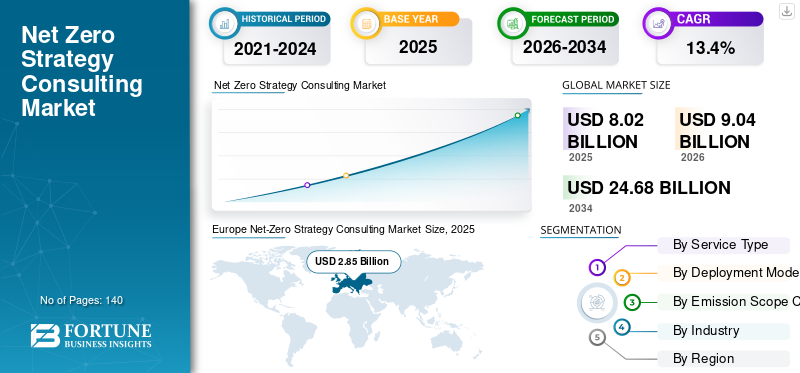
The global net-zero strategy consulting market size was valued at USD 8.02 billion in 2025. The market is projected to grow from USD 9.04 billion in 2026 to USD 24.68 billion by 2034, exhibiting a CAGR of 13.4% during the forecast period. Europe dominated the net zero strategy consulting market with a market share of 35.54% in 2025.
Net-zero strategy consulting comprises specialized advisory, planning, implementation, and sustainability transformation services designed to support enterprises in developing and executing long-term carbon reduction and climate transition strategies across commercial, industrial, institutional, and public-sector environments. These consulting services support the integration of GHG accounting systems, carbon footprint assessment frameworks, climate-risk analytics, transition planning models, renewable energy procurement strategies, supply chain decarbonization programs, sustainability data management platforms, and ESG disclosure frameworks. These strategies are implemented to improve visibility of carbon emissions, regulatory compliance, operational efficiency, and long-term sustainability performance across enterprise operations. Net zero consulting services enable organizations to establish science-based target setting frameworks, optimize energy transition initiatives, align climate governance structures, and implement sustainability-focused operational transformation programs across manufacturing, energy, transportation, infrastructure, financial services, and technology sectors. These consulting solutions also support enterprise transition planning for Scope 1, Scope 2, and Scope 3 emissions management. Further, helping organizations achieve net reduction objectives, strengthen climate resilience, improve stakeholder transparency, and support evolving corporate net zero strategy implementation initiatives. Increasing adoption of global corporate net sustainability commitments, rising demand for carbon neutral operations, and expanding enterprise focus on net zero targets are creating significant market opportunity across North America, Europe, Asia Pacific, and the Middle East & Africa.
- In November 2025, the International Sustainability Standards Board (ISSB) announced expanded implementation support initiatives for IFRS Sustainability Disclosure Standards. Such initiatives strengthen enterprise climate reporting, transition planning, governance alignment, and sustainability risk disclosure practices across global financial and industrial markets.
Accenture plc, Deloitte Limited, PwC, Ernst & Young Global Limited, KPMG International Limited, McKinsey & Company, Boston Consulting Group, Bain & Company, IBM Corporation, Capgemini SE, Tata Consultancy Services Limited, Infosys Limited, WSP Global Inc., AECOM, and Schneider Electric SE are among the major companies operating in the market.
Download Free sample to learn more about this report.
Net Zero Strategy Consulting Market Key Takeaways
 Global Market Size & Forecast
- 2025 Market Size: USD 8.02 billion
- 2026 Market Size: USD 9.04 billion
- 2034 Forecast Market Size: USD 24.68 billion
- CAGR: 13.4% from 2026–2034
 Market Share
- Europe dominated the net-zero strategy consulting market with a 35.54% share in 2025.
- The renewable energy transition advisory segment is expected to grow at a CAGR of 15.6% over the forecast period.
- The Scope 2 consulting segment is expected to grow at a CAGR of 13.2% over the forecast period.
 Key Regional Highlights
Europe
Europe led the market wit USD 2.85 billion in 2025, driven by expanding climate disclosure regulations and rising adoption of decarbonization strategies.
North America
North America generated over USD 2.47 billion in revenue in 2025.
Asia Pacific
Asia Pacific generated USD 1.73 billion in revenue in 2025 and remains a significant growing market.
U.S.
The market is estimated to reach approximately USD 2.32 billion in 2026.
Japan
The market is estimated at approximately USD 0.33 billion in 2026, accounting for roughly 3.7% of global sales.
Read More

NET-ZERO STRATEGY CONSULTING MARKET TRENDS
Digital Carbon Management Platforms and AI-Enabled Sustainability Analytics are Transforming the Market
Demand for net-zero strategy consulting is increasingly being shaped by the growing adoption of digital carbon management platforms, AI-enabled sustainability analytics, and real-time emissions intelligence solutions across enterprise operations. As organizations seek greater visibility into carbon performance and sustainability outcomes, enterprises are increasingly integrating automated carbon accounting systems, predictive emissions modeling, climate-risk analytics, digital twins, and sustainability data platforms into decarbonization programs. The market is witnessing rising demand for consulting services that support enterprise-wide sustainability data integration, emissions forecasting, scenario planning, and AI-driven decision-making. These capabilities are helping organizations improve reporting accuracy, identify emissions reduction opportunities, optimize sustainability investments, and strengthen climate governance across complex operational environments. This shift is transforming net-zero strategy consulting from periodic advisory engagements toward continuous, technology-enabled sustainability management.
- In January 2026, the European Financial Reporting Advisory Group (EFRAG) expanded implementation guidance supporting CSRD compliance and climate disclosure alignment for enterprises adopting European Sustainability Reporting Standards (ESRS) across regional industrial and financial sectors.
MARKET DYNAMICS
MARKET DRIVERS
Download Free sample to learn more about this report.
Rising Corporate Net-Zero Commitments and Climate Disclosure Regulations Driving Market Growth
The market is increasingly being driven by the growing adoption of enterprise-wide decarbonization programs, climate governance initiatives, ESG reporting frameworks, and sustainability-focused operational transformation strategies across industrial, commercial, financial, and public-sector environments. As organizations seek to reduce greenhouse gas emissions, strengthen climate-risk management, improve stakeholder transparency, and align with evolving environmental regulations, demand for specialized net-zero advisory services is increasing across global markets. Net-zero strategy consulting services are becoming a critical component within enterprise sustainability transformation ecosystems. Organizations increasingly require carbon accounting systems, Scope 1, Scope 2, and Scope 3 emissions management, renewable energy transition planning, climate-risk analytics, sustainability disclosure support, and supply chain decarbonization strategies. These strategies further improve operational resilience and long-term regulatory compliance.
- For instance, in February 2026, Deloitte announced expanded climate transition advisory capabilities integrating AI-enabled emissions analytics, Scope 3 assessment tools, and sustainability reporting solutions to support enterprise-wide decarbonization programs across manufacturing, energy, and financial services industries.
MARKET RESTRAINTS
High Sustainability Transformation Costs and Regulatory Complexity Limiting Market Expansion
The net-zero strategy consulting market growth is constrained by high sustainability transformation costs, limited availability of accurate emissions data, and increasing enterprise concerns related to climate disclosure complexity, regulatory uncertainty, and long-term decarbonization investment requirements. Implementing enterprise-wide net-zero strategies often requires significant investment in carbon accounting systems, emissions monitoring infrastructure, renewable energy integration, sustainability reporting frameworks, operational process redesign, and supply chain emissions management. Further, creating financial and implementation barriers for many organizations. In addition, evolving environmental regulations, fragmented international reporting standards, and inconsistencies in Scope 3 emissions measurement methodologies are increasing compliance complexity across global markets. Concerns surrounding sustainability data reliability, supplier transparency limitations, carbon accounting standardization, and long-term return on sustainability investments also continue to create operational and strategic challenges for enterprises pursuing large-scale climate transition initiatives across regulated industries worldwide.
MARKET OPPORTUNITIES
Rising Demand for Supply Chain Decarbonization and Climate Technology Integration is Creating Long-Term Market Opportunities
A major opportunity emerging within the market is the increasing demand for supply chain decarbonization, renewable energy transition planning, sustainability data integration, and climate technology implementation across industrial, commercial, and public-sector environments. As enterprises move beyond standalone sustainability reporting toward enterprise-wide climate transformation strategies, demand is increasing for specialized consulting services. These services are capable of supporting Scope 3 emissions reduction, supplier sustainability engagement, carbon accounting automation, climate-risk analytics, and operational decarbonization initiatives across complex global value chains. This is creating substantial opportunities for consulting providers offering AI-enabled emissions analytics, sustainability data management platforms, renewable energy procurement advisory, climate scenario modeling, and industry-specific transition planning solutions across manufacturing, energy, transportation, infrastructure, BFSI, and technology sectors. The opportunity is especially strong in large-scale industrial transition programs and multinational supply-chain sustainability initiatives, where enterprises require measurable carbon reduction strategies, regulatory compliance support, and long-term climate resilience planning capabilities.
- In March 2026, Accenture plc expanded its industrial sustainability and supply chain decarbonization consulting capabilities through advanced AI-enabled emissions analytics and digital sustainability transformation solutions supporting enterprise-wide net-zero transition programs across manufacturing and logistics sectors.
MARKET CHALLENGES
Evolving Climate Regulations and Sustainability Data Standardization Challenges are Affecting Market Adoption
One of the major challenges affecting the market is the rapidly evolving climate disclosure landscape, inconsistent emissions measurement methodologies, and lack of standardized sustainability data frameworks across industries and geographic regions. Consulting providers must continuously adapt carbon accounting methodologies, climate-risk assessment models, transition-planning frameworks, and ESG reporting strategies to support changing regulatory requirements, emerging disclosure standards, and evolving enterprise sustainability expectations. At the same time, organizations expect net-zero consulting solutions to deliver measurable emissions reduction outcomes, transparent reporting structures, operational scalability, and long-term regulatory alignment across increasingly complex business environments. This creates operational pressure for consulting providers to improve Scope 3 emissions visibility, supplier sustainability tracking, climate scenario analysis, and enterprise sustainability integration capabilities while managing rising implementation costs, fragmented global reporting standards, and evolving environmental compliance frameworks worldwide.
Segmentation Analysis
By Service Type
Net-Zero Strategy & Roadmap Consulting Segment Led the Market Owing to Rising Enterprise Demand for Long-Term Decarbonization Planning and Climate Transition Management
By service type, the market is segmented into net-zero strategy & roadmap consulting, carbon accounting & GHG measurement, ESG & climate disclosure consulting, renewable energy transition advisory, supply chain decarbonization consulting, climate risk & scenario analysis, and others.
Net-zero strategy & roadmap consulting held the largest market share in 2025, as these services remain the most commercially critical and widely adopted component across enterprise sustainability transformation and climate governance initiatives. Enterprises across manufacturing, energy & utilities, BFSI, transportation, infrastructure, technology, and public-sector environments increasingly utilize net-zero strategy consulting services. These services establish science-based emissions reduction targets, develop long-term decarbonization frameworks, align climate governance structures, and implement enterprise-wide sustainability transition programs. Compared with specialized consulting areas such as climate-risk analytics or emissions measurement services, the segment has broader applicability across operational decarbonization, ESG integration, supply chain sustainability, renewable energy transition planning, investor disclosure alignment, and regulatory compliance management. Further, making it the primary revenue-generating segment within the net-zero strategy consulting ecosystem.
- In February 2026, Accenture plc expanded enterprise sustainability transformation capabilities through advanced net-zero transition planning and AI-enabled carbon analytics solutions. These solutions are designed to support large-scale industrial decarbonization and climate governance programs across global manufacturing and infrastructure sectors.
The renewable energy transition advisory segment is expected to witness the highest growth rate, registering a CAGR of 15.6% during the forecast period. It is driven by increasing enterprise investments in renewable energy procurement, electrification strategies, clean energy infrastructure modernization, and industrial decarbonization initiatives. The segment is gaining strong momentum as organizations increasingly require specialized consulting support for energy transition planning, carbon reduction optimization, renewable integration strategies, and long-term sustainability investment alignment across complex operational environments.
To know how our report can help streamline your business, Speak to Analyst
By Deployment Mode
Hybrid Consulting Segment Led the Market Owing to Growing Enterprise Demand for Flexible and Scalable Sustainability Transformation Engagement Models
By deployment mode, the market is segmented into hybrid consulting, onsite consulting, and remote/digital consulting.
Hybrid consulting held the largest market share in 2025, as enterprises increasingly prefer flexible sustainability advisory engagement models that combine onsite operational assessment capabilities with remote analytics, digital sustainability monitoring, and cloud-based collaboration platforms. Organizations across manufacturing, energy & utilities, BFSI, infrastructure, transportation, and technology sectors widely utilize hybrid consulting models. These models support enterprise-wide decarbonization planning, emissions monitoring, climate-risk assessment, ESG reporting, and supply chain sustainability management across geographically distributed operations. Compared with fully onsite consulting models, hybrid consulting environments offer greater operational scalability, improved cost efficiency, faster sustainability data integration, and enhanced collaboration across multi-location enterprise ecosystems. Further, making them the most commercially established deployment category within the market.
The remote/digital consulting segment is expected to witness the highest growth rate, registering a CAGR of 15.6% during the forecast period. It is driven by increasing enterprise demand for scalable digital sustainability advisory services, cloud-based carbon management platforms, AI-enabled emissions analytics, and remote ESG compliance monitoring solutions.
By Emission Scope Coverage
Scope 3 Consulting Segment Led the Market Owing to Rising Enterprise Focus on Supply Chain Emissions Management and Value Chain Decarbonization
By emission scope coverage, the market is segmented into scope 3 consulting, scope 1 consulting, and scope 2 consulting.
Scope 3 consulting held the largest net-zero strategy consulting market share in 2025, as enterprises increasingly prioritize value chain emissions management, supplier sustainability engagement, and indirect carbon footprint reduction strategies across global operations. Organizations across manufacturing, transportation, retail, BFSI, energy, infrastructure, and technology sectors widely utilize scope 3 consulting services. These services help to improve supply chain emissions visibility, strengthen climate disclosure compliance, support investor transparency requirements, and align enterprise sustainability initiatives with long-term decarbonization objectives. Compared with Scope 1 and Scope 2 advisory services, Scope 3 consulting has broader applicability across procurement networks, logistics operations, product lifecycle management, supplier assessment frameworks, and multinational operational ecosystems. Further, making it the most commercially significant segment within the market.
The scope 2 consulting segment is expected to witness a significant growth rate, registering a CAGR of 13.2% during the forecast period. It is driven by increasing enterprise investments in renewable electricity procurement, energy efficiency optimization, electrification strategies, and clean energy transition initiatives.
By Industry
Manufacturing Segment Led the Market Owing to Rising Industrial Decarbonization Initiatives and Supply Chain Sustainability Requirements
By industry, the market is segmented into energy & utilities, manufacturing, oil & gas, automotive & transportation, chemicals & materials, BFSI, construction & infrastructure, and others.
Manufacturing held the largest market share in 2025, as industrial enterprises remain among the largest contributors to global greenhouse gas emissions and are increasingly prioritizing enterprise-wide decarbonization, operational efficiency optimization, and supply chain sustainability transformation initiatives. Manufacturers across automotive, electronics, heavy machinery, consumer goods, industrial equipment, and semiconductor sectors increasingly utilize net-zero strategy consulting services. These services help to support carbon accounting, Scope 3 emissions management, renewable energy transition planning, sustainable procurement strategies, climate-risk assessment, and ESG disclosure alignment across complex production and supplier ecosystems.
The construction & infrastructure segment is expected to witness the highest growth rate, registering a CAGR of 15.3% over the forecast period. It is driven by increasing green building investments, sustainable infrastructure modernization, energy-efficient construction initiatives, and government-supported climate transition programs.
Net-Zero Strategy Consulting Market Regional Outlook
By region, the market is categorized into Europe, North America, Asia Pacific, South America, and the Middle East & Africa.
North America
Europe Net-Zero Strategy Consulting Market Size, 2025 (USD Billion)
To get more information on the regional analysis of this market, Download Free sample
The North America market accounted for over USD 2.47 billion in revenue in 2025. It is supported by increasing corporate decarbonization commitments, expanding climate disclosure requirements, and rising enterprise investments in sustainability transformation initiatives across the U.S., Canada, and Mexico. Regional demand is strongly influenced by growing adoption of carbon accounting systems, Scope 3 emissions management, renewable energy transition planning, ESG disclosure consulting, and climate-risk assessment services. These services are implemented across manufacturing, energy & utilities, BFSI, transportation, infrastructure, technology, and government sectors. The region benefits from strong enterprise sustainability spending, advanced digital sustainability infrastructure, increasing investor focus on ESG performance, and expanding implementation of climate governance and emissions transparency frameworks across large-scale commercial and industrial operations.
U.S. Net-Zero Strategy Consulting Market
The U.S. market is expected to dominate the region with an estimated revenue of about USD 2.32 billion in 2026. Such growth is driven by the country’s large enterprise sustainability consulting ecosystem, increasing climate disclosure preparedness, and rising investments in enterprise-wide decarbonization and energy transition programs. Demand for net-zero strategy consulting remains particularly strong across manufacturing companies, financial institutions, energy providers, infrastructure developers, technology firms, and transportation operators. These sectors increasingly require climate transition planning, carbon accounting, ESG reporting alignment, renewable energy procurement strategies, and supply chain decarbonization advisory services to support long-term sustainability goals and regulatory compliance initiatives. The country also demonstrates strong demand for digital sustainability platforms, AI-enabled emissions analytics, and enterprise climate governance solutions as organizations increasingly integrate sustainability transformation strategies into operational and investor-focused business environments.
Europe
Europe is expected to dominate the market in the estimated period. The growth is driven by expanding climate disclosure regulations, increasing enterprise sustainability commitments, and rising adoption of decarbonization strategies across Germany, the U.K., France, Italy, Spain, BENELUX, Nordics, and other European markets. Regional demand is closely associated with Corporate Sustainability Reporting Directive (CSRD) implementation, Scope 3 emissions disclosure requirements, renewable energy transition initiatives, and increasing adoption of enterprise-wide climate governance frameworks across industrial and commercial sectors. Europe remains one of the most important consumption markets as enterprises, financial institutions, manufacturers, infrastructure developers, energy providers, and public-sector organizations increasingly utilize sustainability advisory services, carbon accounting systems, and climate transition planning solutions. These services support regulatory compliance, investor transparency, operational resilience, and long-term net-zero transformation initiatives across complex multinational business environments.
U.K. Net-Zero Strategy Consulting Market
The U.K. market in 2026 is estimated at around USD 0.60 billion, representing roughly 6.6% of global sales.
Germany Net-Zero Strategy Consulting Market
Germany’s market is projected to reach approximately USD 0.71 billion in 2026, equivalent to around 7.9% of global sales.
Asia Pacific
Asia Pacific remains the significant growing market, generating revenue of USD 1.73 billion in 2025 globally. Within the region, China and Japan are projected to reach approximately USD 0.69 billion and USD 0.33 billion, respectively by 2026. Regional market expansion is strongly associated with increasing industrial decarbonization initiatives, rising enterprise sustainability investments, and growing adoption of climate disclosure and carbon management frameworks across commercial and industrial sectors. Demand is also supported by expanding renewable energy transition programs, supply chain sustainability requirements, manufacturing emissions reduction initiatives, and increasing adoption of enterprise-wide net-zero transformation strategies across manufacturing, energy & utilities, transportation, infrastructure, technology, and BFSI industries.
China Net-Zero Strategy Consulting Market
China’s market is projected to remain dominant in the Asia Pacific region, with 2026 revenues estimated at around USD 0.69 billion, representing roughly 7.6% of global sales.
Japan Net-Zero Strategy Consulting Market
The Japan market in 2026 is estimated at around USD 0.33 billion, accounting for roughly 3.7% of the global sales.
India Net-Zero Strategy Consulting Market
The India market in 2026 is estimated at around USD 0.28 billion, accounting for roughly 3.1% of global sales.
Middle East & Africa
The Middle East & Africa market is driven by increasing investments in energy transition programs, sovereign sustainability initiatives, and rising enterprise adoption of decarbonization strategies. These strategies are implemented across GCC countries, South Africa, Israel, North Africa, and the rest of the Middle East & Africa. Demand is closely linked to renewable energy expansion, industrial sustainability programs, ESG disclosure adoption, and carbon management initiatives across energy, infrastructure, mining, transportation, financial services, and public-sectors. GCC countries lead regional consumption due to strong investments in green hydrogen, renewable energy infrastructure, and oil & gas decarbonization programs, while Israel benefits from advanced climate technology innovation and enterprise sustainability analytics adoption.
GCC Net-Zero Strategy Consulting Market
The GCC market is projected to reach around USD 0.31 billion in 2026, representing roughly 3.4% of the global sales.
South America
The South America market is driven by increasing enterprise sustainability initiatives, renewable energy investments, and growing adoption of carbon management strategies across Brazil, Argentina, Chile, Colombia, and other regional markets. Demand for net-zero strategy consulting is primarily associated with mining companies, energy providers, manufacturers, agricultural exporters, financial institutions, and infrastructure developers seeking climate transition planning, carbon accounting, ESG disclosure support, renewable energy advisory, and supply chain decarbonization solutions.
Brazil Net-Zero Strategy Consulting Market
The Brazil market is projected to reach around USD 0.28 billion in 2026, representing roughly 3.1% of the global sales.
COMPETITIVE LANDSCAPE
Key Industry Players
Competitive Advantage Driven by Decarbonization Advisory Expertise, Climate Analytics, and Enterprise Sustainability Transformation Capabilities
The net-zero strategy consulting market is moderately fragmented, with competitive positioning shaped by capabilities in carbon accounting, climate-risk assessment, renewable energy transition planning, ESG disclosure advisory, supply chain decarbonization, and enterprise sustainability transformation services. Leading companies including Accenture plc, Deloitte Touche Tohmatsu Limited, PwC, Ernst & Young Global Limited, KPMG International Limited, McKinsey & Company, Boston Consulting Group, Capgemini SE, IBM Corporation, WSP Global Inc., Schneider Electric SE, and AECOM maintain strong market positions. They leverage enterprise sustainability expertise, digital climate analytics platforms, industry-specific decarbonization solutions, and integrated climate transition consulting capabilities supporting commercial, industrial, and government organizations globally.
Competitive differentiation is increasingly influenced by the ability to provide AI-enabled emissions analytics, Scope 3 emissions management, sustainability data integration, climate governance advisory, renewable energy procurement strategies, and scalable enterprise decarbonization frameworks. Companies are continuously investing in digital carbon management platforms, climate scenario modeling tools, ESG reporting solutions, sustainability intelligence systems, and industry-specific transition planning capabilities. These investments support operational resilience, regulatory compliance, and long-term climate transformation initiatives across global industries.
- In March 2026, Ernst & Young Global Limited expanded enterprise climate transformation and decarbonization advisory capabilities through enhanced AI-enabled sustainability analytics and ESG reporting solutions. These solutions are designed to support large-scale net-zero transition programs across industrial and financial sectors.
LIST OF KEY NET-ZERO STRATEGY CONSULTING COMPANIES PROFILED
- Accenture plc (Ireland)
- Deloitte Limited (U.K.)
- PwC (U.K.)
- Ernst & Young Global Limited (U.K.)
- KPMG International Limited (Netherlands)
- McKinsey & Company (U.S.)
- Boston Consulting Group (U.S.)
- Capgemini SE (France)
- IBM Corporation (U.S.)
- WSP Global Inc. (Canada)
KEY INDUSTRY DEVELOPMENTS
- March 2026: Boston Consulting Group (BCG) announced expanded climate and sustainability transformation services integrating AI-enabled carbon analytics and Scope 3 emissions management capabilities to support enterprise-wide decarbonization initiatives across industrial sectors.
- January 2026: WSP Global Inc. launched enhanced net-zero transition advisory services focused on renewable energy integration, climate-risk assessment, and infrastructure sustainability planning for large-scale commercial and public-sector projects.
- October 2025: AECOM strengthened sustainable infrastructure and climate resilience consulting capabilities through integrated carbon reduction planning and energy transition advisory solutions supporting long-term net-zero development projects globally.
- July 2025: KPMG International Limited introduced expanded ESG reporting and climate disclosure advisory services supporting CSRD readiness, sustainability governance alignment, and enterprise carbon management implementation across multinational organizations.
- April 2025: McKinsey & Company expanded sustainability consulting capabilities through advanced decarbonization modeling and operational emissions reduction frameworks designed to accelerate enterprise climate transition strategies globally.
REPORT COVERAGE
The global net-zero strategy consulting market analysis includes a comprehensive study of the market size & forecast by all the market segments included in the report. It includes details on the market dynamics and market trends expected to drive the market over the forecast period. It provides information on key aspects, including an overview of technological advancements, the regulatory environment, and product launches. Additionally, it details partnerships, mergers & acquisitions, and key industry developments and prevalence by key regions. The global market research report also provides a depth competitive landscape with information on the market share and profiles of key operating players.
Request for Customization to gain extensive market insights.
Report Scope & Segmentation
| ATTRIBUTE | DETAILS |
| Study Period | 2021-2034 |
| Base Year | 2025 |
| Estimated Year | 2026 |
| Forecast Period | 2026-2034 |
| Historical Period | 2021-2024 |
| Growth Rate | CAGR of 13.4% from 2026-2034 |
| Unit | Value (USD Billion) |
| Segmentation | By Service Type, Deployment Mode, Emission Scope Coverage, Industry, and Region |
| By Service Type |
|
| By Deployment Mode |
|
| By Emission Scope Coverage |
|
| By Industry |
|
| By Region |
|
Frequently Asked Questions
According to Fortune Business Insights, the global market value stood at USD 8.02 billion in 2025 and is projected to reach USD 24.68 billion by 2034.
In 2025, the market value stood at USD 2.85 billion.
The market is expected to exhibit a CAGR of 13.4% during the forecast period.
By industry, the manufacturing segment leads the market.
Rising corporate net-zero commitments, climate disclosure regulations, Scope 3 emissions management demand, renewable energy transition initiatives, and enterprise sustainability transformation programs drive market growth.
Accenture plc, Deloitte Touche Tohmatsu Limited, PwC, Ernst & Young Global Limited, KPMG International Limited, McKinsey & Company, Boston Consulting Group are the top players in the market.
Europe held the largest market share in 2025.


- 2021-2034
- 2025
- 2021-2024
- 140
Get 30-60 hrs Free Customization
Expand Regional and Country Coverage, Segments Analysis, Company Profiles, Competitive Benchmarking, and End-user Insights.











-
US +1 833 909 2966 ( Toll Free )
-
Get In Touch With Us