Neurotechnology Market Size, Share & Industry Analysis By Product Type (Neuroprosthetics, Neuromodulation, Neurorehabilitation, and Others), By Application (Parkinson’s Disease, Epilepsy, Alzheimer’s Disease, and Others), By End User (Hospitals, Specialty Clinics, Homecare Settings, and Others), and Regional Forecast, 2026-2034
 Download Free Sample
Neurotechnology Market Size and Future Outlook
 Listen to Audio Version
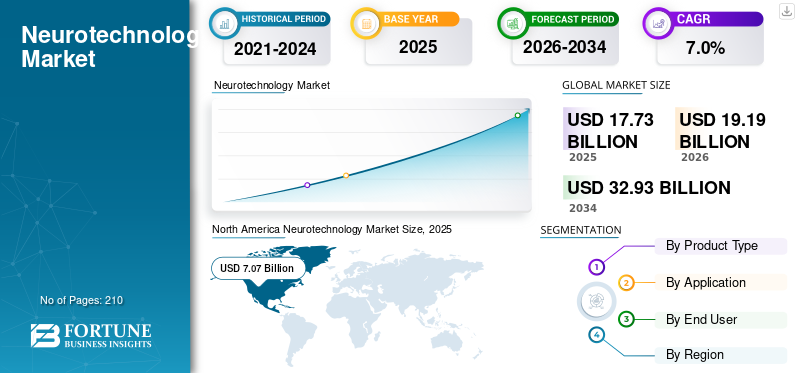
The global neurotechnology market size was valued at USD 17.73 billion in 2025 and is projected to grow from USD 19.19 billion in 2026 to USD 32.93 billion by 2034, exhibiting a CAGR of 7.0% during the forecast period. North America dominated the neurotechnology market with a market share of 39.87% in 2025.
Neurotechnology is a field that encompasses techniques and devices, including imaging, brain-computer interfaces, and neurostimulation that directly connect with the brain or nervous system to record activity or alter function among the patient population. The growing prevalence of neurological disorders, the rising demand for neuromodulation therapies, and increasing investments in neuroscience research are driving greater adoption of these devices in the market. The growing geriatric population is further driving demand for such products among the patient population in the market.
- For instance, according to the 2025 data published by Alzheimer’s Association, about 7.2 million Americans aged 65 and older are living with Alzheimer's in the U.S.
Furthermore, the rising incorporation of technological advancements in these products by major players, such as Medtronic and Abbott, is contributing to the demand for these devices globally.
Download Free sample to learn more about this report.
NEUROTECHNOLOGY MARKET KEY TAKEAWAYS
 Market Size & Forecast
- 2025 Market Size: USD 17.73 billion
- 2026 Market Size: USD 19.19 billion
- 2034 Forecast Market Size: USD 32.93 billion
- CAGR: 7.0% from 2026–2034
 Market Share
- North America dominated the neurotechnology market with a market share of 39.87% in 2025.
- The neuroprosthetics segment is expected to grow at a CAGR of 7.7% over the forecast period.
- The segment of Alzheimer’s disease is set to flourish with a growth rate of 8.2% across the forecast period.
 Key Regional Highlights
North America
The North America market held the dominant share in 2024, valued at USD 6.51 billion, and also took the leading share in 2025 with USD 7.07 billion.
Europe
Europe is projected to record a growth rate of 6.3% in the coming years, which is the second highest among all regions, and reach a valuation of USD 5.99 billion by 2026.
Asia Pacific
Asia Pacific is estimated to reach USD 4.08 billion in 2026 and secure the position of the third-largest region in the market.
U.S.
The U.S. dominance within the region, the U.S. market can be analytically approximated at around USD 7.06 billion in 2026, accounting for roughly 36.8% of global sales.
Japan
The Japan market in 2026 is estimated at around USD 1.14 billion, accounting for roughly 5.9% of global revenues.
Read More

Neurotechnology Market Trends
Incorporation of AI and Advanced Data Analytics in Devices to Fuel Demand
The growing technological advancements in such devices, coupled with the incorporation of artificial intelligence and advanced data analytics, are transforming the monitoring, diagnosis, and treatment of neurological conditions. The advanced neurotechnology platforms, such as neurostimulation systems, brain–computer interfaces (BCIs), and neuroprosthetic devices, are rapidly integrating artificial intelligence algorithms to analyze complex neural signals, enhance device accuracy, and enable tailored therapies.
The artificial intelligence-driven devices can analyze large volumes of brain data in real time, enabling healthcare professionals to detect neurological disorders and optimize treatment therapies. Additionally, advancements in neural implants, wearable systems, and minimally invasive technologies are improving treatment outcomes and widening the clinical applications of neurotechnology across healthcare facilities.
- In March 2024, Paradromics developed an implantable Brain-Computer Interface (BCI) device that can access brain-activity data and use artificial intelligence to translate that activity into actions.
Market Dynamics
Market Drivers
Download Free sample to learn more about this report.
Rising Adoption of Neurotechnology Solutions to Fuel Market Growth
The growing prevalence of chronic disorders, including epilepsy, Parkinson’s disease, and others, is resulting in the rising adoption of neurotechnology solutions for diagnosis, treatment, and rehabilitation among the patient population in the market.
- For instance, according to 2026 data published by the Parkinson’s Foundation, it was reported that about 1.1 million people are affected by Parkinson’s disease in the U.S.
This, along with a growing geriatric population, is also supporting the growing prevalence of these conditions, thereby augmenting the adoption rate of these devices for the management of chronic pain and disorders in the market. Therefore, the factors above, along with the increasing focus of key players on introducing R&D activities to launch novel devices, are anticipated to boost the adoption rate of these devices, further supporting the global market size.
Other Prominent Drivers
- Increasing investments in neuroscience research and brain health initiatives.
- Growing demand for minimally invasive neuromodulation therapies.
Market Restraints
High Development and Implementation Costs of Neurotechnology Devices to Hinder Market Growth
There are growing technological advancements in neurotechnology devices globally. However, the high cost associated with the development, implementation, and maintenance of such systems remains a major restraint in the market. Such devices, including neuroprosthetics, deep brain stimulation (DBS) devices, and brain–computer interfaces, require advanced R&D processes and materials, and extensive clinical testing to meet stringent regulatory standards.
Moreover, the requirement of specialized surgical procedures and highly trained clinicians further increases the overall treatment costs. These factors make it challenging to adopt advanced devices among the small and mid-sized healthcare facilities, further hampering the market growth.
- For instance, according to the 2026 statistics published by the Turkey Luxury Clinics, the procedural cost of deep brain stimulation (DBS) is around USD 22,000 to 30,000 for managing Parkinson’s disease and other movement disorders.
Market Opportunities
Expansion of Healthcare Infrastructure in Emerging Countries Opens Market Opportunities
There is a rapid expansion of healthcare infrastructure in developing economies, which is creating opportunities for the market. The governmental and non-governmental organizations in emerging countries, including China, India, and several Southeast Asian nations, are focusing on investing in hospitals, specialty neurology centers, and advanced diagnostic settings.
These investments are enhancing access to diagnosis, procedures, and rehabilitation services, thereby boosting the adoption rate of neurotechnology devices, including neurostimulation devices, neuroprosthetics, and neurodiagnostic devices.
- According to 2025 data published by the International Trade Administration (ITA), the healthcare expenditure is about USD 135.0 billion in Brazil.
Market Challenges
Limited Healthcare Access in Developing Nations to Limit Market Growth
The limited access to advanced healthcare infrastructure in many developing nations remains a major challenge for the market. Limited neurology professionals, neurosurgical centers, and diagnostic capabilities hamper the adoption of advanced neurotechnology devices in the emerging countries.
Furthermore, limited healthcare expenditure, inadequate insurance coverage, and disparities in urban–rural healthcare access further limit the adoption of these technologies. Therefore, despite the growing prevalence of neurological disorders, many patients in emerging countries are unable to access advanced neurotechnology-based treatments, thereby hampering the growth of the market.
- For instance, according to 2023 data published by The World Bank Group (WBG), about 4.5 billion people lack full access to essential health services globally.
Other Prominent Challenges
- Ethical concerns and regulatory complexity associated with brain technologies.
SEGMENTATION ANALYSIS
By Product Type
Increasing Number of Neuromodulation Procedures Led to Segment Dominance
Based on the product type, the market is classified into neuroprosthetics, neuromodulation, neurorehabilitation, and others.
The neuromodulation segment held the largest revenue share in 2025. The growth is owing to the increasing prevalence of neurological disorders among patients, resulting in a growing number of neurological procedures globally. This, along with the growing focus of key players on introducing innovative products, is further anticipated to contribute to the global neurotechnology market growth.
- For instance, according to statistics published by the Cleveland Clinic, more than 200,000 people have had a procedure to implant a deep-brain stimulation device globally in 2024.
The neuroprosthetics segment is expected to grow at a CAGR of 7.7% over the forecast period.
To know how our report can help streamline your business, Speak to Analyst
By Application
Growing Prevalence of Neurological Disorders Led to Dominance of Others Segment
Based on application, the market is segmented into Parkinson’s disease, epilepsy, Alzheimer’s disease, and others.
The others segment dominated the global market in 2025. By application, the others segment held the share of 36.8% in 2025. The growth is due to the growing prevalence of neurological disorders, such as multiple sclerosis, among others, resulting in an increasing number of neuromodulation and neuroprosthetics procedures globally, thereby contributing to the adoption rate of these devices in the market.
- For instance, according to the 2020 statistics published by the National Center for Biotechnology Information (NCBI), it was reported that an estimated 2.8 million people are living with multiple sclerosis globally.
The segment of Alzheimer’s disease is set to flourish with a growth rate of 8.2% across the forecast period.
By End User
Increasing Number of Hospitals Led to Segmental Dominance
Based on end user, the market is segmented into hospitals, specialty clinics, homecare settings, and others.
The hospitals segment dominated the market in 2025. The increasing prevalence of chronic disorders, growing number of neurological procedures in hospitals, rising number of hospitals, among others, are some of the crucial factors contributing to the growth of the segment in the market. Furthermore, the segment is set to hold an 63.8% share in 2026.
- For instance, according to 2025 data published by Statistisches Bundesamt, there are about 1,874 hospitals in Germany.
In addition, specialty clinics’ end users are projected to grow at a 7.2% CAGR during the forecast period.
Neurotechnology Market Regional Outlook
Based on region, the market has been studied across North America, Europe, Asia Pacific, Latin America, and the Middle East & Africa.
North America
North America Neurotechnology Market Size, 2025 (USD Billion)
To get more information on the regional analysis of this market, Download Free sample
The North America market held the dominant share in 2024, valued at USD 6.51 billion, and also took the leading share in 2025 with USD 7.07 billion. The rising prevalence of neurological disorders, advanced healthcare infrastructure, and the development of such products, among others, are some of the factors contributing to the growth of the segment in the market.
- For instance, according to 2023 statistics published by the Centers for Disease Control & Prevention (CDC), around 1.2% of the people have active epilepsy in the U.S.
U.S. Neurotechnology Market
Based on North America’s strong contribution and the U.S. dominance within the region, the U.S. market can be analytically approximated at around USD 7.06 billion in 2026, accounting for roughly 36.8% of global sales.
Europe
Europe is projected to record a growth rate of 6.3% in the coming years, which is the second highest among all regions, and reach a valuation of USD 5.99 billion by 2026. The strong presence of neuroscience research institutes and medical device manufacturers is anticipated to support the market growth.
U.K. Neurotechnology Market
The U.K. market size in 2026 is estimated at around USD 1.10 billion, representing roughly 5.8% of global revenues.
Germany Neurotechnology Market
Germany’s market is projected to reach approximately USD 1.31 billion in 2026, equivalent to around 6.8% of global sales.
Asia Pacific
Asia Pacific is estimated to reach USD 4.08 billion in 2026 and secure the position of the third-largest region in the market. The rapid growth driven by expanding healthcare systems and technology adoption is expected to support the growth of the market. In the region, India and China are both estimated to reach USD 0.54 billion and USD 1.33 billion, respectively, in 2026.
Japan Neurotechnology Market
The Japan market in 2026 is estimated at around USD 1.14 billion, accounting for roughly 5.9% of global revenues. Japan has historically reported a relatively increasing prevalence of neurological diseases, with a growing adoption of products in the industry.
China Neurotechnology Market
China’s market is projected to be one of the largest worldwide, with 2026 revenues estimated at around USD 1.33 billion, representing roughly 6.9% of global sales.
India Neurotechnology Market
The India market size in 2026 is estimated at around USD 0.54 billion, accounting for roughly 2.8% of global revenues.
Latin America and Middle East & Africa
Latin America and the Middle East & Africa regions are expected to witness moderate growth in this market space during the forecast period. The Latin America market is set to reach a valuation of USD 0.14 billion in 2026. The growth is due to the increasing adoption of neurodiagnostic technologies in the region. The Middle East & Africa are also expected to grow, driven by healthcare investments supporting neurological treatment technologies in the region. In the Middle East & Africa, the GCC is set to reach a value of USD 0.31 billion in 2026.
South Africa Neurotechnology Market
The South Africa market is projected to reach around USD 0.14 billion in 2026, representing roughly 0.7% of global revenues.
Competitive Landscape
Key Industry Players
Increasing Number of Product Approvals to Support Dominance of Key Players in Market
A robust and diversified device portfolio, along with a significant emphasis on strategic initiatives globally, is one of the crucial factors supporting the dominance of these companies in the market. Medtronic and Abbott are major companies in the market in 2025. Furthermore, the rising focus of key companies on receiving product approvals is expected to strengthen their presence, further contributing to the global neurotechnology market share.
- For instance, in February 2025, Medtronic received approval for Adaptive deep brain stimulation (aDBS) and BrainSense Electrode Identifier (EI), for personalized care for patients with Parkinson's disease.
Other key players, including Boston Scientific Corporation and others, are also growing in the market, primarily due to their growing focus on acquisitions among other players to strengthen their presence in the market.
List of Key Neurotechnology Companies Profiled
- Medtronic (U.S.)
- Abbott (U.S.)
- Boston Scientific Corporation (U.S.)
- LivaNova PLC (U.K.)
- Neuronetics (U.S.)
- Paradromics (U.S.)
- Natus (U.S.)
- NeuroPace, Inc. (U.S.)
- Neuralink (U.S.)
- Brain Products GmbH (Germany)
KEY INDUSTRY DEVELOPMENTS
- January 2026: Medtronic presented new long-term clinical data for Inceptiv spinal cord stimulation (SCS) with an aim to create advancements in neuromodulation.
- December 2025: Medtronic received U.S. FDA approval for its expanded Dystonia clinical labeling for Deep Brain Stimulation (DBS). This approval reflects a shift from Humanitarian Device Exemption (HDE) status to full effectiveness labeling supported by clinical evidence, marking an important milestone for patients and clinicians.
- September 2025: Medtronic, a global player in healthcare technology, announced the results from the Medtronic Adaptive DBS Algorithm for Personalized Therapy in Parkinson’s Disease (ADAPT-PD) trial. This helped the company in strengthening its presence.
- May 2025: Neuralink closed a USD 600.0 million funding round, valuing the neurotechnology company at USD 9.0 billion as it advances its brain-computer interface (BCI)
- January 2025: Neuralink announced that a third person has received an implant from its brain-computer interface with an aim to cater to the growing demand among patients globally.
- November 2024: Boston Scientific Corporation acquired Axonics with an aim to advance their sacral neuromodulation products portfolio globally.
- April 2024: Tether announced that it has made a strategic investment of USD 200 million into Blackrock Neurotech, the global player for Brain-Computer-Interface (BCI) technology, through its newly formed venture division Tether Evo.
REPORT COVERAGE
The report provides a detailed global neurotechnology market analysis and focuses on key aspects such as leading companies and market segmentation, including product type, application, and end user. Besides this, the global report offers insights into the market growth trends and highlights key industry developments. In addition to the aforementioned factors, the report encompasses several factors that have contributed to the growth and advancement of the market over recent years.
Request for Customization to gain extensive market insights.
Report Scope & Segmentation
| ATTRIBUTE | DETAILS |
| Study Period | 2021-2034 |
| Base Year | 2025 |
| Estimated Year | 2026 |
| Forecast Period | 2026-2034 |
| Historical Period | 2021-2024 |
| Growth Rate | CAGR of 7.0% from 2026-2034 |
| Unit | Value (USD Billion) |
| Segmentation | By Product Type, Application, End User, and Region |
| By Product Type |
|
| By Application |
|
| By End User |
|
| By Region |
|
Frequently Asked Questions
Fortune Business Insights says that the global market size was USD 17.73 billion in 2025 and is projected to reach USD 32.93 billion by 2034.
In 2025, North Americas market value stood at USD 7.07 billion.
Growing at a CAGR of 7.0%, the market will exhibit steady growth over the forecast period.
By product type, the neuromodulation segment is the leading segment in this market.
The introduction of novel neurotechnology products is one of the major factors driving the market's growth.
Medtronic and Abbott are the major players in the global market.
North America dominated the market share in 2025.
The growing prevalence of neurological conditions, the increasing number of neurological procedures, among others, are some of the crucial factors anticipated to boost the adoption of these devices globally.



- 2021-2034
- 2025
- 2021-2024
- 210
Get 30-60 hrs Free Customization
Expand Regional and Country Coverage, Segments Analysis, Company Profiles, Competitive Benchmarking, and End-user Insights.













.webp)






Related Reports
-
US +1 833 909 2966 ( Toll Free )
-
Get In Touch With Us