Next-Generation Firewall (NGFW) Market Size, Share & Industry Analysis, By Component (Hardware, Software and Services), By Deployment (Cloud and On-premises), By Enterprise Type (Large Enterprises and SMEs), By Application (Application Visibility & Control, Intrusion Detection & Prevention System, Advanced Threat Protection, and Others), By Industry (BFSI, IT & Telecom, Retail, Healthcare, Manufacturing, and Others), and Regional Forecast, 2026-2034
 Download Free Sample
Next Generation Firewall Market Size and Industry Overview
 Listen to Audio Version
The global Next-Generation Firewall (NGFW) market size was valued at USD 64.03 billion in 2025 and is projected to grow from USD 7.08 billion in 2026 to USD 15.92 billion y 2034, exhibiting a CAGR of 10.66% during the forecast period. North America dominated the next-generation firewall (ngfw) market with a market share of 35.30% in 2025.
Next-generation firewall is a 7-layer security system that blocks unauthorized access as well as identifies, categorizes, and controls applications and users traversing the network, which enterprises enforce granular security policies.
The increasing frequency of ransomware, phishing, and zero-day attacks has heightened the need for intelligent, application-aware firewalls. Organizations are adopting NGFWs to gain deeper visibility and prevent sophisticated threats that traditional firewalls cannot detect.
The market is dominated by established key players, such as Palo Alto Networks, Check Point Software, SonicWall, Cisco Systems, Inc., and Juniper Networks. These players are continuously enhancing NGFWs with AI-driven threat detection, behavioral analytics, and deep packet inspection to address evolving attack vectors. They are also integrating zero trust and advanced decryption capabilities to secure encrypted and cloud native environments.
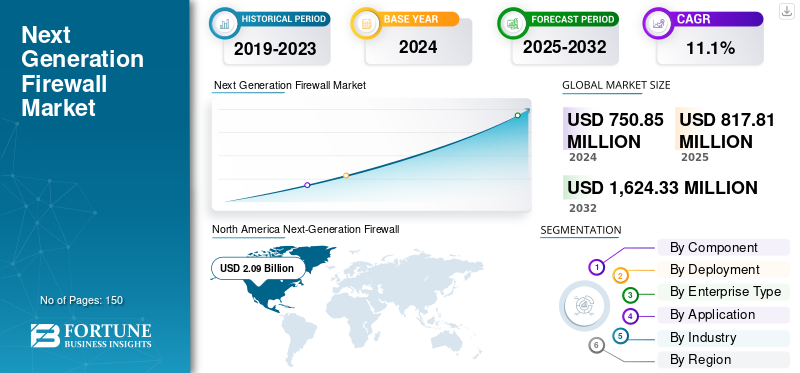
Download Free sample to learn more about this report.
Next-Generation Firewall Market Key Takeaways
 Market Size & Forecast
- 2025 Market Size: USD 6.40 Billion
- 2026 Market Size: USD 7.08 Billion
- 2034 Forecast Market Size: USD 15.92 Billion
- CAGR: 10.66% from 2026–2034
 Market Share
- North America dominated the next-generation firewall (NGFW) market with a 35.30% share in 2025.
- The hardware segment is projected to lead the market with a 48.43% share in 2026.
- The on-premises segment is projected to dominate with a 57.88% share in 2026.
 Key Regional Highlights
North America
North America generated USD 2.26 billion in 2025 and held the largest market share globally.
Asia Pacific
Asia Pacific reached USD 1.70 billion in 2025 and is projected to grow to USD 1.94 billion in 2026.
Europe
Europe accounted for USD 1.60 billion in 2025 and is expected to reach USD 1.75 billion in 2026.
U.S.
The market is estimated to reach USD 1.71 billion in 2026, driven by strong cybersecurity investments.
Japan
Rising cloud adoption, digital transformation, and cybersecurity requirements are supporting NGFW demand.
Read More

IMPACT OF GENERATIVE AI
Rising Generative AI Adoption Leading to Enhanced Threat Detection and Proactive Cyber Defense
Generative AI is revolutionizing how NGFWs detect and respond to cyber threats. Unlike traditional systems that rely on predefined signatures, generative models analyze massive datasets to recognize complex, evolving attack patterns and unknown malware variants. These AI engines continuously learn from global threat intelligence and real-time network behavior, enabling predictive and adaptive defense mechanisms. By detecting anomalies that deviate from normal traffic patterns, NGFWs can neutralize zero-day exploits and insider threats more effectively. Overall, generative AI enhances the accuracy, speed, and intelligence of NGFW threat detection, significantly strengthening organizations’ proactive cybersecurity posture. For instance,
- In July 2025, Microsoft expanded its partnership with Accenture on gen-AI-powered cyber solutions. Through this collaboration, Accenture aims to invest in generative-AI-driven solutions for automated data/AI security and enhanced Identity Access Management.
MARKET DYNAMICS
Market Drivers
Increasing Remote and Hybrid Work Environments is Driving Market Growth
The shift toward remote and hybrid work models has expanded organizational networks far beyond traditional office perimeters, introducing new vulnerabilities across distributed devices and endpoints. Employees now connect through multiple, often unsecured, networks, which increases exposure to cyberattacks. NGFWs address these challenges by providing secure VPN connectivity, identity-based access control, and consistent policy enforcement for remote users. They also integrate with Zero Trust architectures to ensure that every user and device is authenticated before accessing enterprise resources. As hybrid work becomes a permanent fixture, this need for continuous, location-agnostic security is driving sustained investment in NGFW solutions worldwide. For instance,
- August 2025: Palo Alto Networks and Okta expanded their partnership to secure hybrid/remote work by integrating Okta Workforce Identity with Prisma Access Browser and linking Okta AI’s Identity Threat Protection to Palo Alto’s Cortex XSIAM/XDR for automated, context-aware access and response.
Market Restraints
High Initial Deployment and Upgrade Costs May Hinder Market Growth
The implementation of NGFWs often demands a substantial upfront investment in hardware, software licenses, and professional integration services. For large enterprises, upgrading to high-throughput or cloud-integrated firewalls can also involve significant infrastructure reconfiguration and downtime. Small and mid-sized businesses, in particular, find these costs prohibitive, especially when factoring in recurring expenses such as subscription renewals and maintenance contracts. Additionally, the shift toward advanced NGFW features such as AI-driven analytics and TLS decryption requires more powerful and costlier appliances. As a result, the high total cost of ownership (TCO) remains a key barrier to widespread adoption, especially in cost-sensitive or emerging markets.
Market Opportunities
Rising Demand from SMEs and Emerging Economies Create Lucrative Opportunity for Market Growth
Small and medium-sized enterprises in emerging economies are rapidly digitizing their operations, exposing themselves to heightened cybersecurity risks. However, limited budgets and a shortage of skilled IT professionals make traditional enterprise firewalls difficult to deploy. This has led to growing adoption of affordable, cloud-based NGFW and subscription models, which provide enterprise-grade security with minimal infrastructure investment.
Moreover, vendors are actively targeting these markets through localized offerings, channel partnerships, and managed security services (MSSPs). As digital transformation accelerates in Asia Pacific, Latin America, and Africa, SMEs are becoming a major growth engine for the global NGFW market. For instance,
- February 2025, SonicWall launched a novel NGFW solution designed specifically for MSPs serving SMBs and emerging-market SMEs, featuring simplified subscription licensing and multi-tenant management.
Next-Generation Firewall Market Trends
Rise in Popularity of Cloud Migration and Hybrid IT Infrastructure Fuels Market Growth
The rapid shift of enterprises toward cloud computing and hybrid IT environments is transforming how organizations secure their networks and data. As applications and workloads move between on-premises data centers, public clouds, and SaaS platforms, maintaining consistent security policies becomes a challenge. NGFWs address this need by offering virtual and cloud-native deployments that protect traffic across hybrid environments. These firewalls provide unified visibility, policy enforcement, and threat prevention across both physical and virtual infrastructures. Consequently, the growing complexity of hybrid networks is driving strong demand for cloud-integrated NGFW solutions that ensure seamless, end-to-end protection. For instance,
- In June 2025, Check Point launched an India-based Harmony SASE instance to deliver cloud-delivered network security with local data residency and compliance for enterprises operating in hybrid IT setups.
Download Free sample to learn more about this report.
SEGMENTATION ANALYSIS
By Component
Continued Enterprise Reliance on Physical Appliances Drives Dominance of Hardware Segment
Based on component, the market is trifurcated into hardware, software, and services.
In 2024, hardware captured the largest market share with USD 3.00 billion. This is due to enterprises continuing to invest heavily in high-performance physical appliances to secure on-premises data centers and branch networks handling large traffic volumes. Despite the growth of cloud and virtual solutions, hardware-based NGFWs remained preferred for their superior throughput, reliability, and integrated threat prevention capabilities in mission-critical environments.
Software is anticipated to grow at the highest CAGR of 15.0% during the forecast period, owing to the rising adoption of virtual firewalls and cloud-delivered security services that offer scalability, flexibility, and lower deployment costs across hybrid and multi-cloud environments. The hardware segment is projecteed to dominate the market with a share of 48.43% in 2026.
By Deployment
Increasing Demand for Regulatory Compliance and Data Control Requirements Boosts On-premise Segment Growth
Based on deployment, the market is categorized into on-premises and cloud.
On-premises captured the largest market share and accounted for USD 3.47 billion in 2024. This is owing to many enterprises, especially in regulated sectors such as BFSI and government, continuing to prioritize data control, compliance, and low-latency network protection within their own infrastructure. Organizations managing sensitive information prefer on-premises NGFWs for their customizable configurations, greater visibility, and reduced reliance on third-party cloud environments. The On-Premise segment is projecteed to dominate the market with a share of 57.88% in 2026.
Cloud is expected to grow at the highest CAGR of 13.4% during the forecast period. This is due to the increasing adoption of cloud-based applications and hybrid infrastructures, which drive demand for scalable, easily managed, and cost-efficient Firewall-as-a-Service (FWaaS) solutions.
By Enterprise Type
Complex Network Infrastructures and Security Needs Strengthen Large Enterprise Dominance
Based on enterprise type, the market is bifurcated into large enterprises and SMEs.
Large enterprises captured the largest market share and accounted for USD 3.92 billion in 2024, as they possess the financial resources and complex network infrastructures that demand advanced, high-capacity NGFW solutions. Their need to protect vast amounts of sensitive data across multiple global sites further drives investments in comprehensive, multi-layered advanced security architectures with integrated threat intelligence and centralized management. The Large Enterprises segment is projecteed to dominate the market with a share of 65.99% in 2026.
SMEs are anticipated to grow at the highest CAGR of 13.3% during the forecast period, due to the increasing adoption of affordable, cloud-based NGFW solutions and managed security services, which enable smaller businesses to enhance cybersecurity without significant capital investment or in-house expertise.
By Application
Rising Cyber Threats and Real-Time Protection Needs Propel Intrusion Detection & Prevention Systems Growth
Based on application, the market is divided into application visibility & control, intrusion detection & prevention system, advanced threat protection, and others (content filtering, etc.).
Intrusion detection & prevention system captured the largest market share in 2024 and generated USD 2.29 billion. This is due to organizations prioritizing real-time threat identification and automated response to counter increasingly sophisticated cyberattacks. Also, the growing need to detect anomalies, block malicious activity, and prevent data breaches made IDPS functionality a core component of NGFW deployments across enterprises. The Intrusion Detection & Prevention System segment is expected to lead the market, contributing 37.61% globally in 2026.
Advanced threat protection is expected to grow at the highest CAGR of 14.8% during the forecast period. As organizations increasingly adopt AI- and machine-learning–powered NGFW solutions capable of detecting zero-day attacks and advanced malware that traditional firewalls fail to identify.
To know how our report can help streamline your business, Speak to Analyst
By Industry
Expansion of 5G Networks and High Data Traffic Driving Dominance of IT & Telecom Sector
Based on industry, the market is categorized into BFSI, IT & telecom, retail, healthcare, manufacturing, and others (government, energy & utility, etc.).
In 2024, IT & telecom accounted for the largest market share with USD 1.76 billion, owing to its high data traffic volumes and complex network infrastructures that demand continuous monitoring and advanced threat prevention. The rapid expansion of 5G networks, cloud services, and data centers further increased the need for robust NGFW solutions to secure endpoints, applications, and communication channels.
Healthcare is projected to grow at the highest CAGR of 13.1% during the forecast period, as hospitals and healthcare providers increasingly adopt digital health systems, connected medical devices, and telemedicine platforms, creating new cybersecurity vulnerabilities.
NEXT-GENERATION FIREWALL MARKET REGIONAL OUTLOOK
By geography, the market is categorized into North America, Europe, Asia Pacific, South America, and the Middle East & Africa.
North America Next-Generation Firewall (NGFW) Market Size, 2025 (USD Billion) To get more information on the regional analysis of this market, Download Free sample
North America
North America’s market size in 2025 was USD 2.26 billion and increased to USD 2.46 billion in 2026, while registering the largest Next-Generation Firewall (NGFW) market share. The factors behind the regional growth include its early adoption of advanced cybersecurity technologies and the strong presence of leading NGFW vendors such as Palo Alto Networks, Fortinet, Cisco, and Check Point. The region’s high concentration of data centers, cloud service providers, and digitally mature enterprises has driven consistent investment in next-generation network protection. For instance,
- In October 2025, Climb Channel Solutions announced a strategic partnership with Binary Defense to bring attacker-minded managed detection and response (MDR) solutions to North America, thereby enhancing channel reach and cybersecurity offerings in the region.
In 2026, the U.S. market is estimated to reach USD 1.71 billion. The high frequency of cyberattacks targeting critical infrastructure, government networks, and large enterprises, prompting stronger investments in advanced network protection. Additionally, the presence of major cybersecurity vendors and stringent regulatory frameworks such as NIST and HIPAA are accelerating the adoption of next-generation firewalls across diverse industries.
To know how our report can help streamline your business, Speak to Analyst
Europe
Europe dominated the market with a valuation of USD 1.6 billion in 2025 and is expected to reach USD 1.75 billion in 2026. This is primarily due to heightened geopolitical cyber risk and supply-chain attacks are driving demand for deeper inspection (including TLS 1.3 decryption) and integrated IPS/ATP across borders. Rapid cloud and hybrid IT adoption plus data-residency/sovereign-cloud requirements are accelerating uptake of virtual NGFWs and FWaaS with centralized, audit-ready policy. In 2026, the U.K.’s market value will be USD 0.33 billion, while Germany will reach USD 0.32 billion, followed by France at USD 0.26 billion.
Asia Pacific
Asia Pacific dominated the market with a valuation of USD 1.7 billion in 2025 and is expected to reach USD 1.94 billion in 2026. Accelerated digitization, cloud migration, 5G rollouts, and booming e-commerce, driving higher network traffic and a larger attack surface. Also, a vast base of SMEs and fast-growing enterprises is adopting subscription-based and managed NGFW services to get enterprise-grade protection without heavy CapEx is fueling the next-generation firewall (NGFW) market growth. Powered by these factors, in 2026 India and China are projected to reach USD 0.28 billion and USD 0.39 billion, respectively.
South America is expected to witness significant growth in 2025 at an estimated USD 0.32 billion, driven by increasing cloud adoption and regulatory efforts across Brazil, Chile, and Colombia. These countries are encouraging organizations to invest in advanced network protection and next-generation firewall technologies.
Middle East & Africa
Middle East & Africa accounted for USD 512.22 Billion in 2025, representing 8.00% of the global market share, and is projected to reach USD 569.84 Billion in 2026. and is expected to depict a prominent growth rate in the coming years, owing to the rise in cyberattacks on critical infrastructure and new national cybersecurity strategies. These plan of actions taking place in the UAE, Saudi Arabia, and South Africa are driving greater investment in advanced NGFW and cloud based security solutions. In the region, GCC is set to capture USD 0.16 billion in 2025.
- July 2025, Mindware and Everfox announced a strategic distribution agreement to deliver defense-grade cybersecurity solutions, including next-generation firewall and cross-domain technologies, across the Middle East and Africa region.
Competitive Landscape
KEY INDUSTRY PLAYERS
Wide Range of Product Offerings coupled with the Strong Geographic Presence by Key Companies to Support their Leading Positions
The global market shows a semi-concentrated structure with numerous small-to-mid-size companies actively involved in product innovation, strategic partnerships, and geographic expansion.
Palo Alto Networks, Check Point Software, SonicWall, Cisco Systems, Inc., and Juniper Networks are some of the dominating players focused on creating advanced solutions to cater to customer demands. Additionally, they focus on collaboration, acquisitions, and partnerships with regional players to maintain dominance across regions.
Apart from this, other prominent players in the market include Hillstone Networks, Zscalar, Fortinet, Inc., Forcepoint, and Huawei Technologies Co., Ltd. These companies are undertaking various strategic initiatives such as investments in R&D, geographic expansion, and product launches, to bolster their product offerings.
Long List of Next-Generation Firewall Companies Studied
- Palo Alto Networks (U.S.)
- Check Point Software Technologies Ltd. (Israel)
- SonicWall (U.S.)
- Hillstone Networks (U.S.)
- Cisco Systems, Inc. (U.S.)
- Juniper Networks (U.S.)
- Zscalar (Germany)
- Fortinet, Inc. (Japan)
- Forcepoint (U.S.)
- Huawei Technologies Co., Ltd (China)
- Sophos (U.K.)
- WatchGuard (U.S.)
- Barracuda Networks (U.S.)
- Stormshield (France)
- Zyxel (Taiwan)
- Sangfor Technologies (China)
- H3C (Germany)
- Rohde & Schwarz Cybersecurity (Germany)
- Clavister (Sweden)
- AhnLab (South Korea)
….and more
KEY INDUSTRY DEVELOPMENTS
- September 2025: Check Point Software Technologies entered a strategic partnership with Wiz to deliver integrated CNAPP and cloud‑network security solutions, combining Check Point’s gateway firewall capabilities with Wiz’s risk‑exposure analytics.
- September 2025: Huawei Technologies launched its upgraded “Xinghe AI Network Security Solution” during HUAWEI CONNECT 2025, establishing all‑scenario, zero‑trust network protection spanning branches, campuses and data centers, aligning with NGFW and network security trends.
- August 2025: Palo Alto Networks released significant enhancements to its Cloud NGFW for AWS/Azure, including additional custom metrics, region expansions, and centralized management via Strata Cloud Manager, making cloud‑native NGFW deployments more scalable and manageable.
- June 2025: Launched a full suite of next‑generation firewalls (NGFW) and services targeting managed service providers (MSPs), including mid‑range and high‑end units built for co‑managed security and profitable service models.
- February 2025: Juniper Networks launched a new AI‑native networking platform for wired and wireless access, integrating zero‑trust security and drive for improved NGFW‑adjacent capabilities for managed service/cloud environments.
REPORT COVERAGE
The report provides a detailed analysis of the market and focuses on key aspects such as leading companies, product types, and leading applications of the product. Besides, the report offers insights into the market trends and highlights key industry developments. In addition to the factors above, the report encompasses several factors that contributed to the next-generation firewall market growth in recent years.
Request for Customization to gain extensive market insights.
REPORT SCOPE & SEGMENTATION
|
ATTRIBUTE |
DETAILS |
|
Study Period |
2021-2034 |
|
Base Year |
2025 |
|
Estimated Year |
2026 |
|
Forecast Period |
2026-2034 |
|
Historical Period |
2021-2024 |
|
Growth Rate |
CAGR of 10.66% from 2026 to 2034 |
|
Unit |
Value (USD Billion) |
|
Segmentation |
By Component
By Deployment
By Enterprise Type
By Application
By Industry
By Region North America (By Component, Deployment, Enterprise Type, Application, Industry, and Country)
South America (By Component, Deployment, Enterprise Type, Application, Industry, and Country)
Europe (By Component, Deployment, Enterprise Type, Application, Industry, and Country)
Middle East & Africa (By Component, Deployment, Enterprise Type, Application, Industry, and Country)
Asia Pacific (By Component, Deployment, Enterprise Type, Application, Industry, and Country)
|
|
Companies Profiled in the Report |
Palo Alto Networks (U.S.) Check Point Software (Israel) SonicWall (U.S.) Hillstone Networks (U.S.) Cisco Systems, Inc. (U.S.) Juniper Networks (U.S.) Zscalar (Germany) Fortinet, Inc. (Japan) Forcepoint (U.S.) Huawei Technologies Co., Ltd (China) |
Frequently Asked Questions
The market is expected to reach USD 15.92 billion by 2034.
The market is expected to reach USD 64.03 billion by 2025.
The market is expected to grow at a CAGR of 10.66% during the forecast period.
By application, the intrusion detection & prevention system led the market.
Increasing remote and hybrid work environments is driving the market growth.
Palo Alto Networks, Check Point Software, SonicWall, Hillstone Networks, Cisco Systems, Inc., Juniper Networks, Zscalar, Fortinet, Inc., Forcepoint, Huawei Technologies Co., Ltd are the top players in the market.
North America dominates by accounting for the largest market share.
The healthcare industry is expected to grow with the highest CAGR.



- 2021-2034
- 2025
- 2021-2024
- 150
Get 30-60 hrs Free Customization
Expand Regional and Country Coverage, Segments Analysis, Company Profiles, Competitive Benchmarking, and End-user Insights.




















-
US +1 833 909 2966 ( Toll Free )
-
Get In Touch With Us