Nickel Manganese Cobalt Battery Market Size, Share & Industry Analysis, By Battery Chemistry (NMC 111 (1:1:1), NMC 532 (5:3:2), NMC 622 (6:2:2), and Others), By Form Factor (Cylindrical Cells, Prismatic Cells, and Pouch Cells), By Capacity (Below 50 Ah, 50 Ah–100 Ah, 100 Ah–200 Ah, and Above 200 Ah), By Voltage (Below 12V, 12V–48V, 48V–300V, and Above 300V), and Regional Forecast, 2026–2034
 Download Free Sample
(Offer valid till 31st Oct 2026)

Nickel Manganese Cobalt Battery Market Size and Future Outlook
 Listen to Audio Version
The global nickel manganese cobalt battery market size was valued at USD 62.45 billion in 2025 and is projected to grow from USD 71.76 billion in 2026 to USD 217.98 billion by 2034, exhibiting a CAGR of 14.9% during the forecast period. Asia Pacific dominated the nickel manganese cobalt battery market with a market share of 62.8% in 2025.
Nickel Manganese Cobalt (NMC) battery is a key segment of the lithium-ion battery industry, driven by rising demand for electric vehicles (EVs), energy storage systems, and consumer electronics. NMC batteries are widely preferred due to their high energy density, extended driving range, improved thermal stability, and balanced performance characteristics. Growing investments in EV production, advancements in battery chemistry, and supportive government policies promoting clean transportation are accelerating market growth. Asia Pacific dominates the market, led by China, South Korea, and Japan, while North America and Europe are witnessing rapid expansion through battery manufacturing and localization initiatives.
Key drivers of the market include the rapid adoption of electric vehicles, increasing demand for high-energy-density batteries, expansion of renewable energy storage systems, and advancements in battery technology. Government incentives for clean transportation, investments in battery manufacturing, and growing consumer electronics demand further accelerate market growth.
Major players in the market include CATL, LG Energy Solution, Samsung SDI, Panasonic Holdings, SK On, BYD, CALB, EVE Energy, Gotion High-Tech, and SVOLT Energy Technology, competing through advanced battery chemistry innovations, high-energy-density cell development, manufacturing capacity expansion, strategic partnerships with automotive OEMs, cost optimization, supply chain integration, and enhanced safety and fast-charging capabilities to strengthen their market positions globally.
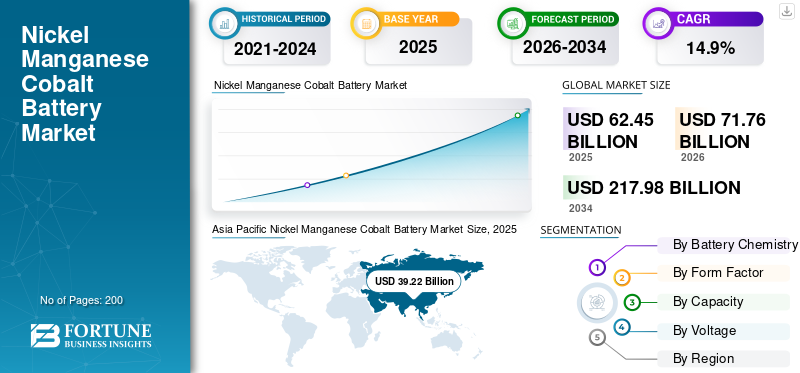
Download Free sample to learn more about this report.
Nickel Manganese Cobalt Battery Market Key Takeaways
 Global Market Size & Forecast
- 2025 Market Size: USD 62.45 billion
- 2026 Market Size: USD 71.76 billion
- 2034 Forecast Market Size: USD 217.98 billion
- CAGR: 14.9% from 2026–2034
 Market Share
- Asia Pacific dominated the market with a 62.8% share, valued at USD 39.22 billion in 2025.
- NMC 622 (6:2:2) segment dominated the market in 2025, driven by its balanced energy density, safety, and cost efficiency.
- Prismatic Cells segment dominated the market in 2025, owing to high energy density and superior space efficiency.
 Key Regional Highlights
North America
The market is the third-largest regional market, driven by EV adoption and battery manufacturing.
Asia Pacific
The market reached USD 39.22 billion in 2025, driven by EV production and battery manufacturing.
Europe
The market is the second-largest regional market, driven by EV adoption and battery gigafactory investments.
U.S.
The market is projected to reach USD 8.38 billion by 2026, supported by EV production and energy storage investments.
Japan
The market is projected to reach USD 2.02 billion by 2026, driven by advanced battery research and automotive manufacturing.
Read More

NICKEL MANGANESE COBALT BATTERY MARKET TRENDS
Development of High-Nickel NMC Chemistries Enhances Battery Performance is a Key Market Trend
A major trend influencing the global market is the development of integrated hydrogen ecosystems combining renewable energy integration, generation, hydrogen production, storage, distribution, and mobility applications. Industry participants are increasingly focusing on creating end-to-end hydrogen value chains to ensure a reliable fuel supply and operational efficiency. Collaborative projects involving automotive manufacturers, utility providers, and governments are supporting the establishment of hydrogen corridors and smart transportation networks. Another notable trend is the growing adoption of hydrogen-powered commercial vehicles, particularly buses and heavy-duty trucks, in urban public transportation systems. Technological innovations in fuel cell durability, lightweight storage tanks, and high-capacity electrolyzers are improving vehicle performance and reducing operational costs. Furthermore, companies are investing in digital monitoring and energy management systems to optimize hydrogen consumption and infrastructure utilization, reflecting the market’s transition toward scalable and interconnected clean mobility solutions.
MARKET DYNAMICS
MARKET DRIVERS
Download Free sample to learn more about this report.
Increased High-Energy-Density Battery Demand Due to Rapid Electric Vehicle Adoption is Driving Market Expansion
The accelerating global adoption of electric vehicles (EVs) is a primary driver for the nickel manganese cobalt battery market growth. NMC batteries offer a superior balance of energy density, power output, safety, and lifecycle performance, making them the preferred choice for passenger and commercial EV manufacturers. Governments globally are implementing stricter emission regulations, fuel economy standards, and EV incentive programs, encouraging automakers to electrify their fleets. Additionally, consumer demand for longer driving ranges and faster charging capabilities continues to support NMC battery deployment. Major automotive manufacturers are expanding EV production capacities, while battery producers are increasing investments in advanced NMC chemistries. These developments collectively strengthen demand and contribute significantly to the long-term growth of the NMC battery market.
MARKET RESTRAINTS
Increasing Production Costs Due to Volatility in Critical Raw Material Prices Restrict Market Expansion
Fluctuations in the prices of key raw materials such as nickel, cobalt, and lithium remain a significant restraint for the NMC Battery Market. These metals are essential for NMC battery cathodes, and their supply chains are often concentrated in a limited number of countries, making them vulnerable to geopolitical tensions, mining disruptions, and trade restrictions. Price volatility directly affects battery manufacturing costs, reducing profit margins for producers and creating uncertainty in long-term procurement planning. Additionally, environmental and social concerns associated with cobalt mining have increased regulatory scrutiny and compliance costs. Although manufacturers are working to reduce cobalt content through advanced chemistries, dependence on critical minerals continues to challenge cost stability and market expansion, particularly in price-sensitive applications.
MARKET OPPORTUNITIES
Expansion of Grid-Scale Energy Storage Systems is Creating New Revenue Streams
The growing deployment of renewable energy generation is creating substantial opportunities for NMC battery manufacturers in grid-scale energy storage applications. As solar and wind power installations increase globally, utilities and energy providers require efficient storage systems to manage intermittency and maintain grid stability. NMC batteries offer high energy density, strong cycle performance, and reliable operational efficiency, making them suitable for commercial and utility-scale energy storage projects. Governments and energy companies are investing heavily in Battery Energy Storage Systems (BESS) to support renewable integration and modernize electricity infrastructure. Emerging markets are also expanding energy storage deployments to improve power reliability. This diversification beyond the automotive sector provides battery manufacturers with new growth avenues and strengthens long-term market potential.
MARKET CHALLENGES
Intensifying Competition from Alternative Battery Technologies Challenges Market Growth
The NMC battery market faces growing competition from alternative battery chemistries, particularly lithium iron phosphate (LFP) batteries and emerging next-generation technologies. LFP batteries have gained significant traction due to their lower cost, improved safety profile, and reduced dependence on expensive materials such as cobalt and nickel. Many automotive manufacturers are increasingly adopting LFP batteries for entry-level and mass-market electric vehicles, especially in cost-sensitive regions. At the same time, research into solid-state batteries and sodium-ion technologies is progressing rapidly, potentially offering advantages in safety, sustainability, and cost efficiency. As battery manufacturers diversify their technology portfolios, NMC battery producers must continuously innovate to maintain their competitive position while balancing performance, cost, and sustainability requirements in an evolving energy storage landscape.
Segmentation Analysis
By Battery Chemistry
NMC 622 (6:2:2) Segment Takes the Lead Due to Balanced Performance and Broad EV Adoption
Based on battery chemistry, the market is categorized into NMC 111 (1:1:1), NMC 532 (5:3:2), NMC 622 (6:2:2), and others.
The NMC 622 (6:2:2) segment dominates the market, owing to its optimal balance between energy density, safety, cost efficiency, and cycle life. The chemistry is widely adopted across electric passenger vehicles, commercial EVs, and energy storage systems, offering improved range while maintaining thermal stability. Battery manufacturers and automotive OEMs increasingly favor NMC 622 as a commercially mature solution that delivers reliable performance at scale. Its extensive deployment across high-volume EV platforms and established supply chains continues to reinforce its leading market position globally.
The NMC 532 (5:3:2) segment is projected to grow at a CAGR of 15.8% during the forecast period. Growth is supported by its cost-effective chemistry, enhanced energy density compared to earlier NMC variants, and increasing adoption in mid-range electric vehicles and stationary storage applications, particularly in emerging battery manufacturing markets.
By Form Factor
Superior Space Utilization and High-Energy Applications Propel Prismatic Cells Segmental Dominance
Based on form factor, the market is categorized into cylindrical cells, prismatic cells, and pouch cells.
The prismatic cells segment dominates the market due to its superior space efficiency, high energy density, and suitability for large battery pack configurations. These cells are extensively used in electric vehicles and stationary energy storage systems, where compact packaging and optimized thermal management are critical. Automotive OEMs increasingly prefer prismatic designs as they reduce module complexity and improve pack-level energy utilization. Growing deployment in premium EVs and commercial battery systems, coupled with continuous advancements in cell architecture, reinforces the segment’s leadership position and sustained market penetration globally.
The cylindrical cells segment is projected to expand at a CAGR of 12.4% during the forecast period. Growth is driven by increasing adoption in electric mobility, power tools, and consumer electronics applications, supported by established manufacturing processes, cost-effective production, excellent mechanical stability, and continuous improvements in cell energy density and performance.
To know how our report can help streamline your business, Speak to Analyst
By Capacity
Rising Demand for Long-Range EV Batteries Boosts 100 Ah–200 Ah Segmental Dominance
Based on capacity, the market is categorized into below 50 Ah, 50 Ah–100 Ah, 100 Ah–200 Ah, and above 200 Ah.
The 100 Ah–200 Ah segment dominates the market, owing to its widespread adoption in electric vehicles, commercial transportation, and large-scale energy storage applications. This capacity range offers an ideal balance between energy storage capability, vehicle range, charging efficiency, and battery pack size. Automotive manufacturers increasingly utilize batteries within this range to meet consumer demand for extended driving distances and improved performance. Furthermore, growing deployment in electric buses, delivery vehicles, and renewable energy storage projects supports sustained demand. Its versatility across multiple end-use sectors and compatibility with advanced NMC chemistries continue to strengthen the segment’s leading market position globally.
The 50 Ah–100 Ah segment is projected to grow at a CAGR of 14.1% during the forecast period. Growth is driven by increasing adoption in compact electric vehicles, hybrid vehicles, light commercial mobility solutions, and residential energy storage systems, where moderate capacity, cost efficiency, and reliable performance are key purchasing considerations.
By Voltage
High-Voltage EV Architectures and Fast-Charging Requirements Propel Above 300V Segmental Dominance
Based on voltage, the market is categorized into below 12V, 12V–48V, 48V–300V, and above 300V.
The above 300V segment dominates the market due to its extensive use in modern electric vehicles, electric buses, commercial vehicles, and utility-scale energy storage systems. High-voltage battery systems enable longer driving ranges, faster charging capabilities, improved power delivery, and greater energy efficiency. Leading automotive manufacturers are increasingly adopting 400V and 800V platforms to enhance vehicle performance and reduce charging times. The growing demand for premium EVs and high-capacity battery packs further strengthens adoption. Additionally, advancements in power electronics and charging infrastructure continue to support the widespread deployment of above-300V NMC battery systems across global markets.
The 48V–300V segment is projected to grow at a CAGR of 12.1% during the forecast period. Growth is driven by rising adoption in hybrid vehicles, compact electric vehicles, industrial equipment, and mid-capacity energy storage systems, where efficient power management, lower system costs, and operational flexibility are key advantages.
Nickel Manganese Cobalt Battery Market Regional Outlook
By geography, the market is categorized into Europe, North America, Asia Pacific, the Middle East & Africa, and Latin America.
Asia Pacific
Asia Pacific Nickel Manganese Cobalt Battery Market Size, 2025 (USD Billion)
To get more information on the regional analysis of this market, Download Free sample
Asia Pacific dominates the global nickel manganese cobalt battery market share, driven by its leadership in electric vehicle production, battery manufacturing, and raw material processing. China, South Korea, and Japan collectively account for a significant share of global NMC battery demand and supply. Strong government support for EV adoption, large-scale investments in gigafactories, and the presence of leading battery manufacturers such as CATL, LG Energy Solution, Samsung SDI, and Panasonic strengthen regional dominance. Additionally, the rapid expansion of energy storage systems and growing demand for high-performance batteries across automotive and industrial applications continue to support market growth throughout the region.
China Nickel Manganese Cobalt Battery Market
The China market in 2026 is estimated at around USD 32.10 billion. China dominates global demand due to its extensive EV manufacturing ecosystem, large-scale battery production capacity, robust government support, and strong presence of leading battery manufacturers and material suppliers.
Japan Nickel Manganese Cobalt Battery Market
The Japan market in 2026 is estimated at around USD 2.02 billion. Advanced battery research, strong automotive manufacturing capabilities, increasing electrification initiatives, and continuous investments by domestic battery manufacturers in high-performance NMC technologies support market growth.
Europe
Europe represents the second-largest market and is projected to expand at a CAGR of 15.6% during the forecast period. Stringent carbon emission regulations, aggressive EV adoption targets, and significant investments in domestic battery manufacturing support the region's growth. Countries such as Germany, France, and the U.K. are actively developing localized battery supply chains to reduce dependence on imports. Increasing production of electric passenger and commercial vehicles, coupled with expanding renewable energy storage projects, is driving NMC battery demand. Strong policy support and the emergence of multiple battery gigafactories further contribute to the region’s robust market expansion.
U.K. Nickel Manganese Cobalt Battery Market
The U.K. market in 2026 is estimated at around USD 1.68 billion. Rising electric vehicle sales, growing battery manufacturing investments, supportive net-zero policies, and increasing deployment of renewable energy storage systems are driving demand for advanced NMC batteries.
Germany Nickel Manganese Cobalt Battery Market
The Germany market in 2026 is estimated at around USD 3.86 billion. Growth is fueled by the country’s strong automotive sector, expanding battery gigafactory investments, increasing EV adoption, and government initiatives supporting localized battery production and sustainable transportation development.
North America
North America holds the third-largest market share, supported by rising electric vehicle adoption, expanding battery production capacity, and favorable government incentives. The U.S. leads regional demand due to growing investments in EV manufacturing, battery recycling, and domestic supply chain development. Major automakers and battery manufacturers are establishing new production facilities to strengthen local sourcing and reduce import dependency. Increasing deployment of utility-scale energy storage systems and rising consumer preference for long-range electric vehicles further stimulate demand for NMC batteries. The region also benefits from technological advancements and strategic partnerships across the battery value chain.
U.S. Nickel Manganese Cobalt Battery Market
The U.S. market in 2026 is estimated at around USD 8.38 billion. Growth is driven by expanding EV production, battery manufacturing investments, the Inflation Reduction Act incentives, and increasing deployment of grid-scale energy storage systems, strengthening domestic demand for advanced NMC battery technologies.
Middle East & Africa
The Middle East & Africa market is experiencing steady growth, supported by increasing investments in renewable energy projects, grid modernization, and sustainable transportation initiatives. Countries such as the UAE and Saudi Arabia are actively promoting clean energy adoption and electric mobility as part of their long-term economic diversification strategies. The growing deployment of battery energy storage systems to support solar power integration is creating additional demand for advanced battery technologies. While EV adoption remains at an early stage compared to developed regions, improving infrastructure, government sustainability programs, and rising awareness of clean energy solutions are expected to support future market expansion.
UAE Nickel Manganese Cobalt Battery Market
The UAE market in 2026 is estimated at around USD 0.41 billion. Growth is supported by clean energy initiatives, electric mobility adoption, large-scale renewable energy projects, and government efforts to diversify the economy through sustainable technology investments.
Latin America
Latin America is witnessing increasing demand for NMC batteries as governments and businesses invest in electric mobility and renewable energy infrastructure. Brazil and Mexico are leading regional adoption through growing electric vehicle sales, expanding charging networks, and investments in clean transportation. The rising need for reliable energy storage systems to support renewable power generation is also contributing to market growth. Furthermore, the region’s abundant mineral resources and growing interest in battery supply chain development are attracting investment from global battery manufacturers. Continued urbanization, sustainability initiatives, and improving EV affordability are expected to drive long-term demand across Latin America.
Brazil Nickel Manganese Cobalt Battery Market
The Brazil market in 2026 is estimated at around USD 1.02 billion. Increasing adoption of electric vehicles, growing renewable energy installations, expanding energy storage requirements, and investments in battery supply chains are contributing to the market’s steady long-term growth trajectory.
COMPETITIVE LANDSCAPE
Key Industry Players
Competitive Landscape Driven by Capacity Expansion and Strategic OEM Partnerships
The global nickel manganese cobalt battery market is characterized by intense competition among established battery manufacturers and emerging technology developers. Leading companies, including CATL, LG Energy Solution, Samsung SDI, Panasonic Holdings, SK On, BYD, CALB, EVE Energy, Gotion High-Tech, and SVOLT Energy Technology, focus on expanding production capacity, enhancing energy density, and improving battery safety. Strategic collaborations with automotive OEMs, investments in gigafactories, and long-term raw material sourcing agreements remain key competitive strategies. Market participants are also investing heavily in research and development to commercialize advanced high-nickel NMC chemistries that offer superior performance while reducing cobalt dependency and production costs.
Competition is increasingly centered on technological innovation, supply chain integration, and geographic expansion. Major players are strengthening their positions through vertical integration across mining, material processing, cell manufacturing, and battery recycling operations. Companies are also prioritizing localized production facilities in North America and Europe to support regional EV manufacturing growth and comply with government localization initiatives. Additionally, advancements in fast-charging capabilities, thermal management systems, and battery lifecycle optimization are becoming critical differentiators. As electric vehicle adoption accelerates globally, manufacturers with strong production scalability, advanced battery technologies, and secure raw material access are expected to maintain a competitive advantage in the evolving NMC battery market.
LIST OF KEY NICKEL MANGANESE COBALT BATTERY COMPANIES PROFILED
- CATL (China)
- LG Energy Solution (South Korea)
- Panasonic Energy (Japan)
- Samsung SDI (South Korea)
- SK On (South Korea)
- BYD (China)
- CALB (China)
- EVE Energy (China)
- Gotion High-Tech (China)
- Envision AESC (Japan)
- Farasis Energy (China)
- SVOLT Energy Technology (China)
KEY INDUSTRY DEVELOPMENTS
- April 2026: CATL unveiled its third-generation Qilin NMC battery at the company’s annual Tech Day, featuring a peak discharge output of 3,000 kW and enabling electric vehicles to achieve over 1,000 km driving range. The company also introduced a 350 Wh/kg condensed battery capable of supporting up to 1,500 km range in premium passenger vehicles, reinforcing CATL’s leadership in high-performance Nickel Manganese Cobalt (NMC) battery technology and next-generation EV energy storage solutions.
- April 2026: Samsung SDI signed a multi-year agreement with Mercedes-Benz to supply high-nickel NCM (Nickel Manganese Cobalt) batteries for the automaker’s next-generation electric vehicles. The partnership marks Samsung SDI’s first EV battery supply contract with Mercedes-Benz and expands collaboration in future mobility technologies, including the joint development of high-performance battery solutions. The agreement strengthens Samsung SDI’s position in the global NMC battery market while supporting Mercedes-Benz’s electrification strategy and long-range EV development objectives.
- June 2025: Gotion High-Tech introduced upgraded NMC battery solutions featuring enhanced cycle life and improved thermal stability. The company targeted both electric mobility and energy storage applications while expanding its international manufacturing footprint.
- February 2025: SK On announced at InterBattery 2025 an expanded battery portfolio featuring pouch, prismatic, and cylindrical cell formats, highlighting its growing capabilities across multiple battery architectures. The company also unveiled a high-voltage mid-nickel NCM battery with reduced nickel and cobalt content, designed to deliver a balance of energy density, cost competitiveness, safety, and longer lifespan. The development aligns with evolving market demand for affordable, high-performance Nickel Manganese Cobalt (NMC) battery solutions across electric vehicle and energy storage applications.
- February 2025: SVOLT Energy Technology unveiled a new generation of high-nickel NMC batteries engineered to deliver higher energy density while significantly reducing cobalt content. The advanced battery technology is designed to improve driving range, enhance cost efficiency, and strengthen supply chain sustainability. The launch reflects the industry's ongoing focus on developing high-performance Nickel Manganese Cobalt (NMC) batteries that balance affordability, safety, and long-term reliability for electric vehicle and energy storage applications.
- November 2024: CATL announced advancements in NMC battery cell architecture aimed at increasing driving range and improving fast-charging capabilities. The company continued investing in global production facilities to support accelerating electric vehicle adoption globally.
- September 2024: LG Energy Solution secured multiple long-term battery supply agreements with global automotive manufacturers for NMC battery technologies. The contracts reinforced the company's position as a key supplier in the rapidly expanding electric vehicle market.
REPORT COVERAGE
The global nickel manganese cobalt battery market analysis provides an in-depth study of market size & forecast by all the market segments included in the report. It includes details on the market dynamics and market trends expected to drive the market over the forecast period. It offers information on the technological advancements, new product launches, key industry developments, and details on partnerships, mergers & acquisitions. The market research report also encompasses a detailed competitive landscape, including market share and profiles of key operating players.
Request for Customization to gain extensive market insights.
Report Scope & Segmentation
| ATTRIBUTE | DETAILS |
| Study Period | 2021-2034 |
| Base Year | 2025 |
| Estimated Year | 2026 |
| Forecast Period | 2026-2034 |
| Historical Period | 2021-2024 |
| Growth Rate | CAGR of 14.9% from 2026 to 2034 |
| Unit | Value (USD Billion) |
| Segmentation | By Battery Chemistry, By Form Factor, By Capacity, By Voltage, and By Region |
| By Battery Chemistry |
|
| By Form Factor |
|
| By Capacity |
|
| By Voltage |
|
| By Region |
|
Frequently Asked Questions
Fortune Business Insights says that the global market value stood at USD 62.45 billion in 2025 and is projected to reach USD 217.98 billion by 2034.
In 2025, the market value in Asia Pacific stood at USD 39.22 billion.
The market is expected to exhibit a CAGR of 14.9% during the forecast period of 2026-2034
The prismatic cells segment led the market by form factor.
Increased high-energy-density battery demand due to rapid electric vehicle adoption is driving market expansion.
Asia Pacific dominated the market in 2025.



- 2021-2034
- 2025
- 2021-2024
- 200
-
(Offer valid till 31st Oct 2026)
Get 30-60 hrs Free Customization
Expand Regional and Country Coverage, Segments Analysis, Company Profiles, Competitive Benchmarking, and End-user Insights.




















Related Reports
-
US +1 833 909 2966 ( Toll Free )
-
Get In Touch With Us