Nickel Nano Powder Market Size, Share & Industry Analysis, By Type (< 50 nm and ≥ 50 nm), By Application (Chemical Manufacturing, Electronics, Research & Laboratory, Nuclear Energy, Nanomaterials, and Others), and Regional Forecast, 2026-2034
 Download Free Sample

(Offer valid till 30th Nov 2026)

NICKEL NANO POWDER MARKET SIZE AND FUTURE OUTLOOK
 Listen to Audio Version
The global nickel nano powder market size was valued at USD 516.5 million in 2025. The market is projected to grow from USD 563.6 million in 2026 to USD 1,165.2 million by 2034, exhibiting a CAGR of 9.5% during the forecast period.
Nickel nano powder is a high-purity metallic nickel material produced in nanoscale and ultrafine particle-size grades, generally covering particles below 50 nm, along with selected commercial grades extending to approximately 500 nm. Owing to their very small particle size, these powders provide a high specific surface area, electrical and thermal conductivity, magnetic behavior, catalytic activity, and improved sintering performance compared with conventional nickel powders. Nickel nano powder is used in chemical manufacturing, electronics, conductive formulations, catalysts, research and laboratory applications, nuclear-energy-related applications, nanomaterials, and other specialized uses. Commercial grades are differentiated primarily by particle size, purity, morphology, surface area, surface treatment, dispersion characteristics, and resistance to oxidation.
Advancements in nanotechnology are expanding potential applications for nickel nanopowder across the industrial and research sectors, thereby creating growth opportunities for the market. Key players in the market include SHOEI CHEMICAL INC., Sumitomo Metal Mining Co., Ltd., Tekna, CVMR Corporation, and American Elements.
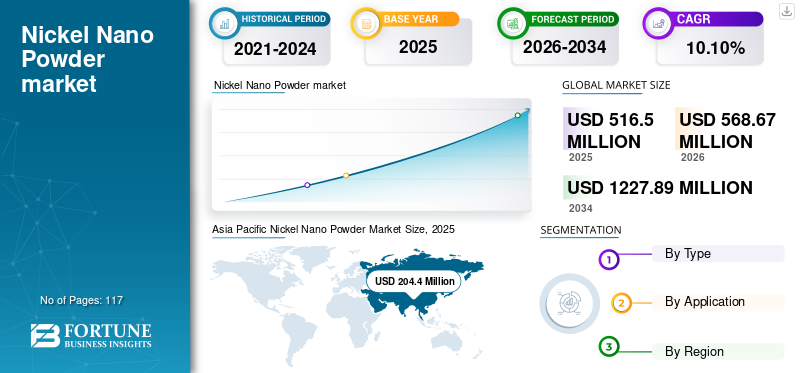
Download Free sample to learn more about this report.
NICKEL NANO POWDER MARKET TRENDS
Shift Toward Finer, High-Purity, and Surface-Controlled Nickel Powders to Shape Market Growth
A major trend in the global market is the transition toward smaller particle sizes, narrower particle-size distributions, higher purity, improved spherical morphology, and controlled particle surfaces. This development is particularly evident in electronics, where thinner multilayer ceramic capacitor (MLCC) electrodes require increasingly fine and uniformly dispersed nickel powders. Sumitomo Metal Mining states that the development of higher-capacity and thinner-layer MLCCs is increasing the demand for smaller nickel particles, with nickel powders with particle sizes of 200 nm or less, currently associated with advanced MLCC applications, expected to become increasingly mainstream over the next generation.
MARKET DYNAMICS
MARKET DRIVERS
Download Free sample to learn more about this report.
Rising Demand from the Electronics Industry to Drive Market Growth
The growing electronics industry is driving nickel nano powder market growth. Nickel nanopowder is used in conductive pastes for internal electrodes in multilayer ceramic capacitors (MLCCs), electronic components, and other functional materials due to its electrical conductivity, fine particle size, high surface area, and favorable sintering behavior.
Demand is increasing with the expansion of smartphones, computers, communication equipment, automotive electronics, AI servers, data centers, and other high-performance electronic systems. Continued miniaturization of electronic components is also increasing the need for conductive materials with controlled particle size, high purity, consistent morphology, and reliable electrical performance.
According to the Semiconductor Industry Association, global semiconductor sales reached USD 791.7 billion in 2025, increasing by 25.6% from USD 630.5 billion in 2024. The association also highlighted AI, IoT, 6G, and autonomous driving as important technologies supporting semiconductor demand. Continued expansion of semiconductor production is expected to strengthen consumption of advanced conductive and functional materials used in electronic components.
Market Drivers - Impact & CAGR Contribution (2026–2034)
| Rank | Market Drivers | Overall Impact Rank | CAGR Contribution (2026-2034) (2026-2034) |
Impact: 2026-2028 | Impact: 2029-2031 | Impact: 2032-2034 |
|---|---|---|---|---|---|---|
| 1 | Rising demand for ultra-fine nickel powder in MLCCs and miniaturized electronic components | High | 3.20% | High | High | High |
| 2 | Expansion of AI infrastructure, 5G devices, electric vehicles, ADAS, and automotive electronics increasing high-density electronic component demand | High | 2.50% | High | High | High |
| 3 | Growing use of nickel nanopowder in chemical manufacturing, catalysts, hydrogen-related processes, and other high-surface-area applications | Medium-High | 2.10% | Medium | High | High |
| 4 | Continuous advancements in CVD, plasma, wet-synthesis, particle-size control, surface engineering, and oxidation-control technologies | Medium-High | 1.90% | Medium | High | High |
| 5 | Increasing commercialization of nanomaterials, conductive coatings, magnetic materials, electromagnetic shielding, and specialty functional materials | Medium | 1.80% | Medium | Medium | High |
| 6 | Others (expanding nanotechnology R&D, increasing availability of high-purity nano grades, localization of electronic-material supply chains, development of specialty energy applications) | Low | 1.00% | Low | Medium | Medium |
| Total Positive Growth Contribution | 12.50% | |||||
Source: Fortune Business Insights
Download Free sample For In-Depth Market Drivers & Impact Forecasts
MARKET RESTRAINTS
High Production and Processing Costs to Restrain Market Growth
Nickel nanopowder manufacturing involves specialized processing technologies, precise operating conditions, high-purity raw materials, and strict particle-size control. Processes such as chemical reduction, plasma synthesis, carbonyl-based production routes, and other nanoscale synthesis methods require controlled temperature, pressure, reaction time, precursor concentration, and surface treatment. These requirements make production more complex and expensive than conventional nickel powder manufacturing.
Maintaining consistent nanoscale particle size and morphology also increases processing costs. Nickel nanoparticles are highly sensitive to synthesis conditions, and small changes in temperature, reducing agents, stabilizers, or precursor concentration can affect particle size and surface characteristics. Additional purification, classification, passivation, drying, and quality-control stages are often required to achieve commercial specifications.
A 2024 study associated with the U.S. National Laboratory of the Rockies specifically evaluated manufacturing costs in nickel nanoparticle synthesis. It highlighted raw-material costs and synthesis-performance parameters as important cost drivers during scale-up and commercialization. This demonstrates that economic optimization remains an important challenge for industrial nickel nanoparticle production.
Production and downstream processing also require additional safety infrastructure. The National Institute for Occupational Safety and Health (NIOSH) recommends appropriate engineering controls for occupational exposure to engineered nanomaterials. Such requirements may involve enclosed processing equipment, local exhaust ventilation, controlled powder transfer, filtration, personal protective equipment, and workplace monitoring, increasing operating and capital expenses for manufacturers.
Market Restraints - Impact & Negative CAGR Contribution (2026–2034)
| Rank | Market Restraints | Overall Impact Rank | Negative CAGR Contribution (2026-2034) (2026-2034) |
Impact: 2026-2028 | Impact: 2029-2031 | Impact: 2032-2034 |
|---|---|---|---|---|---|---|
| 1 | Complex nano-scale manufacturing, agglomeration and oxidation control, and high production costs limit economical large-scale production | High | -1.30% | High | High | Medium |
| 2 | Occupational safety, nanoparticle handling, environmental compliance, and exposure-management requirements increase operating complexity | Medium-High | -0.90% | High | Medium | Medium |
| 3 | Long customer qualification cycles and stringent consistency requirements for particle size, purity, morphology, dispersion, and sintering performance | Medium | -0.50% | High | Medium | Low |
| 4 | Others (nickel price volatility, intellectual-property barriers, competition from alternative conductive/catalytic materials, scale-up difficulties, storage and transportation issues) | Low | -0.30% | Low | Low | Low |
| Total Negative Growth Impact | -3.00% | |||||
Source: Fortune Business Insights
Download Free sample For In-Depth Market Restraints & Risk Analysis
MARKET OPPORTUNITIES
Rapid Expansion of Nanomaterial Applications to Create Lucrative Market Opportunities
The development of specialized nanomaterial applications across electronics, energy, manufacturing, and catalysis may create additional opportunities for nickel nanopowder. Nickel nanopowder offers high surface area, electrical conductivity, magnetic properties, catalytic activity, and favorable sintering behavior, supporting its use in a growing range of nanoscale material systems.
Continuous innovation in nanotechnology is encouraging manufacturers to develop materials with controlled particle size, morphology, surface chemistry, and purity. These developments may support demand for specialized nickel nanopowder grades used in conductive materials, catalysts, magnetic components, energy-storage systems, nanocomposites, and research applications.
The European Commission identifies advanced materials, including nanomaterials, as important across sectors such as electronics, energy, mobility, healthcare, construction, batteries, smartphones, and other industrial products. The Commission also emphasizes continued research and innovation to improve the performance, safety, sustainability, and circularity of advanced materials. This broadening application base provides opportunities for metallic nanopowders such as nickel in next-generation material systems.
NIST states that nanostructured materials are important to innovation in high-performance computing, electronics, energy conservation, renewable energy, biomedical research, and healthcare. NIST also develops characterization methods for nanoscale materials, reflecting the increasing technical importance of precisely engineered nanostructures across advanced applications.
MARKET CHALLENGES
Manufacturing Complexity, Particle Stability, and Customer Qualification Requirements Pose Market Challenges
A major challenge in the global market is maintaining consistent particle size, morphology, crystallinity, purity, surface condition, and dispersion characteristics at commercial production scale. These parameters become increasingly difficult to control as manufacturers move toward smaller particle sizes. JFE Mineral's continuing development of high-crystallinity 0.1 µm nickel powder with a narrow particle-size distribution illustrates the technological precision required for next-generation electronic applications. Its commercial production relies on CVD technology specifically designed to provide high-precision submicron particle control.
RESEARCH AND DEVELOPMENT (R&D) TRENDS
R&D in the global market is increasingly focused on smaller and more uniform particle sizes, improved spherical morphology, narrow particle-size distribution, higher purity and crystallinity, controlled surface oxidation, customized surface chemistry, reduced agglomeration, improved dispersion, and scalable CVD, wet-synthesis, and plasma-based production technologies. Development activity is particularly concentrated on nickel powders in the 50–100 nm range and selected grades below 50 nm for thinner MLCC internal electrodes, conductive pastes and inks, catalysts, magnetic materials, and other advanced nanomaterial applications.
SEGMENTATION ANALYSIS
By Type
Growing Electronics Applications Supported ≥50 nm Segment Dominance
Based on type, the market is segmented into < 50 nm and ≥ 50 nm.
The ≥50 nm segment accounted for the largest nickel nano powder market share in 2025. This category includes nickel powders at 50 nm and above and selected commercially marketed nano/ultrafine grades extending beyond 100 nm. Its dominance primarily reflects the commercial scale of nickel nano/ultrafine powders used in electronics, particularly multilayer ceramic capacitor internal electrodes. Leading manufacturers demonstrate the commercial importance of these particle sizes. JFE Mineral commercially manufactures high-purity nickel ultrafine powder with an average diameter of approximately 0.2–0.4 µm, principally for MLCC internal electrodes used in smartphones, laptops, and automotive electronic systems. Jiangsu Boqian's portfolio includes nickel powders with nominal particle sizes ranging from approximately 80 nm through 600 nm, with applications encompassing MLCC electrodes, electronic pastes, catalysts, magnetic fluids, coatings and absorbing materials.
The <50 nm segment is expected to register 10.8% CAGR during the forecast period. These ultrafine nickel powders generally require tighter particle-size control, higher purity, controlled surface chemistry and greater protection against agglomeration and oxidation. The segment is concentrated in higher-value specialty applications such as advanced catalysts, nanomaterial development, research, functional coatings, and emerging electronic-material applications.
By Application
To know how our report can help streamline your business, Speak to Analyst
Increasing Use in MLCC Internal Electrodes Supported Electronics Segment Dominance
Based on application, the market is segmented into chemical manufacturing, electronics, research & laboratory, nuclear energy, nanomaterials, and others.
The electronics segment accounted for the largest market share of 54.1% in 2025. The principal industrial use is nickel powder for internal electrodes in MLCCs. JFE states that its nickel ultra-fine powder is primarily used in MLCCs for smartphones, laptops, and electronically controlled automotive systems. Tekna similarly positions its 50–100 nm nickel nanopowder specifically for advanced MLCC manufacturing and identifies EVs, 5G and IoT-related electronics as drivers of component miniaturization. Nickel's role in MLCC electrodes gives electronics a scale advantage that other nano-nickel applications currently lack. Continued reductions in electrode-layer thickness are also increasing technical requirements for particle uniformity, dispersibility, surface chemistry, and finer particle sizes, supporting growth.
The chemical manufacturing segment is projected to register significant growth during the forecast period. Nickel nanopowders provide high surface area relative to conventional powders, making them useful in catalytic and chemically active systems. Boqian explicitly identifies catalyst applications among the uses for its fine nickel powders, alongside batteries, electronic materials, magnetic fluids, and specialty coatings. The segment is projected to register a CAGR of 9.7% during the forecast period.
The nanomaterials segment is expected to register notable growth during the forecast period. This segment includes nickel nanopowder incorporated into functional materials, conductive systems, magnetic materials, coatings, composites, and other nanoscale material formulations. The product frequently requires tightly specified nano-sized particles rather than commodity nickel powder. Boqian's commercial portfolio demonstrates applications in magnetic fluids, special coatings and absorbing materials, illustrating the broader functional-material role of fine nickel particles.
The others segment is projected to register positive growth during the forecast period. It captures applications that do not fit cleanly within the five principal categories, including selected batteries, magnetic fluids, electromagnetic absorbing materials, specialty coatings, and related functional-material uses. Boqian's official product information confirms applications in nickel batteries, storage batteries, magnetic fluids, specialty coatings, and absorbing materials, supporting the presence of a diversified secondary application base. However, these applications remain collectively smaller than electronics, chemical manufacturing and dedicated nanomaterial applications.
NICKEL NANO POWDER MARKET REGIONAL OUTLOOK
By region, the market is segmented into North America, Europe, Asia Pacific, Latin America, and the Middle East & Africa.
Asia Pacific
Asia Pacific Nickel Nano Powder Market Size, 2025 (USD Million)
To get more information on the regional analysis of this market, Download Free sample
Asia Pacific holds the dominant share of the global market. Its leadership is principally associated with the exceptionally high concentration of electronics manufacturing, MLCC production, semiconductor capacity, electronic-component supply chains, and industrial-scale ultra-fine nickel-powder manufacturers across China, Japan, South Korea, and Taiwan. The electronics manufacturing concentration is particularly significant. SEMI reported that China, Taiwan, and South Korea together accounted for 79% of worldwide semiconductor-manufacturing equipment spending in 2025.
China Nickel Nano Powder Market
The market in China is one of the largest globally, with 2025 revenue at USD 82.6 million, representing roughly 16.0% of global sales.
North America
North America represents a significant regional market. The region’s growth is supported primarily by the U.S.' advanced electronics, semiconductor, nanotechnology, specialty chemicals, research, and advanced-material ecosystem. The region is an important market for high-value, fine-particle nickel powders requiring stringent purity, surface-area, particle-size, and performance specifications.
U.S. Nickel Nano Powder Market
In 2025, the U.S. market was valued at USD 100.0 million, driven primarily by strong demand from research and laboratory applications. The U.S. accounts for roughly 19.4% of global sales.
Europe
The market in Europe is set to register steady growth over the forecast period due to rising adoption of nickel-rich cathode materials in lithium-ion batteries and energy storage systems. European demand is comparatively diversified across electronics, specialty chemicals, functional nanomaterials, research, automotive electronics, and other high-performance material applications. Germany, France, and the U.K. form important individual markets, while the Netherlands, Italy, Sweden, Belgium, Finland, and other European economies contribute to the broader regional advanced-material supply chain.
Germany Nickel Nano Powder Market
The market in Germany in 2025 was valued at around USD 26.9 million, representing roughly 5.2% of global market revenues.
Rest of the World
The Rest of the World is expected to register positive growth during the forecast period. The region remains considerably smaller than North America, Europe, or Asia Pacific, as large-scale MLCC and advanced electronic-component manufacturing is comparatively limited. Demand is therefore more closely associated with chemical processing, research, functional materials, industrial electronics, catalysts, coatings, and selected advanced-material applications. Latin America represents an emerging industrial market led primarily by Brazil. At the same time, the Middle East & Africa remains comparatively small and oriented toward specialized chemical, research, energy, and advanced-material applications.
COMPETITIVE LANDSCAPE
KEY INDUSTRY PLAYERS
Top Players are Strengthening Fine-Particle Manufacturing, Surface-Control Technologies, and Production Scale to Maintain Their Market Positions
The competitive structure of the nickel nano powder market is relatively concentrated in high-volume electronic and MLCC-grade nickel ultra-fine powders, where technical barriers, capital-intensive production processes, and lengthy customer qualification favor established manufacturers. SHOEI Chemical manufactures metallic powders down to approximately 80 nm and identifies nickel powder and paste for MLCC internal electrodes as its flagship business.
LIST OF KEY NICKEL NANO POWDER COMPANIES PROFILED
- Tekna (Canada)
- Otto Chemie Pvt. Ltd. (India)
- SkySpring Nanomaterials, Inc. (U.S.)
- Nanoshel LLC (U.S.)
- American Elements (U.S.)
- Nanografi (Turkey)
- ACS Material LLC (U.S.)
- Guangzhou Hongwu Material Technology Co., Ltd. (China)
- CVMR Corporation (Canada)
- US Research Nanomaterials, Inc. (U.S.)
- SHOEI CHEMICAL INC. (Japan)
- Sumitomo Metal Mining Co., Ltd. (Japan)
KEY INDUSTRY DEVELOPMENTS
- January 2026: Sumitomo Metal Mining disclosed continued R&D on ultra-fine nickel powder below 0.1 μm, developed through its proprietary wet process. The company highlighted uniform particle-size distribution and strong dispersibility, directly supporting finer nickel-powder applications.
- March 2025: CVMR announced plans to establish a high-purity nickel refinery in Andhra Pradesh, India, designed for 10,000 tons per year of high-purity nickel products using its proprietary vapour metallurgy technology. The announcement links the project to high-purity metal powders and nanomaterials.
- September 2024: CVMR announced a new nickel and iron refinery project in Albania, with the first phase planned to produce 10,000 tons per year of high-purity nickel and iron powders and nano powders. Construction was planned to begin in January 2025, with commissioning and production targeted for late 2026.
REPORT COVERAGE
The global nickel nano powder market report provides a detailed analysis of the market. It focuses on key aspects, such as leading companies, types, and applications. Besides this, it offers insights into the market and current industry trends and highlights key industry developments. In addition to the factors mentioned above, the report also covers several factors contributing to market growth.
Request for Customization to gain extensive market insights.
Report Scope and Segmentation
| ATTRIBUTE | DETAILS |
| Study Period | 2021-2034 |
| Base Year | 2025 |
| Estimated Year | 2026 |
| Forecast Period | 2026-2034 |
| Historical Period | 2021-2024 |
| Unit | Value (USD Million) |
| Growth Rate | CAGR of 9.5% from 2026 to 2034 |
| Segmentation | By Type, By Application, By Region |
| By Type |
|
| By Application |
|
| By Region |
|
Frequently Asked Questions
Fortune Business Insights says that the global market size was valued at USD 516.5 million in 2025 and is projected to reach USD 1,165.2 million by 2034.
Recording a CAGR of 9.5%, the market is slated to exhibit steady growth during the forecast period.
By application, the electronic segment leads the market.
Asia Pacific held the highest market share in 2025.
Rising demand from the electronics industry is driving market growth.



- 2021-2034
- 2025
- 2021-2024
- 158
-
(Offer valid till 30th Nov 2026)
Get 30-60 hrs Free Customization
Expand Regional and Country Coverage, Segments Analysis, Company Profiles, Competitive Benchmarking, and End-user Insights.


















Related Reports
-
US +1 833 909 2966 ( Toll Free )
-
Get In Touch With Us