Non-Destructive Testing (NDT) Product Market Size, Share & Industry Analysis, By Technique (Ultrasonic Testing, Visual Inspection Testing, Magnetic Particle Testing, Liquid Penetrant Testing, Eddy Current Testing, Radiographic Testing, Computed Tomography (CT), Acoustic Emission Testing, and Others), By Ultrasonic Testing (Traditional UT and Modern UT), By Method (Visual, Inspection, Surface Inspection, Volumetric Inspection, and Others), By Vertical, (Manufacturing, Oil & Gas, Aerospace, Public Infrastructure, Automotive, Power Generation, and Others) and Regional Forecast, 2026-2034
 Download Free Sample
KEY MARKET INSIGHTS
 Listen to Audio Version
The global non-destructive testing (NDT) product market size was valued at USD 3.93 billion in 2025 and is projected to grow from USD 4.24 billion in 2026 to USD 5.81 billion by 2034, exhibiting a CAGR of 4.03% during the forecast period. North America dominated the non-destructive testing (NDT) product market with a market share of 1.37% in 2025.
Non-destructive testing (NDT) products, components, or equipment are products, items, or devices employed to assess the characteristics, integrity, or quality of materials, components, or systems without damaging them or changing their use state. NDT is a broad array of inspection methods that enable the identification of defects, discontinuities, corrosion, or structural imperfections while leaving the test item in its original state.
The NDT products market is expanding strongly as safety, regulation, aging infrastructure, and the adoption of new technologies are fueling demand in mission-critical industries such as aerospace, energy, oil & gas, and automotive. The convergence of artificial intelligence, robotics, and digital technologies is improving accuracy, productivity, and affordability of inspections, further fueling adoption of the product.
Furthermore, the market encompasses several major market players with broad portfolio, innovative products, and strong regional presence expansion supporting the dominance of these companies in the market. Major key players in the market include General Electric (GE), Mistras Group, Inc., Olympus Corporation, Waygate Technologies (Baker Hughes subsidiary), Zetec Inc., and so on.
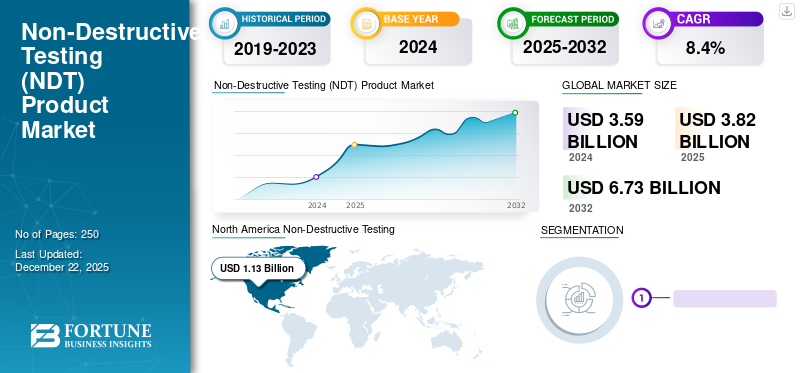
Download Free sample to learn more about this report.
Non-Destructive Testing Product Market Key Takeaways
 Global Market Size & Forecast
- 2025 Market Size: USD 3.93 billion
- 2026 Market Size: USD 4.24 billion
- 2034 Forecast Market Size: USD 5.81 billion
- CAGR: 4.03% from 2026–2034
 Market Share
- North America dominated the market with a 35.74% share in 2025.
- The Ultrasonic Testing (UT) segment accounted for 34.13% of the market in 2024 and is projected to be the fastest-growing testing method.
- The Ultrasonic Testing (UT) segment accounted for 34.13% of the market in 2024 and is projected to be the fastest-growing testing method.
 Key Regional Highlights
Asia Pacific
The market accounted for USD 0.72 billion in 2025 and is projected to reach USD 0.79 billion in 2026.
North America
The market reached USD 1.37 billion in 2025 and is projected to grow to USD 1.45 billion in 2026.
Europe
The market was valued at USD 1.36 billion in 2025 and is expected to reach USD 1.47 billion in 2026.
U.S.
The market was valued at USD 0.99 billion in 2024.
Japan
The market was valued at USD 0.23 billion in 2024.
Read More

Market Dynamics
MARKET DRIVERS
Unprecedented Growth across Multiple Industries, and Increasing Demand for Quality Assurance Contributes to Market Growth
With the increasing global focus on quality assurance and public safety, regulatory authorities are implementing stricter regulations. Oil and gas, aerospace, nuclear power and others industries must carry out regular, extensive inspections, and there is a persistent demand for high-end NDT components thus contributing to the market expansion.
Additionally, industrialized countries face great challenge of maintaining aged industrial and public infrastructure, such as bridges, pipelines, and power plants. NDT equipment is instrumental in determining the structural integrity of these infrastructures to prevent fatal failures and minimize repair costs.
According to the U.S. Bureau of Labor Statistics, the non-destructive testing (NDT) industry is expected to grow 14% between 2020 and 2030 with an added increase in ultrasonic testing due to its portability, ease of use, and high precision compared to other traditional NDT techniques.
Recent innovations in technology include developments in handheld phased array gear, the implementation of full matrix capture (FMC) and total focusing method (TFM) technologies, which are transforming the sector of ultrasonic testing with enhanced detection capabilities. Growth in large industries are spending heavily in new projects necessitating large NDT components and services that spur the market growth during forecast year.
- For instance, in January 2025, TRIGO, one of key leader in transportation industry quality management, has acquired Controreupe, a specialist in non-destructive testing (NDT). The acquisition represents an important milestone in TRIGO's strategic development plan to extend its component testing, inspection, and control solutions.
MARKET RESTRAINTS
Intertwined Technical, Regulatory and Economic Hurdles Hinder Market Growth
The key inhibiting factor within the NDT industry is the enormous initial investment in advanced testing equipment and ongoing running expenses. Format NDT experts illuminate that while basic NDT methods such as dye penetrant inspection (DPT) and magnetic particle inspection (MPT) employ relatively low-cost consumables, advanced methods including phased array ultrasonic inspection (PAUT) and digital radiography employ top-grade digital machinery, software integration, and highly skilled operators that significantly drive expenses, restraining the market growth.
OEMs such as Olympus, GE Inspection Technologies, and Sonatest deal in instruments but at a premium price due to their precision, accuracy, and customer support services. High initial costs of modern NDT equipment is one of the crucial barrier to business growth globally. this has made it difficult for small and medium-scale enterprises (SMEs) to fit digital and automated NDT machines such as phased array systems or industrial CT scanners.
The NDT industry operates within advanced regulatory frameworks that are subject to heavy compliance requirements and standardization challenges across various jurisdictions and applications. The Boiler and Pressure Vessel Code, ASME Section V, establishes detailed specifications for many of the NDE methods with standardized procedures for personnel qualification, equipment calibration, and documentation to ensure consistent, accurate inspections between industries.
The alignment of these restraining factors poses a difficult business climate for NDT firms, where rising costs, skill shortages, regulatory complexity, technological limitations, access barriers, market consolidation, and digitization requirements collectively restrict industry growth and business performance.
MARKET OPPORTUNITIES
Advanced Infrastructure Demand and Favorable Regulations Creates Lucrative Market Opportunities
Critical infrastructure across developed nations is aging creating enormous demand for NDT equipment and services. The federal government of the U.S. spent more than USD 635 million in November 2024 to repair or replace more than 70 bridges across 19 states, reflecting the scale of infrastructure investment driving demand for NDT.
In addition, government bridge inspection programs demand periodic NDT testing. The National Bridge Inspection Standards (NBIS) specify that every highway bridge must be inspected on a 24-month frequency, with fracture-critical bridges needing specialized NDT tests. State departments of transportation must run extensive bridge inspection programs, creating continuous demand for non-destructive testing (NDT) market.
Additionally, NASA's stringent NDT requirements are an evidence for the aerospace industry's growth potential. NASA-STD-5009C establishes extensive nondestructive evaluation standards for metallic fracture-critical structures, mandating that all human-rated aerospace flight systems must go through rigorous NDT procedures to ensure the removal of tragic failure.
The Federal Aviation Administration (FAA) has strict NDT regulations on aviation parts, with certified NDT personnel and accepted processes. Government regulatory bodies such as European Union Aviation Safety Agency (EASA) and FAA specify strict test procedures for aviation parts, and non-compliance leading to costly recalls and grounding of aircraft.
For instance, in May 2025, The International Atomic Energy Agency (IAEA) launched Guidelines on Training Syllabi in NDT for Civil Engineering as the first in the world, trying to harmonize worldwide engineer training and certification. International standardization offers opportunities for equipment suppliers and service providers to grow markets in newly emerging economies.
MARKET CHALLENGES
Technical and Operational Factors Hampers Market Growth
The non-destructive testing (NDT) product market is posed with serious challenges of detecting smaller or subsurface defects, especially in complex geometries or areas that are inaccessible, as noted in government-sponsored research by the National Institutes of Health.
Government reports by NASA highlight that in new technologies such as additive manufacturing, lack of sound predictive models for parts approval exaggerates these detection issues, as NDT must accommodate process-specific flaws that conventional techniques may not consistently detect. Another important challenge is regarding in-situ monitoring integration and consensus standard development, based on NASA's technology gap analyses. Without established mature real-time monitoring approaches, industries lack the ability to monitor part quality in-process, with post-process inspection typically being inefficient and expensive.
Human issues and compliance with regulations are also few barriers as seen in health and safety research by the National Institutes of Health. For instance, in workplace environments, radiation-based NDT for plant inspection, sensor systems such as thermoluminescent dosimeters (TLDs) do not monitor actual exposure levels due to misuse or underreporting, posing health threats such as azoospermia among workers.
In addition, the National Science Foundation (NSF) highlights that there are special machine learning challenges associated with the use of NDT in additive manufacturing environments, including synchronization of defect vocabulary and determination of probability of detection data, which are not yet adequately developed. This is especially significant for government-sponsored research in defense and manufacturing, where non-uniform defect description can impact performance prediction.
NON-DESTRUCTIVE TESTING (NDT) PRODUCT MARKET TRENDS
Integration of 5G, Edge Computing, Digital Twins, and Blockchain is an Emerging Market Trend
The NDT components and equipment industry is in the midst of a profound technological transformation driven by artificial intelligence, next-generation sensor technologies, and Industry 4.0 integration. The significant trends revolutionizing the sector are AI-driven automated defect detection, robot and drone-based inspection systems, digital twin technology for predictive maintenance, and emerging quantum sensing capabilities.
These technologies are revolutionizing traditional NDT practice by elevating accuracy, reducing human involvement, enabling remote operation, and providing real-time monitoring capabilities in applications throughout critical infrastructure.
Machine learning and deep learning technology are turning points in NDT, where algorithms can process complicated data sets rapidly and accurately. AI-driven NDT systems are outperforming human inspectors in defect detection, with machine learning algorithms achieving over 98% accuracy.
- For instance, in June 2025, XARION Laser Acoustics introduced a revolutionary solution for non-destructive testing (NDT) that makes it possible to conduct fully automated, robot-guided quality inspection. Quality inspection is highly significant in the process of automation. Nevertheless, traditional ultrasound needs with media such as water or gel is a stark hurdle to automation.
Additionally, robotic crawlers employing magnetic adhesion systems use electro-permanent magnets arranged in Halbach configurations to offer reliable surface contact even through 10mm thick coatings. Self-compensating magnetic flux density with electro-permanent magnets offers a firm grasp on rough or corroded surfaces.
- For instance, in August 2025, Waygate Technologies introduced its new, fully automatic ultrasonic wheelset testing system Krautkrämer WheelStar RPS. The robotic solution is intended to improve safety and efficiency in the rail sector by minimizing the time and expense of required wheelset inspections.
Download Free sample to learn more about this report.
SEGMENTATION ANALYSIS
By Technique
The Growing Demand for Advanced Ultrasonic Testing Techniques Anticipates Segmental Growth
The market is segmented by techniques into ultrasonic testing, visual inspection testing, magnetic particle testing, liquid penetrant testing, eddy current testing, radiographic testing, computed tomography (CT), acoustic emission testing, and others.
Ultrasonic Testing segment dominated the global non-destructive testing (NDT) product market in 2024. It accounts for 34.13% market share in 2024 and is anticipated to be the fastest growing segment at a CAGR of 12.6% during the forecast period. The segment is booming rapidly due to its accurate, quick, flexible, and increasingly smart inspection solutions essential across regulated industries and growing infrastructure worldwide. Additionally, companies including evoSonic are some of the newest UT technology that are bringing actual commercial success.
- For instance, in July 2025, South Australian early-stage tech company evoSonic, rolled out of NDE Solutions, offering high-end ultrasonic inspection device that generates powerful interest in the U.S. It has sold its flagship ultrasonic product to 20 U.S. customers before shipping, hitting July's sales target within three days, and is looking for USD 90 million in revenues by FY2030.
Magnetic Particle Testing segment is booming in popularity as it is quick, accurate, and smarter thus aligning with industry requirements for safety, efficiency, and automation. Advancing technologies such as AI-powered robotic inspection demonstrates its efficiency.
By Ultrasonic Testing
Integration of Advance Components and Technologies in Modern UT Drives Segment Growth
The market is segmented by ultrasonic testing into traditional UT and modern UT.
The modern UT is estimated to be the fastest growing segment with CAGR of 12.3% during 2025-2032. Modern UT has progressed with technologies such as Phased Array Ultrasonic Testing (PAUT), Time-of-Flight Diffraction (TOFD), Full Matrix Capture (FMC), and Total Focusing Method (TFM). These technologies employ sophisticated transducer arrays and digital signal processing to produce 2D/3D images of defects, offering higher accuracy and visualization, leading to segmental growth.
Moreover traditional UT segment accounted for 64.07% market share in 2024 and, is anticipated to grow at a CAGR of 7.9% during the forecast period. Conventional ultrasonic testing remains the most applied method worldwide, according to market value and scope of applications. A number of factors attest to this dominance. This technique is highly powerful in detecting internal cracks, porosity, and thickness variations in metals, composites, and welds.
By Method
Demand for Accuracy in Data Inspection Leads to Growth of Volumetric Inspection Segment
The market is segmented by method into visual inspection, surface inspection, volumetric inspection, and others.
Among the methods, volumetric inspection segment held the highest global Non-Destructive Testing (NDT) Product market share in 2024. The segment accounted for 43.36% market share in 2024 and is anticipated grow at fastest CAGR of 9.0% during the forecast period. Growth in volumetric inspection is being led by a frequently expanding requirement for high-throughput, high-resolution examination of materials and welded joints in safety-critical sectors including oil & gas, power generation, aerospace, and nuclear energy.
- For instance, in 2025, a new research proposed a novel approach to the real-time non-destructive testing (NDT) of wire ropes, an essential safety break-through for ports, mines, elevators, and heavy-lift operations. The study describes creation of a system that transcends major limitations of conventional inspection methods and existing deep learning architectures by combining a new, light-weight AI model with an energy-friendly embedded platform.
Surface inspection segment is growing in the forecast period due to Surface-based techniques and visual inspection can capture most of the routine inspections as they are inexpensive, easy to use, and portable.
By Vertical
To know how our report can help streamline your business, Speak to Analyst
Demand for Non-Destructive Testing (NDT) Products in Emerging Verticals Including Oil and Gas Drives the Segmental Growth
The market is segmented by vertical into manufacturing, oil & gas, aerospace, public infrastructure, automotive, power generation, and others.
Among the vertical, oil & gas segment dominated the global non-destructive testing (NDT) product market in 2024. It accounted for 18.52% market share in 2024 and, is anticipated to grow at a CAGR of 7.9% during the forecast period.
Oil & Gas segment is growing due to safety and environmental necessities, demanding ongoing assurance that high‐pressure equipment and aging pipelines are defect‐free. Additionally, regulators such as the Pipeline and Hazardous Materials Safety Administration (PHMSA) demand regular in‐line inspection of transmission pipelines by smart pigs that contain ultrasonic and magnetic flux leakage sensors.
- For instance, in August 2025, Aberdeen, U.K., Bilfinger, a global industrial services, has obtained a contract to deliver inspection services utilizing Non-Destructive Testing (NDT) for all of BP's Oil and Gas industry in the North Sea. This achievement comes after the recent three-year extension of Bilfinger's current insulation, access, and painting (ISP) agreement with BP in the U.K.
Automotive sector is projected to be the fastest growing during the forecast period with highest CAGR of 10.1%. This increase is attributed to the transition to lightweight materials (aluminum, magnesium alloys, and carbon-fiber composites) and additive-manufactured components.
Non-Destructive Testing (NDT) Product Market Regional Outlook
By geographic, the market is classified into North America, Europe, Asia Pacific, Latin America and Middle East & Africa.
North America
North America Non-Destructive Testing (NDT) Product Market Size, 2025 (USD Billion)
To get more information on the regional analysis of this market, Download Free sample
In 2025, North America held 35.74% of the global market share, reaching a valuation of USD 1.37 billion, and is projected to grow to USD 1.45 billion in 2026. North America region is growing due to a mixture of aging infrastructure requirements, strict regulatory regimes, and robust aerospace and energy industries. Federal regulations including the National Bridge Inspection Standards mandate biennial volumetric examination of fracture-critical bridges by ultrasonic and magnetic techniques. North America leadership in aerospace has facilitated ongoing improvements in NDT equipment. NASA-STD-5009C calls for sophisticated ultrasonic and eddy-current techniques for the examination of flight-critical metal parts, stimulating the creation of high-frequency phased-array probes and automated gantry systems for rocket and aircraft component analysis drive the non-destructive testing (NDT) product market growth.
U.S.
U.S., accounted for the largest market share with a value of USD 0.99 billion in 2024. According to, American Society for Nondestructive Testing (ASNT) Foundation studies, almost thirty percent of certified NDT professionals are aged above fifty years, posing a retirement wave that can undermine industry continuity at any time. ASNT Foundation's 2024 Industry Workforce Readiness Report identifies large skills gaps between practitioner self-evaluations and employer demands, especially in sophisticated data analysis and knowledge of latest NDT technologies.
Asia Pacific
Asia Pacific contributed approximately USD 0.72 billion to the global market in 2025, accounting for 18.48% share, and is expected to reach USD 0.79 billion in 2026. Asia Pacific accelerated expansion in high-precision manufacturing, specifically electronics and car manufacturing. These are subjected to enhanced dependence on automated C-scan and D-scan platforms. NIST M2DC standards are being taken up in joint initiatives between U.S. and South Korean research institutions, implementing NDT sensor networks on metal additive-manufacturing lines to real-time validate component quality. New nuclear reactors being built in South Korea and China abide by IAEA safety guidelines prioritizing volumetric NDT for reactor pressure vessel welds, hence procuring underwater ultrasonic transducers and robotic crawler assemblies.
Furthermore, the emerging countries such as China is accounted for the USD 0.26 billion, Japan has estimated with market value in 2024 is USD 0.23 billion. In addition, India has estimated the highest growth with CAGR of 11.8% during the forecast period.
Europe
The market in Europe reached USD 1.36 billion in 2025, representing 31.86% of total market revenue, and is projected to reach USD 1.47 billion in 2026.
Middle East & Africa & Latin America
The Middle East & Africa region captured 5.89% of the global market in 2025, generating USD 0.25 billion in revenue, and is projected to reach USD 0.28 billion in 2026. In 2025, Latin America generated USD 0.23 billion, contributing 8.07% to global market revenue, and is projected to grow to USD 0.26 billion in 2026.
COMPETITIVE LANDSCAPE
Key Market Players
Escalating Investments in Advanced Technological Components by Key Players Propels Market Growth
The worldwide NDT equipment market reflects highly competitive dynamics fueled by ongoing technological innovation and strategic positioning, including major players such as Evident Corporation (formerly Olympus Corporation), Baker Hughes' Waygate Technologies, YXLON International, and upstart consolidated players such as Eddyfi Technologies establishing unique competitive advantages through exclusive technological ability and end-to-end solution portfolios.
The competitive dynamics of such acquisitions reach beyond market share consolidation to present opportunities for greater technological synergies and faster cycles of innovation. Government research by the International Committee for Non-Destructive Testing shows that profitable acquisitions in the NDT industry usually involve complementary technological capabilities combined with increased geographical coverage and customer access.
The competitive environment favors businesses able to deliver localized service and support with global technological standards, as witnessed by the geographically dispersed sales and manufacturing facilities of Evident Corporation and its ability to meet varied regional needs. Reports published by governments of International Committee for Non-Destructive Testing stresses that globally competitive businesses need to maintain standardized technological excellence and regional customization ability, especially in the case of businesses operating in markets where regulatory requirements and industry preferences are sharply divergent.
Specialist firms, in particular digital technologies, are disrupting competition by concentrating on software-led solutions, augmenting conventional NDT strengths, presenting new competitive risks and the opportunities for partnership. According to the International Committee for Non-Destructive Testing, firms are managing to combine conventional NDT experience with sophisticated digital capability, providing integrated solutions to meet shifting industry requirements for real-time monitoring and predictive analytics.
List of Key Non-Destructive Testing (NDT) Product Companies Profiled
- Applus Services, S.A. (Spain)
- Commet Holding AG (Switzerland)
- Mistras Group (U.S.)
- Nikon Metrology Inc. (U.S.)
- EVIDENT (Olympus Corporation) (France)
- Previan Technologies Inc. (Canada)
- Waygate Technologies Inc. (Germany)
- Sonatest Ltd. (U.K.)
- Magnaflux (ITW) (U.S.)
- Sonotron NDT (Israel)
- OKOndt Group (U.S.)
KEY INDUSTRY DEVELOPMENTS
- August 2025: Oceaneering International, Inc. (Oceaneering) revealed that its Integrity Management and Digital Solutions (IMDS) division has extended its agreement with a significant operator for inspection services in West Africa. The tasks that Oceaneering will undertake include non-destructive testing, non-destructive examination, and various inspection services provided.
- July 2025: MSI Viking revealed a commercial partnership to serve as an official channel partner for Waygate Technologies, a division of Baker Hughes that offers nondestructive testing (NDT) solutions for industry inspections.
- May 2025: Waygate Technologies, a division of Baker Hughes and a worldwide frontrunner in nondestructive testing (NDT) solutions for industrial inspections, introduced its latest high-resolution computed tomography (CT) system, the Phoenix Nanotom HR (High Resolution). This system aims to extend advanced X-ray imaging capabilities to a wider audience within the electronics industry and in research and development sectors, including materials science, life sciences, and geoscience.
- April 2025: TSC Subsea won a multi-year contract in Brazil with a prominent operator for Subsea Phased Array (SPA) inspection of circumferential welds on rigid subsea pipelines. The scope encompasses both flowline and riser sections at depths of up to 3,000 meters (10,000 feet). This contract, which will be in effect from 2025 to 2027, guarantees the provision of ongoing subsea inspection techniques throughout its duration.
- April 2025: - The National Research and Innovation Agency (BRIN), via the Research Organization for Nuclear Energy (ORTN), entered into a cooperation agreement with the Pakistan Atomic Energy Commission (PAEC) focused on research in non-destructive testing and structural integrity.
REPORT COVERAGE
The global non-destructive testing (NDT) product market analysis provides an in-depth study of market size & forecast by all the market segments included in the report. It includes details on the non-destructive testing (NDT) product market trends and market dynamics expected to drive the market over the forecast period. It offers information on the technological advancements, new product launches, key industry developments, and details on partnerships, mergers & acquisitions. The market research report also encompasses detailed competitive landscape with information on the market share and profiles of key operating players.
[gZRhsrvCPf]
REPORT SCOPE AND SEGMENTATION
|
ATTRIBUTE |
DETAILS |
|
Study Period |
2021-2034 |
|
Base Year |
2025 |
|
Estimated Year |
2026 |
|
Forecast Period |
2026-2034 |
|
Historical Period |
2021-2024 |
|
Growth Rate |
CAGR of 4.03% from 2026-2034 |
|
Unit |
USD Billion |
|
Segmentation |
By Technique · Ultrasonic Testing · Visual Inspection Testing · Magnetic Particle Testing · Liquid Penetrant Testing · Eddy Current Testing · Radiographic Testing · Computed Tomography (CT) · Acoustic Emission Testing · Others By Ultrasonic Testing · Traditional UT · Modern UT By Method · Visual Inspection · Surface Inspection · Volumetric Inspection · Others By Vertical · Manufacturing · Oil & Gas · Aerospace · Public Infrastructure · Automotive · Power Generation · Others By Region North America (By Technique, By Ultrasonic Testing, By Method, By Vertical, and By Country) · U.S. (By Technique) · Canada (By Technique) Europe (By Technique, By Ultrasonic Testing, By Method, By Vertical, and By Country) · U.K. (By Technique) · Germany (By Technique) · France (By Technique) · Italy (By Technique) · Russia (By Technique) · Rest of Europe (By Technique) Asia Pacific (By Technique, By Ultrasonic Testing, By Method, By Vertical, and By Country) · China (By Technique) · India (By Technique) · Japan (By Technique) · Rest of Asia Pacific (By Technique) Latin America (By Technique, By Ultrasonic Testing, By Method, By Vertical, and By Country) · Brazil (By Technique) · Argentina (By Technique) · Mexico (By Technique) · Chile (By Technique) · Rest of Latin America (By Technique) Middle East & Africa (By Technique, By Ultrasonic Testing, By Method, By Vertical, and By Sub-Region) · Middle East (By Technique) · Africa (By Technique) |
Frequently Asked Questions
Fortune Business Insights says that the global market value stood at USD 3.93 billion in 2025 and is projected to reach USD 5.81 billion by 2034.
In 2025, the market value stood at USD 1.37 billion
The market is expected to exhibit a CAGR of 4.03% during the forecast period of 2026-2034.
The automotive sub-segment from by Vertical segment is expected to hold the highest CAGR over the forecast period.
Non-destructive Testing (NDT) Components Are Experiencing Unprecedented Growth Across Multiple Industries, Driven By Stringent Safety Regulations, Technological Advancements, And Increasing Demand for Quality Assurance Poise the Market Growth
General Electric (GE), Mistras Group, Inc., Olympus Corporation, Waygate Technologies (Baker Hughes subsidiary), Zetec Inc., and so on are top players in the market.
Asia Pacific estimated to be the fastest growing region during the forecast period.



- 2021-2034
- 2025
- 2021-2024
- 250
Get 30-60 hrs Free Customization
Expand Regional and Country Coverage, Segments Analysis, Company Profiles, Competitive Benchmarking, and End-user Insights.




















Related Reports
-
US +1 833 909 2966 ( Toll Free )
-
Get In Touch With Us