Non-GMO Food Market Size, Share & Industry Analysis, By Type (Cereals & Nuts, Fruits & Vegetables, Meat & Poultry Products, Beverages, Dairy Products, Processed Food, and Others), Distribution Channel (Hypermarkets/Supermarkets, Specialty Stores, Online Retail Stores, and Others), and Regional Forecast, 2026-2034
 Download Free Sample
(Offer valid till 15th Oct 2026)

KEY MARKET INSIGHTS
 Listen to Audio Version
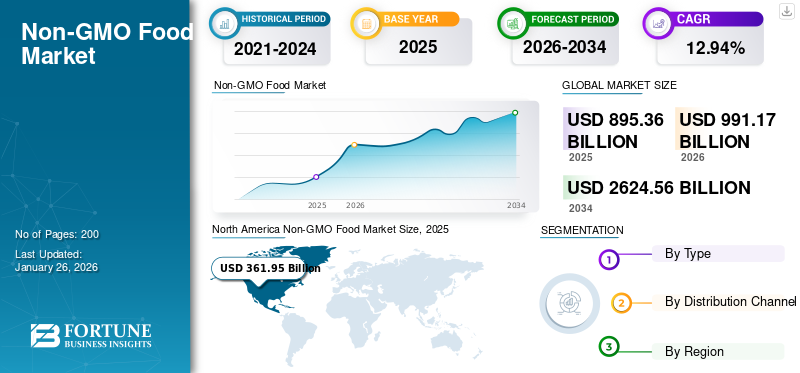
The global non-GMO food market size was USD 895.36 billion in 2025 and is projected to grow from USD 991.17 billion in 2026 to USD 2,624.56 billion by 2034, growing at a CAGR of 12.94% during the 2026-2034 period. North America dominated the non-gmo food market with a market share of 40.43% in 2025. Moreover, the non-GMO food extract market size in the U.S. is projected to grow significantly, reaching an estimated value of USD 594.51 billion by 2032, driven by strong economic growth leading to increased purchasing power of the consumers.
Non-genetically modified organisms (non-GMO) food is prepared without ingredients derived from genetically engineered organisms. The rising awareness amongst customers regarding the health benefits of non-GMO food consumption is anticipated to drive market growth. Moreover, environmentally-conscious consumers are willing to pay a much higher price for sustainable products such as non-GMO and locally-produced foods since ethical considerations are becoming important in their decision-making process. Several organizations are encouraging farmers to grow non-GMO food, which is also likely to support the market growth in the forthcoming years.
The coronavirus pandemic has had a profound influence on the non-GMO food industry. Customers are turning towards natural food ingredients as they look more closely at nutrition, wellness, and personal health. The pandemic is anticipated to change the global non-GMO food industry, with several trends affecting the further development of non-GMO agriculture in several ways. The pandemic has helped various manufacturers strongly comprehend the correlation between nutrition and health in front of consumers. This has contributed to a considerable increase in the number of consumers. The consumer base is predicted to increase at a decent pace in the upcoming years.
The sector's most significant problems in 2020 were restricted movement, lockdowns, and border closures, which led to a decline in the supply from the product manufacturing companies across the board. Import and production of raw materials slowed down, hampering the overall output. Along with this, limitation in the workforce due to initial lockdowns has also affected the industry performance. As these limitations are not continued for an extended period, these supply chain shortages will not create a ripple effect on the marketplace.
Download Free sample to learn more about this report.
Non-GMO Food Market Key Takeaways
 Global Market Size & Forecast
- 2025 Market Size: USD 895.36 Billion
- 2026 Market Size: USD 991.17 Billion
- 2034 Forecast Market Size: USD 2,624.56 Billion
- CAGR: 12.94% from 2026–2034
 Market Share
- North America dominated the market with a 40.43% share in 2025.
- Fruits & vegetables are projected to account for 38.50% of the market by type in 2026.
- Hypermarkets/supermarkets are expected to hold 48.63% of the market by distribution channel in 2026.
 Key Regional Highlights
North America
North America generated USD 361.95 billion in 2025, accounting for 40.43% of the global market.
Europe
Europe reached USD 339.88 billion in 2025, representing 37.96% of global revenue.
Asia Pacific
Asia Pacific recorded USD 129.19 billion in 2025, contributing 14.43% of the global market.
U.S.
The market is projected to reach USD 350.44 billion in 2026.
Japan
The market is projected to reach USD 33.39 billion in 2026.
Read More

Non-GMO Food Market Trends
Market Players Emphasize Creating Name and Brand Awareness
Creating a name and brand awareness through digitalization is the latest trend in the industry. But if companies don’t have a huge marketing budget to do a heavy advertising push like the larger companies. In that case, they can find attention-getting strategies to generate unpaid publicity or collaborate with a well-known company. For instance, tout the company as environmentally conscious by asking consumers to return their bottles to you for recycling and publicize the program with a press release to local and national newspapers. The company can enter into a joint marketing agreement so that its name and products can become famous, gain inroads into its consumer base, and share expenses.
Additionally, government organizations have joined hands with companies to promote and educate the benefits of non-GMO food products. It will shape the market in the near future. For instance, in February 2021, the European Non-GMO Industry Association, a newly formed association to promote non-GMO food products, proposed to expand GMO-free production across EU states.
Download Free sample to learn more about this report.
Non-GMO Food Market Growth Factors
Significant Increase in Certified Non-GMO Processors to Augment Market Share
The non-GMO food industry is moving from being a niche market to a mainstream market within the food and beverage industry. The increasing number of consumers inclined towards purchasing sustainable food is encouraging prominent food producers to get a certification for sustainability and non-GMO ingredients to increase their consumer base. For instance, in December 2023, African Dream Foods, a sauces and condiments manufacturing company, received the non-GMO project verification for its entire line of eight sauces, three spicy salts, and one smoky seasoning. In August 2023, Arla Foods Ingredients, a global dairy products manufacturer, received the certificate from the Non-GMO Project for its milk protein brand – MicelPure. Several organizations and government bodies, such as The Non-GMO Project, NSF International, and USDA encourage food processors to get Non-GMO certification, which is likely to support market growth.
Rising Investment in Research and Development Activities to Support Market Growth
The increasing investments by market players and associations in the research and development of innovative products are projected to positively impact the market's growth. For instance, in September 2021, Nature's Path announced the launch of a new keto line of granolas and cereal. The novel range of Keto products includes a couple of organic keto cereals and three new Ketola Crunch granolas. All of Nature's Path's new keto products are non-GMO, gluten-free, 100% organic, plant-based, dairy-free, and do not contain any artificial sweeteners or flavors.
The companies are embarking on digitalization to diversify their consumer offering and increase their presence across the globe. For instance, in April 2021 - United Natural Foods introduced a Community Marketplace, a business-to-business digital e-commerce solution for developing brands that want to expand distribution with UNFI customers. This virtual marketplace will help manufacturers gain immediate access to UNFI's digital infrastructure to sell and promote their products to UNFI's broad customer base.
RESTRAINING FACTORS
Presence of Competing Labels is Expected to Hinder Market Growth
Non-GMO is the dominant eco-label; nonetheless, the food and beverage industry has more than 150 labels that symbolize sustainable/ethical attributes. Consumers now have various options to buy food and beverage with any sustainability or health aspects. In terms of ethical labels, there is competition from organic, natural, vegan, and free-from foods. The presence of competing labels is expected to restrain the market growth in the upcoming years. Furthermore, another major issue is that manufacturers and retailers must worry about maintaining a steady supply of non-GMO raw materials. The producers should take extra precautions to source and secure reliable quantities of non-GMO ingredients for product manufacturing.
Non-GMO Food Market Segmentation Analysis
By Type Analysis
Consumer Demand for Non-GMO Fruits & Vegetables will Propel Market Forward
Based on type, the market is divided into cereals & nuts, fruits & vegetables, meat & poultry products, beverages, dairy products, processed food, and others. The fruits & vegetable segment is anticipated to hold a dominant market share of 38.50% in 2026. Fruits and vegetables have become an essential part of the wholesome diet. The rising per capita consumption and increasing demand for premium quality fruits and vegetables are anticipated to support the segment's growth. The increasing aging population and the upsurge in life expectancy have boosted demand for non-GMO fresh products across the globe.
Meat and poultry products, especially eggs, are anticipated to grow at a significant pace. The increasing health consciousness among customers and rising demand for protein-rich food are expected to increase non-GMO meat and poultry products. In addition, other segments, including baby or infant food, edible oil, and others, are also witnessing steady growth. The increasing focus of prominent as well as niche market’s key players on the launch of novel non-GMO products is anticipated to support the segment's growth. For instance, in January 2021, The India-based company, Timios, entered into the manufacturing of baby or infant food with a new 'Made to Order' Porridge range for infants and toddlers. All the ingredients used for manufacturing baby food products are organic and non-GMO certified.
By Distribution Channel Analysis
To know how our report can help streamline your business, Speak to Analyst
Online Sales of Non-GMO Food to Surge owing to Ease and Convenience
On the basis of distribution channels, the market is categorized into hypermarkets/supermarkets, specialty stores, online retail stores, and others. The retail sector of the world is enormous. The presence of many supermarkets and hypermarkets located throughout the world will typically adapt business models to increase their consumer reach. The retail sector continues to adapt and change, with e-commerce becoming the latest trend in the industry.
The hypermarkets/supermarkets segment is expected to lead the market, contributing 48.63% in 2026. As the demand for non-GMO goods and products continues to climb, these stores are devoting more shelf space to the non-GMO brands that appeal to conscientious shoppers. Furthermore, sometimes they also offer home delivery and freebies to attract consumers. These factors are anticipated to support the product sales from these stores.
The online retail stores segment is likely to grow at a flourishing CAGR in the upcoming years. The trend of shopping for food items from E-commerce has exploded across the globe in recent years. Customers value the convenience that e-commerce brings them, mainly residents in more rural areas without access to certain goods. The online retail sector has evolved to become a new norm in the market, aided by the COVID-19 pandemic, which witnessed a significant shift towards E-commerce. Recently Amazon has launched its Amazonfresh service, which aims to facilitate the rapid delivery of fresh foods all across the globe. Such initiatives taken by major e-commerce stores are likely to support the segment’s growth.
REGIONAL INSIGHTS
North America Non-GMO Food Market Size, 2025 (USD Billion)
To get more information on the regional analysis of this market, Download Free sample
North America
In 2025, North America represented USD 361.95 billion, accounting for 40.43% of the worldwide market, and is projected to grow to USD 399.77 billion in 2026. Strong economic growth and rising urbanization in North America are driving rapid growth in the middle class and the purchasing power of its approx. 500 million consumers. In the U.S., big grocery stores that demonstrate personal interest in environmental and human health are more likely to offer these products in their stores, likely to support the regional market's growth. Moreover, strong and increasing consumer awareness of health and environmental issues, including a rising resistance amongst customers towards food products made with genetically modified organisms and GM farming, is expected to drive the market. The U.S. market is projected to reach USD 350.44 billion by 2026.
To know how our report can help streamline your business, Speak to Analyst
Europe
The Europe market generated USD 339.88 billion in 2025, representing 37.96% of the global market landscape, and is expected to reach USD 376.05 billion in 2026. The retail sector's gradually aggressive and targeted marketing and promotion of the products will likely intensify as mainstream retailers move into the non-GMO trade. The wide availability of the product type at every distribution channel is likely to impact the market growth positively. Furthermore, the introduction of good policies from the government to encourage the production and consumption of non-GMO food are likely to have a significant positive impact on the further development of the industry. The increased focus on non-GMO products from the industry itself and from customers is driving the regional market. The UK market is projected to reach USD 27.18 billion by 2026, and the Germany market is projected to reach USD 106.46 billion by 2026.
Asia Pacific
Asia Pacific contributed 14.43% to the global market in 2025, with a valuation of USD 129.19 billion, and is projected to reach USD 144.74 billion in 2026. While there is a major interest in the product among the higher-income, better-educated population in Korea, Japan, and Australia, consumers in China and India drive demand expansion within the region. The Japan market is projected to reach USD 33.39 billion by 2026, the China market is projected to reach USD 49.49 billion by 2026, and the India market is projected to reach USD 12.66 billion by 2026.
South America and Middle East & Africa
South American market continues to grow both in terms of production and sales; in 2020, retail sales were around USD 30.50 billion, and in 2028 it is expected to reach about USD 61.68 billion. Brazil is predicted to have the largest market in the region, with increasing production and rising consumer awareness expands and the market. The Middle East and Africa would witness steady growth in terms of consumption and sales of these products, which would further positively impact the market growth. The Middle East & Africa market was valued at USD 18.57 billion in 2025, capturing 2.07% of global revenue, and is estimated to reach USD 20.28 billion in 2026.
Latin America
The market in Latin America reached USD 45.76 billion in 2025, representing 5.11% of total market revenue, and is projected to reach USD 50.32 billion in 2026.
List of Key Companies in Non-GMO Food Market
Prominent Players are Focusing on Novel Product Development to Expand Business
Cargill Inc., Amy’s Kitchen, Danone S.A., United Natural Foods, and Hormel Food Corporation are focusing on certification and expanding their product portfolio. These companies are investing in the research and development, and marketing of novel products. Similarly, these companies acquire, collaborate, and partner with relevant stakeholders to surge their geographic presence.
- In June 2021 - United Natural Foods revealed its new growth strategy, outlining the pillars of its “Fuel the Future” plan and its major focus on a rising market share through network optimization, stronger innovation, and an improved client experience.
LIST OF KEY COMPANIES PROFILED:
- Cargill Inc. (Minnesota, U.S.)
- Amy’s Kitchen (California, U.S.)
- Danone S.A. (Paris, France)
- United Natural Foods (Rhode Island, U.S.)
- Hormel Food Corporation (Minnesota, U.S.)
- Hain Celestial (New York, U.S.)
- Organic Valley (Wisconsin, U.S.)
- The Kellogg Company (Michigan, U.S.)
- PepsiCo Inc. (New York, U.S.)
- Clif Bar & Company (California, U.S.)
KEY INDUSTRY DEVELOPMENTS:
- November 2023: Myna Snacks, a food products manufacturing company, introduced several new cookies and snacks products. The company’s newly launched Midnight Mini Cookie and other snack products are manufactured from non-GMO and gluten-free ingredients.
- March 2022: Beech-Nut® Nutrition Company, an emerging baby and toddler food manufacturer, launched four new products, including snacks, breakfast blends, and Immune supporting supplements, to expand its portfolio. These new products contain 14 variants. These products are organic and non-GMO-certified infant food products.
- February 2022: Benson Hill, Inc., a global company, launched TruVail™, a new line of domestically sourced, non-GMO plant-based protein ingredients. The company developed this Ultra-High Protein (UHP) soy flour to fulfill the market requirements of rapidly growing alternative plant-based protein.
- November 2021: Protein Industries Canada co-invested in a project that will expand Canada’s meat-alternative product offerings. Merit Functional Foods, Wamame Foods, Winecrush Technology, and Wismettac Asian Foods are partnering to manufacture plant-based, non-soy alternatives to Wagyu beef and pork. The new products will include Canadian-grown crops, non-GMO peas, and canola.
- November 2021: Plant-based foods maker LikeMeat introduced a new product, Like Chick’n Wings. The meat-free wings are packaged with Buffalo sauce for easy preparation and are non-GMO.
REPORT COVERAGE
The market research report includes quantitative and qualitative insights into the global market. It also offers a complete analysis of the non-GMO food market growth forecast, market size, and growth rates for all possible market segments. Several key insights mentioned in the report are an overview of the parent market, competitive landscape, non-GMO food market trends, recent industry developments such as base expansion, the regulatory scenario in critical countries, and key industry trends.
Request for Customization to gain extensive market insights.
Report Scope & Segmentation
|
ATTRIBUTE |
DETAILS |
|
Study Period |
2021-2034 |
|
Base Year |
2025 |
|
Forecast Period |
2026-2034 |
|
Historical Period |
2021-2024 |
|
Unit |
Value (USD Billion) |
|
Growth Rate |
CAGR of 12.94% from 2026 to 2034 |
|
Segmentation |
By Type
By Distribution Channel
By Region
|
Frequently Asked Questions
Fortune Business Insights says that the global market size was USD 991.17 billion in 2026 and is expected to reach USD 2,624.56 billion by 2034.
The market is likely to grow at a CAGR of 12.94% over the forecast period (2026-2034).
Fruits & vegetables is anticipated to be the leading segment during the estimated period.
A significant increase in certified non-GMO processors is the key factor driving the market growth.
Cargill Inc., Amys Kitchen, Danone S.A., United Natural Foods are some of the leading players in the market.
North America dominated the non-gmo food market with a market share of 40.43% in 2025.
Hypermarkets/supermarkets hold the major share in the global market.
Creating a name and brand awareness is the global market trend.



- 2021-2034
- 2025
- 2021-2024
- 200
-
(Offer valid till 15th Oct 2026)
Get 30-60 hrs Free Customization
Expand Regional and Country Coverage, Segments Analysis, Company Profiles, Competitive Benchmarking, and End-user Insights.



















Related Reports
-
US +1 833 909 2966 ( Toll Free )
-
Get In Touch With Us