Non-invasive Spinal Cord Stimulation Market Size, Share & Industry Analysis By Product Type (Stimulation Systems and Accessories), By Technology (Transcutaneous Electrical Spinal Cord Stimulation (tSCS), Transspinal Magnetic Stimulation, and Others), By Stimulation Site (Cervical Spine, Thoracic Spine, and Lumbosacral Spine), By Application (Spinal Cord Injury Rehabilitation, Stroke & Neurological Motor Rehabilitation, Autonomic Dysfunction Management, and Others), By End User (Hospitals, Specialty Clinics, Homecare Settings, and Others), and Regional Forecast, 2026-2034
 Download Free Sample
 Non-invasive Spinal Cord Stimulation Market Size and Future Outlook
 Listen to Audio Version
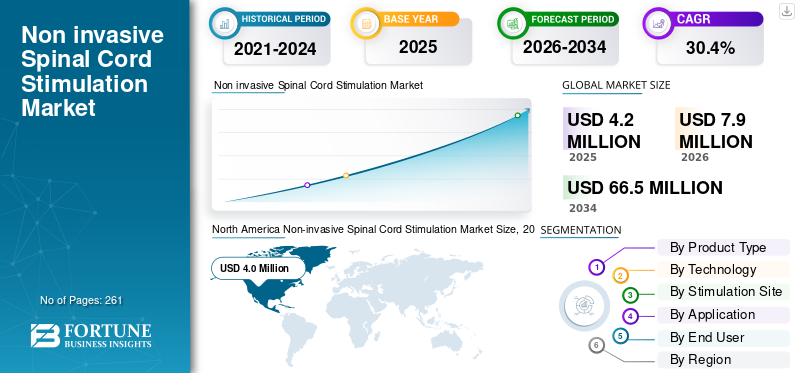
The non-invasive spinal cord stimulation market size was valued at USD 4.2 million in 2025. The market is projected to grow from USD 7.9 million in 2026 to USD 66.5 million by 2034, exhibiting a CAGR of 30.4% during the forecast period. North America dominated the non invasive spinal cord stimulation market with a market share of 95.23% in 2025.
Non-invasive spinal cord stimulation is a treatment that uses electric currents to stimulate the spinal cord through electrodes placed on the skin’s surface over the spine. The increasing prevalence of spinal cord injuries and the expansion of healthcare infrastructure are resulting in a growing adoption rate of these devices in the market. The increasing preference for non-invasive treatment is further increasing the demand for these devices among patients, thereby boosting the adoption rate of non-invasive spinal cord stimulation.
- For instance, according to the 2024 data published by the World Health Organization (WHO), about 15 million people are living with spinal cord injury worldwide.
Furthermore, the rising approval for spinal cord stimulation devices among the major players, such as ONWARD Medical, ANEUVO among others, is further contributing to the demand for these devices in the market.
Download Free sample to learn more about this report.
Non invasive Spinal Cord Stimulation Market Key Takeaways
 Global Market Size & Forecast
- 2025 Market Size: USD 4.2 million
- 2026 Market Size: USD 7.9 million
- 2034 Forecast Market Size: USD 66.5 million
- CAGR: 30.4% from 2026–2034
 Market Share
- North America dominated the market with a 95.23% share, valued at USD 4.0 million in 2025.
- Transcutaneous electrical spinal cord stimulation (tSCS) segment dominated the market with a 97.9% share in 2025.
- Cervical spine segment dominated the market with an 85.9% share in 2025.
 Key Regional Highlights
North America
The market reached USD 4.0 million in 2025, driven by healthcare spending and product approvals.
Asia Pacific
The market is projected to reach USD 0.1 million by 2027, supported by expanding hospital capacity and healthcare access.
Europe
The market is projected to reach USD 0.6 million by 2026, driven by the rising prevalence of spinal cord injuries.
U.S.
The market is projected to reach USD 7.2 million by 2026, driven by strong demand and healthcare investment.
Japan
The market is projected to reach USD 0.01 million by 2027, supported by demand for non-invasive spinal cord stimulation therapies.
Read More

Non-invasive Spinal Cord Stimulation Market Trends
Shift from Implantable Neuromodulation Toward External Stimulation for Rehabilitation is a Prominent Market Trend
The market is shifting from traditional implantable neuromodulation toward external/transcutaneous spinal cord stimulation. These spinal cord stimulators offer deliver stimulation through electrodes placed on the surface of the skin over the spinal cord, resulting in a rising adoption rate of these devices in rehabilitation centers, neurorecovery programs, and potentially home-based therapy.
Additionally, the trend is also supported by clinical evidence. A 2024 Nature Medicine study among 65 participants reported that externally applied electrical stimulation over the cervical spinal cord, along with structured rehabilitation, improved hand and arm function in people with chronic tetraplegia due to spinal cord injury. The pivotal Up-LIFT study included 65 participants across 14 SCI centers in the U.S., Europe, and Canada, showing that non-invasive stimulation is shifting from research settings into structured clinical rehabilitation pathways.
Market Dynamics
Market Drivers
Download Free sample to learn more about this report.
Growing Burden of Spinal Cord Injuries to Fuel Market Growth
The increasing prevalence of spinal cord injuries and others is resulting in the rising demand for non-invasive rechargeable spinal cord stimulator devices. Increasing demand for non-invasive rehabilitation technologies that can improve mobility, sensation, hand function, neurological recovery, and quality of life is resulting in growing demand for these devices globally.
- For instance, according to 2026 data published by the Christopher & Dana Reeve Foundation (CDRF), the annual incidence of spinal cord injury (SCI) is approximately 54 cases per one million people in the U.S.
This, along with an expansion of healthcare infrastructure and a growing number of product approvals, is further augmenting the market expansion. The growing focus of key companies on introducing R&D activities to launch innovative devices, are anticipated to boost the non-invasive spinal cord stimulation market growth.
Market Restraints
Limited Reimbursement Policies Hampers Market Growth
The inadequate reimbursement policies are a key restraint for the global market, as the payer coverage pathways are not yet standardized. The non-invasive spinal cord stimulation has received regulatory approval for improving hand sensation and strength in chronic incomplete cervical spinal cord injury; however, the reimbursement framework typically limits the adoption rate. This results in delayed purchasing decisions by outpatient neurorehabilitation centers, rehabilitation hospitals, and homecare users.
The ARC-EX non-invasive spinal cord stimulation device is used together with standardized functional task practices, showcasing that the total cost of therapy may include the device, clinician time, training, rehabilitation sessions, and follow-up, resulting in a growing cost among the patient population. Therefore, increasing costs and a lack of reimbursement framework is restraining the overall market growth.
Market Opportunities
Expansion of Healthcare Infrastructure offers Lucrative Market Opportunities
There is a rapid expansion of healthcare settings in developing economies, including Brazil, India, and others. The growing burden of spinal cord injuries and paralysis, expansion of healthcare infrastructure, growing number of hospitals and rehabilitation centers are consequently increasing the adoption of non-invasive spinal cord stimulation treatment in the healthcare settings.
- According to 2023 data published by Valley Forge, there are about 28,900 rehabilitation centers in the U.S.
Market Challenges
Limited Healthcare Access in Developing Countries to Limit Market Growth
There is a growing demand for non-invasive spinal cord stimulation treatment among the patient population. However, a shortage of technologically advanced non-invasive SCS devices, limited healthcare expenditure, along with inadequate reimbursement policies, especially in developing countries, is resulting in limited access to healthcare facilities among the patient population. Moreover, a limited number of clinical facilities and limited trained professionals, among others, are some of the vital factors, resulting in the limited adoption of spinal cord stimulation devices, especially in emerging nations, such as China, Brazil, among others.
- For instance, according to 2023 data published by The World Bank Group (WBG), approximately 4.5 billion people lack full access to essential health services worldwide.
SEGMENTATION ANALYSIS
By Product Type
Increasing Number of Surgical Procedures Led to the Handheld Segment Dominance
Based on the product type, the market is classified into stimulation systems and accessories.
To know how our report can help streamline your business, Speak to Analyst
The stimulation systems segment held the largest non-invasive spinal cord stimulation market share in 2025. The growth is due to the increasing prevalence of spinal cord injuries among patients, resulting in a rising demand for non-invasive spinal cord stimulation devices worldwide. This, coupled with the growing focus of key companies on launching novel devices, is further anticipated to contribute to the segment’s dominance.
The accessories segment is expected to grow at a CAGR of 35.9% over the forecast period.
By Technology
Increasing Approval for Transcutaneous Electrical Spinal Cord Stimulation Based Devices Led to the Segment’s Dominance
Based on technology, the market is segmented into transcutaneous electrical spinal cord stimulation (tSCS), transspinal magnetic stimulation, and others.
The transcutaneous electrical spinal cord stimulation segment dominated the global market in 2025 and held a share of 97.9%. This growth is due to the increasing clinical validation and regulatory approval for this technology among key companies, resulting in a growing demand for non-invasive SCS devices based on this technology.
The segment of transspinal magnetic stimulation is set to flourish with a growth rate of 47.7% across the forecast period.
By Stimulation Site
Increasing Prevalence of Cervical Spinal Cord Injury Led to the Dominance of Cervical Spine Segment
Based on the stimulation site, the market is segmented into cervical spine, thoracic spine, and lumbosacral spine.
The cervical spine segment dominated the global market in 2025 and held the share of 85.9%. This growth is due to the increasing prevalence of cervical spine cord injuries, and the benefits of non-invasive treatment options are resulting in a growing adoption rate for these devices, thereby contributing to the segmental growth.
The thoracic spine segment is expected to growth with a CAGR 32.3% during the forecast period.
By Application
Growing Adoption of Non-Invasive SCS Devices for Spinal Cord Injury Rehabilitation leads to Segment’s Dominance
Based on application, the market is segmented into spinal cord injury rehabilitation, stroke & neurological motor rehabilitation, autonomic dysfunction management, and others.
The spinal cord injury rehabilitation segment dominated the global market in 2025. with a share of 48.9%. The growth is due to the strong clinical emphasis of non-invasive SCS systems on restoring functional outcomes in patients with spinal cord injury, especially upper-limb function, and others. This, along with the adoption of these devices for rehabilitation, is contributing to the segmental growth in the market.
The autonomic dysfunction management segment is set to grow with a CAGR of 33.5% over the forecast period.
By End-user
Increasing Number of Hospitals Led to the Segmental Dominance
Based on end user, the market is sub-segmented into hospitals, specialty clinics, homecare settings, and others.
The hospitals segment dominated the market in 2025. The increasing prevalence of spinal cord injuries and paralysis, the growing number of hospitals, increasing healthcare expenditure, among others, are some of the crucial factors supporting the growth of the segment in the market. Furthermore, the segment is set to hold an 82.9% share in 2026.
- For instance, according to 2025 data published by the Statistisches Bundesamt, there are about 1,874 hospitals in Germany.
In addition, specialty clinics’ end users are projected to grow at a 31.2% CAGR during the forecast period.
Non-invasive Spinal Cord Stimulation Market Regional Outlook
Based on region, the market has been studied across North America, Europe, Asia Pacific, Latin America, and the Middle East & Africa.
North America
North America Non-invasive Spinal Cord Stimulation Market Size, 2025 (USD Million)
To get more information on the regional analysis of this market, Download Free sample
The North America market held the dominant share in 2024, valued at USD 0.1 million, and also took the leading share in 2025 with USD 4.0 million. The increasing prevalence of chronic conditions, increasing healthcare spending, and rising number of product approvals, are some of the factors supporting regional market growth.
- For instance, according to 2024 statistics published by the Centers for Medicare & Medicaid Services, the healthcare expenditure is about USD 5.3 trillion in the U.S.
U.S. Non-invasive Spinal Cord Stimulation Market
Based on North America’s strong contribution, the U.S. market can be analytically approximated at around USD 7.2 million in 2026, accounting for roughly 90.8% of global sales.
Europe
Europe is projected to record a growth rate of 42.8% in the coming years, which is the second highest among all regions, and reach a valuation of USD 0.6 million by 2026. The growing prevalence of spinal cord injuries is likely to support the market growth.
U.K. Non-invasive Spinal Cord Stimulation Market
The U.K. market in 2026 is estimated at around USD 0.1 million, representing roughly 1.4% of global revenues.
Germany Non-invasive Spinal Cord Stimulation Market
Germany market is projected to reach approximately USD 0.2 million in 2026, equivalent to around 2.6% of global sales.
Asia Pacific
The Asia Pacific market is currently in the research and early-development phase, with commercial growth anticipated to gain momentum from 2027 onward; accordingly, Asia Pacific is projected to account for approximately USD 0.1 million in 2027. The expanding hospital capacity and rising healthcare access are expected to support the growth of the market.
Japan Non-invasive Spinal Cord Stimulation Market
The Japan market in 2027 is estimated at around USD 0.01 million, accounting for roughly 0.1% of global revenues. Japan has historically reported a relatively high prevalence of spinal cord injuries, with a huge demand for non-invasive treatment.
China Non-invasive Spinal Cord Stimulation Market
China’s market is projected to be one of the largest worldwide, with 2026 revenues estimated at around USD 0.01 million, representing roughly 0.1% of global sales.
India Non-invasive Spinal Cord Stimulation Market
The India market in 2026 is estimated at around USD 0.01 million, accounting for roughly 0.1% of global revenues.
Latin America and Middle East & Africa
The Latin America and Middle East & Africa regions are expected to witness moderate growth during the forecast period. The Latin America market is set to reach a valuation of USD 0.03 million in 2029. The growth is due to the gradual growth tied to public healthcare investment and growing adoption of these systems for pain management and other applications in the region. Middle East & Africa is also expected to grow due to increasing demand for non-invasive spinal cord stimulation therapies and rising R&D activities among the key companies to strengthen their presence in the market. In the Middle East & Africa, the GCC is set to reach a value of USD 0.02 million in 2029.
South Africa Non-invasive Spinal Cord Stimulation Market
The South Africa market is projected to reach around USD 0.005 million in 2026, representing roughly 0.02% of global revenues.
Competitive Landscape
Key Industry Players
Increasing Number of SCS Device Approvals to Support Key Player’s Dominating Position
A robust and diversified product portfolio, coupled with a strong focus on inorganic growth strategies globally, is one of the key factors contributing to the dominance of key companies in the market. ONWARD Medical and ANEUVO are major companies in the market. Moreover, the growing focus of key companies on receiving product approvals for non-invasive spinal cord stimulation systems is likely to strengthen their presence and contribute to market growth.
- For instance, in November 2025, ONWARD Medical, the neurotechnology company to restore movement and function in people with spinal cord injuries (SCI) and other movement disabilities, received 510(k) approval to expand the ARC-EX System indication for home use in the U.S.
Other key players, including ANEUVO, are also growing in the market, primarily due to their increasing focus on R&D activities to strengthen their non-invasive SCS devices channel in the market.
List of Key Non-invasive Spinal Cord Stimulation Companies Profiled
- ONWARD Medical (Switzerland)
- ANEUVO (U.S.)
- SpineX Inc. (U.S.)
- COSIMA (Russia)
- University of Washington (U.S.)
- Kessler Foundation (U.S.)
- University of Louisville (U.S.)
- University of Miami (U.S.)
KEY INDUSTRY DEVELOPMENTS
- April 2026: ANEUVO, a medical technology company advancing non-invasive neuromodulation for people living with spinal cord injury, announced FDA approval for its ExaStim Stimulation System, marking a key milestone in the company’s commercial strategy.
- October 2025: VIVATRONIX Tech and SpineX Inc., received approval from India’s Central Drugs Standard Control Organisation (CDSCO) for the xStep device to treat individuals with paralysis.
- April 2025: ANEUVO received CE Mark certification for ExaStim, the transcutaneous spinal stimulation therapy broadly approved in the European market for adult spinal cord injury.
- March 2025: ImagineHealth Co., Ltd., partnered with Vivatronix Technologies Pvt. Ltd., the exclusive license holder of SpineX technologies, to bring xStep— a non-invasive spinal cord neurostimulation device into international markets.
- January 2025: ONWARD Medical announced the first commercial sales of its ARC-EX System in the U.S. This helped the company to increase its brand presence.
- December 2024: ONWARD Medical received U.S. FDA de novo classification and U.S. market authorization for ARC-EX non-invasive spinal cord stimulation system for people with chronic spinal cord injury.
- October 2024: ONWARD Medical, the medical technology company announced its investigational ARC-EX System has been named one of TIME's Best Inventions of 2024.
- September 2024: ONWARD Medical, the neurotechnology company to restore movement and function, received CE Mark certification for its ARC-EX System under the European Union Medical Device Regulation (MDR), enabling commercialization in the European Union and certain other countries.
- March 2022: ONWARD Medical, the medical technology company creating innovative therapies to restore movement, independence, and health in people with spinal cord injury, initiated enrollment in the LIFT Home Study for ARCEX Therapy.
REPORT COVERAGE
The report provides a detailed non-invasive spinal cord stimulation market analysis and focuses on key aspects such as leading companies and market segmentation, including product type, technology, stimulation site, application, and end user. Besides this, the global report offers insights into the market growth trends and highlights key industry developments. In addition to the aforementioned factors, the report encompasses several factors that have contributed to the growth and advancement of the market over recent years.
Request for Customization to gain extensive market insights.
Report Scope & Segmentation
| ATTRIBUTE | DETAILS |
| Study Period | 2021-2034 |
| Base Year | 2025 |
| Estimated Year | 2026 |
| Forecast Period | 2026-2034 |
| Historical Period | 2021-2024 |
| Growth Rate | CAGR of 30.4% from 2026-2034 |
| Unit | Value (USD Million) |
| Segmentation | By Product Type, Technology, Stimulation Site, Application, End User, and Region |
| By Product Type |
|
| By Technology |
|
| By Stimulation Site |
|
| By Application |
|
| By End User |
|
| By Region |
|
Frequently Asked Questions
Fortune Business Insights says that the global market size was USD 4.2 million in 2025 and is projected to reach USD 66.5 million by 2034.
In 2025, the North America regional market value stood at USD 4.0 million.
Growing at a CAGR of 30.4%, the market will exhibit steady growth over the forecast period (2026-2034).
By product type, the stimulation systems segment is the leading segment in this market.
The introduction of novel non-invasive spinal cord stimulation devices is one of the major factors driving the market's growth.
ONWARD Medical and ANEUVO are the major players in the global market.
North America held the highest share of the market.
The growing prevalence of spinal cord injuries, the increasing technological advancements in devices, among others, are some of the vital factors expected to boost the adoption of these products worldwide.



- 2021-2034
- 2025
- 2021-2024
- 261
Get 30-60 hrs Free Customization
Expand Regional and Country Coverage, Segments Analysis, Company Profiles, Competitive Benchmarking, and End-user Insights.













.webp)






Related Reports
-
US +1 833 909 2966 ( Toll Free )
-
Get In Touch With Us