Nootropic Foods Market Size, Share & Industry Analysis, By Product Type (Functional Snacks, Bars & Bites, Bakery & Cereals, Dairy & Yogurt Products, and Confectionery), By Functionality (Energy & Alertness, Stress Relief & Mood Support, Cognitive Aging Support, Sleep & Relaxation Support, and Memory & Mental Health), By Ingredient Type (Omega-3 Fatty Acids, Caffeine, Probiotics & Prebiotics, Vitamins & Minerals, and Herbal/Botanical Extracts), By Distribution Channel (Supermarkets/Hypermarkets, Specialty Stores, and Pharmacies/Drug Stores), and Regional Forecast, 2026-2034
 Download Free Sample
(Offer valid till 31st Oct 2026)

Nootropic Foods Market Size and Future Outlook
 Listen to Audio Version
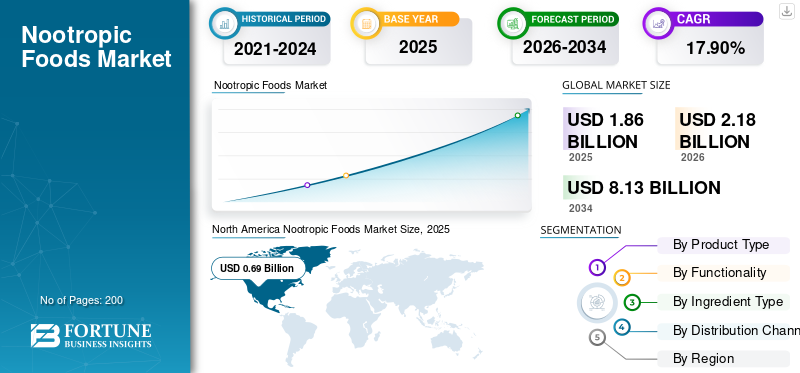
The global nootropic foods market size was valued at USD 1.86 billion in 2025. The market is projected to grow from USD 2.18 billion in 2026 to USD 8.13 billion by 2034, exhibiting a CAGR of 17.90% during the forecast period. North America dominated the nootropic foods market with a market share of 37.09% in 2025.
Nootropic foods refer to packaged food products positioned to support focus, alertness, memory, mood balance, stress relief, relaxation, sleep quality, cognitive aging support, and sustained mental performance. These products are generally formulated as functional snacks, bars, bites, bakery and cereal products, dairy and yogurt products, confectionery, and ready-to-eat foods containing ingredients such as omega-3 fatty acids, caffeine, probiotics and prebiotics, vitamins and minerals, amino acids, and herbal or botanical extracts.
The market is gaining momentum, owing to growing consumer preference for food-based functional solutions instead of pills or capsules for daily wellness routines. Rising stress levels, sleep concerns, hybrid work patterns, demand for convenient nutrition, and increasing awareness of gut-brain health are encouraging manufacturers to develop nootropic snacks, fortified bars, probiotic yogurts, amino acid-rich foods, caffeine-infused bites, and botanical-based functional foods.
The global market is supported by the presence of leading companies and brands such as Nestlé S.A., PepsiCo, Inc., General Mills, Inc., Danone S.A., and Mondelēz International, Inc. These companies maintain an active position across functional snacks, fortified cereals, probiotic dairy, nutrition bars, wellness foods, plant-based functional products, and convenient health-oriented packaged foods.
Download Free sample to learn more about this report.
Nootropic Foods Market Key Takeaways
 Global Market Size & Forecast
- 2025 Market Size: USD 1.86 billion
- 2026 Market Size: USD 2.18 billion
- 2034 Forecast Market Size: USD 8.13 billion
- CAGR: 17.90% (2026–2034)
 Market Share
- North America dominated the market with a 37.09% share in 2025.
- The amino acids segment is projected to register the fastest growth at a 20.17% CAGR during the forecast period.
- The sleep & relaxation support segment is projected to register the fastest growth at a 20.86% CAGR during the forecast period.
 Key Regional Highlights
Asia Pacific
Asia Pacific generated USD 0.47 billion in 2025 and is projected to reach USD 2.24 billion by 2034, registering the fastest growth at a 19.04% CAGR.
North America
North America generated USD 0.69 billion in 2025 and is projected to reach USD 2.89 billion by 2034.
Europe
Europe generated USD 0.52 billion in 2025 and is projected to reach USD 2.30 billion by 2034, growing at an 18.09% CAGR.
U.S.
U.S. market reached approximately USD 0.63 billion in 2025.
Japan
Japan market is projected to witness significant growth during the forecast period.
Read More

Nootropic Foods Market Trends
Functional Snacks, Mood Support Foods, and Gut-Brain Function Positioning to Shape Industry Trends
A major trend shaping the market is the movement from general healthy snacking toward targeted functional eating. Consumers are increasingly looking for foods that can fit into daily work, study, fitness, and evening routines while also supporting perceived cognitive wellness, energy balance, calmness, and recovery. This is strengthening demand for functional snacks, protein and nutrition bars, probiotic yogurts, fortified cereals, omega-3 foods, vitamin-enriched products, and botanical-infused snack formats.
Gut-health positioning is also becoming closely linked with cognitive health. Probiotics, prebiotics, fermented dairy, and fiber-rich foods are increasingly marketed around digestive wellness, immune support, and broader well-being. The Food and Agriculture Organization (FAO) has noted that consumers in many countries are increasingly turning to food supplements and functional or health foods as part of diets intended to support individual health and well-being, while also emphasizing the need for proper safety assessment, dosage clarity, and transparent labeling for functional ingredients.
- According to the National Center for Health Statistics, 57.6% of U.S. adults used at least one dietary supplement in the past 30 days during 2017–2018, with multivitamin-mineral products most common, followed by vitamin D and omega-3 fatty acid products.
MARKET DYNAMICS
Market Drivers
Download Free sample to learn more about this report.
Rising Consumer Focus on Mental Wellness, Sleep, and Daily Energy is Driving Market Growth
One of the strongest drivers of the global nootropic foods market growth is the increasing consumer focus on mental wellness, stress management, better sleep, and sustained energy. Modern lifestyles, long screen exposure, irregular eating patterns, and work-related fatigue are encouraging consumers to choose functional foods that are easier to integrate into daily routines than supplements. Sleep-related concerns are a particularly important demand driver for relaxation and evening-positioned nootropic ingredients.
- According to the Centers for Disease Control and Prevention, insufficient sleep among U.S. adults remained high in 2022, with men at 37% and adults aged 45–64 at 39%, showing a large consumer base for foods positioned around relaxation and sleep support.
Market Restraints
Scientific Claim Limitations, Ingredient Dosage Concerns, and Regulatory Scrutiny May Limit Market Expansion
A major restraint affecting the global market growth is the difficulty of substantiating cognitive, mood, sleep, and performance-related claims in food products. While consumers are interested in brain health and daily mental performance, food companies must be careful with claims related to memory, focus, stress relief, sleep, and mood support. Many products rely on structure-function style positioning, but stronger clinical or disease-related claims require more rigorous substantiation.
The Food and Agriculture Organization (FAO) has specifically highlighted that functional foods and food supplements require careful attention to safety considerations, including interactions, appropriate dosage, ingredient concentration, and safety assessment for ingredients that do not have a long history of consumption. This is especially relevant for nootropic foods containing botanicals, adaptogens, high-caffeine ingredients, or concentrated amino acids.
- The European Food Safety Authority explains that its health-claim evaluation helps ensure claims made on food labels and advertising are meaningful and accurate. EFSA also reports that it published 341 opinions covering 2,758 general-function health claims under Article 13, showing the scale and rigor of scientific evaluation required for food health claims in Europe.
Market Opportunities
Online Retail, Personalized Nutrition, and Routine-based Functional Snacking to Create New Growth Potential
A major opportunity in the global market lies in the expansion of online retail and routine-based functional snacking. Nootropic foods are well-suited to e-commerce as consumers often search for specific benefits such as focus, mood support, sleep, energy, memory, gut health, and stress relief. This makes online retail an important discovery channel for emerging brands, subscription packs, variety bundles, and targeted functional snack formats.
Online retail is projected to be the fastest-growing distribution channel, supported by direct-to-consumer models, targeted digital marketing, influencer-led wellness education, and repeat-purchase subscriptions for bars, bites, fortified snacks, and functional dairy alternatives.
The personalized nutrition trend also creates an opportunity for differentiated product positioning. FAO has identified personalized nutrition, food supplements, and functional foods as an evolving area where consumers are increasingly using products to support individual health and well-being.
- For instance, in January 2025, M&S launched its Brain Food range in the U.K., developed with nutrition criteria in consultation with the British Nutrition Foundation. The range champions brain-health-supporting nutrients, including omega-3 DHA, iron, iodine, folate, zinc, and vitamin B12. Products include smoothies, kefir yogurt, yogurt pouches, granola, mixed berry bars, berry balls, nut butter, salmon salad, and kefir shots.
SEGMENTATION ANALYSIS
By Product Type
Functional Snacks Dominated Market Due to Their Strong Convenience and Better Daily Use Frequency
Based on product type, the market is segmented into functional snacks, bars & bites, bakery & cereals, dairy & yogurt products, confectionery, ready-to-eat foods, and others.
The functional snacks segment dominated the global nootropic foods market share with USD 0.46 billion in 2025, owing to its strong fit with between-meal consumption, office snacking, school and college routines, fitness lifestyles, and digital work patterns. Functional snacks are easier to position around focus, alertness, mood support, stress relief, and energy, as they can be consumed at specific need states during the day. The segment also benefits from strong innovation in nut mixes, protein snacks, fortified chips, granola clusters, seed-based snacks, and botanical-infused snack products. Functional snacks are also projected to grow at the fastest CAGR of 18.54% from 2026 to 2034.
Bars & bites are the second fastest-growing segment with a CAGR of 17.97% over the forecast period.
To know how our report can help streamline your business, Speak to Analyst
By Functionality
Energy & Alertness Segment Dominated Market Due to Strong Demand from Work, Study, Sports, and Daily Productivity Occasions
Based on functionality, the market is segmented into energy & alertness, stress relief & mood support, cognitive aging support, sleep & relaxation support, memory & mental health, and performance & endurance support.
The energy & alertness segment dominated the global market with USD 0.41 billion in 2025. The segment growth is driven by strong demand from working professionals, students, gamers, fitness consumers, and active adults seeking sustained energy through food-based formats. Products in this segment commonly use caffeine, B vitamins, amino acids, protein, complex carbohydrates, and botanical ingredients to support alertness and daily performance positioning.
The sleep & relaxation support segment is projected to grow at the fastest CAGR of 20.86% from 2026 to 2034.
By Ingredient Type
Omega-3 Fatty Acids Dominated Market Due to Their Broad Use in Fortified Foods
Based on ingredient type, the market is segmented into omega-3 fatty acids, caffeine, probiotics & prebiotics, vitamins & minerals, amino acids, herbal/botanical extracts, and others.
The omega-3 fatty acids segment dominated the global market with USD 0.37 billion in 2025, due to strong consumer recognition of omega-3 ingredients in brain, heart, and general wellness positioning. Omega-3 ingredients are used in fortified dairy, bars, cereals, snacks, and other functional food formats.
The amino acids segment is projected to grow at the fastest CAGR of 20.17% from 2026 to 2034.
By Distribution Channel
Supermarkets/Hypermarkets Segment Dominated Market Due to Strong Shelf Visibility and Mainstream Functional Food Availability
Based on the distribution channel, the market is segmented into supermarkets/hypermarkets, specialty stores, pharmacies/drug stores, convenience stores, online retail, and others.
The supermarkets/hypermarkets segment dominated the global market with USD 0.65 billion in 2025. The segment growth is attributed to strong shelf visibility, broad household penetration, established packaged food aisles, and growing placement of functional snacks, nutrition bars, fortified cereals, probiotic dairy, and health-positioned confectionery. Large retailers allow nootropic foods to reach mainstream consumers who may not actively search for supplements but are willing to try functional food options during routine grocery shopping.
The online retail segment is projected to grow at the fastest CAGR of 20.58% from 2026 to 2034.
Nootropic Foods Market Regional Outlook
Regionally, the market is studied across North America, Europe, Asia Pacific, South America, and the Middle East & Africa.
North America
North America Nootropic Foods Market Size, 2025 (USD Billion)
To get more information on the regional analysis of this market, Download Free sample
North America led the market with USD 0.69 billion in 2025. The region is projected to reach USD 2.89 billion by 2034, growing at a CAGR of 17.19% during the forecast period. Growth is driven by high consumer awareness of functional foods, strong demand for energy and focus snacks, rising interest in sleep and stress-support foods, high protein snack penetration, and broad availability of nutrition bars, fortified cereals, probiotic yogurts, and functional snacks across mass retail and online channels.
U.S. Nootropic Foods Market
The U.S. dominates the North American market, valued at approximately USD 0.63 billion in 2025, supported by strong demand for functional snacks, energy bars, probiotic dairy, fortified cereals, cognitive wellness foods, and sleep-support products.
Europe
Europe was valued at USD 0.52 billion in 2025 and is projected to reach USD 2.30 billion by 2034, growing at a CAGR of 18.09% during the forecast period. Growth is supported by rising demand for fortified foods, functional dairy, probiotic products, clean-label snacks, botanical ingredients, healthy aging products, and mood-support formulations.
Germany Nootropic Foods Market
Germany was valued at approximately USD 0.13 billion in 2025, supported by strong demand for functional snacks, fortified cereals, probiotic dairy products, natural foods, and herbal wellness-positioned products.
U.K. Nootropic Foods Market
The U.K. market was valued at approximately USD 0.10 billion in 2025, driven by demand for functional bars, protein snacks, fortified breakfast products, probiotic dairy, and mental wellness-oriented foods.
Asia Pacific
Asia Pacific was valued at USD 0.47 billion in 2025 and is projected to reach USD 2.24 billion by 2034, growing at the fastest CAGR of 19.04% during the forecast period. Growth is driven by rising urbanization, increasing disposable income, strong snacking frequency, expanding e-commerce, higher awareness of functional foods, and growing demand for energy, focus, stress relief, and healthy aging products.
China Nootropic Foods Market
China was valued at approximately USD 0.17 billion in 2025, supported by strong e-commerce penetration, rising demand for functional snacks, growing interest in healthy aging, and increasing consumption of fortified foods and probiotic products.
India Nootropic Foods Market
India was valued at approximately USD 0.08 billion in 2025, supported by rising health awareness, growing packaged snack consumption, increasing demand for functional bars and fortified foods, and expanding online grocery and wellness retail.
South America and Middle East & Africa
South America was valued at USD 0.10 billion in 2025 and is projected to reach USD 0.46 billion by 2034, growing at a CAGR of 18.63% during the forecast period. Growth in the region is driven by rising demand for healthy snacks, fortified foods, protein bars, probiotic dairy, and affordable functional products. Although the market is smaller than North America, Europe, and the Asia Pacific, urban consumers are increasingly adopting functional food products through supermarkets, pharmacies, specialty stores, and online channels.
The Middle East & Africa market was valued at USD 0.07 billion in 2025 and is projected to reach USD 0.25 billion by 2034, growing at a CAGR of 14.10% during the forecast period. Growth is supported by expanding modern retail, rising demand for premium wellness foods, growing interest in functional snacks, and increasing availability of fortified foods, protein bars, and dairy-based functional products.
Brazil Nootropic Foods Market
Brazil dominated the South American market, valued at approximately USD 0.06 billion in 2025, supported by its large packaged food industry, expanding wellness retail, growing protein snack consumption, and rising demand for functional dairy and fortified foods.
COMPETITIVE LANDSCAPE
Key Industry Players
Major Participants Focus on Functional Snacks, Probiotic Products, and Cognitive Wellness Positioning to Strengthen Market Positions
The competitive landscape of the global nootropic foods market is shaped by product formulation, ingredient credibility, sensory quality, claims compliance, channel penetration, price positioning, and brand trust. Companies are expanding portfolios across functional snacks, nutrition bars, fortified cereals, probiotic dairy, plant-based foods, sleep-support products, protein snacks, and better-for-you confectionery.
Large packaged food companies have an advantage due to established distribution across supermarkets, convenience stores, pharmacies, specialty stores, and online retail. However, emerging brands are gaining traction by focusing on specific claims such as focus, calm, energy, sleep, memory, gut-brain support, and stress relief. As competition intensifies, companies are expected to invest in ingredient transparency, cleaner labels, better taste masking, functional dosage communication, and product formats aligned with daily routines.
Key Players in the Nootropic Foods Market
|
Rank |
Company Name |
|
1 |
Nestlé S.A. |
|
2 |
PepsiCo, Inc. |
|
3 |
General Mills, Inc. |
|
4 |
Danone S.A. |
|
5 |
Mondelēz International, Inc. |
List of Key Nootropic Food Companies Profiled
- Nestlé S.A. (Switzerland)
- PepsiCo, Inc. (U.S.)
- General Mills, Inc. (U.S.)
- Danone S.A. (France)
- Mondelēz International, Inc. (U.S.)
- Kellanova (U.S.)
- The Hain Celestial Group, Inc. (U.S.)
- Unilever PLC (U.K.)
- Abbott Laboratories (U.S.)
- Mars, Incorporated (U.S.)
KEY INDUSTRY DEVELOPMENTS
- May 2026: Abbott launched Ensure Strength Pro in India, a nutrition product designed to support healthy aging and overall well-being, with nutrients linked to muscles, bones, heart, blood cells, immunity, metabolism, and nervous system support.
- March 2026: Babybel introduced Babybel PRO, a snack cheese combining 5 g protein and 1 billion live & active LGG probiotics per serving. This is a direct example of dairy-based functional snacking moving beyond yogurt into protein-plus-probiotic cheese snacks.
- March 2026: Perfect Snacks launched Protein + Prebiotics, a refrigerated protein bar containing 20 g of protein and prebiotic fiber. This development supports demand for clean-label, gut-health-focused, high-protein bars.
- October 2025: GHOST partnered with General Mills to launch a new line of protein bars after an earlier collaboration on protein cereals. The bars were introduced in flavors such as chocolate caramel, chocolate peanut butter, and choco chip cookie dough.
- June 2025: RXBAR launched a High Protein innovation along with a new Lemon Honey Cashew Butter flavor. The launch was aimed at high-protein bar consumers seeking simple, nutritious, and flavorful snack options.
REPORT COVERAGE
The global nootropic foods market report analyses the market in depth and highlights crucial aspects such as global market trends, market dynamics, supply chains, prominent companies, investment in research and development, and end-use. Besides this, the report also provides insights into the global market analysis and highlights significant industry developments.
Request for Customization to gain extensive market insights.
Report Scope & Segmentation
| ATTRIBUTE | DETAILS |
| Study Period | 2021-2034 |
| Base Year | 2025 |
| Estimated Year | 2026 |
| Forecast Period | 2026-2034 |
| Historical Period | 2021-2024 |
| Growth Rate | CAGR of 17.90% from 2026 to 2034 |
| Unit | Value (USD Billion) |
|
Segmentation |
By Product Type
|
|
By Functionality
|
|
|
By Ingredient Type
|
|
|
By Distribution Channel
|
|
|
By Region
|
Frequently Asked Questions
Fortune Business Insights says that the global market was valued at USD 1.86 billion in 2025 and is anticipated to reach USD 8.13 billion by 2034.
At a CAGR of 17.90%, the global market will exhibit steady growth over the forecast period.
By product type, the functional snacks segment led the market.
North America held the largest market share in 2025.
Rising consumer focus on mental wellness, sleep, and daily energy is driving market growth.
Nestlé S.A., PepsiCo, Inc., General Mills, Inc., Danone S.A., and Mondelēz International, Inc. are the leading players in the market.
Functional snacks, mood support foods, and gut-brain positioning to shape industry trends.



- 2021-2034
- 2025
- 2021-2024
- 200
-
(Offer valid till 31st Oct 2026)
Get 30-60 hrs Free Customization
Expand Regional and Country Coverage, Segments Analysis, Company Profiles, Competitive Benchmarking, and End-user Insights.

















Related Reports
-
US +1 833 909 2966 ( Toll Free )
-
Get In Touch With Us