Nordic Urinary Catheters Market Size, Share & Industry Analysis, By Product (Indwelling Catheters, Intermittent Catheters, and External Catheters), By Application (Urinary Incontinence, Spinal Cord Injury, Gynecology, Benign Prostatic Hyperplasia, Surgery, and Others), By Gender (Male and Female), By End-User (Hospitals, Age Care Centers, and Others), and Country/ Sub-Regional Forecast, 2026-2034
 Download Free Sample
Nordic Urinary Catheters Market Size and Industry Overview
 Listen to Audio Version
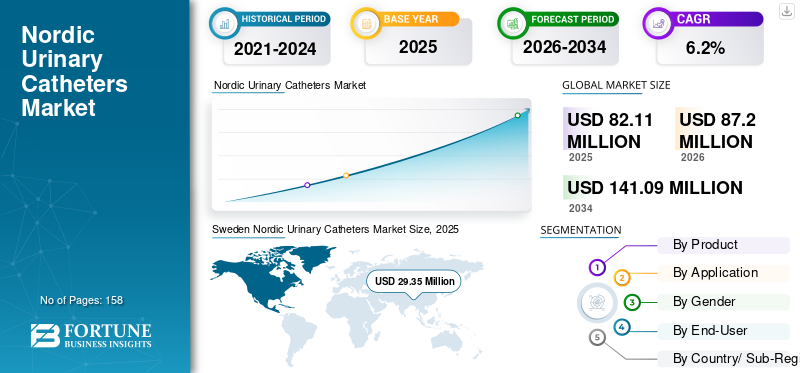
The global nordic urinary catheters market size of USD 82.11 million in 2025 and is projected to expand from USD 87.20 million in 2026 to USD 141.09 million by 2034, growing at a CAGR of 6.20% over the forecast period. Sweden dominated the nordic urinary catheters market with a market share of 35.74% in 2025.
A urinary catheter is a medical device that is inserted into the bladder through the urethra to allow urine to drain from the bladder for collection. It is used in medical conditions that cause urinary incontinence and urinary retention. Urinary incontinence is a major health problem and a growing concern among people of the Nordic region. Urinary incontinence is not caused due to aging, but it is particularly common in older people. The growing cases of urinary incontinence due to various chronic diseases and ageing population are expected to increase the demand for the product. Such factors will also augment the growth of the market.
- As per an article published by the Swedish Institute in 2022, among the 10.5 million Swedish citizens, about 20% of them had passed the standard retirement age of 65. This number is projected to grow to 23% by 2040. The increasing geriatric population will significantly increase the product demand due to growing cases of Urinary Incontinence (UI) among them.
Surge in the number of urological and gynecological surgeries, advanced healthcare facilities, and suitable reimbursement policies are promoting the product adoption in the market. In addition, key market players are continuously focusing on R&D and other strategic initiatives to introduce advanced products and expand their distribution channels. Such factors are projected to fuel the Nordic urinary catheters market growth.
Download Free sample to learn more about this report.
Nordic Urinary Catheters Market Snapshot & Highlights
Market Size & Forecast:
- 2025 Market Size: USD 82.11 million
- 2026 Market Size: USD 87.2 million
- 2034 Forecast Market Size: USD 141.09 million
- CAGR: 6.2% from 2026–2034
Market Share:
- Country: Sweden dominated the Nordic market with a 35.74% share in 2025. This is driven by an increasing number of patient admissions, rising hospital stays, a growing prevalence of chronic diseases, and the availability of robust insurance and public healthcare facilities.
- By Product: The Intermittent Catheters segment held a significant market share in 2025. Intermittent catheterization is considered the gold standard and is preferred over indwelling catheters as it is a short-term process that decreases the risk of Catheter-Associated Urinary Tract Infections (CAUTIs).
Key Country Highlights:
- Sweden: The market is driven by a large and growing geriatric population, with about 20% of citizens over the age of 65. The country's publicly financed healthcare system, which provides comprehensive care, also supports the high demand for medical devices.
- Norway: Growth is supported by improved healthcare facilities, higher adoption of urinary catheters, and a strong focus on a superior lifestyle. The country also has a notable prevalence of traumatic spinal cord injuries, particularly among males, which drives the need for catheterization.
- Denmark: The market is advanced by a high prevalence of urinary incontinence, which was observed in 46% of Danish women. The presence of major domestic manufacturers, such as Coloplast A/S, which recently launched new and innovative products, is also a key growth factor.
- Finland: The market is expanding due to improved healthcare infrastructure, available reimbursement facilities, and rising adoption of urinary catheters to meet the growing demands of an aging patient population.
NORDIC URINARY CATHETERS MARKET TRENDS
Introduction of Series of Technologically Advanced Products to Boost Market Growth
Over the past few years, one of the most prominent trends in this market has been the rising shift from traditional products to advanced products among patients and healthcare providers. To cater to this change, companies are increasing their investments to bring about advancements in the technologies used in urinary catheters.
- For instance, in February 2023, Coloplast A/S launched a new male intermittent catheter called “Luja.” It is the first and only male catheter featuring 80+ micro-holes to reduce the risk of Urinary Tract Infections (UTIs). The product was first launched in Denmark and Finland, followed by other key markets.
Similarly, another new trend in the market is finding more sustainable raw material sources to produce plastic medical devices. Thus, with the rising efforts of the key companies to develop advanced products, the adoption of these products is expected to grow significantly across the Nordic region.
Download Free sample to learn more about this report.
DRIVING FACTORS
Rising Prevalence of Urinary Incontinence and Other Medical Conditions to Enhance Product Demand
Urinary incontinence in men can arise due to several medical conditions, such as an enlarged prostate, diabetes, and Parkinson's disease. Also, it can be common after undergoing some type of prostate surgery. In women, urinary incontinence is likely to develop during pregnancy and after childbirth or after the hormonal changes during menopause. The rising prevalence of urinary incontinence in the region is anticipated to boost the adoption of various products, such as indwelling (Foley), external, and intermittent catheters.
- According to an article published by Family Practice in 2020, the prevalence rate of Urinary Incontinence (UI) was observed to be 46% among Danish women. Furthermore, UI in women is quite common.
Additionally, the rising geriatric population in Nordic countries is a common factor for urinary incontinence. Such a scenario is expected to further propel the market growth.
Increasing Number of Surgeries and Hospitalizations to Augment Market Growth
The number of chronic disorders among the population requiring surgeries has been increasing in the Nordic region. This will eventually lead to an increased demand for these products as they measure the urine output during and after a surgery as an indirect marker of the patient's renal, cardiovascular, and fluid status. Thus, the rising demand for these products among people suffering from various chronic disorders is projected to fuel the market growth during the forecast period.
- For instance, urinary catheterization is considered standard for all cardiac surgeries, allowing the patient's urine to drain freely from the bladder for collection. According to a study published by the International Journal of Cardiology: Cardiovascular Risk and Prevention in 2023, approximately 44% of patients with heart failure are admitted to the internal medicine department at least once a year with an average hospital stay of 6-7 days in Sweden. This is one of the major factors propelling the Nordic market growth.
RESTRAINING FACTORS
Social Stigma and Risk of Acquiring Catheter-Associated Urinary Tract Infections (CAUTI) to Restrict Market Growth
One of the major factors hindering the market’s expansion is the rising cases of Catheter Associated Urinary Tract Infection (CAUTI) caused by indwelling urinary catheters. They are generally reported as hospital-acquired infections. The growing concern regarding infections from these products is expected to reduce their adoption.
Additionally, the usage of these products for a longer duration is expected to increase the risk of developing catheter-associated infections, thereby lowering the product adoption in the coming years.
- For instance, according to an article published by the U.S. National Institutes of Health (NIH) in 2021, a prevalence survey was conducted in 2018 among 3,547 patients in acute-care hospitals in Stockholm, Sweden. The reported prevalence rate of Healthcare-Associated Urinary Tract Infection (HAUTI) was 20.2% among patients suffering from Healthcare-Associated Infections (HAIs).
Furthermore, there is still stigma and embarrassment surrounding UTIs. These factors may restrict the market growth.
SEGMENTATION ANALYSIS
By Product Analysis
Potential Benefits Offered By Intermittent Catheters Boosted Their Adoption
Based on product, the market is segmented into indwelling catheters, intermittent catheters, and external catheters.
The intermittent catheters segment held a significant Nordic urinary catheters market share in 2022. Intermittent catheterization is a short term process, wherein the catheter is removed after each usage. This factor decreases the risk of infections, particularly Catheter-Associated UTIs (CAUTIs), which will drive the adoption of intermittent catheters and propel the segment’s growth in the market.
- According to an article published by the National Library of Medicine in 2023, Intermittent Catheterization (IC) is the gold standard. IC is preferred over continuous catheterization as the former causes fewer UTIs than indwelling catheterization.
Indwelling catheters are used in long term catheterization, and there is no need to continuously replace the device after each use. Due to this factor, they are widely used in gynecological and other surgical procedures in hospitals. Thus, the indwelling catheter segment’s growth is expected to be attributed to the increase in reconstructive urological surgeries across many countries. This will drive the utilization of these catheters.
The external catheters segment captured a lower market share in 2022. External catheters/condom catheters reduce the risk of Catheter-Associated Urinary Tract Infections (CAUTIs) tremendously and cause lesser damage to the urethra than indwelling catheters. They can be used by non-medical professionals at home as well. These factors are expected to increase the segment’s share in the market during the forecast period.
To know how our report can help streamline your business, Speak to Analyst
By Application Analysis
Robust Prevalence of Urinary Incontinence Boosted the Product Sales
Based on application, the market is segmented into urinary incontinence, spinal cord injury, gynecology, benign prostatic hyperplasia, surgery, and others.
The urinary incontinence segment dominated the Nordic market share in 2022. Urinary incontinence is a common condition among the geriatric population. Aging leads to changes in the lower urinary system, including reduced bladder capacity & feeling of fullness, decreased pelvic floor muscle resistance, reduced rate of detrusor muscle contraction, and high residual urine volume. The rising percentage of aging population is expected to propel the segment’s growth.
The surgery segment held a major market share due to the growing number of urological surgeries, which is likely to expand the use of these catheters.
The Benign Prostatic Hyperplasia (BPH) segment is expected to grow steadily due to the strong utilization of intermittent catheters to better manage this disease. Also, the gynecology segment is projected to hold a sizeable market share due to increased efforts to make advancements in gynecological surgeries owing to the rising prevalence of ovarian and bladder cancers.
On the other hand, the spinal cord injury and others segments are expected to record a lower CAGR due to limited product application in these cases.
By Gender Analysis
Rising Prevalence of Prostate Cancer and Other Ailments to Increase Product Adoption Among Males
In terms of gender, the Nordic market is segmented into male and female.
The male segment held a dominant share of the market. The adoption of urinary catheters is considerably high, especially in males, due to the rising prevalence of urological disorders, such as benign prostatic hyperplasia, prostate cancer, kidney failures, and spinal cord injury. This factor is expected to boost the growth of the male segment in the coming years.
- For instance, according to a study published in the National Library of Medicine in 2019, the prevalence of Traumatic Spinal Cord Injury (TSCI) in males was 76%. This study took place in Norway and involved 349 individuals.
The female segment, on the other hand, will capture a lower market share due to the availability of alternatives that are cheaper and more convenient to treat urinary incontinence, such as adult diapers. Such a scenario will impact the adoption of these catheters among female patients.
By End-User Analysis
Catheters to be Widely Used in Hospitals Due to Increasing Number of Patient Admissions
In terms of end-user, the market is segmented into hospitals, age care centers, and others.
The hospitals segment held a dominant share of the market. The segment's growth is attributed to the increasing number of hospitals and prevalence of urological conditions. These factors will spike the number of hospital admissions, resulting in higher demand for urinary catheters from hospitals. Increasing expenditure on healthcare systems across the region is also a prominent factor driving the hospital segment’s growth.
The age care centers segment is expected to grow at a steady pace due to the increasing number of assisted living centers. The rising percentage of geriatric population that requires assisted living will also contribute to the segment’s growth.
- For instance, as per the data reported by the Swedish Institute in 2022, Sweden recorded that home help staff assisted nearly 236,000 people aged 65 or above in 2020. This has increased the demand for aged care centers, thus contributing to a strong demand for these catheters.
The others segment is expected to display the highest CAGR during the forecast period. Strong product adoption in home care settings is anticipated to contribute to the growth of this segment in this market.
REGIONAL ANALYSIS
With respect to geography, this market is segmented into Sweden, Norway, Denmark, Finland, and the Rest of Nordic.
Sweden
Sweden Nordic Urinary Catheters Market Size, 2025 (USD Million) To get more information on the regional analysis of this market, Download Free sample
Sweden dominated the market with a valuation of USD 29.35 million in 2025 and is projected to reached USD 31.16 million in 2026. The increasing number of patient admissions, rising hospital stays, growing prevalence of chronic diseases, availability of insurance facilities, and increasing number of surgical procedures are likely to drive the Swedish market.
- For instance, in 2020, Sweden had a publicly financed healthcare system where cancer care was available to all citizens and required no private healthcare insurance.
Norway
Norway held a sizeable share of the Nordic market due to improved healthcare facilities, higher adoption of urinary catheters to meet healthcare demands, and a strong focus on offering a superior lifestyle.
Denmark, Finland, and the Rest of Nordic
Furthermore, the market in countries, including Denmark, Finland, and the Rest of Nordic are growing due to improved healthcare infrastructure, reimbursement facilities, and rising adoption of these products to meet the growing demands of elderly patients.
KEY INDUSTRY PLAYERS
Strong Presence and Product Portfolio Contributed to Key Companies’ Market Dominance
The competitive landscape of the Nordic market reflects a fragmented structure, with some players accounting for a significant market share. Some prominent players, such as Coloplast A/S, Wellspect HealthCare (Dentsply Sirona), BACTIGUARD, B. Braun SE, and ConvaTec, Inc. held a dominant Nordic market share due to their robust product portfolios, established market presence, strong distribution networks, and innovative product launches.
- For instance, in April 2022, Wellspect HealthCare (Dentsply Sirona) received a Nordic Swan label license for its LoFric range of catheters. LoFric Elle, LoFric Origo, LoFric Sense, LoFric Hydro-Kit, and LoFric Primo are the world’s first catheters to get the Nordic Swan eco-labeling.
Teleflex Incorporated, Hollister Incorporated, BD (Becton, Dickinson and Company), and others are also some of the key players in the market. These companies are continuously focusing on strategic initiatives and product portfolio expansion to enhance their market presence in key Nordic countries.
LIST OF KEY PLAYERS PROFILED:
- BACTIGUARD AB (Sweden)
- Coloplast A/S (Denmark)
- Convatec Group PLC (U.K.)
- Hollister Incorporated (U.S.)
- Boston Scientific Corporation (U.S.)
- BD (Becton, Dickinson and Company) (U.S.)
- B. Braun SE (Germany)
- Wellspect HealthCare (Dentsply Sirona) (Denmark)
KEY INDUSTRY DEVELOPMENTS:
- June 2023: Convatec Group PLC launched GentleCath Air for women to minimize the risk of contaminating the catheter. It is designed to benefit patients by offering them ultimate convenience and comfort.
- April 2023: Wellspect HealthCare (Dentsply Sirona) revealed that it had used bioplastic in its female urinary catheter, “LoFric Elle.” It replaced the conventional fossil-based raw material and reduced the carbon footprint by 55%.
- April 2022: Wellspect HealthCare (Dentsply Sirona) received the Nordic Swan label license for its LoFric range of catheters. LoFric Elle, LoFric Origo, LoFric Sense, LoFric Hydro-Kit and LoFric Primo are the world’s first catheters to be given the Nordic Swan eco-labelling.
- July 2019: Hollister Incorporated received innovative technology designation from Vizient for its VaPro no touch intermittent catheter.
- October 2018: BACTIGUARD AB partnered with Mediplast, a medical device company and healthcare supplier in the Nordic region. This collaboration provided a platform to launch the BIP portfolio in Norway and Denmark.
REPORT COVERAGE
The report provides a comprehensive assessment of the market with qualitative and quantitative insights. It encompasses key segments, such as product, application, gender, end-user, and geography. Moreover, the report gives insights into the key industry developments, pricing analysis, technological developments, healthcare overview, market dynamics, profiles of prominent companies, and impact of COVID-19 on the market. Additionally, the report provides information on the market trends and a competitive analysis of the market.
Request for Customization to gain extensive market insights.
Report Scope & Segmentation
|
ATTRIBUTE |
DETAILS |
|
Study Period |
2021-2034 |
|
Base Year |
2025 |
|
Estimated Year |
2026 |
|
Forecast Period |
2026-2034 |
|
Historical Period |
2019-2021 |
|
Growth Rate |
CAGR of 6.2% from 2026-2034 |
|
Unit |
Value (USD million) |
|
Segmentation |
By Product, Application, Gender, End-User, and Country/ Sub-Region |
|
By Product |
|
|
By Application |
|
|
By Gender |
|
|
By End-User |
|
|
By Country/ Sub-Region |
|
Frequently Asked Questions
Fortune Business Insights says that the Nordic market size was valued at USD 87.2 million in 2026 and is projected to reach USD 141.09 million by 2034
The market is projected to record a CAGR of 6.2% during the forecast period.
The intermittent catheters segment was the leading segment in the Nordic market.
Sweden held the dominant market share in 2025.
The rising prevalence of urinary incontinence and increasing number of surgeries are expected to drive the growth of the Nordic market.
Coloplast Group, Wellspect HealthCare (Dentsply Sirona), and BACTIGUARD are the top players in the Nordic market.
The key factors contributing to the product adoption are the introduction of technologically advanced products and rising elderly population across the Nordic region.
The key trend in the market is the surge in strategic activities by key players to launch innovative and safe products.



- 2021-2034
- 2025
- 2021-2024
- 158
Get 30-60 hrs Free Customization
Expand Regional and Country Coverage, Segments Analysis, Company Profiles, Competitive Benchmarking, and End-user Insights.













.webp)






Related Reports
-
US +1 833 909 2966 ( Toll Free )
-
Get In Touch With Us