Off-Road Equipment Market Size, Share & Industry Analysis, By Machinery Type (Construction Equipment(Excavators, Wheel Loaders, Bulldozers, Backhoe Loaders, Motor Graders, and Others (Compaction Equipment, Concrete Mixers etc.), Mining Equipment, Material Handling Equipment, and Agricultural Equipment), By Propulsion Type (Internal Combustion Engine (ICE), Hybrid, and Electric), By End Use (Construction & Infrastructure, Agriculture, Mining, Forestry, and Industrial & Material Handling), and Regional Forecast, 2026 – 2034
 Download Free Sample
Off-Road Equipment Market Size and Future Outlook
 Listen to Audio Version
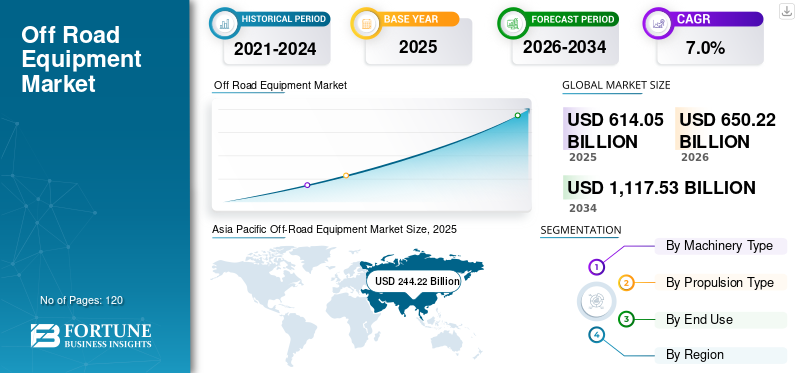
The global off-road equipment market size was valued at USD 614.05 billion in 2025. The market is projected to grow from USD 650.22 billion in 2026 to USD 1,117.53 billion by 2034, exhibiting a CAGR of 7.0% during the forecast period. Asia Pacific dominated the off road equipment market with a market share of 39.77% in 2025.
The market includes heavy-duty mobile machinery built for use across off-highway environments, serving applications in heavy construction, infrastructure development, and mining, the agricultural sector, forestry, and industrial material handling. The market comprises a wide range of construction and agricultural machinery, including excavators, wheel loaders, bulldozers, backhoe loaders, motor graders, compactors, and concrete mixers; mining equipment for excavation, haulage, and auxiliary operations; material handling equipment such as electric forklifts, IC forklifts, and telehandlers; and agricultural equipment including tractors, combine harvesters, trailers, and additional farm machines. Investing in infrastructure, expanding mineral extraction, agricultural mechanization, and warehouse modernization continue to increase the demand for off-road equipment globally. In addition, the growing adoption of fuel-efficient engines, hybrid and electric off-road equipment, telematics-enabled fleet management solutions, autonomous haulage systems, predictive maintenance, and advanced machine control technologies with real-time monitoring capabilities is improving productivity, safety, sustainability, and operating efficiency across demanding worksites and earthmoving operations.
For instance,
- In April 2026, Komatsu commissioned its 1,000th autonomous ultra-class haul truck equipped with its FrontRunner Autonomous Haulage System, strengthening autonomous equipment deployment across mining operations.
Caterpillar Inc., Komatsu Ltd., Volvo Construction Equipment, Deere & Company, Hitachi Construction Machinery Co., Ltd., Liebherr Group, CNH Industrial N.V., SANY Group, XCMG Group are among the major companies operating in the market.
Download Free sample to learn more about this report.
OFF-ROAD EQUIPMENT MARKET TRENDS
Increasing Electrification of Off-Road Equipment is Reshaping Product Development Across End-use Industries
The market is seeing a gradual shift toward electric off-road equipment as equipment makers adapt to tighter emission rules, higher fuel prices, and stronger sustainability goals across construction, mining, agriculture, and material handling industries. Battery-electric and hybrid equipment are seeing wider use in operations needing quieter operation, lower upkeep, and better energy use, especially in city construction sites, warehouses, underground mine operations, and indoor factory operations. OEMs are adding to their product ranges with electric excavators, wheel loaders, forklifts, compact equipment, and autonomous vehicles while focusing on battery systems, charging facilities, and power management systems. This change is also prompting fleet owners to upgrade machinery with connected monitoring tools and predictive maintenance capabilities that improve battery performance, machine usage, and equipment lifecycle planning, helping meet sustainability goals and reduce long-term operating expenses.
For instance,
- In May 2026, Volvo Trucks India introduced the Volvo FMX Edge, a new-generation off-road dump truck developed for mining applications, offering improved productivity, operational efficiency, and reliability under demanding off-road conditions.
MARKET DYNAMICS
MARKET DRIVERS
Download Free sample to learn more about this report.
Expansion of Infrastructure Development, Mining Activities, and Agricultural Mechanization Driving Market Growth
Demand in the market is being pushed by higher spending on roads, rail links, airports, housing projects, commercial buildings, mining sites, and modern farming, as governments and private companies continue investing in infrastructure across both advanced and developing markets. These sectors use heavy off-highway machinery for ground clearing, digging, lifting, loading, carrying, leveling, and preparing job sites, while also helping contractors finish work faster, improve output, and maintain steady performance in difficult site conditions. Investments in large infrastructure projects, renewable energy sites, industrial plants, mine expansion, and large-scale agriculture are creating stronger demand for off road equipment, including excavators, wheel loaders, bulldozers, dump trucks, telehandlers, forklifts, tractors, and other task-specific machines. Many of these machines now come with better hydraulic systems, efficient engines, fleet tracking tools, and automated controls. Alongside this, fleet renewal, machinery upgrades, and the growing use of rental equipment are helping the equipment sector grow through both new machine sales and service-related revenue.
For instance,
- In January 2026, Kubota Corporation unveiled its Transformer electric autonomous tractor concept alongside the commercial M5 Narrow driverless tractor at CES 2026, highlighting continued investment in next-generation agricultural equipment and autonomous machinery development.
|
Rank |
Market Driver |
Expected Impact on Market Growth |
Estimated Gross Market Growth Contribution (USD Billion) |
Impact: 2026-2028 |
Impact: 2029-2031 |
Impact: 2032-2034 |
|
1 |
Rising investments in transportation infrastructure, highways, railways, airports, and urban development projects |
High |
185.00 |
High |
High |
High |
|
2 |
Expansion of mining activities and rising demand for critical minerals for EVs, renewable energy, and industrial production |
High |
140.00 |
Medium |
High |
High |
|
3 |
Growing agricultural mechanization and modernization of farming equipment |
Medium-High |
110.00 |
Medium |
High |
Medium |
|
4 |
Increasing adoption of autonomous, connected, electric, and telematics-enabled off-road equipment |
Medium |
95.00 |
Medium |
Medium |
High |
|
5 |
Fleet replacement, equipment rental expansion, and aftermarket service growth |
Medium-Low |
75.00 |
Medium |
Medium |
Medium |
|
6 |
Others (warehouse expansion, forestry mechanization, quarry equipment demand, government incentives, etc.) |
Low |
45.00 |
Low |
Low |
Medium |
|
|
Total Gross Growth Contribution |
|
650.00 |
|
|
|
MARKET RESTRAINTS
High Equipment Acquisition and Operating Costs Limiting Equipment Adoption
The use of off-road equipment still faces hurdles owing to the heavy upfront investment needed to buy and run large machinery across construction, mining, agriculture, and industrial sectors. Machines such as excavators, wheel loaders, bulldozers, dump trucks, telehandlers, and tractors play a vital role in heavy construction and other demanding applications but come with high initial costs, while fuel use, regular servicing, replacement parts, and repair costs add to the overall ownership cost. This cost burden can hold back purchases, especially for smaller and mid-sized contractors, farmers, and mining operators with tight budgets. In addition, rising loan costs, changing credit conditions, and uncertain economic conditions often push back fleet growth and machinery replacement plans, weakening new machine demand across the construction equipment market in many regional markets.
|
Rank |
Market Restraint |
Expected Impact on Market Growth |
Estimated Reduction in Market Size (USD Billion) |
Impact: 2026-2028 |
Impact: 2029-2031 |
Impact: 2032-2034 |
|
1 |
High equipment acquisition costs, financing burden, and ownership expenses |
High |
72.00 |
High |
High |
Medium |
|
2 |
Volatility in raw material prices and supply chain disruptions |
Medium-High |
50.00 |
High |
Medium |
Medium |
|
3 |
Shortage of skilled equipment operators and maintenance workforce |
Medium |
38.00 |
Medium |
Medium |
High |
|
4 |
Others (economic slowdown, regulatory costs, project delays, interest rate fluctuations, geopolitical risks, etc.) |
Low |
22.69 |
Low |
Low |
Medium |
|
|
Total Market Reduction |
|
182.69 |
|
|
|
MARKET OPPORTUNITIES
Expansion of Equipment and Equipment-as-a-Service (EaaS) Models Creating New Revenue Opportunities
The growing preference for equipment rental, leasing, and Equipment-as-a-Service (EaaS) business models is creating significant opportunities for off-road equipment market growth. Rising equipment acquisition costs, shorter project durations, and the need for operational flexibility are encouraging contractors, mining companies, infrastructure developers, and agricultural businesses to rent machinery instead of purchasing it outright. In response, manufacturers are expanding rental networks, digital fleet management platforms, financing solutions, and lifecycle service offerings to generate recurring revenue while improving customer retention. Increasing adoption of telematics, remote diagnostics, and predictive maintenance is further enabling equipment utilization optimization and value-added service contracts, creating long-term business opportunities across both developed and emerging markets.
- For instance, in September 2025, Caterpillar Inc. expanded its Cat Rental Store digital platform by integrating advanced equipment monitoring and connected fleet services, enabling customers to improve fleet utilization, maintenance planning, and equipment availability.
MARKET CHALLENGES
Balancing Advanced Equipment Technologies with Affordability and Operational Efficiency Creating Challenges for Market Growth
For off-road equipment companies, one ongoing issue is how to add smarter and cleaner technologies without pushing machine prices beyond what customers can afford. Contractors, miners, farmers, and industrial users now want machines with tracking systems, automation, service alerts, improved hydraulics, precise controls, and cleaner drivetrains. However, they also expect these upgrades to come with dependable performance and reasonable ownership costs. This creates added pressure on manufacturers to improve product design, connect machines through software, adopt electric systems, and incorporate real-time fleet management solutions while meeting changing regulations and making equipment strong enough for rough sites and long working hours. Companies also must deal with tighter launch schedules, parts shortages, pricing pressure, and different performance needs across construction, mining, agriculture, and material handling, particularly for earthmoving operations.
Segmentation Analysis
By Machinery Type
Construction Equipment Segment Led Market Owing to Large-Scale Infrastructure Development and High Equipment Utilization
By machinery type, the market is segmented into construction equipment (excavators, wheel loaders, bulldozers, backhoe loaders, motor graders, and others (compaction equipment, concrete mixers etc.), mining equipment, material handling equipment, and agricultural equipment.
Construction equipment segment held the largest off-road equipment market share in 2025, supported by sustained investments in transportation infrastructure, urban development, commercial construction, and public utility projects globally. Equipment such as excavators, wheel loaders, bulldozers, backhoe loaders, motor graders, compactors, and concrete mixers remain indispensable for earthmoving, site preparation, material handling, road equipment applications, and road construction activities. Rising government expenditure on highways, railways, airports, smart cities, and renewable energy infrastructure, coupled with the growing preference for technologically advanced and fuel-efficient machines, continues to support demand for construction equipment across both developed and emerging markets, strengthening growth in the market.
- For instance, in March 2025, Caterpillar Inc. introduced the next-generation Cat® 775 Off-Highway Truck, featuring enhanced payload monitoring, improved fuel efficiency, and integrated digital technologies to improve productivity across construction and quarrying operations.
Mining equipment segment is projected to record the fastest growth, growing at a CAGR of 9.2% over the forecast period, supported by rising spending on mineral discovery activities, critical mineral production, and expansion of mining capacity to meet rising demand for EVs, renewable energy systems, and industrial production. Wider use of automated hauling systems, electric mining machines, modern fleet management tools, and condition-based maintenance solutions is prompting mine operators to upgrade operations while raising output, workplace safety, and cost control. Ongoing spending in copper, lithium, nickel, iron ore, and rare earth mining projects across key mining regions is expected to further increase demand for articulated dump trucks, digging, hauling, and support mining machinery used in quarry operations and large-scale mining projects over the forecast period.
To know how our report can help streamline your business, Speak to Analyst
By Propulsion Type
Internal Combustion Engine (ICE) Segment Led Market Owing to Its Extensive Deployment Across Heavy-Duty Off-Road Applications
By propulsion type, the market is segmented into internal combustion engine (ICE), hybrid, and electric.
In 2025, the Internal Combustion Engine (ICE) segment captured the leading share of the market, as diesel-powered machines remain the preferred choice across construction sites, mines, farms, and material handling operations. Equipment such as excavators, wheel loaders, bulldozers, dump trucks, motor graders, tractors, forklifts, and telehandlers is still widely used due to its strong engine performance, high torque delivery, longer working range, and ability to operate dependably in harsh site conditions. ICE-based machines also have an advantage over newer propulsion options as they are supported by existing fuel supply networks, proven field performance, shorter refueling time, and easy availability in both developed and developing markets. Continued spending on road projects, mining activity, commercial building work, and farm mechanization is likely to keep demand for ICE-powered off-road machinery strong across global markets.
Electric segment is set to expand the quickest, recording a CAGR of 15.1% during the forecast period. Growth is being shaped by tighter emission standards, stronger sustainability targets among companies, and rising investment in clean construction and industrial machines. Better battery performance, wider charging availability, and improved energy control systems are also helping equipment makers bring more electric excavators, compact wheel loaders, forklifts, telehandlers, and tractors into their product ranges. Demand is likely to rise further as these machines are used more often in city job sites, warehouses, enclosed material handling areas, underground mining operations, and other low-emission applications.
By End Use
Construction & Infrastructure Segment Led Market Owing to Urban Expansion and Increased Government Spending
By end use, the market is segmented into construction & infrastructure, agriculture, mining, forestry, and industrial & material handling.
Construction & infrastructure segment continued as the largest revenue contributor in 2025, as heavy worksite machines are used on some of the largest construction and infrastructure projects. From residential projects and commercial complexes to highways, rail routes, airports, utilities, and public works, these machines help with day-to-day site activities. Excavators, wheel loaders, bulldozers, backhoe loaders, motor graders, compactors, and concrete equipment are commonly used for excavation, land clearing, moving materials, grading surfaces, foundation work, and road development. The segment maintains the largest share as major construction projects are ongoing across road and rail corridors, smart city development, clean energy sites, and growing cities. Increased government spending, urban expansion, and fleet replacement are also helping keep demand strong for off-road machinery globally.
Mining segment to grow at the fastest rate, with a CAGR of 9.1% during the forecast years. The segment is supported by higher spending on key minerals, mining capacity expansion, and mine modernization. Demand for copper, lithium, nickel, iron ore, and rare earth minerals is rising as EVs, renewable energy systems, and advanced manufacturing need more raw materials. To meet this need, mine operators are deploying autonomous haul trucks, battery-powered mining equipment, connected fleet tracking systems, and large excavation machines for improved quarry operations. These changes are expected to support increased use of advanced off-road machinery across key mining regions.
Off-Road Equipment Market Regional Outlook
By geography, the market is categorized into Europe, North America, Asia Pacific, South America, and the Middle East & Africa.
North America
Asia Pacific Off-Road Equipment Market Size, 2025 (USD Billion)
To get more information on the regional analysis of this market, Download Free sample
North America generated more than USD 169.48 billion in revenue in 2025, supported by well-established construction, mining, agriculture, and material handling industries, along with high equipment mechanization across the U.S. and Canada. Ongoing spending on transport infrastructure, housing and commercial projects, mine upgrades, warehouse development, and farm productivity improvement continues to strengthen the demand for off-road equipment across the region. The region also gains from strong replacement demand, wide use of advanced machines fitted with telematics, automation features, and fleet management solutions, along with a large equipment rental base. In addition, public funding for infrastructure projects, higher investment in critical mineral mining, and growing use of low-emission and electric off-road equipment are helping maintain steady market growth across North America.
U.S. Off-Road Equipment Market
The U.S. is expected to dominate the North American market with an estimated revenue of about USD 176.99 billion in 2026, supported by continued investment in transportation infrastructure, residential and commercial construction, mining projects, agricultural mechanization, and logistics facilities. Demand for off-road equipment remains particularly strong across earthmoving, excavation, hauling, roadbuilding, farming, quarrying, and industrial material handling applications. Excavators, wheel loaders, bulldozers, articulated dump trucks, motor graders, tractors, forklifts, and telehandlers are widely used across these activities. Fleet replacement, a well-established equipment rental sector, and wider adaption of telematics, autonomous functions, predictive maintenance, and low-emission machinery are further strengthening equipment demand across the country.
Europe
Europe is expected to grow at a stable pace over the forecast period, helped by rising investment in road and rail projects, sustainable building practices, mine upgrades, agricultural mechanization, and industrial handling operations. Demand across the region is also shaped by strict emission standards, increasing use of electric and low-emission off-road machines, and regular replacement of aging fleets in construction and mining. The region continues to be an important market for advanced machinery, supported by strong local manufacturing, high machine usage, and wider deployment of precision construction tools and connected fleet management systems. Germany, the U.K., France, Italy, and Russia remain major markets due to their developed industrial base, infrastructure renewal activity, quarrying and mining projects, and ongoing spending on modern construction and farm equipment.
U.K. Off-Road Equipment Market
The U.K. market is estimated at around USD 20.39 billion in 2026, representing roughly 3.1% of global sales.
Germany Off-Road Equipment Market
Germany’s market is projected to reach approximately USD 36.99 billion in 2026, equivalent to around 5.7%
Asia Pacific
Asia Pacific remained the largest regional market in 2025, with revenue valued at USD 244.22 billion. The region’s growth is mainly linked to rapid construction activity, mine expansion, farm mechanization, and strong industrial production across leading economies. China, Japan, India, South Korea, and Australia continue to account for a major share, supported by large infrastructure programs, higher investment in roads and transport systems, rising mineral output, and greater use of modern construction and farm machinery. Off-road equipment demand is also moving upward as public infrastructure budgets increase, mining firms renew their fleets, and industries adopt more efficient, automated, and technology-enabled machines to raise output, improve operating performance, and enhance jobsite safety.
China Off-Road Equipment Market
China’s market is projected to remain the dominant in the Asia Pacific region, with 2026 revenues estimated at around USD 122.90 billion, representing roughly 18.9% of global sales.
Japan Off-Road Equipment Market
The Japanese market is estimated at around USD 37.74 billion in 2026, accounting for roughly 5.8% of the global sales.
India Off-Road Equipment Market
India’s market is estimated at around USD 52.26 billion in 2026, accounting for roughly 8.0% of global sales.
Middle East & Africa
The Middle East & Africa market is growing steadily as infrastructure projects, mining spending, city development projects, and major construction activity continue across important regional markets. Off-road equipment is commonly used in road construction, rail projects, commercial construction, industrial facilities, and mine sites for activities such as excavation, earthmoving, material loading, material transport, and site preparation. GCC countries are driving regional demand, backed by diversification programs, smart city development, industrial zone expansion, and clean energy investments. South Africa is also supporting growth as mining companies increase production and upgrade older equipment. These factors are boosting demand for advanced off-road equipment across construction, mining, and industrial sectors.
GCC Off-Road Equipment Market
The GCC market is projected to reach around USD 16.0 billion in 2026, representing roughly 2.5% of the global sales.
South America
South America’s market is being supported by rising spending on mining, transport infrastructure, farming, and construction across Brazil, Argentina, Chile, Peru, and Colombia. Demand is driven by copper, iron ore, and lithium projects, road and highway work, commercial building activity, and greater use of mechanized farming equipment. These sectors need dependable off-road machines for digging, hauling, earthmoving, loading, and material movement. Brazil remains the leading regional market due to its large construction base, broad agricultural operations, and growing mining sector. Meanwhile, Chile and Peru are seeing strong demand from continued investment in critical minerals and fleet upgrades. Together, these factors encourage wider use of advanced off-road equipment across construction, mining, agriculture, and industrial operations.
Brazil Off-Road Equipment Market
The Brazilian market is projected to reach around USD 21.67 billion in 2026, representing roughly 3.3% of the global sales.
COMPETITIVE LANDSCAPE
Key Industry Players
Competitive Advantage Driven by Product Innovation, Advanced Equipment Technologies, and Global Manufacturing Presence
The off-road equipment market is moderately concentrated, with competitive positioning shaped by product innovation, manufacturing capabilities, equipment reliability, digital technologies, global dealer networks, and comprehensive aftermarket support. Leading companies including Caterpillar Inc., Komatsu Ltd., Volvo Construction Equipment, Deere & Company, Hitachi Construction Machinery Co., Ltd., Liebherr Group, CNH Industrial N.V., SANY Group, and XCMG Group maintain strong market positions through extensive portfolios of construction, mining, agricultural, and material handling equipment serving diverse end-use industries. These manufacturers continue to strengthen their market presence through investments in autonomous equipment, electrification technologies, precision machine control systems, digital fleet management platforms, and expansion of manufacturing capacity and dealer networks across high-growth markets.
Competitive differentiation is increasingly influenced by the ability to deliver fuel-efficient, low-emission, and digitally connected equipment capable of improving productivity, reducing operating costs, and enhancing operator safety under demanding jobsite conditions. Manufacturers are investing in battery-electric and hybrid machinery, predictive maintenance capabilities, intelligent machine automation, equipment connectivity, and integrated aftermarket service offerings while expanding financing solutions and customer support to strengthen long-term competitive positioning.
- For instance, in March 2025, Deere & Company expanded its autonomous technology portfolio by introducing new autonomous construction equipment capabilities, strengthening its strategy to improve productivity, precision, and operational efficiency across construction applications.
LIST OF KEY OFF-ROAD EQUIPMENT COMPANIES PROFILED IN REPORT
- Caterpillar Inc. (S.)
- Komatsu Ltd. (Japan)
- Deere & Company (John Deere) (U.S.)
- Volvo Construction Equipment (Sweden)
- Hitachi Construction Machinery Co., Ltd. (Japan)
- CNH Industrial N.V. (U.K.)
- Liebherr Group (Switzerland)
- Doosan Bobcat Inc. (South Korea)
- XCMG Group (China)
- SANY Group (China)
KEY INDUSTRY DEVELOPMENTS
- May 2026: Volvo Construction Equipment expanded its electric construction equipment portfolio by introducing a new generation of battery-electric wheel loaders and excavators, reinforcing its commitment to zero-emission construction solutions.
- March 2026: Deere & Company introduced new autonomous articulated dump trucks and advanced autonomous technology solutions, expanding its autonomous equipment portfolio for quarrying and construction applications.
- February 2026: Hitachi Construction Machinery Co., Ltd. launched its LANDCROS Connect fleet management platform, enhancing remote machine monitoring, predictive maintenance, and operational efficiency for construction and mining customers
- October 2025: JCB unveiled a hydrogen-powered engine for heavy-duty construction equipment, advancing the commercialization of low-carbon propulsion technologies for off-road machinery.
- August 2025: CNH Industrial N.V. expanded its precision technology portfolio for agriculture by introducing next-generation automation and digital farming solutions, strengthening productivity and machine connectivity across its agricultural equipment range.
REPORT COVERAGE
The global off-road equipment market analysis includes a comprehensive study of market size and forecast across all segments covered in the report. It provides detailed insights into market dynamics, growth drivers, restraints, opportunities, and key industry trends expected to influence market development during the forecast period. The study examines critical aspects including infrastructure development, construction activities, mining expansion, agricultural mechanization, fleet modernization, equipment rental trends, electrification, autonomous machinery, telematics adoption, predictive maintenance, and low-emission equipment technologies. Additionally, it analyzes product launches, strategic partnerships, manufacturing capacity expansions, mergers & acquisitions, and other key industry developments undertaken by leading equipment manufacturers. The report also provides an in-depth competitive landscape, market share analysis, and profiles of major companies operating in the global industry.
Request for Customization to gain extensive market insights.
Report Scope & Segmentation
| ATTRIBUTE | DETAILS |
| Study Period | 2021-2034 |
| Base Year | 2025 |
| Estimated Year | 2026 |
| Forecast Period | 2026-2034 |
| Historical Period | 2021-2024 |
| Growth Rate | CAGR of 7.0% from 2026-2034 |
| Unit | Value (USD Billion) |
| Segmentation | By Machinery Type, Propulsion Type, End Use, and Region |
| By Machinery Type |
Construction Equipment
Mining Equipment
Material Handling Equipment
Agricultural Equipment
|
| By Propulsion Type |
|
| By End Use |
|
| By Region |
|
Frequently Asked Questions
According to Fortune Business Insights, the global market value is expected to stand at USD 650.22 billion in 2026 and is projected to reach USD 1,117.53 billion by 2034.
In 2025, the Asia Pacific’s market value stood at USD 244.22 billion.
The market is expected to exhibit a CAGR of 7.0% during the forecast period.
By end-use industry, the construction & infrastructure segment leads the market.
Rising infrastructure development, mining expansion, agricultural mechanization, fleet modernization, increasing equipment rental, and growing adoption of autonomous, connected, and fuel-efficient machinery are driving market growth.
Caterpillar Inc., Komatsu Ltd., Volvo Construction Equipment, Deere & Company, Hitachi Construction Machinery Co., Ltd. are the top players in the market.
Asia Pacific held the largest market share in 2025.


- 2021-2034
- 2025
- 2021-2024
- 120
Get 30-60 hrs Free Customization
Expand Regional and Country Coverage, Segments Analysis, Company Profiles, Competitive Benchmarking, and End-user Insights.














Related Reports
-
US +1 833 909 2966 ( Toll Free )
-
Get In Touch With Us