Off-Road Motorcycle Market Size, Share & Industry Analysis, By Engine Stroke Type (Two-Stroke Engines and Four-Stroke Engines), By Motorcycle Type (Motocross Motorcycles, Enduro/Trail Motorcycles, and Dual Sport Motorcycles), By Propulsion Type (ICE and Electric), By Engine Capacity (Below 125cc, 125cc-249cc, 250cc-449cc, and 450cc and Above), By End Use (Recreational & Leisure Riding, Amateur Competition, Professional Competition, and Utility & Institutional Use), and Regional Forecast, 2026-2034
 Download Free Sample
(Offer valid till 15th Oct 2026)

Off-Road Motorcycle Market Size and Future Outlook
 Listen to Audio Version
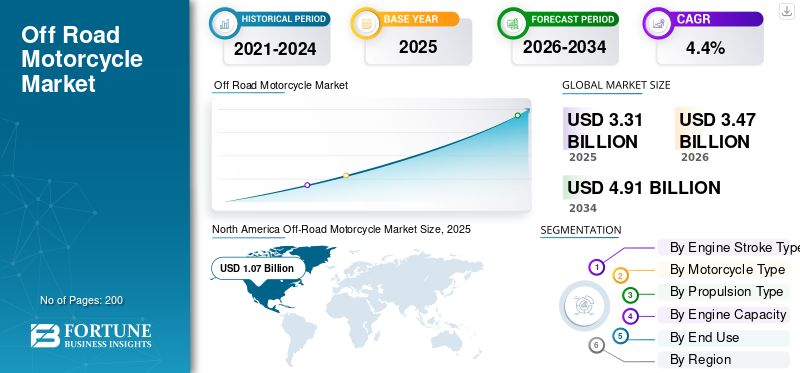
The global off-road motorcycle market size was valued at USD 3.31 billion in 2025 and is projected to grow from USD 3.47 billion in 2026 to USD 4.91 billion by 2034, exhibiting a CAGR of 4.4% during the forecast period. North America dominated the off-road motorcycle market with a market share of 32.32% in 2025.
Off-road motorcycles are two-wheeled powersports vehicles engineered for unpaved terrain, including dirt, mud, sand, rocks, and forest trails. They feature lightweight frames, long-travel suspension, high ground clearance, off-road tires, and durable engines for recreation, competition, utility, and training.
The global market growth is driven by rising participation in off-road riding and motocross racing, increasing recreational spending, expanding adventure tourism, and growing youth engagement. Advanced motorcycle suspension systems, improved off-road tires, lightweight materials, broader dealer networks, and the rapid introduction of electric dirt bikes also support market demand.
Major players operating in the market include Honda, Yamaha, KTM, Kawasaki, Suzuki, and Husqvarna. Competitive trends center on premium motocross bikes, enduro motorcycles, trail bikes, dual-sport motorcycles, and electric platforms. Manufacturers are investing in lighter chassis, connected features, advanced suspension, racing partnerships, and wider product portfolios to strengthen market share.
Download Free sample to learn more about this report.
Off Road Motorcycle Market KEY TAKEAWAYS
 Global Market Size & Forecast
- 2025 Market Size: USD 3.31 billion
- 2026 Market Size: USD 3.47 billion
- 2034 Forecast Market Size: USD 4.91 billion
- CAGR: 4.4% from 2026–2034
 Market Share
- North America dominated the market with a 32.32% share in 2025.
- The two-stroke engines segment is projected to grow at a CAGR of 3.3% during the forecast period.
- The dual sport motorcycles segment is projected to grow at a CAGR of 7.2% during the forecast period.
 Key Regional Highlights
Asia Pacific
Asia Pacific is projected to achieve the fastest growth, supported by large motorcycle populations, rising incomes, local manufacturing, recreational riding, and expanding dual-sport and electric motorcycle demand.
North America
North America dominated the market, supported by established racing communities, strong consumer spending, premium motorcycle ownership, and expanding electric dirt bike offerings.
Europe
Europe is expected to record consistent growth, supported by strong enduro and motocross culture, premium manufacturers, road-homologated models, and established dealer networks.
U.S.
The U.S. market is estimated to reach USD 0.91 billion by 2026, supported by motocross, trail, cross-country participation, premium motorcycle sales, and growing electric dirt bike adoption.
Japan
Japan’s market is estimated to reach USD 0.16 billion by 2026, supported by established off-road motorcycle portfolios, mature motocross and trail communities, and continued demand for premium and competition-focused models.
Read More

OFF-ROAD MOTORCYCLE MARKET TRENDS
Connected Tuning and Telemetry Integration to Reshape Product Development
Smartphone-based tuning, GPS-linked telemetry, and digital setup tools are changing how riders configure off-road motorcycles for different tracks and terrain. These systems allow fuel mapping, traction settings, suspension adjustments, lap analysis, and maintenance monitoring to move closer to real-time use. Manufacturers can strengthen customer engagement through software updates and performance data, while dealers gain opportunities for diagnostics and accessory sales.
- In April 2024, KTM introduced the Connectivity Unit Offroad for its 2025 SX-F range, offering adjustment functions through the KTMconnect application and a GPS sensor.
MARKET DYNAMICS
MARKET DRIVERS
Download Free sample to learn more about this report.
Expanding Racing Participation and Event Calendars Fuel Market Growth
Expanding motocross, enduro, cross-country, and amateur racing activity supports motorcycle purchases, replacement cycles, parts demand, and brand visibility. Organized events encourage youth participation, rider training, sponsorship, and progression from entry-level machines to professional competition models. Manufacturers also use racing programs to validate engines, chassis, suspension, tires, and electronic controls before transferring improvements to production motorcycles. These factors further boosts the off-road motorcycle market growth.
- In December 2024, the FIM announced 23 officially approved teams and a 20-event Grand Prix calendar for the 2025 MXGP and MX2 championships, including a season-opening in Cordoba, Argentina.
|
Rank |
Market drivers |
Overall impact rank |
CAGR contribution (2026-2034) |
Impact 2026-2028 |
Impact 2029-2031 |
Impact 2032-2034 |
|
1 |
Expanding Recreational and Leisure Riding Participation Supports Market Expansion |
High |
2.15% |
High |
High |
High |
|
2 |
Continuous Product Innovation and Performance Upgrades Strengthen Replacement Demand |
High |
1.75% |
High |
High |
High |
|
3 |
Expanding Racing Participation and Event Calendars Fuel Market Growth |
Medium-High |
1.50% |
High |
High |
Medium |
|
4 |
Rising Adoption of Electric Off-Road Motorcycles Expands Addressable Demand |
Medium-High |
1.30% |
Medium |
High |
High |
|
5 |
Growing Dealer Networks and Organized Riding Infrastructure Improve Market Accessibility |
Medium |
1.15% |
Medium |
Medium |
High |
|
6 |
Others |
Low |
1.00% |
Low |
Low |
Low |
|
Total Positive Growth Contribution |
8.85% |
|
|
|
MARKET RESTRAINTS
Restricted Trail Access and Environmental Controls Limit Market Expansion
Limited access to legal riding areas restricts frequent motorcycle use and can delay purchases among recreational riders. Seasonal closures, habitat-protection measures, noise controls, insurance requirements, and local opposition reduce available trail networks, particularly near populated or environmentally sensitive areas. These restrictions also increase travel time and participation costs as riders must transport motorcycles to approved facilities.
|
Rank |
Market Restraints |
Overall impact rank |
Negative CAGR contribution (2026-2034) |
Impact 2026-2028 |
Impact 2029-2031 |
Impact 2032-2034 |
|
1 |
Restricted Trail Access and Environmental Controls Limit Market Expansion |
High |
-1.55% |
High |
High |
High |
|
2 |
High Ownership Costs and Premium Pricing Restrict Mass-Market Adoption |
High |
-1.15% |
Medium |
High |
High |
|
3 |
Supply Chain Volatility and Capital Intensity Challenge Manufacturer Stability |
Medium-High |
-1.00% |
High |
Medium |
Medium |
|
4 |
Others |
Low |
-0.75% |
Low |
Low |
Low |
|
|
Total Negative Growth Contribution |
-4.45% |
MARKET OPPORTUNITIES
Affordable Electric Dirt Bikes Unlock New Customers and Riding Opportunities
Lower-cost electric dirt bikes can attract beginners, urban riders, training schools, and customers seeking quieter operation with reduced routine maintenance. Removable batteries and compact charging systems can support riding in parks, private land, short trail sessions, and mixed recreational use where noise restrictions limit conventional motorcycles. Manufacturers can expand through modular battery platforms, subscription services, fleet sales, and youth-oriented models.
- In November 2024, Zero Motorcycles launched the XB and XE X Line models, featuring removable batteries, switchable traction control, factory-tuned suspension, and lighter packages designed for trails and city streets.
MARKET CHALLENGES
Supply Chain Volatility and Capital Intensity Challenge Manufacturer Stability
Off-road motorcycle manufacturers face high working capital requirements, dependence on complex supplier networks, uneven dealer inventories, and costly development programs covering engines, electronics, suspension, and racing. Demand volatility can leave companies with excess stock, while production interruptions weaken dealer confidence and delay model availability. Smaller specialists are especially exposed as they lack diversified revenue streams and access to large financing resources.
Segmentation Analysis
By Engine Stroke Type
Broad Torque Delivery and Extensive Model Availability Sustain Four-Stroke Engines Segment Growth
Based on engine stroke type, the market is segmented into two-stroke engines and four-stroke engines.
The four-stroke engines segment held the largest off-road motorcycle market share in 2025 and is also projected to grow at the fastest CAGR over the forecast period. Smoother torque delivery, fuel efficiency, lower emissions, durability, and wider adoption across trail, dual-sport, utility, and competition motorcycles support its dominance. Broad OEM availability further sustains demand across global markets.
The two-stroke engines segment is projected to grow at a CAGR of 3.3% over the forecast period, supported by lightweight construction, rapid throttle response, simpler maintenance, and continued use in motocross and enduro racing. However, narrower road usability and emissions constraints limit overall expansion.
By Motorcycle Type
Broad Terrain Versatility and Recreational Utility Sustain Enduro/Trail Motorcycles Segment Growth
Based on motorcycle type, the market is segmented into motocross motorcycles, enduro/trail motorcycles, and dual sport motorcycles.
The enduro/trail motorcycles segment dominated the market in 2025, as it serves recreational riders, technical trail users, club competitors, and utility customers globally. Its balanced torque, durability, longer-range capability, and broader terrain suitability further support consistent replacement demand.
- In January 2025, Yamaha introduced the heavily revised WR250F with an enduro-specific chassis and advanced off-road technology.
The dual sport motorcycles segment is projected to grow at a CAGR of 7.2% over the forecast period, making it the fastest-growing category, as riders seek road legality and trail capability.
- In November 2024, Suzuki unveiled the DR-Z4S for global markets beginning in 2025.
By Propulsion Type
Established Refueling and Service Infrastructure to Sustain ICE Segment Leadership
Based on propulsion type, the market is segmented into ICE and electric.
The ICE segment dominated the market in 2025, as gasoline models offer rapid refueling, longer practical range, mature repair networks, broad model availability, and proven durability across motocross, enduro, trail, and dual-sport applications. Established dealer ecosystems and rider familiarity continue to support replacement demand.
- In February 2025, Honda announced updated four-stroke CRF250L and CRF250 Rally models for Japan.
The electric segment is projected to grow at a CAGR of 16.1% over the forecast period, making it the fastest-growing category as instant torque, quiet operation, reduced maintenance, and improved battery performance broaden adoption.
- In November 2025, Yamaha revealed its YE-01 electric motocross concept.
By Engine Capacity
Balanced Performance and Accessible Ownership to Sustain 125cc-249cc Segment Growth
Based on engine capacity, the market is segmented into below 125cc, 125cc-249cc, 250cc-449cc, and 450cc and above.
The 125cc-249cc segment dominated the market in 2025, as it balances affordable pricing, manageable weight, fuel efficiency, trail capability, and sufficient performance for beginners and recreational riders. Its broad use across trail and dual-sport motorcycles further strengthens global demand.
- In January 2025, Kawasaki continued its updated 233cc KLX230 lineup for on-road and off-road riding.
The 450cc and above segment is projected to grow at a CAGR of 4.4% over the forecast period, making it the fastest-growing category as experienced riders seek stronger torque and premium performance.
- In June 2025, Yamaha announced the redesigned 2026 YZ450F with a new engine, frame, hydraulic clutch, and rear suspension.
To know how our report can help streamline your business, Speak to Analyst
By End Use
Broad Rider Participation and Accessible Trail Use to Sustain Recreational & Leisure Riding Segment Growth
Based on end use, the market is segmented into recreational & leisure riding, amateur competition, professional competition, and utility & institutional use.
The recreational & leisure riding segment dominated the market in 2025, as family participation, trail access, tourism, private-land use, and beginner-friendly motorcycles created demand. However, affordable pricing and lower performance barriers also sustain replacement demand.
- In June 2024, Kawasaki launched the 2025 KLX230R and KLX230RS models, for trail
The amateur competition segment is projected to grow at a CAGR of 5.6% over the forecast period, making it the fastest-growing category as club racing, youth participation, and privateer events expand.
- In March 2025, the AMA added three off-road racing series to its schedule.
OFF-ROAD MOTORCYCLE MARKET REGIONAL OUTLOOK
By region, the market is categorized into Europe, North America, Asia Pacific, South America, and the Middle & Africa.
North America
North America Off-Road Motorcycle Market Size, 2025 (USD Billion)
To get more information on the regional analysis of this market, Download Free sample
North America held a dominant position in the global market, supported by established motocross tracks, trail networks, racing communities, and strong replacement demand. The region benefits from high consumer spending, premium motorcycle ownership, advanced suspension systems, youth participation, and expanding electric dirt bike offerings. The U.S. contributes higher-value demand, Canada supports recreational and enduro riding, and Mexico adds volume through affordable dual-sport motorcycles. Land-access restrictions, ownership costs, and mature penetration keep overall expansion stable during the forecast period across both leisure and competition-oriented customer groups.
U.S. Off-Road Motorcycle Market
The U.S. market is estimated to reach USD 0.91 billion by 2026, supported by extensive motocross, trail, and cross-country participation. Premium motorcycle sales, organized racing, youth programs, replacement purchases, and broad dealer coverage strengthen demand. At the same time, electric dirt bikes and advanced suspension technologies support higher-value product adoption across recreational and competitive applications.
Europe
Europe is expected to record consistent growth in the market, supported by a strong enduro and motocross culture, premium manufacturer presence, road-homologated models, and established dealer networks. Germany, France, Italy, the U.K., Russia, and other European countries contribute through recreational riding, amateur competition, and dual-sport use. Lightweight chassis, advanced suspension, fuel-injected engines, and electric platforms reinforce demand. Emission regulations, higher prices, and restricted trail access moderate volumes, while premiumization sustains market value during the forecast period across established and developing national off-road riding communities.
U.K. Off-Road Motorcycle Market
The U.K. market is projected to reach USD 0.12 billion in 2026, supported by enduro, trail, motocross, and amateur competition activity. Specialist dealers, organized clubs, premium European brands, and road-legal dual-sport models sustain demand, while land-access restrictions, insurance costs, and regulatory requirements moderate broader adoption among recreational riders and enthusiasts.
Germany Off-Road Motorcycle Market
Germany accounts for approximately 17.7% of the European market in 2026, supported by strong purchasing power, premium motorcycle demand, and access to major European manufacturers. Consumers favor advanced enduro, trail, and dual-sport models with road homologation, durable components, and high-performance suspension, while environmental rules and limited riding areas restrain volume growth.
Asia Pacific
Asia Pacific is projected to achieve the fastest growth in the market, supported by large motorcycle populations, rising incomes, local manufacturing, and expanding recreational riding. China, India, Japan, South Korea, Southeast Asia, and Australia contribute through motocross, trail, dual-sport, and electric dirt bike demand. Growth is reinforced by broader dealer availability, adventure tourism, rural mobility, and increasing participation in amateur racing. Affordability constraints and limited organized riding infrastructure remain challenging, but product diversification continues to expand the regional customer base across both entry-level and premium motorcycle categories.
China Off-Road Motorcycle Market
China accounts for approximately 23.5% of the Asia Pacific market in 2026, supported by domestic manufacturing, expanding recreational riding, and wider availability of affordable ICE and electric models. Local brands strengthen motocross, trail, and dual-sport supply, while rising incomes, online retail channels, and improving product quality support higher-value demand across urban and rural users.
India Off-Road Motorcycle Market
India is expected to register a CAGR of 9.7% during the forecast period, supported by its large motorcycle base, rising disposable income, and growing demand for affordable dual-sport models. Rural mobility, adventure tourism, local manufacturing, and improving dealer availability broaden adoption, while premium motocross and enduro demand develops from a smaller base.
Japan Off-Road Motorcycle Market
Japan’s market is estimated to reach USD 0.16 billion by 2026, supported by established Honda, Yamaha, Kawasaki, and Suzuki off-road portfolios. Mature motocross and trail communities, premium engineering, replacement demand, advanced suspension, and competition-focused models sustain market value, while demographic maturity limits rapid unit expansion despite continued electric product development.
South America
South America is projected to expand steadily in the market, supported by local motorcycle production, rural mobility, recreational riding, and increasing use of dual-sport models on mixed road conditions. Brazil contributes the largest demand base, while Argentina and other countries add motocross, trail, and amateur competition activity. Growth is strengthened by broad dealer coverage, locally assembled lower-capacity motorcycles, and tourism. Currency volatility, import duties, financing costs, and uneven economic conditions continue to restrict premium purchases across the region through the medium term despite continuing demand resilience.
Brazil Off-Road Motorcycle Market
Brazil accounts for approximately 68.1% of the South America market in 2026, supported by large-scale motorcycle production, broad dealer coverage, and strong demand for trail and dual-sport models. Local manufacturing improves affordability, while rural mobility, recreation, and amateur competition sustain sales despite currency volatility, financing costs, and premium import constraints.
Middle East & Africa
Middle East & Africa is expected to record steady growth in the market, supported by desert recreation, rural transport, utility applications, tourism, and expanding dealer networks. South Africa contributes higher-value motocross and enduro demand, while Gulf countries support premium desert and electric models. Other African markets remain influenced by affordable trail and dual-sport motorcycles used for practical mobility. Import dependence, limited financing, uneven service coverage, and weak charging infrastructure restrain adoption, although broader product availability creates long-term opportunities across consumer and institutional applications over time.
South Africa Off-Road Motorcycle Market
South Africa is projected to grow at a CAGR of 4.4% during the forecast period, supported by established motocross and enduro communities, recreational trail riding, and premium imported brands. Developed dealer and service networks support replacement demand, while economic pressure, currency movement, and import costs limit faster expansion across consumer and competition segments.
COMPETITIVE LANDSCAPE
Key Industry Players
Focus on Racing Innovation, Product Breadth, and Dealer Network Expansion to Define Competitive Landscape
The off-road motorcycle market is moderately fragmented, with Japanese volume leaders, European performance specialists, and emerging electric manufacturers competing across motocross, enduro, trail, and dual-sport categories. Honda, Yamaha, KTM, Kawasaki, Suzuki, Husqvarna, GASGAS, Beta, Sherco, Triumph, and Stark Future compete through racing credibility, model breadth, suspension performance, lightweight chassis, engine technology, and dealer reach. Companies strengthen their competitive edge by refreshing two-stroke and four-stroke platforms, expanding electric dirt bike portfolios, supporting factory racing teams, and offering youth-to-professional product ranges. Premium brands emphasize technical differentiation and motorsport success, while larger manufacturers benefit from global distribution, financing, parts availability, and established service networks. Partnerships with riders, racing organizations, and component suppliers accelerate product validation and brand visibility.
- In October 2025, Triumph reported that its newly introduced motocross and enduro motorcycles had secured multiple national championship titles and podiums across Europe, North America, and Australia.
LIST OF KEY OFF-ROAD MOTORCYCLE COMPANIES PROFILED
- Honda Motor Co., Ltd. (Japan)
- Yamaha Motor Co., Ltd. (Japan)
- KTM Sportmotorcycle GmbH (Austria)
- Kawasaki Motors, Ltd. (Japan)
- Suzuki Motor Corporation (Japan)
- Husqvarna Mobility GmbH (Austria)
- GASGAS Motorcycles (Austria)
- Betamotor S.p.A. (Italy)
- Sherco Motorcycles (France)
- Triumph Motorcycles Ltd. (U.K.)
- Fantic Motor S.p.A. (Italy)
- TM Moto S.r.l. (Italy)
- Stark Future S.L. (Spain)
- Rieju S.A. (Spain)
- Ducati Motor Holding S.p.A. (Italy)
KEY INDUSTRY DEVELOPMENTS
- June 2026: Beta expanded its MY2027 enduro range with the new XTrainer 200 two-stroke, positioned beside the existing 300. The lighter model introduced revised porting, piston, power-valve timing, ignition mapping, exhaust, chassis tuning, electric start, oil injection, and a lower seat, targeting younger, smaller, novice, and technical-trail riders globally.
- June 2026: Beta unveiled its 2027 RX motocross range and added the all-new RX 250 4T after prototype development in MXGP competition. The motorcycle uses a newly engineered engine and chassis and joins the RX 450 4T, RX 350 two-stroke, and RX 250 two-stroke, creating a four-model competition portfolio.
- June 2026: KTM Factory Racing and Moto-Master extended their long-running off-road partnership for the 2026 season. Moto-Master braking and drive components continue across KTM programs in MXGP, AMA Supercross, Pro Motocross, EnduroGP, Hard Enduro, rally-raid, U.S. off-road racing, and junior teams, supplying performance hardware and development feedback to factory engineers.
- May 2026: Triumph Factory Racing strengthened its partnership with performance-apparel company 5.11, which became title sponsor of the U.S. race team for the 2026 AMA Pro Motocross season. The expanded agreement supports Triumph’s TF 450-X and TF 250-X programs, team branding, rider visibility, and operational consistency across the outdoor championship.
- May 2026: Husqvarna Mobility announced its nine-model 2027 motocross and minicycle range, spanning the TC 50 through FC 450. Updates include white chromium-molybdenum frames, revised graphics, WP XACT suspension, Brembo and ProTaper components, Dunlop or Maxxis tires, throttle-body injection, selectable engine maps, quick shifter, traction control, and launch-control systems.
REPORT COVERAGE
The global off-road motorcycle market analysis provides an in-depth study of the market size & forecast across all market segments included in the report. It contains details on market dynamics and trends expected to drive the market during the forecast period. It offers information on rapid technological advancements, new product launches, key industry developments, strategic partnerships, and mergers & acquisitions. The forecast provides a comprehensive competitive landscape, including the most significant global market shares, emerging opportunities, and profiles of key players.
Request for Customization to gain extensive market insights.
Report Scope & Segmentation
| ATTRIBUTE | DETAILS |
| Study Period | 2021-2034 |
| Base Year | 2025 |
| Estimated Year | 2026 |
| Forecast Period | 2026-2034 |
| Historical Period | 2021-2024 |
| Growth Rate | CAGR of 4.4% from 2026 to 2034 |
| Unit | Value (USD Billion) and Volume (Units) |
| Segmentation | By Engine Stroke Type, By Motorcycle Type, By Propulsion Type, By Engine Capacity, By End Use, and By Region |
| By Engine Stroke Type |
|
| By Motorcycle Type |
|
| By Propulsion Type |
|
| By Engine Capacity |
|
| By End Use |
|
| By Region |
|
Frequently Asked Questions
Fortune Business Insights says that the global market value stood at USD 3.31 billion in 2025 and is projected to reach USD 4.91 billion by 2034.
In 2025, North America’s market value stood at USD 1.07 billion.
The market demand is expected to grow at a CAGR of 4.4% from 2026 to 2034.
The ICE segment led the market share by propulsion type.
Rising participation in off-road riding and motocross racing, increasing recreational spending, and expanding adventure tourism are the key factors driving the market.
The key market players in the market include Honda, Yamaha, KTM, Kawasaki, Suzuki, and Husqvarna.
North America accounted for the largest share of the market in 2025.
North America, Europe, Asia Pacific, South America, and the Middle East & Africa.



- 2021-2034
- 2025
- 2021-2024
- 200
-
(Offer valid till 15th Oct 2026)
Get 30-60 hrs Free Customization
Expand Regional and Country Coverage, Segments Analysis, Company Profiles, Competitive Benchmarking, and End-user Insights.




















-
US +1 833 909 2966 ( Toll Free )
-
Get In Touch With Us