Offshore Oil & Gas Market Size, Share & Industry Analysis, By Service Type (Exploration (Seismic & Survey), Drilling, Production & Processing, Decommissioning, and Others), By Platform Type (Fixed Platforms, Floating Production Systems (FPSO, FPU), Tension Leg Platforms (TLP), Spar Platforms, and Others), By Water Depth (Shallow Water, Deepwater, and Ultra-Deepwater), By Hydrocarbon Type (Crude Oil, Natural Gas, and Others), and Regional Forecast, 2026-2034
 Download Free Sample
(Offer valid till 30th Sep 2026)

Offshore Oil & Gas Market Size and Future Outlook
 Listen to Audio Version
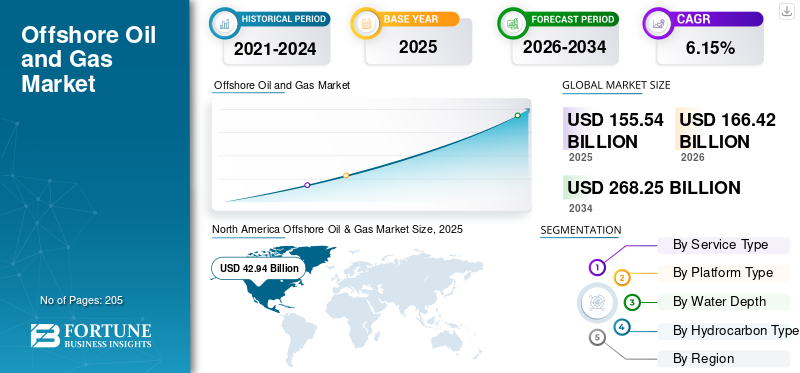
The global offshore oil & gas market size was valued at USD 155.54 billion in 2025. The market is projected to grow from USD 166.42 billion in 2026 to USD 268.25 billion by 2034, exhibiting a CAGR of 6.15% during the forecast period. North America dominated the offshore oil & gas market with a market share of 27.60% in 2025.
Offshore oil and gas refers to the exploration and production of hydrocarbons beneath the seabed, forming a critical component of global energy demand and supply, particularly as onshore reserves mature. According to insights from organizations such as the International Energy Agency (IEA) and IOGP, offshore fields contribute roughly one-third of global oil production, with a growing share coming from deepwater and ultra-deepwater developments. The sector is characterized by capital-intensive infrastructure, including floating production systems, subsea equipment, and advanced drilling operations.
The key factor driving the market share is the increasing reliance on deepwater reserves in regions such as Brazil, Guyana, and West Africa, where large-scale discoveries continue to reshape supply dynamics. In addition, offshore natural gas development, particularly in Qatar, Australia, and East Africa, is gaining momentum due to rising global LNG demand and the relative carbon advantage of gas over other fossil fuels.
- For instance, in March 2023, Petrobras advanced its offshore portfolio by commencing production at the Almirante Barroso FPSO in Brazil’s Búzios field, one of the largest deepwater oil fields globally. The project utilizes advanced subsea systems and high-capacity floating production infrastructure to enhance output efficiency. This development reflects the growing emphasis on deepwater resources and FPSO deployment to unlock large offshore reserves while maintaining cost optimization and operational scalability.
Some of the leading companies operating in the global industry include Saudi Aramco, Petrobras, ExxonMobil Corporation, Royal Dutch Shell plc, and others. Saudi Aramco is one of the world’s leading offshore oil & gas operators, with extensive production activities in the Arabian Gulf. The company manages some of the largest offshore fields globally, including Safaniya, the world’s biggest offshore oil field. Aramco focuses on low-cost, high-volume offshore production, supported by advanced drilling and platform infrastructure. It is also expanding offshore gas developments to strengthen its long-term energy portfolio.
Download Free sample to learn more about this report.
OFFSHORE OIL & GAS MARKET KEY TAKEAWAYS
 Global Market Size & Forecast
- 2025 Market Size: USD 155.54 billion
- 2026 Market Size: USD 166.42 billion
- 2034 Forecast Market Size: USD 268.25 billion
- CAGR: 6.15% from 2026–2034
 Market Share
- North America dominated the offshore oil & gas market with a 27.60% share in 2025.
- Production & processing led the service type segment with a 36.68% share in 2025.
- Crude oil dominated the hydrocarbon type segment with a 58.84% share in 2025.
 Key Regional Highlights
North America
North America reached USD 42.94 billion in 2025 and maintained its lead with USD 45.42 billion in 2026.
Latin America
Latin America recorded USD 41.85 billion in 2025, supported by Brazil’s deepwater developments and Guyana’s offshore expansion.
Europe
Europe reached USD 26.64 billion in 2025 and is projected to grow at a 3.93% rate over the coming years.
U.S.
The offshore oil & gas market reached approximately USD 36.49 billion in 2025, representing 23.46% of global market size.
Japan
Japan is not separately valued in the source data, with Asia Pacific growth driven primarily by Australia, China, India, and Southeast Asia.
Read More

OFFSHORE OIL & GAS MARKET TRENDS
Expansion of Subsea Tiebacks and Hub Developments is the Key Market Trend
The offshore oil & gas market growth is driven by the increasing use of subsea tiebacks to existing infrastructure, allowing operators to develop smaller or satellite fields without installing new platforms. This approach significantly reduces capital expenditure and accelerates project timelines, particularly in mature basins such as the North Sea and Gulf of Mexico. Operators are prioritizing hub-and-spoke models, where multiple subsea wells are connected to a central processing facility or Floating Production, Storage, and Offloading (FPSO), improving asset utilization and extending field life.
In addition, advancements in long-distance subsea tieback technology are enabling connections over greater distances and in deeper waters, making previously uneconomic reserves commercially viable. This trend is also driven by the need to optimize returns amid volatile oil prices while maintaining production levels. As a result, offshore development strategies are shifting toward incremental, infrastructure-led expansion rather than standalone mega-projects, enhancing flexibility and cost efficiency across the value chain.
MARKET DYNAMICS
MARKET DRIVERS
Download Free sample to learn more about this report.
Rising Focus on Energy Security and Supply Diversification is the Key Market Driver
A key driver for the offshore oil and gas market is the increasing emphasis on energy security and diversification of supply sources, particularly among major importing economies. Geopolitical disruptions and supply chain uncertainties have pushed countries to reduce dependence on a limited set of suppliers, leading to renewed interest in developing domestic and regional offshore resources. Governments are supporting offshore licensing rounds and accelerating approvals for new developments to stabilize long-term energy availability.
In addition, offshore assets offer large-scale, long-life production profiles, making them attractive for ensuring a stable supply compared to shorter-cycle onshore projects. National oil companies are also prioritizing offshore investments to strengthen sovereign control over energy resources, especially in regions with significant untapped reserves. This shift is further reinforced by strategic initiatives to balance imports with domestic production, particularly in the Asia Pacific and parts of Europe. These factors are anticipated to drive the CAGR during the forecast period.
MARKET RESTRAINTS
High Capital Intensity and Project Execution Risks to Hamper the Market Demand
A major restraint in the market is the high capital intensity and complexity associated with project development, which creates significant financial and operational risks for operators. Offshore projects, especially in deepwater and ultra-deepwater environments, require substantial upfront investment in drilling, subsea systems, and production infrastructure, often running into billions of dollars. These projects are also exposed to cost overruns, schedule delays, and technical uncertainties, particularly in harsh offshore conditions.
Also, long project lead times make investments highly sensitive to oil price volatility, impacting final investment decisions. Regulatory approvals, environmental compliance requirements, and logistical challenges further increase execution risks.
MARKET OPPORTUNITIES
Integration of Offshore Assets with Carbon Management Initiatives Drives Market Opportunities
A significant opportunity in the industry lies in the integration of offshore infrastructure with carbon management solutions, particularly carbon capture, utilization, and storage (CCUS). Many mature offshore fields and depleted reservoirs are being evaluated as potential CO₂ storage sites, leveraging existing wells, pipelines, and platforms to reduce development costs. This creates a dual-use model where offshore assets can transition from hydrocarbon production to long-term carbon storage hubs, especially in regions such as the North Sea.
Furthermore, operators are exploring the electrification of offshore platforms using nearby renewable sources to reduce emissions intensity. These developments open new revenue streams while aligning offshore operations with evolving environmental regulations. As governments introduce incentives and frameworks for carbon management, offshore oil & gas infrastructure is increasingly positioned as a critical enabler in broader decarbonization strategies, creating long-term growth opportunities beyond traditional production activities.
MARKET CHALLENGES
Workforce Constraints and Specialized Skill Gaps Limit Market Growth
A key challenge in the market is the shortage of skilled workforce and specialized technical expertise required for complex offshore operations. As projects move into deeper waters and adopt advanced technologies such as subsea processing and digital monitoring systems, the demand for highly trained engineers, geoscientists, and offshore technicians has increased significantly. However, the industry faces difficulties in attracting new talent due to cyclical investment patterns and competition from renewable energy sectors. Additionally, an aging workforce in mature regions such as the North Sea is leading to knowledge gaps and higher training requirements.
Segmentation Analysis
By Service Type
Production & Processing Segment Dominated Due to Long Lifecycle and Continuous Production Operations
Based on the segmentation of service type, the market is classified into exploration (seismic & survey), drilling, production & processing, decommissioning, and others.
In 2025, the production & processing segment accounted for 36.68% market share due to their extended operational lifespan and continuous revenue-generating nature. Once offshore fields are developed, production activities can span several decades, requiring sustained investment in platforms, FPSOs, and subsea processing systems. This segment involves the extraction, separation, and initial treatment of hydrocarbons before transportation, making it central to the overall value chain. Additionally, operators prioritize optimizing production efficiency through enhanced recovery techniques and real-time monitoring systems, further strengthening their market share.
The decommissioning segment is experiencing the highest growth and is expected to grow at a CAGR of 8.83% over the forecast period.
To know how our report can help streamline your business, Speak to Analyst
By Platform Type
Fixed Platforms Segment Dominated Due to Established Infrastructure in Shallow Water Fields
Based on the segmentation of the platform type, the market is classified into fixed platforms, Floating Production Systems (FPSO, FPU), Tension Leg Platforms (TLP), spar platforms, and others.
In 2025, the fixed platforms segment accounted for 32.56% share of the global market. These platforms are permanently installed on the seabed, providing high stability and reliability for large-scale production operations. Regions such as the Middle East and the North Sea rely heavily on fixed platforms due to favorable water depths and established offshore infrastructure. Additionally, these platforms support high production capacity and integrated processing facilities, making them suitable for long-term field development.The Tension Leg Platforms (TLP) segment is expected to grow at a CAGR of 7.14% over the forecast period.
By Water Depth
Shallow Water Segment Dominated Due to Lower cost and Mature Infrastructure Availability
On the basis of water depth, the market is classified into shallow water, deepwater, and ultra-deepwater.
In 2025, the shallow water segment accounted for 45.38% of the global offshore oil & gas market share. Operations in shallow waters require less complex drilling and production technologies compared to deepwater projects, resulting in lower capital and operational expenditure. Many of the world’s earliest offshore developments were concentrated in shallow regions such as the Middle East, Southeast Asia, and the North Sea, leading to a dense network of existing platforms, pipelines, and processing facilities.
The ultra-deepwater segment is expected to grow at a CAGR of 7.55% over the forecast period.
By Hydrocarbon Type
Crude Oil Segment Dominated Due to Extensive Offshore Oil Reserves and Demand
On the basis of hydrocarbon type, the market is classified into crude oil, natural gas, and others.
In 2025, the crude oil segment accounted for approximately 58.84% share of the global market. Major offshore basins such as Brazil’s pre-salt, the Middle East offshore fields, and West Africa are heavily oil-rich, driving significant investment in oil-focused production infrastructure. Offshore projects have historically been developed to maximize oil output, supported by technologies such as FPSOs and subsea systems tailored for crude extraction and processing. In addition, crude oil remains a critical input for transportation fuels and petrochemical production, ensuring consistent demand.
The natural gas segment is expected to grow at a CAGR of 7.55% over the forecast period.
Offshore Oil & Gas Market Regional Outlook
By region, the market is categorized into North America, Europe, Asia Pacific, Latin America, and the Middle East & Africa.
North America
North America Offshore Oil & Gas Market Size, 2025 (USD Billion)
To get more information on the regional analysis of this market, Download Free sample
The North America market held a dominant share in 2025, valued at USD 42.94 billion and maintained its dominance in 2026 with USD 45.42 billion.
Offshore activities in North America are primarily driven by sustained investments in the U.S. Gulf of Mexico, where deepwater assets offer competitive breakeven costs and stable long-term production profiles. Operators are increasingly focusing on subsea tiebacks and brownfield expansions, enabling faster and cost-efficient development of nearby discoveries by leveraging existing infrastructure.
U.S. Offshore Oil & Gas Market
Based on North America’s strong contribution and the U.S. dominance within the region, the U.S. market was approximated at around USD 36.49 billion in 2025, accounting for roughly 23.46% of the global market size.
Europe
Europe is projected to record a growth rate of 3.93% in the coming years and reached a valuation of USD 26.64 billion in 2025. Offshore activity in Europe is driven by continued investment in extending the life of mature North Sea assets, particularly through enhanced recovery and infrastructure upgrades. Additionally, decommissioning programs and redevelopment of smaller fields via tiebacks are supporting sustained offshore operations despite declining discoveries.
Germany Offshore Oil & Gas Market
The Germany market in 2025 was valued at around USD 0.85 billion and is estimated to reach USD 0.88 billion in 2026, representing roughly 0.55% of the global revenues. Germany’s offshore activity remains extremely limited, with minimal production in the North Sea and no major new developments planned. The country’s focus has largely shifted toward offshore wind and energy transition initiatives, reducing investment and growth prospects in offshore hydrocarbons.
Asia Pacific
Asia Pacific market size reached USD 23.77 billion in 2025. In the region, India and China both reached USD 2.84 billion and USD 6.50 billion, respectively, in 2025.
The market growth in Asia Pacific is driven by the expansion of gas-focused offshore projects in Australia and Southeast Asia, supporting rising LNG export demand. Additionally, increasing exploration activity in China and India’s deepwater basins is strengthening regional offshore investment momentum.
India Offshore Oil & Gas Market
The India market accounted for roughly 1.83% of global revenues. Offshore activity in India is driven by increased focus on deepwater exploration in the Krishna-Godavari basin, supported by government policies to boost domestic production. Additionally, redevelopment of mature fields, such as Mumbai High, through enhanced recovery techniques is sustaining offshore output.
China Offshore Oil & Gas Market
China’s market in 2025 represented roughly 4.18% of the global revenues.
Australia Offshore Oil & Gas Market
The Australia market in 2025 was valued at around USD 5.58 billion, accounting for roughly 3.59% of global revenues.
Latin America
Latin America is expected to witness moderate growth in this market space in the long term. The region’s market reached a valuation of USD 41.85 billion in 2025. The region’s growth is being propelled by Brazil’s large-scale pre-salt deepwater developments and rapid production expansion in Guyana’s offshore Stabroek block.
Brazil Offshore Oil & Gas Market
Brazil's market size was recorded at around USD 29.21 billion in 2025, representing roughly 18.78% of the global sales.
Middle East & Africa
The Middle East & Africa are expected to witness significant growth in this market space during the forecast period. The market in this region reached a valuation of USD 20.35 billion in 2025.
The region’s offshore activity is supported by Qatar’s offshore gas expansion and Saudi Arabia’s large-scale offshore production capacity projects in the Arabian Gulf. In Africa, increasing investments in deepwater developments and LNG-linked offshore gas projects in Angola, Nigeria, and Mozambique are strengthening regional growth momentum.
GCC Offshore Oil & Gas Market
The GCC market was valued at around USD 11.89 billion in 2025, representing roughly 7.65% of the global revenue.
COMPETITIVE LANDSCAPE
Key Industry Players
Major Players Actively Expanding Market Share via Partnerships, Business Expansion, and Technological Advancements
The global offshore oil & gas market is characterized by a consolidated landscape, featuring major industry leaders such as Saudi Aramco, Petrobras, ExxonMobil Corporation, Shell plc, and others. Companies are implementing specific expansion strategies aimed at strengthening their product offerings, technical capabilities, expanding manufacturing presence, and advancing in various other sectors.
- In July 2023, Saudi Aramco awarded multiple offshore engineering and installation contracts under its long-term offshore expansion program in the Arabian Gulf. The initiative focused on enhancing production capacity from major offshore fields, including Safaniya and Zuluf, through new platforms, subsea pipelines, and processing infrastructure. The project reflects Aramco’s strategy of maintaining stable offshore crude output while strengthening long-term supply capabilities through advanced offshore asset modernization and integrated production systems.
Additional significant players within this global market encompass Chevron Corporation, TotalEnergies SE, and BP plc, among others. It is anticipated that these companies will focus on new product launches and collaborations in order to increase their global market share during the forecast period.
LIST OF KEY OFFSHORE OIL & GAS COMPANIES PROFILED
- Saudi Aramco (Saudi Arabia)
- Petrobras (Brazil)
- ExxonMobil Corporation (U.S.)
- Shell plc (U.K.)
- Chevron Corporation (U.S.)
- TotalEnergies SE (France)
- BP plc (U.K.)
- Equinor ASA (Norway)
- China National Offshore Oil Corporation (CNOOC) (China)
- Eni S.p.A. (Italy)
KEY INDUSTRY DEVELOPMENTS
- April 2024: BP advanced offshore activity at the Kaskida project in the Gulf of Mexico, targeting deepwater resources with modern subsea production infrastructure. The development aims to improve production efficiency while utilizing existing offshore operational expertise in the region. BP’s continued investment in Gulf deepwater assets demonstrates the importance of high-potential offshore reserves in maintaining long-term upstream production and optimizing offshore asset utilization.
- February 2024: Shell approved the development of the Gato do Mato offshore project in Brazil, targeting deepwater pre-salt reserves. The project includes subsea production systems connected to a floating production unit designed for long-term offshore operations. Shell’s investment reflects its focus on selective high-margin offshore developments capable of delivering stable production with lower operational intensity through advanced deepwater engineering and integrated offshore infrastructure.
- December 2023: Equinor initiated production from the Breidablikk field in the Norwegian North Sea. The offshore project was developed using subsea tiebacks connected to existing infrastructure, reducing development costs and accelerating production timelines. Equinor’s approach reflects the growing offshore trend of infrastructure-led developments and enhanced recovery strategies aimed at extending the commercial life of mature North Sea assets while maintaining production stability.
- November 2023: ExxonMobil advanced offshore operations in Guyana by initiating production from the Payara development project in the Stabroek block. The project utilized the Prosperity FPSO and expanded the company’s deepwater production footprint in one of the world’s fastest-growing offshore regions. ExxonMobil’s continued investment in Guyana highlights the increasing importance of large-scale offshore discoveries and floating production infrastructure in driving long-term offshore supply growth.
- August 2023: Chevron expanded its offshore portfolio in the U.S. Gulf of Mexico through continued development activities at the Anchor deepwater project. The project incorporates high-pressure subsea technologies and advanced drilling systems designed for challenging offshore environments. Chevron’s investment demonstrates the growing role of technologically complex deepwater developments in extending offshore production while improving operational efficiency and reservoir recovery in mature offshore basins.
REPORT COVERAGE
The global offshore oil & gas market analysis provides an in-depth study of the market size & forecast by all the market segments included in the report. It includes details on the market dynamics and the market trends expected to drive the market in the forecast period. It offers information on the technological advancements, new product launches, key industry developments, and details on partnerships, mergers & acquisitions. The market research report also encompasses a detailed competitive landscape with information on the market share and profiles of key operating players.
Request for Customization to gain extensive market insights.
Report Scope & Segmentation
| ATTRIBUTE | DETAILS |
| Study Period | 2021-2034 |
| Base Year | 2025 |
| Estimated Year | 2026 |
| Forecast Period | 2026-2034 |
| Historical Period | 2021-2024 |
| Growth Rate | CAGR of 6.15% from 2026 to 2034 |
| Unit | Value (USD Billion) |
| Segmentation | By Service Type, Platform Type, Water Depth, Hydrocarbon Type, and Region |
| By Service Type |
|
| By Platform Type |
|
| By Water Depth |
|
| By Hydrocarbon Type |
|
| By Region |
|
Frequently Asked Questions
Fortune Business Insights says that the global market value stood at USD 155.54 billion in 2025 and is projected to reach USD 268.25 billion by 2034.
In 2025, the market value stood at USD 42.94 billion.
The market is expected to exhibit a CAGR of 6.15% during the forecast period.
The production & processing segment led the market by service type.
Increasing deepwater discoveries, rising offshore natural gas and LNG demand, and growing investments in FPSOs and subsea infrastructure are the key factors driving the market.
Saudi Aramco, Petrobras, and ExxonMobil Corporation are some of the prominent players in the market.
North America dominated the market in 2025.
Expansion of deepwater exploration, increasing LNG-linked offshore gas projects, and advancements in subsea and floating production technologies are major factors expected to favor adoption.



- 2021-2034
- 2025
- 2021-2024
- 205
-
(Offer valid till 30th Sep 2026)
Get 30-60 hrs Free Customization
Expand Regional and Country Coverage, Segments Analysis, Company Profiles, Competitive Benchmarking, and End-user Insights.



















Related Reports
-
US +1 833 909 2966 ( Toll Free )
-
Get In Touch With Us