Offshore Energy Storage Market Size, Share & Industry Analysis, By Storage Technology (Battery Energy Storage Systems (BESS), {Lithium-ion Batteries, Sodium-based Batteries, Flow Batteries, and Others}, Mechanical Energy Storage, {Compressed Air Energy Storage (CAES), Flywheel Energy Storage, & Gravity-based Storage}, Hydrogen Energy Storage, & Others) By Deployment Type (Fixed & Floating), By End-User (Offshore Wind Farm Operators, Oil & Gas Offshore Platforms, Utilities / Grid Operators, Energy Storage Developers, and Government & Renewable Energy Projects), & Regional Forecast, 2026-2034
 Download Free Sample
Offshore Energy Storage Market Size and Future Outlook
 Listen to Audio Version
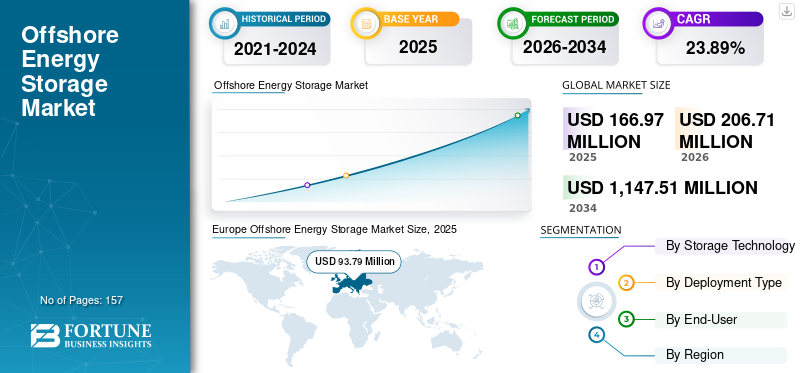
The global offshore energy storage market size was valued at USD 166.97 million in 2025. The market is projected to grow from USD 206.71 million in 2026 to USD 1,147.51 million by 2034, with a CAGR of 23.89% over the forecast period. Europe dominated the offshore energy storage market with a market share of 56.17% in 2025.
Offshore energy storage systems are technologies designed to store electrical or energy carriers generated from offshore energy sources—primarily offshore wind—and transport that energy to the grid or end users when required. These systems help balance the intermittent nature of offshore renewable generation by storing surplus energy and releasing it during periods of high demand or low generation. Offshore storage solutions may include Battery Energy Storage Systems (BESS), hydrogen production and storage systems, Compressed Air Energy Storage (CAES), gravity-based storage, and other long-duration technologies are typically deployed on offshore platforms, subsea installations, or floating structures.
The demand for offshore energy storage is primarily driven by the rapid expansion of offshore wind capacity and increasing need for grid flexibility in coastal and island energy systems. As countries accelerate decarbonization and energy transition strategies, offshore renewable projects are becoming larger and located farther from shore, creating challenges related to transmission constraints, intermittency, and grid integration. Energy storage solutions deployed offshore can mitigate these challenges by enabling power smoothing, peak shifting, and transmission optimization, thereby improving overall system efficiency and reducing curtailment of renewable energy sources. Technological developments such as floating offshore platforms, subsea energy storage concepts, and offshore hydrogen production hubs are expanding the range of viable storage options. Additionally, the growing focus on green hydrogen as an energy carrier is encouraging the development of offshore energy storage systems that convert excess renewable electricity into hydrogen for long-term storage and transport.
The competitive landscape for the market is evolving as key players such as Siemens Energy, ABB Ltd., Wartsila, Equinor, Shell, Orsted, and Fluence Energy collaborate with offshore engineering firms, renewable energy developers, and utilities to deploy pilot and demonstration projects. Companies specializing in energy storage technologies, offshore infrastructure, and hydrogen systems are increasingly forming strategic partnerships to develop integrated offshore energy hubs that combine generation, storage, and transmission solutions. Competitive strategies are centered on technology scalability, system durability in harsh marine environments, seamless integration with offshore wind farms, and the capability to support long-duration energy storage applications.
Download Free sample to learn more about this report.
Offshore Energy Storage Market Key Takeaways
 Global Market Size & Forecast
- 2025 Market Size: USD 166.97 Million
- 2026 Market Size: USD 206.71 Million
- 2034 Forecast Market Size: USD 1,147.51 Million
- CAGR: 23.89% from 2026–2034
 Market Share
- Europe dominated the offshore energy storage market with a 56.17% share in 2025.
- The fixed deployment segment accounted for 65.50% of the market share in 2025.
- Offshore wind farm operators represented approximately 70.00% of the end-user market in 2025.
 Key Regional Highlights
Europe
Europe accounted for USD 93.79 million, representing 56.17% of the global market in 2025.
Asia Pacific
Asia Pacific reached USD 41.94 million, accounting for 25.12% of the global market in 2025.
North America
North America was valued at USD 23.94 million, holding 14.34% of the global market in 2025.
U.S.
The U.S. offshore energy storage market is projected to grow from USD 21.87 million in 2025 to USD 26.65 million in 2026.
Japan
The Japan offshore energy storage market is projected to grow from USD 7.83 million in 2025 to USD 9.53 million in 2026.
Read More

Offshore Energy Storage Market Trends
Offshore Wind Capacity Expansion Driving the Need for Integrated Energy Storage
The rapid expansion of offshore wind capacity is creating a growing need for offshore energy storage systems that can manage intermittency, smooth power output, and reduce curtailment during periods of excess generation. Offshore wind farms are increasingly being deployed farther from shore and at larger scales, increasing the complexity of grid integration and transmission management. Energy storage systems deployed offshore—including battery systems, hydrogen production units, and subsea compressed air storage—are being explored to store excess electricity and release it during peak demand or when wind generation declines. The accelerating scale of offshore wind development highlights the structural demand for storage solutions integrated directly within offshore energy infrastructure.
The Global Wind Energy Council (GWEC) reports that global offshore wind capacity surpassed 75 GW in 2023, with projections indicating that capacity could exceed 380 GW by 2032. Europe currently accounts for roughly 45–50% of global offshore wind installations, while Asia Pacific—led by China—is the fastest-growing region. In addition, the International Energy Agency (IEA) estimates that offshore wind could generate over 4,200 TWh of electricity annually by 2040, making energy storage solutions essential to manage variability and maximize renewable utilization.
MARKET DYNAMICS
Market Drivers
Download Free sample to learn more about this report.
Growing Government Support For Hydrogen And Long-Duration Energy Storage are Promoting The Market Growth
Government decarbonization policies and hydrogen strategies are accelerating the development of offshore energy storage solutions that convert renewable electricity into hydrogen for long-term storage and transport. Hydrogen produced offshore using renewable electricity can be stored for extended periods and transported to shore through pipelines or maritime logistics systems, effectively functioning as a large-scale energy storage medium. Offshore hydrogen storage systems also provide a pathway for storing excess renewable electricity that would otherwise be curtailed due to grid limitations.
Policy frameworks are reinforcing this trend. The European Union’s Hydrogen Strategy aims to install 40 GW of renewable hydrogen electrolysers capacity by 2030, while countries such as Japan and South Korea have established national hydrogen roadmaps supporting hydrogen production and storage infrastructure. Additionally, pilot projects such as the PosHYdon offshore hydrogen project in the Netherlands demonstrate the technical feasibility of producing and storing hydrogen directly on offshore platforms powered by offshore wind energy.
Market Restraints
High Capital Costs And Technical Complexity Of Offshore Infrastructure To Hamper Market Growth
The deployment of these systems involves significantly higher capital costs compared with onshore storage installations due to the complexities associated with marine environments, offshore construction, and specialized equipment. Offshore platforms must withstand harsh ocean conditions, including high wind speeds, corrosion, saltwater exposure, and wave loads, which increases engineering requirements and project costs. Additionally, integrating energy storage systems within offshore wind farms or offshore energy hubs often requires complex subsea cables, control systems, and maintenance logistics.
According to the International Renewable Energy Agency (IRENA) offshore wind projects already require substantial investment, with average project costs ranging from USD 2.5 million to USD 4 million per megawatt of installed capacity. Adding energy storage infrastructure further increases capital expenditures, creating financial challenges for project developers and potentially slowing the large-scale adoption of offshore storage technologies.
Market Opportunities
Development of Integrated Offshore Energy Hubs Provides a Major Growth Opportunities for Storage Technologies
The development of integrated offshore energy hubs represents a significant growth opportunity for the market. These hubs combine offshore wind farms, hydrogen production facilities, energy storage systems, and transmission infrastructure within a unified offshore platform. By co-locating generation, storage, and transmission capabilities, these hubs enable better management of energy flows, reduce transmission bottlenecks, and improve overall system efficiency. As a result, offshore energy storage plays a critical role in balancing supply and demand, supporting grid stability, and enabling large-scale integration of renewable energy.
Several large-scale offshore energy hub projects are already being developed in Europe. The Danish Energy Island project in the North Sea is expected to connect up to 10 GW of offshore wind capacity, while the Princess Elisabeth Energy Island project in Belgium aims to serve as a central transmission and energy hub linking multiple offshore wind farms in the North Sea. These projects highlight the growing potential for offshore energy storage systems to become a core component of future offshore energy infrastructure.
Market Challenges
Grid Integration and Transmission Infrastructure to Constrains Market Growth
A key challenge for offshore energy storage market growth is its deployment. The complexity of integrating these systems with existing onshore grid infrastructure pose a constraint on their demand. Offshore renewable projects are often located far from major load centers, requiring extensive subsea transmission networks and grid upgrades to transport electricity to shore. Energy storage systems can help mitigate some of these challenges, but lack of standardized grid connection frameworks and regulatory clarity in many regions continues to create barriers for project developers.
Grid congestion and transmission bottlenecks are already emerging challenges in regions with significant offshore wind development. For example, several North Sea countries are currently expanding offshore transmission networks to accommodate growing renewable capacity. According to the European Network of Transmission System Operators for Electricity (ENTSO-E), Europe will require over EUR 458.7 billion in grid investments by 2030 to support the expansion of renewable energy infrastructure, including offshore wind and associated energy storage systems.
Segmentation Analysis
By Storage Technology
Battery Energy Storage Systems Dominated Owing To Their High Efficiency And Faster Response Time
Based on storage technology, the market is segmented into Battery Energy Storage Systems (BESS), mechanical energy storage (compressed air energy storage, flywheel energy storage, gravity-based storage), hydrogen energy storage, and others.
Battery Energy Storage Systems (BESS) currently represent the largest share in the storage technology segment, primarily due to their high efficiency, fast response time, and technological maturity compared with other offshore storage technologies. Lithium-ion battery systems are widely deployed in renewable energy projects to provide short-duration energy storage, grid stabilization, frequency regulation, and power smoothing for offshore wind farms. Their modular design allows integration within offshore substations, floating platforms, and hybrid renewable energy systems. As offshore wind projects increase in scale and complexity, developers are increasingly incorporating battery systems to manage power variability and reduce energy curtailment.
Hydrogen energy storage is projected to grow at a CAGR of 27.75% during the forecast period, as offshore wind farms increasingly adopt hydrogen production and storage as a long-duration energy storage solution. The stored hydrogen then can be transported to shore or used for power generation, industrial processes, or fuel production. In this model, excess electricity generated by offshore wind turbines is converted into hydrogen through electrolysis and stored in offshore tanks or subsea reservoirs.
By Deployment Type
Fixed Offshore Installations Lead The Market Owing To Their Stable Structural Foundations
Based on deployment type, the market is segmented into fixed and floating.
Fixed deployment type accounted for 65.50% share of the market in 2025, as it is commonly integrated into fixed-bottom offshore wind platforms and offshore substations located in shallow to moderate water depths. These installations benefit from stable structural foundations, making them suitable for hosting battery storage units, hydrogen production modules, and other energy storage equipment. Fixed platforms are particularly prevalent in regions such as the North Sea and the Baltic Sea, where most existing offshore wind farms are located in relatively shallow waters.
Floating deployment systems are expected to witness the fastest growth at a CAGR of 26.68% during the forecast period, driven by rapid development of floating offshore wind farms and deep-water renewable energy projects. Floating platforms allow energy storage systems to be deployed in deeper waters where fixed-bottom foundations are not economically viable. These systems are being designed to host modular battery storage units, hydrogen electrolysers, and other long-duration energy storage technologies. As floating offshore wind projects expand globally—particularly in Japan, South Korea, U.S., and parts of Europe—these solutions are expected to play an increasingly important role in supporting offshore renewable energy integration.
By End-User
To know how our report can help streamline your business, Speak to Analyst
Offshore Wind Farm Operators Lead the Demand Due to High Integration to Enhance Power Stability and
Based on end-user, the market is segmented into offshore wind farm operators, oil & gas offshore platforms, utilities/grid operators, energy storage developers, and government & renewable energy projects.
Offshore wind farm operators represent the largest end-user segment accounting approximately 70% share in 2025, as energy storage systems are increasingly being integrated directly within offshore wind projects to improve power stability and maximize renewable energy utilization. Offshore wind developers are deploying storage systems to manage fluctuations in electricity generation, reduce transmission constraints, and enable more efficient grid integration. As offshore wind farms continue to increase in scale, the need for energy storage solutions that can smooth power output and provide backup capacity is expected to grow significantly.
Energy storage developers are projected to be the fastest-growing end-user segment in the market during the forecast period, driven by the increasing commercialization of large-scale renewable energy storage projects and the emergence of specialized companies focused on long-duration energy storage technologies. These developers play a critical role in designing, financing, and deploying advanced offshore storage solutions such as battery storage systems, subsea compressed air energy storage, gravity-based storage technologies, and offshore hydrogen storage systems which can be integrated with offshore renewable energy infrastructure.
Offshore Energy Storage Market Regional Outlook
By geography, the market has been studied across North America, Europe, Asia Pacific, Latin America, and the Middle East & Africa.
North America
Europe Offshore Energy Storage Market Size, 2025 (USD Million)
To get more information on the regional analysis of this market, Download Free sample
North America was valued at USD 23.94 million in 2025, accounting for approximately 14.34% of the global market. Market growth in the region is supported by the rapid development of offshore wind projects along the Atlantic coast of the U.S. and increasing investments in long-duration energy storage technologies designed to support renewable integration. Offshore energy storage systems are gaining attention as utilities and project developers explore solutions to manage intermittent renewable power generation, reduce transmission congestion, and improve grid reliability. In addition, government initiatives promoting offshore wind development and clean energy deployment are encouraging the integration of advanced storage technologies including battery storage systems and hydrogen production facilities within offshore renewable energy projects.
U.S. Offshore Energy Storage Market
The U.S. market was at USD 21.87 million in 2025 and is expected to record USD 26.65 million in 2026, supported by the rapid expansion of offshore wind capacity along the East Coast and increasing investment in energy storage technologies to enhance grid flexibility.
Europe
Europe accounted for USD 93.79 million in 2025, representing approximately 56.17% of global market revenues, making it the largest regional market. The region benefits from its leadership in offshore wind deployment and strong policy frameworks supporting renewable energy integration and hydrogen infrastructure development. European countries are increasingly investing in offshore energy storage technologies to manage large-scale renewable energy generation and support grid stability across interconnected electricity markets. The development of offshore energy hubs, subsea storage technologies, and offshore hydrogen production projects is further accelerating market growth in the region.
Germany Offshore Energy Storage Market
The Germany market was valued at USD 15.26 million in 2025 and is expected to record USD 19.07 million in 2026, supported by the country’s strong renewable energy policies and continued expansion of offshore wind capacity in the North Sea and Baltic Sea. Germany’s focus on hydrogen production and long-duration energy storage technologies is also supporting the development of offshore storage infrastructure.
U.K. Offshore Energy Storage Market
The U.K. market was at USD 22.80 million in 2025 and is expected to record USD 29.29 million in 2026, supported by the country’s position as one of the largest offshore wind markets globally. The U.K. government’s offshore wind expansion strategy and net-zero commitments are encouraging the development of integrated offshore energy systems that combine wind generation with storage technologies to enhance system flexibility.
Asia Pacific
Asia Pacific was valued at USD 41.94 million in 2025, accounting for approximately 25.12% of global market revenues. The region is witnessing rapid growth in offshore renewable energy capacity, particularly in offshore wind projects in China, Japan, South Korea, and Taiwan. As offshore wind installations expand, energy storage systems are increasingly being deployed to improve grid integration, reduce curtailment of renewable energy, and support power system flexibility. Government initiatives promoting clean energy development and hydrogen infrastructure are also encouraging investment in the market across the region.
China Offshore Energy Storage Market
The China market reached USD 21.08 million in 2025 and is expected to record USD 27.27 million in 2026, supported by the country’s position as the world’s largest offshore wind market. Rapid deployment of offshore wind projects and continued investments in renewable energy infrastructure are creating strong demand for energy storage technologies that can stabilize power output and enhance grid integration.
Japan Offshore Energy Storage Market
The Japan market was valued at USD 7.83 million in 2025 and is estimated to touch USD 9.53 million in 2026, supported by growing interest in floating offshore wind projects and hydrogen-based energy systems. Japan’s national hydrogen strategy and focus on renewable energy integration are encouraging the development of offshore storage solutions capable of supporting long-duration energy storage.
Rest of World
The Rest of World region accounted for USD 7.30 million in 2025, representing approximately 4.37% of the global market. Although the region currently represents a smaller share of the market, several emerging economies are exploring offshore renewable energy projects that may incorporate energy storage technologies in the future. Countries such as Brazil, Saudi Arabia, and Chile are increasingly evaluating offshore wind potential and hydrogen production opportunities, which could drive future demand in the market.
Saudi Arabia Offshore Energy Storage Market
Saudi Arabia market was valued at USD 2.02 million in 2025 and is estimated to touch USD 2.40 million in 2026, supported by the country’s broader energy transition strategy and investments in renewable energy and hydrogen production infrastructure. Offshore energy storage technologies may play a role in supporting large-scale renewable energy projects and future hydrogen export initiatives.
Chile Offshore Energy Storage Market
Chile market was at USD 1.34 million in 2025 and is estimated to touch USD 1.59 million in 2026, supported by growing interest in offshore wind development and the country’s ambitious renewable energy targets. Energy storage technologies are expected to support future offshore renewable projects by improving grid flexibility and enabling the integration of variable renewable power generation.
COMPETITIVE LANDSCAPE
KEY INDUSTRY PLAYERS
Technology Innovation, Offshore Engineering Expertise, And Integration With Renewable Energy Infrastructure Are The Primary Differentiating Pedals
The technology innovation, offshore engineering expertise, and integration with renewable energy infrastructure are emerging as the primary competitive levers in the market. The market is currently in an early stage of development and remains relatively fragmented, with participation from energy storage technology providers, offshore engineering firms, renewable energy developers, and hydrogen technology companies. Competitive dynamics is driven by the ability to develop resilient storage solutions, integrate systems with offshore wind projects, and execute complex offshore developments through strategic partnerships with utilities and project developers.
As offshore wind capacity expands globally, companies are increasingly focusing on integrated offshore energy systems that combine generation, storage, and transmission infrastructure. Storage technologies such as Battery Energy Storage Systems (BESS), Subsea Compressed Air Energy Storage (CAES), gravity-based storage, and offshore hydrogen production and storage systems are being developed to support large-scale offshore renewable energy projects. Strategic partnerships between renewable energy developers, energy storage technology firms, and offshore infrastructure companies are becoming a key competitive strategy to accelerate project commercialization and technology validation.
List of Key Offshore Energy Storage Companies Profiled
- Ocean Grazer B.V. (U.S.)
- Hydrostor Inc. (U.S.)
- Subsea 7 S.A. (Luxembourg)
- Equinor ASA (Norway)
- Siemens Energy AG (Germany)
- ABB Ltd. (Switzerland)
- Orsted A/S (Denmark)
- Technip Energies N.V. (France)
- DNV Group (Norway)
- Provaris Energy Ltd. (Australia)
KEY INDUSTRY DEVELOPMENTS
- March 2026: Siemens Energy announced progress in the development of offshore hydrogen production and storage modules designed for integration with large-scale offshore wind farms, focusing on enabling long-duration energy storage through hydrogen conversion and subsea transport infrastructure.
- January 2026: Ocean Grazer expanded the testing of its Ocean Battery subsea energy storage technology, designed to store renewable energy generated from offshore wind farms using modular underwater reservoirs deployed on the seabed, supporting multi-hour energy storage for offshore renewable systems.
- October 2025: Hydrostor advanced development activities for its Advanced Compressed Air Energy Storage (A-CAES) technology are aimed at integrating long-duration storage with renewable energy generation, including potential offshore and subsea energy storage applications.
- August 2025: Equinor strengthened its offshore energy system strategy by expanding research initiatives focused on integrating offshore wind power with hydrogen production and energy storage solutions, supporting the development of hybrid offshore energy hubs.
- July 2024: Siemens Energy expanded its collaboration initiatives focused on offshore hydrogen production and storage systems, aiming to convert excess offshore wind electricity into hydrogen for long-duration energy storage and transport.
REPORT COVERAGE
The report provides a comprehensive analysis of the market, focusing on key aspects such as leading companies, product processes, and Porter's Five Forces. Additionally, the report provides valuable insights into market trends and highlights key industry developments. In addition to the factors mentioned above, the report also encompasses several factors that contributed to the market's growth in recent years.
Request for Customization to gain extensive market insights.
REPORT SCOPE & SEGMENTATION
| ATTRIBUTE | DETAILS |
| Study Period | 2021-2034 |
| Base Year | 2025 |
| Estimated Year | 2026 |
| Forecast Period | 2026-2034 |
| Historical Period | 2021-2024 |
| Growth Rate | CAGR of 23.89% from 2026 to 2034 |
| Unit | Value (USD Million) |
|
Segmentation |
By Storage Technology
|
|
By Deployment Type
|
|
|
By End-User
|
|
|
By Region
|
Frequently Asked Questions
According to a Fortune Business Insights study, the market size was USD 166.97 million in 2025 and is projected to reach USD 1,147.51 million by 2034.
The market is likely to grow at a CAGR of 23.89% over the forecast period.
By end-user, the offshore wind farm operators segment is the leading end-user.
The Europe market size stood at USD 93.79 million in 2025.
Growing government support for hydrogen and long-duration energy storage promoting the adoption in the market.
Some of the top players in the market include Ocean Grazer B.V., Hydrostor Inc., Subsea 7, and S.A. Equinor ASA.



- 2021-2034
- 2025
- 2021-2024
- 157
Get 30-60 hrs Free Customization
Expand Regional and Country Coverage, Segments Analysis, Company Profiles, Competitive Benchmarking, and End-user Insights.



















Related Reports
-
US +1 833 909 2966 ( Toll Free )
-
Get In Touch With Us